GPT 4 Domain Specific Language
1.0.0

[NB: Este repositorio es un seguimiento de la misma tarea de inferencia que evalúa el chatgpt.]
Los modelos de lenguaje grande (LLM) como GPT-4, ChatGPT y Claude han demostrado impresionantes habilidades de programación, y son capaces de resolver problemas en una amplia gama de idiomas y sus taxonomías. A pesar de estos éxitos, cierto escepticismo persiste en la medida en que estos modelos exhiben cualquier apreciación subyacente de las reglas sintácticas y operativas que subyacen a estos idiomas ( versus la memorización de patrones de los datos de capacitación).
En este repositorio de ingeniería rápida, las habilidades de programación de GPT-4 se exploran utilizando un lenguaje arbitrario específico de dominio (DSL). Los DSL representan un sustrato atractivo para estudiar las capacidades de inferencia de LLM porque son novedosos y menos probables que se han encontrado y memorizados ampliamente durante el entrenamiento 1 . Como tal, permiten una prueba más directa de la medida en que los LLM pueden inferir las reglas de los nuevos lenguajes de programación de una manera de disparo .
Aquí, el lenguaje específico del dominio SIL (lenguaje de integración de simetría) se seleccionó por dos razones. En primer lugar, es extremadamente improbable que GPT-4 haya estado expuesto a cualquier volumen significativo de código SIL durante la capacitación, ya que es un DSL interno desarrollado por un fondo de cobertura pesado tecnológico llamado Symmetry Investments. En segundo lugar, como lenguaje de programación, tiene algunas características interesantes para que el modelo se reproduzca (por ejemplo, es un lenguaje funcional que enfatiza la expresividad, pero carece de expresiones let como en Haskell o Ocaml).
Después de algunas indicaciones de código de ejemplo, GPT-4 intenta escribir código en un DSL funcional novedoso conocido como 'SIL'.
A continuación se muestra una colección de algunas indicaciones que consisten en ejemplos cortos de código SIL que resaltan su funcionalidad. Después de solicitar GPT-4 con la tarea y proporcionar muestras de código SIL (ver más abajo; la biblioteca completa de indicaciones y muestras de código generadas también se pueden encontrar en este repositorio), le pedí que implementara una serie de tareas de programación convencionales en Sil.
En las secciones a continuación, muestro algunos de los scripts de código SIL de ejemplo con los que se solicitó el modelo (el conjunto completo de ejemplos se puede encontrar aquí) y sus intentos de implementar varios problemas en SIL.
El primer mensaje es un script para manejar alguna funcionalidad del servidor de correo. Como tal, difiere enormemente del tipo de problema que posteriormente pediré a ChatGPT a resolver, pero ilustra parte de la sintaxis, las estructuras de datos y los aspectos funcionales de SIL (p |> ,
 // example of using IMAP IDLE to run rules on new mail
import imap
moveMessages(session,ids,target) => if (ids.length > 0 ) then imap.moveUIDs(session,ids,target) else false
login = imap.ImapLogin(environment( " IMAP_USER " ),environment( " IMAP_PASS " ))
server = imap.ImapServer( " imap.fastmail.com " , " 993 " )
session = imap.Session(server,login, true ,imap.Options(debugMode: true )) | > imap.openConnection | > imap.login

rules=[ [
	[ " INBOX/0receipts " ,
	[
		" FROM [email protected] " ,
		" FROM interactivebrokers.com " ,
	]],
	[ " Junk " ,
	[
		" FROM Tapatalk " ,
	]],
	[ " INBOX/newsletters " ,
	[
		" FROM [email protected] " ,
		" HEADER X-mailer mailgun " ,
		" HEADER X-mailer WPMailSMTP/Mailer/mailgun 2.4.0 " ,
		" HEADER X-mailer nlserver " ,
		" FROM hbr.org " ,
		" FROM elliottwave.com " ,
		" OR FROM cio.com FROM cio.co.uk " ,
		" FROM substack.com " ,
		" FROM eaglealpha.com " ,
		" FROM haaretz.com " ,
		" FROM gavekal.com " ,
		" FROM go.weka.io " ,
		" FROM marketing.weka.io " ,
		` HEADER list-unsubscribe "" ` ,
		` HEADER list-Id "" ` ,
		` HEADER list-Post "" ` ,
		` HEADER list-owner"" ` ,
		` HEADER Precedence bulk ` ,
		` HEADER Precedence list ` ,
		` HEADER list-bounces "" ` ,
		` HEADER list-help "" ` ,
		` HEADER List-Unsubscribe "" ` ,
		" FROM no-reply " ,
	]],
	[ " INBOX/notifications " ,
	[
		` KEYWORD "$IsNotification" ` ,
		" FROM [email protected] " ,
		" FROM [email protected] " ,
		" FROM skillcast.com " ,
		" FROM reedmac.co.uk " ,
		" FROM [email protected] " ,
		" FROM [email protected] " ,
		" FROM [email protected] " ,
	]],
]

runRules(Session,Rules) => Rules
	| > map(target => [target[ 0 ],(target[ 1 ] | > map(term => imap.search(Session,term).ids))])
	| > mapa(set => moveMessages(Session,set[ 1 ] | > join,set[ 0 ]))

runRulesBox(Session,Rules,Mailbox) => {
	imap.select(Session,Mailbox)
	in runRules (Session,Rules)
}

inboxes=[ " INBOX " ]
result = inboxes | > mapa(inbox => runRulesBox(session,rules,imap.Mailbox(session,inbox)))
print(result)
import parallel;
threadFunction(x) => {
	imap.idle(session)
	in inboxes | > mapa(inbox => runRulesBox(session,rules,imap.Mailbox(session,inbox)))
}
parallel.runEvents((x) => false ,[threadFunction]) El segundo código de ejemplo indica de manera similar a resaltar algunas características de este DSL para el modelo, e introduce algunas nuevas funciones de biblioteca estándar, como iota y fold .
 import imap
import imap_config
import string

// Get the configuration from the environment and command line.
config = imap_config.getConfig(commandLineArguments)

// -------------------------------------------------------------------------------------------------
// Some helper functions.
//
// Firstly, a function to join an array of strings.

joinFields(flds, sep) => {
  len(flds) > 0 | > enforce( " Cannot join an empty array. " )
  in fold (flds[ 1 :$], (str, fld) => str ~ sep ~ fld, flds[ 0 ])
}

// Secondly, a field formatter which strips the field prefix and pads to a fixed width.
// E.g., ("From: [email protected]" |> fmtField(20)) == "[email protected]         "

fmtField(field, width) => {
  pad(str) => iota(width - len(str)) | > fold((a, i) => a ~ " " , str)
  in field
    | > string .split( " : " )[ 1 :$]
    | > joinFields( " : " )
    | > pad
}

// And thirdly, a function which concatenates the headers into a formatted string.

fmtHeaders(outStr, headers) => {
  outStr ~ "  " ~ joinFields(headers, " | " ) ~ " n "
}

// -------------------------------------------------------------------------------------------------

// Connect to the inbox.
creds = imap.ImapLogin(config.user, config.pass)
server = imap.ImapServer(config.host, config.port)
session =
  imap.Session(server, creds)
  | > imap.openConnection()
  | > imap.login()
inbox = imap.Mailbox(session, " INBOX " )

// Get the number of messages in the inbox.
msgCount = imap.status(session, inbox).messages

// Select the default inbox.
inbox | > imap.examine(session, _)

// Get the headers (date, from and subject) for each message, from oldest to newest, format and
// print them.
headers =
  iota(msgCount)
    | > map(id => " # " ~ toString(id + 1 ))
    | > map(id =>
         imap.fetchFields(session, id, " date from subject " ).lines
           | > map(hdr => fmtField(hdr, 40 )))
    | > fold(fmtHeaders, " INBOX: n " )
print(headers)La tercera muestra de código ilustra además algunas de las características inusuales de este DSL, con el objetivo de que ChatGPT las usará en sus propias implementaciones a continuación.
 // This script will create a report based on a specific example set of automated 'support' emails.
// E.g.,
//
// "support.mbox": 17 messages 17 new
//  N  1 [email protected]     Mon May 11 22:26  28/1369  "Alert: new issue 123"
//  N  2 [email protected]     Tue May 12 12:20  22/933   "Notification: service change"
//  N  3 [email protected]     Tue May 12 12:36  26/1341  "Alert: new issue 124"
//  N  4 [email protected]     Wed May 13 02:13  21/921   "Resolution: issue 124"
//  N  5 [email protected]    Wed May 13 18:53  26/1332  "Email not from robot."
//  N  6 [email protected]     Thu May 14 03:13  27/1339  "Alert: new issue 125"
//  N  7 [email protected]     Thu May 14 08:46  26/1270  "Resolution: issue 123"
//  N  8 [email protected]     Thu May 14 17:06  25/1249  "Alert: new issue 126"
//  N  9 [email protected]     Fri May 15 09:46  24/1185  "Resolution: issue 126"
//  N 10 [email protected]     Fri May 15 12:33  23/1052  "Alert: new issue 127"
//  N 11 [email protected]     Fri May 15 15:20  27/1331  "Notification: service change"
//  N 12 [email protected]     Fri May 15 18:06  23/953   "Resolution: issue 127"
//  N 13 [email protected]     Mon May 18 12:46  27/1218  "Alert: new issue 128"
//  N 14 [email protected]     Mon May 18 15:33  32/1628  "Alert: new issue 129"
//  N 15 [email protected]     Tue May 19 05:26  25/1176  "Resolution: issue 128"
//  N 16 [email protected]     Tue May 19 08:13  26/1312  "Notification: service change"
//  N 17 [email protected]     Tue May 19 11:00  28/1275  "Alert: new issue 130"
//
//
// Each of these automated emails are from `robot` _except_ for message 5.  Messages 2, 8 and 16 are
// from `robot` but are unrelated to issues.
//
// This script will search for emails and match new issue numbers with resolutions to report the
// number of outstanding alerts.

import imap
import * from imap.query
import imap_config

import dates
import string

// Get the configuration from the environment and command line.
config = imap_config.getConfig(commandLineArguments)

// Connect to the inbox.
creds = imap.ImapLogin(config.user, config.pass)
server = imap.ImapServer(config.host, config.port)
session =
  imap.Session(server, creds)
    | > imap.openConnection()
    | > imap.login()
inbox = imap.Mailbox(session, " support " )

// Select the default inbox.
inbox | > imap.examine(session, _)

// These criteria are common for both our searches.
commonCrit = imap.Query()
    | > and(from( ` [email protected] ` ))
    | > and(sentSince(dates. Date ( 2020 , 5 , 13 )))

// Get each of the alerts and resolutions from the past week (13-19 May 2020).
alertMsgIds =
  imap.search(session, imap.Query(subject( " Alert: new issue " )) | > and(commonCrit)).ids
resolutionMsgIds =
  imap.search(session, imap.Query(subject( " Resolution: issue " )) | > and(commonCrit)).ids

// A function to get the alert ID from a message subject.
getAlertId(msgId) => {
  imap.fetchFields(session, toString (msgId), " subject " ).lines[ 0 ]
    | > string .split()[$ - 1 ]
}

// A function to remove an entry from a table whether it's there or not.
removeIfExists(tbl, key) => {
  if find( keys (tbl), key) == [] then
    tbl
  else
    removeEntry(tbl, key)
}

// Now find those alerts which have no resolution.  Firstly the subject for each alert, get the
// issue number end and store it in a table.
allAlertTable = alertMsgIds | > fold((tbl, msgId) => addEntry(tbl, getAlertId(msgId), msgId), {})

// Go through the resolutions and remove their corresponding alerts from the table.
unresolvedAlertTable =
  resolutionMsgIds | > fold((tbl, msgId) => removeIfExists(tbl, getAlertId(msgId)), allAlertTable)

// Create a report with the date of the unresolved alerts.
report =
  keys (unresolvedAlertTable)
    | > map(alertId => {
         msgId = unresolvedAlertTable[alertId] | > toString
       in [ alertId
          , imap.fetchFields(session, msgId, " date " ).lines[ 0 ]
          , imap.fetchText(session, msgId).lines[ 0 ]
          ]
       })
    | > fold((outStr, tuple) => {
         outStr ~ " Issue: " ~ tuple[ 0 ] ~ " n  " ~ tuple[ 1 ] ~ " n  Summary: " ~ tuple[ 2 ] ~ " n "
       }, " n UNRESOLVED ISSUES FROM THE PAST 10 DAYS: nn " )

// Close the session.
imap.closeConnection(session)

// Print the report last.
print(report) Como primer ejercicio, le pedí al modelo que implementara una base de datos relacional muy simple en SIL, con funcionalidades básicas (tenga en cuenta que // denota comentarios en SIL).
 import imap
import imap_config
import string

// Get the configuration from the environment and command line.
config = imap_config.getConfig(commandLineArguments)

// Connect to the server.
creds = imap.ImapLogin(config.user, config.pass)
server = imap.ImapServer(config.host, config.port)
session =
  imap.Session(server, creds)
  | > imap.openConnection()
  | > imap.login()

// -------------------------------------------------------------------------------------------------
// Here's an attempt to create something resembling a simple relational database.

// Define two tables, 'Employees' and 'Departments'.
Employees = { " 1 " : [ " Alice " , " Engineering " ], " 2 " : [ " Bob " , " Marketing " ], " 3 " : [ " Charlie " , " Engineering " ] }
Departments = { " Engineering " : [ " Alice " , " Charlie " ], " Marketing " : [ " Bob " ] }

// Function to emulate SQL SELECT operation.
select = (table, id) => {
    table[id] | > enforce( " Id does not exist in table. " )
}

// Function to emulate SQL INSERT operation.
insert = (table, id, values ) => {
    addEntry(table, id, values )
}

// Function to emulate SQL DELETE operation.
delete = (table, id) => {
    removeEntry(table, id)
}

// Function to emulate SQL JOIN operation.
join = (table1, table2, commonField) => {
    // This is a very basic JOIN operation and does not account for multiple matches, etc.
    joinedTable = {}
    for key in keys (table1) {
        value = table1[key][commonField]
        if find( keys (table2), value) != [] {
            joinedTable = addEntry(joinedTable, key, [table1[key], table2[value]])
        }
    }
    joinedTable
}

// Close the session.
imap.closeConnection(session)

// Perform operations.
newEmployee = [ " David " , " Marketing " ]
Employees = insert(Employees, " 4 " , newEmployee)
Departments = insert(Departments, newEmployee[ 1 ], [ " David " ])
print(select(Employees, " 1 " ))
print(join(Employees, Departments, 1 ))La implementación de algoritmos de clasificación es una pregunta de entrevista de ingeniería de software arquetípica. Aquí, le pedí a GPT-4 que implementara Bubblesort (conceptualmente el algoritmo de clasificación más básico) en SIL. A continuación se muestra la respuesta:
 // Helper function to bubble up the largest value in one pass
bubble(list) => {
  if length(list) <= 1 then
    list
  else
    if list[ 0 ] > list[ 1 ] then
      [list[ 1 ]] ~ bubble([list[ 0 ]] ~ list[ 2 to $])
    else
      [list[ 0 ]] ~ bubble(list[ 1 to $])
}

// Main BubbleSort function
bubbleSort(list) => {
  bubbled = bubble(list)
  if bubbled == list then
    list
  else
    bubbleSort(bubbled)
} A continuación, solicité al modelo a escribir un script para calcular la mediana de una lista (respuesta generada a continuación). La sortList de la función auxiliar es, de hecho, consistente con los paradigmas de programación funcional, pero aquí GPT-4 asume la existencia del operador de asignación := .
 // Helper function to sort an array of integers.
sortList(list) => list | > len | > iota | > map(i => list | > min | > snd) | > each((i, minVal) => list := removeIndex(list, minVal))

// Function to compute the median of a set of integers.
computeMedian(list) => {
  // Sort the list in ascending order.
  sortedList = sortList(list)

  // Get the length of the list.
  length = len(sortedList)

  // Check if the length is even.
  isEven = length % 2 == 0

  // If the length is even, the median is the average of the two middle numbers.
  // Otherwise, the median is just the middle number.
  median =
    if isEven then
      (sortedList[length / 2 - 1 ] + sortedList[length / 2 ]) / 2
    else
      sortedList[length / 2 ]

  // Return the median.
  median
} A continuación, GPT -4 implementó el algoritmo de vecinos de K -Nearest en SIL. Además de alucinar/asumir la existencia de un módulo llamado math (que, posiblemente, es una suposición razonable para el alcance de este ejercicio), esto parece una solución aceptable, que aprovecha adecuadamente a los operadores funcionales como |> , map y fold .
 import math

distance(p1, p2) => {
  math.sqrt(
    math.pow(p1[ 0 ] - p2[ 0 ], 2 )
    + math.pow(p1[ 1 ] - p2[ 1 ], 2 )
  )
}

majorityVote(labels) => {
  labelCounts = labels | > fold((counts, label) => addEntry(counts, label, get (counts, label, 0 ) + 1 ), {})
  labelCounts | > maxBy((_, count) => count)
}

knn(data, newPoint, k) => {
  distances = data | > map((point, label) => (distance(point, newPoint), label))
  sorted = distances | > sort((a, b) => a[ 0 ] < b[ 0 ])
  nearest = sorted | > take(k)
  labels = nearest | > map((_, label) => label)
  majorityVote(labels)
}
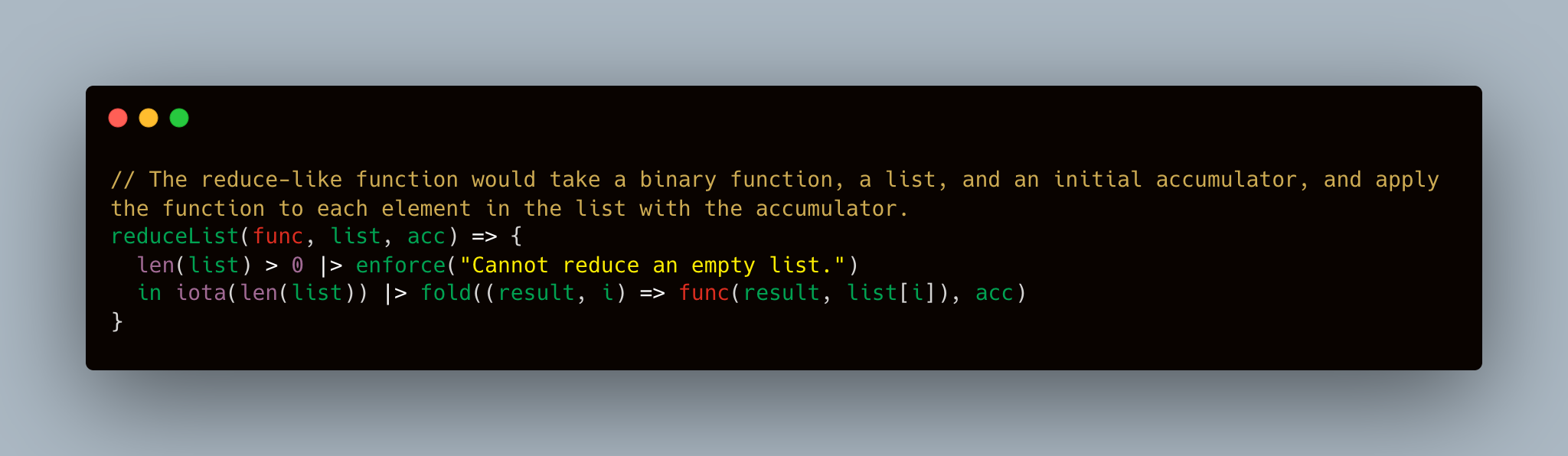
Una de las características interesantes de los idiomas funcionales es que pueden ser altamente expresivos. Aquí, solicité a GPT-4 a implementar map , filter y reduce (o doblar los operadores funcionales básicos (o fold en el contexto de lenguajes funcionales).
 // map

// The map-like function would take a function and a list, and apply the function to each element in the list.
mapList(func, list) => {
  len(list) > 0 | > enforce( " Cannot map over an empty list. " )
  in iota (len(list)) | > fold((result, i) => addEntry(result, func(list[i])), [])
}

// filter

// The filter-like function would take a predicate and a list, and return a list of elements for which the predicate returns true.
filterList(pred, list) => {
  len(list) > 0 | > enforce( " Cannot filter an empty list. " )
  in iota (len(list)) | > fold((result, i) => if pred(list[i]) then addEntry(result, list[i]) else result, [])
}

// reduce

// The reduce-like function would take a binary function, a list, and an initial accumulator, and apply the function to each element in the list with the accumulator.
reduceList(func, list, acc) => {
  len(list) > 0 | > enforce( " Cannot reduce an empty list. " )
  in iota (len(list)) | > fold((result, i) => func(result, list[i]), acc)
}
Project Euler es una colección de problemas matemáticos y de programación (que creo que hacen indicaciones interesantes para los LLM). Aquí, le pido a GPT-4 que resuelva los dos primeros problemas de Euler del proyecto usando SIL.
 // Project Euler problem #1:
// Here, my prompt was to solve the (easy) first problem of the Project Euler series (https://projecteuler.net/problem=1)

// Define a range from 1 to 999.
range = iota( 999 ) | > map(x => x + 1 )

// Define a function to check if a number is a multiple of 3 or 5.
isMultipleOf3Or5 = (num) => num % 3 == 0 || num % 5 == 0

// Filter the range to get only multiples of 3 or 5.
multiples = range | > filter(isMultipleOf3Or5)

// Sum the multiples.
sum = multiples | > fold((a, b) => a + b, 0 )

// Print the sum.
print(sum)
 // Project Euler problem #2:
// This prompt is to solve the second Project Euler problem (https://projecteuler.net/problem=2)

// Define a function to generate the next term in the Fibonacci sequence.
nextFibonacciTerm = (tuple) => [tuple[ 1 ], tuple[ 0 ] + tuple[ 1 ]]

// Start with the first two terms.
initialTerms = [ 1 , 2 ]

// Define a function to generate Fibonacci sequence up to a limit.
generateFibonacci = (limit) => {
  fibonacciSequence = unfold(nextFibonacciTerm, initialTerms, (tuple) => tuple[ 1 ] <= limit)
  fibonacciSequence
}

// Define a function to check if a number is even.
isEven = (num) => num % 2 == 0

// Generate the Fibonacci sequence up to four million.
fibonacciSequence = generateFibonacci( 4000000 )

// Extract the second term from each tuple in the sequence, which is the actual Fibonacci number.
fibonacciNumbers = fibonacciSequence | > map(tuple => tuple[ 1 ])

// Filter the sequence to get only even numbers.
evenFibonacciNumbers = fibonacciNumbers | > filter(isEven)

// Sum the even numbers.
sum = evenFibonacciNumbers | > fold((a, b) => a + b, 0 )

// Print the sum.
print(sum)
Explorar la capacidad de los LLM para inferir y comprender las características de un lenguaje de programación novedoso de una manera de pocos disparos sigue siendo una pregunta abierta e interesante. Aquí, estas capacidades se exploraron en el contexto de impulsar a GPT-4 a resolver problemas provocados en un nuevo lenguaje específico de dominio (DSL) llamado SIL. Los DSL son un caso de prueba potencialmente útil para explorar la inferencia frente a la memorización en LLMS, ya que a menudo tienen características distintivas y es menos probable que se hayan encontrado ampliamente durante el entrenamiento (si es que lo hace).
Quizás el hallazgo más interesante de este ejercicio es que las capacidades de inferencia de pocos disparos de GPT-4 son significativamente mejores que las de ChatGPT cuando se evalúan en las mismas indicaciones y tareas (ver ejercicio análogo con ChatGPT aquí).
Existe evidencia de que la memorización de LLM es promovida por la frecuencia de la presentación de ejemplo de entrenamiento y el número de tokens relevantes utilizados para impulsar el modelo. ↩





