GPT 4 Domain Specific Language
1.0.0

[NB:このレポは、chatgptを評価する同じ推論タスクへのフォローアップです。]
GPT-4、CHATGPT、Claudeなどの大規模な言語モデル(LLM)は、印象的なプログラミング能力を実証しており、幅広い言語とその分類法で問題を解決することができます。これらの成功にもかかわらず、これらのモデルがこれらの言語の根底にある構文および運用ルールの根本的な評価を示す程度には、いくつかの懐疑論が持続します(トレーニングデータからのパターンの記憶に対して)。
このプロンプトエンジニアリングリポジトリでは、GPT-4のプログラミング能力が任意のドメイン固有の言語(DSL)を使用して検討されます。 DSLは、LLMSの推論機能を研究するための魅力的な基質を表しており、トレーニング中に広く遭遇し、記憶された可能性が低いためです。そのため、LLMSが新しいプログラミング言語のルールをいくつかのショット方法で推測できる範囲のより直接的なテストを可能にします。
ここでは、2つの理由でドメイン固有の言語SIL(対称統合言語)が選択されました。第一に、GPT-4がトレーニング中に大量のSILコードにさらされている可能性は非常に低いです。これは、対称投資と呼ばれるハイテク重いヘッジファンドによって開発された社内DSLであるためです。第二に、プログラミング言語として、モデルが再現するための興味深い機能がいくつかあります(たとえば、表現力を強調する機能的な言語ですが、HaskellやOCAMLのように表現let欠いています)。
いくつかの例コードプロンプトの後、GPT-4は「SIL」として知られる斬新な機能的DSLでコードを作成しようとします。
以下は、その機能を強調するSILコードの短い例で構成されるいくつかのプロンプトのコレクションです。 GPT-4にタスクをプロンプトし、SILコードサンプルを提供した後(以下を参照してください。プロンプトと生成されたコードサンプルの完全なライブラリもこのレポで見つけることができます)、SILで多くの主流プログラミングタスクを実装するように依頼しました。
以下のセクションでは、モデルがプロンプトされたSILコードスクリプトの例のいくつかを示します(一連の例はここにあります)とSILでさまざまな問題を実装しようとする試みを示します。
最初のプロンプトは、メールサーバーの機能を処理するスクリプトです。そのため、それは私がその後ChatGPTを解決するように促す問題のタイプとは大きく異なりますが、SILの構文、データ構造、機能的側面の一部を示しています(例えば|> )。
 // example of using IMAP IDLE to run rules on new mail
import imap
moveMessages(session,ids,target) => if (ids.length > 0 ) then imap.moveUIDs(session,ids,target) else false
login = imap.ImapLogin(environment( " IMAP_USER " ),environment( " IMAP_PASS " ))
server = imap.ImapServer( " imap.fastmail.com " , " 993 " )
session = imap.Session(server,login, true ,imap.Options(debugMode: true )) | > imap.openConnection | > imap.login

rules=[ [
	[ " INBOX/0receipts " ,
	[
		" FROM [email protected] " ,
		" FROM interactivebrokers.com " ,
	]],
	[ " Junk " ,
	[
		" FROM Tapatalk " ,
	]],
	[ " INBOX/newsletters " ,
	[
		" FROM [email protected] " ,
		" HEADER X-mailer mailgun " ,
		" HEADER X-mailer WPMailSMTP/Mailer/mailgun 2.4.0 " ,
		" HEADER X-mailer nlserver " ,
		" FROM hbr.org " ,
		" FROM elliottwave.com " ,
		" OR FROM cio.com FROM cio.co.uk " ,
		" FROM substack.com " ,
		" FROM eaglealpha.com " ,
		" FROM haaretz.com " ,
		" FROM gavekal.com " ,
		" FROM go.weka.io " ,
		" FROM marketing.weka.io " ,
		` HEADER list-unsubscribe "" ` ,
		` HEADER list-Id "" ` ,
		` HEADER list-Post "" ` ,
		` HEADER list-owner"" ` ,
		` HEADER Precedence bulk ` ,
		` HEADER Precedence list ` ,
		` HEADER list-bounces "" ` ,
		` HEADER list-help "" ` ,
		` HEADER List-Unsubscribe "" ` ,
		" FROM no-reply " ,
	]],
	[ " INBOX/notifications " ,
	[
		` KEYWORD "$IsNotification" ` ,
		" FROM [email protected] " ,
		" FROM [email protected] " ,
		" FROM skillcast.com " ,
		" FROM reedmac.co.uk " ,
		" FROM [email protected] " ,
		" FROM [email protected] " ,
		" FROM [email protected] " ,
	]],
]

runRules(Session,Rules) => Rules
	| > map(target => [target[ 0 ],(target[ 1 ] | > map(term => imap.search(Session,term).ids))])
	| > mapa(set => moveMessages(Session,set[ 1 ] | > join,set[ 0 ]))

runRulesBox(Session,Rules,Mailbox) => {
	imap.select(Session,Mailbox)
	in runRules (Session,Rules)
}

inboxes=[ " INBOX " ]
result = inboxes | > mapa(inbox => runRulesBox(session,rules,imap.Mailbox(session,inbox)))
print(result)
import parallel;
threadFunction(x) => {
	imap.idle(session)
	in inboxes | > mapa(inbox => runRulesBox(session,rules,imap.Mailbox(session,inbox)))
}
parallel.runEvents((x) => false ,[threadFunction]) 2番目の例コードプロンプトも同様に、モデルのこのDSLのいくつかの機能を強調することを目的としており、 iotaやfoldなどのいくつかの新しい標準ライブラリ関数を導入します。
 import imap
import imap_config
import string

// Get the configuration from the environment and command line.
config = imap_config.getConfig(commandLineArguments)

// -------------------------------------------------------------------------------------------------
// Some helper functions.
//
// Firstly, a function to join an array of strings.

joinFields(flds, sep) => {
  len(flds) > 0 | > enforce( " Cannot join an empty array. " )
  in fold (flds[ 1 :$], (str, fld) => str ~ sep ~ fld, flds[ 0 ])
}

// Secondly, a field formatter which strips the field prefix and pads to a fixed width.
// E.g., ("From: [email protected]" |> fmtField(20)) == "[email protected]         "

fmtField(field, width) => {
  pad(str) => iota(width - len(str)) | > fold((a, i) => a ~ " " , str)
  in field
    | > string .split( " : " )[ 1 :$]
    | > joinFields( " : " )
    | > pad
}

// And thirdly, a function which concatenates the headers into a formatted string.

fmtHeaders(outStr, headers) => {
  outStr ~ "  " ~ joinFields(headers, " | " ) ~ " n "
}

// -------------------------------------------------------------------------------------------------

// Connect to the inbox.
creds = imap.ImapLogin(config.user, config.pass)
server = imap.ImapServer(config.host, config.port)
session =
  imap.Session(server, creds)
  | > imap.openConnection()
  | > imap.login()
inbox = imap.Mailbox(session, " INBOX " )

// Get the number of messages in the inbox.
msgCount = imap.status(session, inbox).messages

// Select the default inbox.
inbox | > imap.examine(session, _)

// Get the headers (date, from and subject) for each message, from oldest to newest, format and
// print them.
headers =
  iota(msgCount)
    | > map(id => " # " ~ toString(id + 1 ))
    | > map(id =>
         imap.fetchFields(session, id, " date from subject " ).lines
           | > map(hdr => fmtField(hdr, 40 )))
    | > fold(fmtHeaders, " INBOX: n " )
print(headers)3番目のコードサンプルは、このDSLの珍しい機能の一部をさらに示しています。ChatGptが次に独自の実装でこれらを使用することを目的としています。
 // This script will create a report based on a specific example set of automated 'support' emails.
// E.g.,
//
// "support.mbox": 17 messages 17 new
//  N  1 [email protected]     Mon May 11 22:26  28/1369  "Alert: new issue 123"
//  N  2 [email protected]     Tue May 12 12:20  22/933   "Notification: service change"
//  N  3 [email protected]     Tue May 12 12:36  26/1341  "Alert: new issue 124"
//  N  4 [email protected]     Wed May 13 02:13  21/921   "Resolution: issue 124"
//  N  5 [email protected]    Wed May 13 18:53  26/1332  "Email not from robot."
//  N  6 [email protected]     Thu May 14 03:13  27/1339  "Alert: new issue 125"
//  N  7 [email protected]     Thu May 14 08:46  26/1270  "Resolution: issue 123"
//  N  8 [email protected]     Thu May 14 17:06  25/1249  "Alert: new issue 126"
//  N  9 [email protected]     Fri May 15 09:46  24/1185  "Resolution: issue 126"
//  N 10 [email protected]     Fri May 15 12:33  23/1052  "Alert: new issue 127"
//  N 11 [email protected]     Fri May 15 15:20  27/1331  "Notification: service change"
//  N 12 [email protected]     Fri May 15 18:06  23/953   "Resolution: issue 127"
//  N 13 [email protected]     Mon May 18 12:46  27/1218  "Alert: new issue 128"
//  N 14 [email protected]     Mon May 18 15:33  32/1628  "Alert: new issue 129"
//  N 15 [email protected]     Tue May 19 05:26  25/1176  "Resolution: issue 128"
//  N 16 [email protected]     Tue May 19 08:13  26/1312  "Notification: service change"
//  N 17 [email protected]     Tue May 19 11:00  28/1275  "Alert: new issue 130"
//
//
// Each of these automated emails are from `robot` _except_ for message 5.  Messages 2, 8 and 16 are
// from `robot` but are unrelated to issues.
//
// This script will search for emails and match new issue numbers with resolutions to report the
// number of outstanding alerts.

import imap
import * from imap.query
import imap_config

import dates
import string

// Get the configuration from the environment and command line.
config = imap_config.getConfig(commandLineArguments)

// Connect to the inbox.
creds = imap.ImapLogin(config.user, config.pass)
server = imap.ImapServer(config.host, config.port)
session =
  imap.Session(server, creds)
    | > imap.openConnection()
    | > imap.login()
inbox = imap.Mailbox(session, " support " )

// Select the default inbox.
inbox | > imap.examine(session, _)

// These criteria are common for both our searches.
commonCrit = imap.Query()
    | > and(from( ` [email protected] ` ))
    | > and(sentSince(dates. Date ( 2020 , 5 , 13 )))

// Get each of the alerts and resolutions from the past week (13-19 May 2020).
alertMsgIds =
  imap.search(session, imap.Query(subject( " Alert: new issue " )) | > and(commonCrit)).ids
resolutionMsgIds =
  imap.search(session, imap.Query(subject( " Resolution: issue " )) | > and(commonCrit)).ids

// A function to get the alert ID from a message subject.
getAlertId(msgId) => {
  imap.fetchFields(session, toString (msgId), " subject " ).lines[ 0 ]
    | > string .split()[$ - 1 ]
}

// A function to remove an entry from a table whether it's there or not.
removeIfExists(tbl, key) => {
  if find( keys (tbl), key) == [] then
    tbl
  else
    removeEntry(tbl, key)
}

// Now find those alerts which have no resolution.  Firstly the subject for each alert, get the
// issue number end and store it in a table.
allAlertTable = alertMsgIds | > fold((tbl, msgId) => addEntry(tbl, getAlertId(msgId), msgId), {})

// Go through the resolutions and remove their corresponding alerts from the table.
unresolvedAlertTable =
  resolutionMsgIds | > fold((tbl, msgId) => removeIfExists(tbl, getAlertId(msgId)), allAlertTable)

// Create a report with the date of the unresolved alerts.
report =
  keys (unresolvedAlertTable)
    | > map(alertId => {
         msgId = unresolvedAlertTable[alertId] | > toString
       in [ alertId
          , imap.fetchFields(session, msgId, " date " ).lines[ 0 ]
          , imap.fetchText(session, msgId).lines[ 0 ]
          ]
       })
    | > fold((outStr, tuple) => {
         outStr ~ " Issue: " ~ tuple[ 0 ] ~ " n  " ~ tuple[ 1 ] ~ " n  Summary: " ~ tuple[ 2 ] ~ " n "
       }, " n UNRESOLVED ISSUES FROM THE PAST 10 DAYS: nn " )

// Close the session.
imap.closeConnection(session)

// Print the report last.
print(report)最初の演習として、私はモデルにSILで非常に単純なリレーショナルデータベースを実装するように依頼しました。基本的な機能を備えています( //は、SILでコメントすることを示しています)。
 import imap
import imap_config
import string

// Get the configuration from the environment and command line.
config = imap_config.getConfig(commandLineArguments)

// Connect to the server.
creds = imap.ImapLogin(config.user, config.pass)
server = imap.ImapServer(config.host, config.port)
session =
  imap.Session(server, creds)
  | > imap.openConnection()
  | > imap.login()

// -------------------------------------------------------------------------------------------------
// Here's an attempt to create something resembling a simple relational database.

// Define two tables, 'Employees' and 'Departments'.
Employees = { " 1 " : [ " Alice " , " Engineering " ], " 2 " : [ " Bob " , " Marketing " ], " 3 " : [ " Charlie " , " Engineering " ] }
Departments = { " Engineering " : [ " Alice " , " Charlie " ], " Marketing " : [ " Bob " ] }

// Function to emulate SQL SELECT operation.
select = (table, id) => {
    table[id] | > enforce( " Id does not exist in table. " )
}

// Function to emulate SQL INSERT operation.
insert = (table, id, values ) => {
    addEntry(table, id, values )
}

// Function to emulate SQL DELETE operation.
delete = (table, id) => {
    removeEntry(table, id)
}

// Function to emulate SQL JOIN operation.
join = (table1, table2, commonField) => {
    // This is a very basic JOIN operation and does not account for multiple matches, etc.
    joinedTable = {}
    for key in keys (table1) {
        value = table1[key][commonField]
        if find( keys (table2), value) != [] {
            joinedTable = addEntry(joinedTable, key, [table1[key], table2[value]])
        }
    }
    joinedTable
}

// Close the session.
imap.closeConnection(session)

// Perform operations.
newEmployee = [ " David " , " Marketing " ]
Employees = insert(Employees, " 4 " , newEmployee)
Departments = insert(Departments, newEmployee[ 1 ], [ " David " ])
print(select(Employees, " 1 " ))
print(join(Employees, Departments, 1 ))ソートアルゴリズムの実装は、典型的なソフトウェアエンジニアリングインタビューの質問です。ここでは、GPT-4にSILでBubblesort(概念的に最も基本的なソートアルゴリズム)を実装するように依頼しました。以下は応答です。
 // Helper function to bubble up the largest value in one pass
bubble(list) => {
  if length(list) <= 1 then
    list
  else
    if list[ 0 ] > list[ 1 ] then
      [list[ 1 ]] ~ bubble([list[ 0 ]] ~ list[ 2 to $])
    else
      [list[ 0 ]] ~ bubble(list[ 1 to $])
}

// Main BubbleSort function
bubbleSort(list) => {
  bubbled = bubble(list)
  if bubbled == list then
    list
  else
    bubbleSort(bubbled)
}次に、リストの中央値を計算するためのスクリプトを作成するようにモデルに促しました(以下の応答を生成します)。ヘルパー関数のsortList 、実際、機能的なプログラミングパラダイムと一致していますが、ここではGPT-4は割り当て演算子の存在を想定しています:= 。
 // Helper function to sort an array of integers.
sortList(list) => list | > len | > iota | > map(i => list | > min | > snd) | > each((i, minVal) => list := removeIndex(list, minVal))

// Function to compute the median of a set of integers.
computeMedian(list) => {
  // Sort the list in ascending order.
  sortedList = sortList(list)

  // Get the length of the list.
  length = len(sortedList)

  // Check if the length is even.
  isEven = length % 2 == 0

  // If the length is even, the median is the average of the two middle numbers.
  // Otherwise, the median is just the middle number.
  median =
    if isEven then
      (sortedList[length / 2 - 1 ] + sortedList[length / 2 ]) / 2
    else
      sortedList[length / 2 ]

  // Return the median.
  median
}GPT -4は、SILでk -nearest Neighborsアルゴリズムを実装するように促されました。 mathと呼ばれるモジュールの存在を幻覚/想定すること(これは、 |>この演習の範囲の合理的な仮定である)を除いて、これmap許容可能なソリューションfoldように見えます。
 import math

distance(p1, p2) => {
  math.sqrt(
    math.pow(p1[ 0 ] - p2[ 0 ], 2 )
    + math.pow(p1[ 1 ] - p2[ 1 ], 2 )
  )
}

majorityVote(labels) => {
  labelCounts = labels | > fold((counts, label) => addEntry(counts, label, get (counts, label, 0 ) + 1 ), {})
  labelCounts | > maxBy((_, count) => count)
}

knn(data, newPoint, k) => {
  distances = data | > map((point, label) => (distance(point, newPoint), label))
  sorted = distances | > sort((a, b) => a[ 0 ] < b[ 0 ])
  nearest = sorted | > take(k)
  labels = nearest | > map((_, label) => label)
  majorityVote(labels)
}
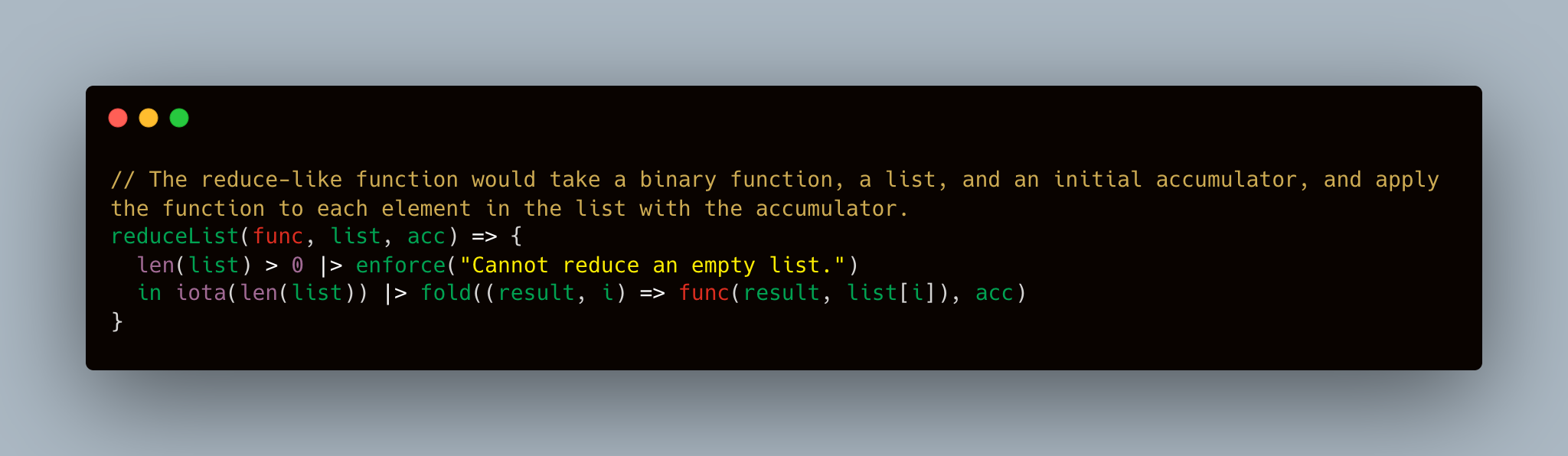
機能的言語の興味深い特徴の1つは、それらが非常に表現力豊かである可能性があることです。ここでは、GPT-4に基本的な機能演算子map 、 filter 、およびreduce (または機能的言語のコンテキストでfold )を実装するように求めました。
 // map

// The map-like function would take a function and a list, and apply the function to each element in the list.
mapList(func, list) => {
  len(list) > 0 | > enforce( " Cannot map over an empty list. " )
  in iota (len(list)) | > fold((result, i) => addEntry(result, func(list[i])), [])
}

// filter

// The filter-like function would take a predicate and a list, and return a list of elements for which the predicate returns true.
filterList(pred, list) => {
  len(list) > 0 | > enforce( " Cannot filter an empty list. " )
  in iota (len(list)) | > fold((result, i) => if pred(list[i]) then addEntry(result, list[i]) else result, [])
}

// reduce

// The reduce-like function would take a binary function, a list, and an initial accumulator, and apply the function to each element in the list with the accumulator.
reduceList(func, list, acc) => {
  len(list) > 0 | > enforce( " Cannot reduce an empty list. " )
  in iota (len(list)) | > fold((result, i) => func(result, list[i]), acc)
}
Project Eulerは、数学的およびプログラミングの問題のコレクションです(LLMSの興味深いプロンプトになると思います)。ここでは、GPT-4にSILを使用して最初の2つのプロジェクトオイラーの問題を解決するように促します。
 // Project Euler problem #1:
// Here, my prompt was to solve the (easy) first problem of the Project Euler series (https://projecteuler.net/problem=1)

// Define a range from 1 to 999.
range = iota( 999 ) | > map(x => x + 1 )

// Define a function to check if a number is a multiple of 3 or 5.
isMultipleOf3Or5 = (num) => num % 3 == 0 || num % 5 == 0

// Filter the range to get only multiples of 3 or 5.
multiples = range | > filter(isMultipleOf3Or5)

// Sum the multiples.
sum = multiples | > fold((a, b) => a + b, 0 )

// Print the sum.
print(sum)
 // Project Euler problem #2:
// This prompt is to solve the second Project Euler problem (https://projecteuler.net/problem=2)

// Define a function to generate the next term in the Fibonacci sequence.
nextFibonacciTerm = (tuple) => [tuple[ 1 ], tuple[ 0 ] + tuple[ 1 ]]

// Start with the first two terms.
initialTerms = [ 1 , 2 ]

// Define a function to generate Fibonacci sequence up to a limit.
generateFibonacci = (limit) => {
  fibonacciSequence = unfold(nextFibonacciTerm, initialTerms, (tuple) => tuple[ 1 ] <= limit)
  fibonacciSequence
}

// Define a function to check if a number is even.
isEven = (num) => num % 2 == 0

// Generate the Fibonacci sequence up to four million.
fibonacciSequence = generateFibonacci( 4000000 )

// Extract the second term from each tuple in the sequence, which is the actual Fibonacci number.
fibonacciNumbers = fibonacciSequence | > map(tuple => tuple[ 1 ])

// Filter the sequence to get only even numbers.
evenFibonacciNumbers = fibonacciNumbers | > filter(isEven)

// Sum the even numbers.
sum = evenFibonacciNumbers | > fold((a, b) => a + b, 0 )

// Print the sum.
print(sum)
LLMSがいくつかのショットで新しいプログラミング言語の特徴を推測および理解する能力を探ることは、オープンで興味深い質問のままです。ここで、これらの能力は、GPT-4にSILと呼ばれる新しいドメイン固有の言語(DSL)で促された問題を解決するように促すという文脈で調査されました。 DSLは、LLMSでの推論と記憶を調査するための潜在的に有用なテストケースです。これは、しばしば特徴的な特徴を持ち、トレーニング中に広く遭遇する可能性が低いためです。
おそらく、この演習の最も興味深い発見は、同じプロンプトとタスクで評価された場合、GPT-4の少数の推論機能がChatGPTのものよりも大幅に優れていることです(ここではChatGPTとの類似の演習を参照)。
LLMの記憶が、トレーニングの例のプレゼンテーションの頻度と、モデルの促進に使用される関連トークンの数によって促進されるという証拠があります。 ↩





