Clean Architecture in Next.js
This repo is an example of how to achieve Clean Architecture in Next.js. There's
a video tutorial that goes through this project. Click on the image to check it
out on YouTube:
You can run the project just by running npm install and npm run dev.
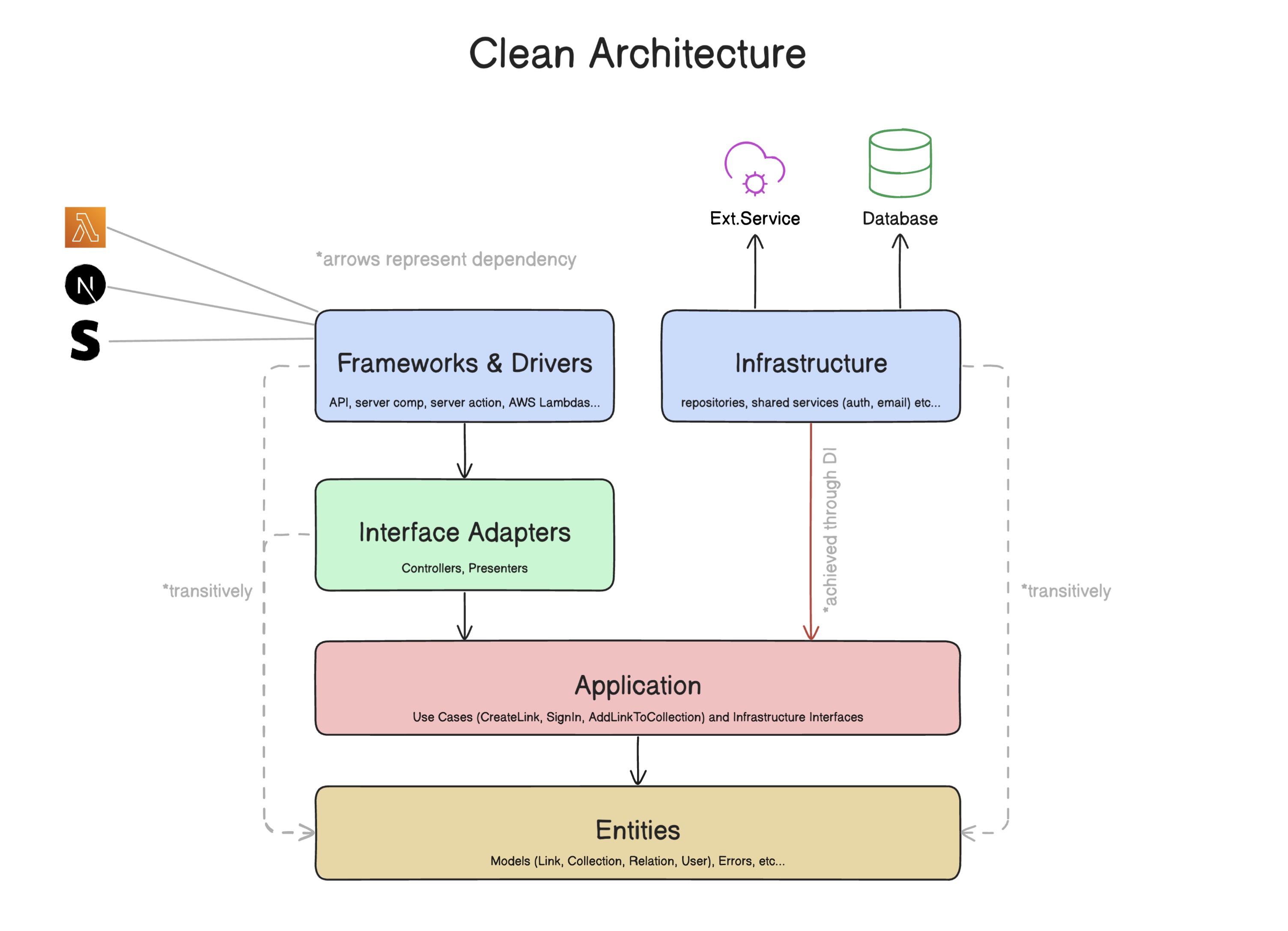
Clean Architecture

Note
? I drew this simplified version of the original Clean Architecture diagram.
I simplified it in a way that makes more sense to me, and it's easier to
comprehend. I hope it helps you too.
I strongly recommend you to read
the original article by Uncle Bob
if this is your first time hearing about Clean Architecture, but I'll try to
summarize it for you below.
Clean Architecture is a set of rules that help us structure our applications
in such way that they're easier to maintain and test, and their codebases are
predictable. It's like a common language that developers understand, regardless
of their technical backgrounds and programming language preferences.
Clean Architecture, and similar/derived architectures, all have the same goal -
separation of concerns. They introduce layers that bundle similar code
together. The "layering" helps us achieve important aspects in our codebase:
- Independent of UI - the business logic is not coupled with the UI
framework that's being used (in this case Next.js). The same system can be
used in a CLI application, without having to change the business logic or
rules.
- Independent of Database - the database implementation/operations are
isolated in their own layer, so the rest of the app does not care about which
database is being used, but communicates using Models.
- Independent of Frameworks - the business rules and logic simply don't know
anything about the outside world. They receive data defined with plain
JavaScript, use plain JavaScript, Services and Repositories to define
their own logic and functionality. This allows us to use frameworks as tools,
instead of having to "mold" our system into their implementations and
limitations. If we use Route Handlers in our app, and want to refactor some of
them to Server Actions, all we need to do is just invoke the specific
controllers in a server action instead of a route handler, but the core
business logic remains unchanged.
- Testable - the business logic and rules can easily be tested because it
does not depend on the UI framework, or the database, or the web server, or
any other external element that builds up our system.
Clean Architecture achieves this through defining a dependency hierarchy -
layers depend only on layers below them, but not above.
Project structure (only the important bits)
app - Frameworks & Drivers Layer - basically everything Next.js (pages,
server actions, components, styles etc...) or whatever "consumes" the app's
logic
di - Dependency Injection - a folder where we setup the DI container and the
modules
drizzle - Everything DB - initializing the DB client, defining schema,
migrations
src - The "root" of the system
application - Application Layer - holds use cases and interfaces for
repositories and services
entities - Entities Layer - holds models and custom errors
infrastructure - Infrastructure Layer - holds implementations of
repositories and services, and pulls in the interfaces from application
interface-adapters - Interface Adapters Layer - holds controllers that
serve as an entry point to the system (used in Frameworks & Drivers layer to
interact with the system)
tests - Unit tests live here - the unit subfolder's structure matches
src
.eslintrc.json - Where the eslint-plugin-boundaries plugin is defined -
this stops you from breaking the dependency rule
vitest.config.ts - Take note of how the @ alias is defined!
Layers explanation
- Frameworks & Drivers: keeps all the UI framework functionality, and
everything else that interacts with the system (ex. AWS Lambdas, Stripe
webhooks etc...). In this scenario, that's Next.js Route Handlers, Server
Actions, Components (Server and Client), Pages, Design System, etc...
- This layer should only use Controllers, Models, and Errors, and must
not use Use Cases, Repositories, and Services.
- Interface Adapters: defines Controllers:
- Controllers perform authentication checks and input validation
before passing the input to the specific use cases.
- Controllers orchestrate Use Cases. They don't implement any logic, but
define the whole operations using use cases.
- Errors from deeper layers are bubbled up and being handled where controllers
are being used.
- Controllers use Presenters to convert the data to a UI-friendly format
just before returning it to the "consumer". This helps us ship less
JavaScript to the client (logic and libraries to convert the data), helps
prevent leaking any sensitive properties, like emails or hashed passwords,
and also helps us slim down the amount of data we're sending back to the
client.
- Application: where the business logic lives. Sometimes called core. This
layer defines the Use Cases and interfaces for the services and repositories.
- Use Cases:
- Represent individual operations, like "Create Todo" or "Sign In" or
"Toggle Todo".
- Accept pre-validated input (from controllers) and handle authorization
checks.
- Use Repositories and Services to access data sources and communicate
with external systems.
- Use cases should not use other use cases. That's a code smell. It
means the use case does multiple things and should be broken down into
multiple use cases.
- Interfaces for Repositories and Services:
- These are defined in this layer because we want to break out the
dependency of their tools and frameworks (database drivers, email services
etc...), so we'll implement them in the Infrastructure layer.
- Since the interfaces live in this layer, use cases (and transitively the
upper layers) can access them through Dependency Injection.
- Dependency Injection allows us to split up the definitions
(interfaces) from the implementations (classes) and keep them in a
separate layer (infrastructure), but still allow their usage.
- Entities: where the Models and Errors are defined.
- Models:
- Define "domain" data shapes with plain JavaScript, without using
"database" technologies.
- Models are not always tied to the database - sending emails require an
external email service, not a database, but we still need to have a data
shape that will help other layers communicate "sending an email".
- Models also define their own validation rules, which are called
"Enterprise Business Rules". Rules that don't usually change, or are least
likely to change when something external changes (page navigation,
security, etc...). An example is a
User model that defines a username
field that must be at least 6 characters long and not include special
characters.
- Errors:
- We want our own errors because we don't want to be bubbling up
database-specific errors, or any type of errors that are specific to a
library or framework.
- We
catch errors that are coming from other libraries (for example
Drizzle), and convert those errors to our own errors.
- That's how we can keep our core independent of any frameworks,
libraries, and technologies - one of the most important aspects of Clean
Architecture.
- Infrastructure: where Repositories and Services are being defined.
- This layer pulls in the interfaces of repositories and services from the
Application Layer and implements them in their own classes.
- Repositories are how we implement the database operations. They are
classes that expose methods that perform a single database operation - like
getTodo, or createTodo, or updateTodo. This means that we use the
database library / driver in these classes only. They don't perform any data
validation, just execute queries and mutations against the database and
either throw our custom defined Errors or return results.
- Services are shared services that are being used across the application -
like an authentication service, or email service, or implement external
systems like Stripe (create payments, validate receipts etc...). These
services also use and depend on other frameworks and libraries. That's why
their implementation is kept here alongside the repositories.
- Since we don't want any layer to depend on this one (and transitively depend
on the database and all the services), we use the
Dependency Inversion principle.
This allows us to depend only on the interfaces defined in the Application
Layer, instead of the implementations in the Infrastructure Layer. We use
an
Inversion of Control
library like ioctopus to abstract the
implementation behind the interfaces and "inject" it whenever we need it. We
create the abstraction in the
di directory. We "bind" the repositories,
services, controllers, and use cases to Symbols, and we "resolve" them using
those symbols when we need the actual implementation. That's how we can use
the implementation, without needing to explicitly depend on it (import it).
FAQ
Tip
If you have a question not covered by the FAQ, feel free to either open an Issue
in this repo, or join my Discord server and start a
conversation there.
Is Clean Architecture / this implementation serverless-friendly? Can I deploy this to Vercel?
Yes! You can use it with Page Router, App Router, Middleware, API Handlers,
Server Actions, anything really! Usually, achieving Dependency Injection in
JavaScript projects is being done with the Inversify.js
library, which is incompatible with other runtimes except Node. This project
implements ioctopus, a simple IoC
container that doesn't rely on reflect-metadata and works on all runtimes.
Should I start implementing Clean Architecture immediately when I create my Next.js project?
I'd say no. If you're starting a brand new project, I'd advise you to focus
on achieving an MVP status as fast as possible (so you can validate your idea /
see if there's a future for your project). When things start to get serious
(more features start to get implemented, your user base experiences a
significant growth, or you're onboarding other developers in your project),
that's when you'd want to invest some time into adapting this architecture (or
any architecture for that matter).
If you're already deep in the weeds on a project, you (and your team) can plan
for gradual refactoring starting from the next sprint. In this case you already
have the code written, you just need to reorganize it a little bit, and you can
do that part by part, route handler by route handler, server action by server
action. By the way, I say it lightly "you just need to reorganize it a little
bit", but it can be far from being as simple as that. Always take into account
"things going wrong" when you plan the refactoring. And put some time in for
writing tests!
This looks like overengineering, and complicates feature development.
If you don't spend more than 3 minutes thinking about this, then yes, it does
look like overengineering. But if you do, you'll realize that architecture =
discipline. The architecture is a contract between the developers that defines
what goes where. It actually simplifies the feature development because it
makes the codebase predictable, and it makes those decisions for you.
You can't grow a project sustainably if every developer working on it writes
code where it's the most convenient. The codebase will turn into a nightmare to
work with, and that's when you'll feel a real complicated feature development
process. To battle this, eventually you will put down some rules. Those rules
will grow as your team faces and solves new issues. Put all those rules in a
document, and there's your very own architecture definition. You still implement
some sort of an architecture, you just reached that point very slowly and
painfully.
Clean Architecture gives you a shortcut and a predefined architecture that's
been tested. And yes, sure, you do need to learn all of this, but you do it once
in your lifetime, and then just apply the principles in any language or
framework you'll be using in future.
Should I apply Clean Architecture in all of my projects?
No. Not if you don't expect the project to grow, both in number of features,
or number of users, or number of developers working on it.
What are other similar architectures to Clean Architecture?
As mentioned in the
original blog post
I mentioned at the top of the README, you got:

- Hexagonal Architecture
(a.k.a. Ports and Adapters) by Alistair Cockburn
- Onion Architecture
by Jeffrey Palermo
- Screaming Architecture
by Uncle Bob (the same guy behind Clean Architecture)
- And a couple more (check out the original blog post)


