QDrant NLP
1.0.0

Keeping the Human in the LOOP. I am not a developer at QDrant, nor directly associated with them, but I think they've built something excellent, and thus far under-appreciated. This repo is here to act as a demo more than anything else.
https://github.com/qdrant/qdrant
I'll call it done once it's tidy and available on DockerHub. Just enough that you could maybe use it to run your own POC without any additional code.
You can achieve almost half of this tool just via their swagger UI, but obviously, that's designed for hitting simple APIs, not data-centric AI workflows, so it's missing a few useful components. This work is written up in more depth here https://medium.com/@george.pearse (vector databases part 2).
The toy logo is somewhere between a magnifying glass for how the tooling enables you to really focus in on a specific data subset, and a classic bayesian graph for if I get carried away enough to try to add active learning in.
Finding the documentation for hugging-face sentence-transformers via Google Search drove me mad, it lives here https://www.sbert.net/docs/hugging_face.html
Quick labelling with hugging-face, streamlit and QDrant. First I'll support NLP, then I'll think about adding image support (which is where this idea came from).
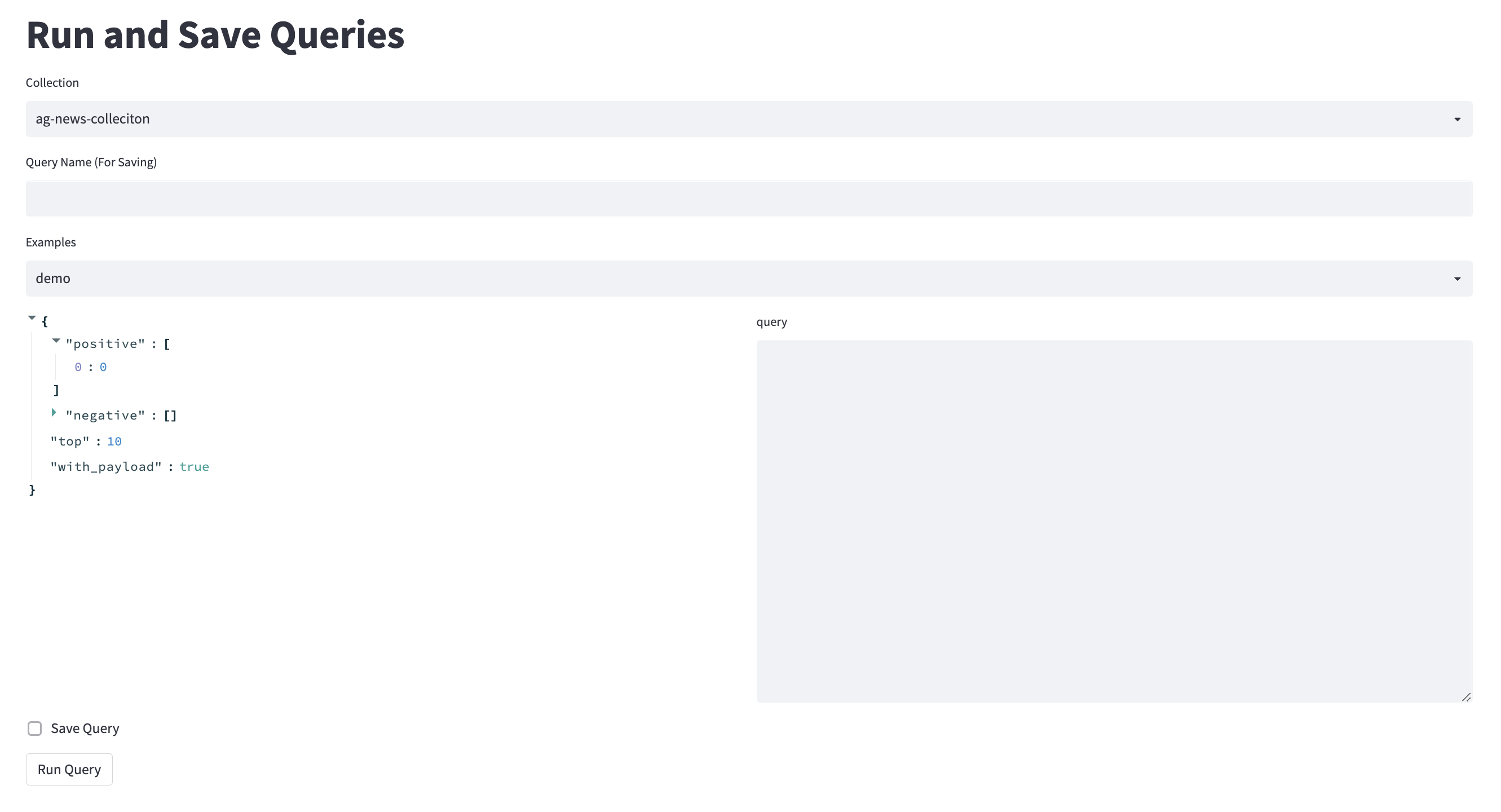
See Kern.AI for a full blown solution which uses QDrant behind the scenes. This tool is meant to be simple enough to act as an intro to vector databases. You can write and see the requests, just as you would via the python API.
Similarly, koaning/bulk is excellent, but what if UMAP (insert alternative dimensionality reduction technique here) loses all of the nuance, and high-level visualizations fail to provide value for your dataset?
I also wanted to give FastAPI a tiny test run, so for each query (post request) you save, you can receive its results by hitting the FastAPI endpoint with the name of the query.
To apply these tools to a multi-modal dataset you would only need to concatenate the embeddings for each component and away you go with all the same technqiues.
NB: Other names
Might make sense to apply a similarity cut off instead of the nearest K.
To get started, just run
docker-compose up





