HarvestText
V0.8

HarvestText : A Toolkit for Text Mining and Preprocessing
document
Synchronize on Github and Code Cloud Gitee. If you browse/download on Github, you can go to the code cloud to operate.
HarvestText is a library that focuses on a (weak) supervision method that integrates domain knowledge (such as types, alias) to process and analyze specific domain texts simply and efficiently. It is suitable for many text preprocessing and preliminary exploratory analysis tasks, and has potential application value in novel analysis, online text, professional literature and other fields.
Use cases:
[Note: This library only completes entity word segmentation and sentiment analysis, and uses matplotlib for visualization]
This README contains typical examples of various functions. The detailed usage of some functions can be found in the documentation:
document
The specific functions are as follows:
Table of contents:
First install, use pip
pip install --upgrade harvesttextOr enter the directory where setup.py is located, and then the command line:
python setup.py installThen in the code:
 from harvesttext import HarvestText
ht = HarvestText ()
You can call the functional interface of this library.
Note: Some functions require the installation of additional libraries, but the installation may fail, so please install manually if necessary.
 # 部分英语功能
pip install pattern
# 命名实体识别、句法分析等功能,需要python <= 3.8
pip install pyhanlpGiven certain entities and their possible synonyms, as well as the entity corresponding type. Log it into the dictionary, divide it first when parting words, and use the corresponding type as part of speech. All entities and their locations in the corpus can also be obtained separately:
 para = "上港的武磊和恒大的郜林,谁是中国最好的前锋?那当然是武磊武球王了,他是射手榜第一,原来是弱点的单刀也有了进步"
entity_mention_dict = { '武磊' :[ '武磊' , '武球王' ], '郜林' :[ '郜林' , '郜飞机' ], '前锋' :[ '前锋' ], '上海上港' :[ '上港' ], '广州恒大' :[ '恒大' ], '单刀球' :[ '单刀' ]}
entity_type_dict = { '武磊' : '球员' , '郜林' : '球员' , '前锋' : '位置' , '上海上港' : '球队' , '广州恒大' : '球队' , '单刀球' : '术语' }
ht . add_entities ( entity_mention_dict , entity_type_dict )
print ( " n Sentence segmentation" )
print ( ht . seg ( para , return_sent = True ))    # return_sent=False时,则返回词语列表
Who are the best forwards in China, including Wu Lei of Shanghai SIPG and Gao Lin of Evergrande? Of course it is Wu Lei, the King of Wu Ball. He is the first in the shooter list. It turns out that the weak single sword has also made progress.
Using traditional word segmentation tools can easily split "Wuqiong King" into "Wuqiong King"
Part of speech annotation, including specified special types.
 print ( " n POS tagging with entity types" )
for word , flag in ht . posseg ( para ):
	print ( "%s:%s" % ( word , flag ), end = " " )
SIPG: Team: uj Wu Lei: Players and: c Evergrande: Team: uj Gao Lin: Players,: x Who: r is: v China:ns Best: a: uj Forward: Position? :x That:r Of course:d is:v Wu Lei: Player Wu Qiu King: Player:ul, :x He:r is:v Scorer list:n First:m, :x Originally:d is:v Weakness:n:uj Single Sword: also:d has:v There is:v Progress:d
 for span , entity in ht . entity_linking ( para ):
	print ( span , entity )
[0, 2] ('Shanghai SIPG', '# Team#') [3, 5] ('Wu Lei', '# Player#') [6, 8] ('Guangzhou Evergrande', '# Team#') [9, 11] ('Gao Lin', '# Player#') [19, 21] ('Forward', '# Position#') [26, 28] ('Wu Lei', '# Player#') [28, 31] ('Wu Lei', '# Player#') [47, 49] ('Single-on-one ball', '# Term#')
Here, the transformation of "Wuqiu King" into a standard term "Wu Lei" can facilitate unified statistical work.
Sentence:
print ( ht . cut_sentences ( para ))['Who is the best forward in China from Shanghai SIPG and Gao Lin from Evergrande? ', 'Of course it's Wu Lei's Wu Football King. He is the first in the shooter list. It turns out that the weak single sword has also made progress']
If there is no dictionary available at hand for the time being, you might as well see if the domain dictionary in the built-in resources of this library is suitable for your needs.
If there are multiple possible entities for the same name ("Li Na playing ball and Li Na singing are not the same person"), you can set keep_all=True to retain multiple candidates. You can use other strategies to disambiguate later, see el_keep_all()
If there are too many entities connected to, some of which are obviously unreasonable, some strategies can be used to filter. Here is an example filter_el_with_rule()
This library can also use some basic strategies to deal with complex entity disambiguation tasks (such as the multiple meanings of the word ["teacher" refers to "Teacher A" or "Teacher B"?], and the candidate words overlap [Mayor xx/Jiang yy?, Mayor xx/Jiang yy?]). For details, you can see linking_strategy()
You can process special characters in text, or remove some special formats that you don't want to appear in text.
Including: @, emoji on Weibo; URL; email; special characters in html code; special characters in %20 in the URL; Traditional Chinese to Simplified Chinese
Examples are as follows:
 print ( "各种清洗文本" )
ht0 = HarvestText ()
# 默认的设置可用于清洗微博文本
text1 = "回复@钱旭明QXM:[嘻嘻][嘻嘻] //@钱旭明QXM:杨大哥[good][good]"
print ( "清洗微博【@和表情符等】" )
print ( "原:" , text1 )
print ( "清洗后:" , ht0 . clean_text ( text1 ))
各种清洗文本
清洗微博【@和表情符等】
原: 回复@钱旭明QXM:[嘻嘻][嘻嘻] //@钱旭明QXM:杨大哥[good][good]
清洗后: 杨大哥
 # URL的清理
text1 = "【#赵薇#:正筹备下一部电影 但不是青春片....http://t.cn/8FLopdQ"
print ( "清洗网址URL" )
print ( "原:" , text1 )
print ( "清洗后:" , ht0 . clean_text ( text1 , remove_url = True ))
清洗网址URL
原: 【#赵薇#:正筹备下一部电影 但不是青春片....http://t.cn/8FLopdQ
清洗后: 【#赵薇#:正筹备下一部电影 但不是青春片....
 # 清洗邮箱
text1 = "我的邮箱是[email protected],欢迎联系"
print ( "清洗邮箱" )
print ( "原:" , text1 )
print ( "清洗后:" , ht0 . clean_text ( text1 , email = True ))
清洗邮箱
原: 我的邮箱是[email protected],欢迎联系
清洗后: 我的邮箱是,欢迎联系
 # 处理URL转义字符
text1 = "www.%E4%B8%AD%E6%96%87%20and%20space.com"
print ( "URL转正常字符" )
print ( "原:" , text1 )
print ( "清洗后:" , ht0 . clean_text ( text1 , norm_url = True , remove_url = False ))
URL转正常字符
原: www.%E4%B8%AD%E6%96%87%20and%20space.com
清洗后: www.中文 and space.com
 text1 = "www.中文 and space.com"
print ( "正常字符转URL[含有中文和空格的request需要注意]" )
print ( "原:" , text1 )
print ( "清洗后:" , ht0 . clean_text ( text1 , to_url = True , remove_url = False ))
正常字符转URL[含有中文和空格的request需要注意]
原: www.中文 and space.com
清洗后: www.%E4%B8%AD%E6%96%87%20and%20space.com
 # 处理HTML转义字符
text1 = "<a c> ''"
print ( "HTML转正常字符" )
print ( "原:" , text1 )
print ( "清洗后:" , ht0 . clean_text ( text1 , norm_html = True ))
HTML转正常字符
原: <a c> ''
清洗后: <a c> ''
 # 繁体字转简体
text1 = "心碎誰買單"
print ( "繁体字转简体" )
print ( "原:" , text1 )
print ( "清洗后:" , ht0 . clean_text ( text1 , t2s = True ))
繁体字转简体
原: 心碎誰買單
清洗后: 心碎谁买单
 # markdown超链接提取文本
text1 = "欢迎使用[HarvestText : A Toolkit for Text Mining and Preprocessing](https://github.com/blmoistawinde/HarvestText)这个库"
print ( "markdown超链接提取文本" )
print ( "原:" , text1 )
print ( "清洗后:" , ht0 . clean_text ( text1 , t2s = True ))
markdown超链接提取文本
原: 欢迎使用[HarvestText : A Toolkit for Text Mining and Preprocessing](https://github.com/blmoistawinde/HarvestText)这个库
清洗后: 欢迎使用HarvestText : A Toolkit for Text Mining and Preprocessing这个库
Find the name of the person, place, organization, etc. in a sentence. pyhanLP interface implementation is used.
 ht0 = HarvestText ()
sent = "上海上港足球队的武磊是中国最好的前锋。"
print ( ht0 . named_entity_recognition ( sent ))
{'上海上港足球队': '机构名', '武磊': '人名', '中国': '地名'}
Analyze the subject-predicate object modification and other grammatical relationships of each word in a statement (including the entity linked to) and extract possible event triples. pyhanLP interface implementation is used.
 ht0 = HarvestText ()
para = "上港的武磊武球王是中国最好的前锋。"
entity_mention_dict = { '武磊' : [ '武磊' , '武球王' ], "上海上港" :[ "上港" ]}
entity_type_dict = { '武磊' : '球员' , "上海上港" : "球队" }
ht0 . add_entities ( entity_mention_dict , entity_type_dict )
for arc in ht0 . dependency_parse ( para ):
    print ( arc )
print ( ht0 . triple_extraction ( para ))
[0, '上港', '球队', '定中关系', 3]
[1, '的', 'u', '右附加关系', 0]
[2, '武磊', '球员', '定中关系', 3]
[3, '武球王', '球员', '主谓关系', 4]
[4, '是', 'v', '核心关系', -1]
[5, '中国', 'ns', '定中关系', 8]
[6, '最好', 'd', '定中关系', 8]
[7, '的', 'u', '右附加关系', 6]
[8, '前锋', 'n', '动宾关系', 4]
[9, '。', 'w', '标点符号', 4]
print ( ht0 . triple_extraction ( para )) [['上港武磊武球王', '是', '中国最好前锋']]
Modified in version V0.7, use tolerance to support the same pinyin check
Link words in the statement that may be a known entity (with one character or pinyin error) to the corresponding entity.
 def entity_error_check ():
    ht0 = HarvestText ()
    typed_words = { "人名" :[ "武磊" ]}
    ht0 . add_typed_words ( typed_words )
    sent0 = "武磊和吴磊拼音相同"
    print ( sent0 )
    print ( ht0 . entity_linking ( sent0 , pinyin_tolerance = 0 ))
    """
    武磊和吴磊拼音相同
    [([0, 2], ('武磊', '#人名#')), [(3, 5), ('武磊', '#人名#')]]
    """
    sent1 = "武磊和吴力只差一个拼音"
    print ( sent1 )
    print ( ht0 . entity_linking ( sent1 , pinyin_tolerance = 1 ))
    """
    武磊和吴力只差一个拼音
    [([0, 2], ('武磊', '#人名#')), [(3, 5), ('武磊', '#人名#')]]
    """
    sent2 = "武磊和吴磊只差一个字"
    print ( sent2 )
    print ( ht0 . entity_linking ( sent2 , char_tolerance = 1 ))
    """
    武磊和吴磊只差一个字
    [([0, 2], ('武磊', '#人名#')), [(3, 5), ('武磊', '#人名#')]]
    """
    sent3 = "吴磊和吴力都可能是武磊的代称"
    print ( sent3 )
    print ( ht0 . get_linking_mention_candidates ( sent3 , pinyin_tolerance = 1 , char_tolerance = 1 ))
    """
    吴磊和吴力都可能是武磊的代称
    ('吴磊和吴力都可能是武磊的代称', defaultdict(<class 'list'>, {(0, 2): {'武磊'}, (3, 5): {'武磊'}}))
"""This library uses the emotion dictionary method to perform emotion analysis, and automatically learns the emotional tendencies of other words from the corpus by providing a small number of standard positive and negative words ("seed words") to form an emotional dictionary. The summation and average of emotional words in the couplet is used to judge the emotional tendency of the sentence:
 print ( " n sentiment dictionary" )
sents = [ "武磊威武,中超第一射手!" ,
      "武磊强,中超最第一本土球员!" ,
      "郜林不行,只会抱怨的球员注定上限了" ,
      "郜林看来不行,已经到上限了" ]
sent_dict = ht . build_sent_dict ( sents , min_times = 1 , pos_seeds = [ "第一" ], neg_seeds = [ "不行" ])
print ( "%s:%f" % ( "威武" , sent_dict [ "威武" ]))
print ( "%s:%f" % ( "球员" , sent_dict [ "球员" ]))
print ( "%s:%f" % ( "上限" , sent_dict [ "上限" ]))
sentiment dictionary: 1.000000 Player: 0.000000 Cap: -1.0000000
 print ( " n sentence sentiment" )
sent = "武球王威武,中超最强球员!"
print ( "%f:%s" % ( ht . analyse_sent ( sent ), sent ))
0.600000: The King of Martial Arts is mighty and the strongest player in the Chinese Super League!
If you haven't figured out which words to choose as "seed words", this library also has a built-in resource for general emotional dictionary, which is the default choice when not specifying emotional words, and you can also choose them as needed.
The SO-PMI algorithm used by default has no upper and lower bound constraints on emotional values. If it needs to be limited to intervals such as [0,1] or [-1,1], you can adjust the scale parameters. Examples are as follows:
 print ( " n sentiment dictionary using default seed words" )
docs = [ "张市筹设兴华实业公司外区资本家踊跃投资晋察冀边区兴华实业公司,自筹备成立以来,解放区内外企业界人士及一般商民,均踊跃认股投资" ,
        "打倒万恶的资本家" ,
    "该公司原定资本总额为二十五万万元,现已由各界分认达二十万万元,所属各厂、各公司亦募得股金一万万余元" ,
    "连日来解放区以外各工商人士,投函向该公司询问经营性质与范围以及股东权限等问题者甚多,络绎抵此的许多资本家,于参观该公司所属各厂经营状况后,对民主政府扶助与奖励私营企业发展的政策,均极表赞同,有些资本家因款项未能即刻汇来,多向筹备处预认投资的额数。由平津来张的林明棋先生,一次即以现款入股六十余万元"
   ]
# scale: 将所有词语的情感值范围调整到[-1,1]
# 省略pos_seeds, neg_seeds,将采用默认的情感词典 get_qh_sent_dict()
print ( "scale= " 0-1 " , 按照最大为1,最小为0进行线性伸缩,0.5未必是中性" )
sent_dict = ht . build_sent_dict ( docs , min_times = 1 , scale = "0-1" )
print ( "%s:%f" % ( "赞同" , sent_dict [ "赞同" ]))
print ( "%s:%f" % ( "二十万" , sent_dict [ "二十万" ]))
print ( "%s:%f" % ( "万恶" , sent_dict [ "万恶" ]))
print ( "%f:%s" % ( ht . analyse_sent ( docs [ 0 ]), docs [ 0 ]))
print ( "%f:%s" % ( ht . analyse_sent ( docs [ 1 ]), docs [ 1 ]))
sentiment dictionary using default seed words
scale="0-1", 按照最大为1,最小为0进行线性伸缩,0.5未必是中性
赞同:1.000000
二十万:0.153846
万恶:0.000000
0.449412:张市筹设兴华实业公司外区资本家踊跃投资晋察冀边区兴华实业公司,自筹备成立以来,解放区内外企业界人士及一般商民,均踊跃认股投资
0.364910:打倒万恶的资本家
 print("scale="+-1", 在正负区间内分别伸缩,保留0作为中性的语义")
sent_dict = ht.build_sent_dict(docs,min_times=1,scale="+-1")
print("%s:%f" % ("赞同",sent_dict["赞同"]))
print("%s:%f" % ("二十万",sent_dict["二十万"]))
print("%s:%f" % ("万恶",sent_dict["万恶"]))
print("%f:%s" % (ht.analyse_sent(docs[0]), docs[0]))
print("%f:%s" % (ht.analyse_sent(docs[1]), docs[1]))
 scale="+-1", 在正负区间内分别伸缩,保留0作为中性的语义
赞同:1.000000
二十万:0.000000
万恶:-1.000000
0.349305:张市筹设兴华实业公司外区资本家踊跃投资晋察冀边区兴华实业公司,自筹备成立以来,解放区内外企业界人士及一般商民,均踊跃认股投资
-0.159652:打倒万恶的资本家
You can find documents containing the corresponding entity (and its alias) from the document list, and count the number of documents containing an entity. Use the data structure with inverted indexes to complete a quick retrieval.
The following code is an excerpt from the process of adding entities. Please use functions such as add_entities to add the entity you want to pay attention to, and then index and search.
 docs = [ "武磊威武,中超第一射手!" ,
		"郜林看来不行,已经到上限了。" ,
		"武球王威武,中超最强前锋!" ,
		"武磊和郜林,谁是中国最好的前锋?" ]
inv_index = ht . build_index ( docs )
print ( ht . get_entity_counts ( docs , inv_index ))  # 获得文档中所有实体的出现次数
# {'武磊': 3, '郜林': 2, '前锋': 2}

print ( ht . search_entity ( "武磊" , docs , inv_index ))  # 单实体查找
# ['武磊威武,中超第一射手!', '武球王威武,中超最强前锋!', '武磊和郜林,谁是中国最好的前锋?']

print ( ht . search_entity ( "武磊 郜林" , docs , inv_index ))  # 多实体共现
# ['武磊和郜林,谁是中国最好的前锋?']

# 谁是最被人们热议的前锋?用这里的接口可以很简便地回答这个问题
subdocs = ht . search_entity ( "#球员# 前锋" , docs , inv_index )
print ( subdocs )  # 实体、实体类型混合查找
# ['武球王威武,中超最强前锋!', '武磊和郜林,谁是中国最好的前锋?']
inv_index2 = ht . build_index ( subdocs )
print ( ht . get_entity_counts ( subdocs , inv_index2 , used_type = [ "球员" ]))  # 可以限定类型
# {'武磊': 2, '郜林': 1}(Implemented using networkx) Use word co-occurrence relationships to establish a network relationship between the graph structures between the bodies (return to networkx.Graph type). It can be used to build social networks between characters, etc.
 # 在现有实体库的基础上随时新增,比如从新词发现中得到的漏网之鱼
ht . add_new_entity ( "颜骏凌" , "颜骏凌" , "球员" )
docs = [ "武磊和颜骏凌是队友" ,
		"武磊和郜林都是国内顶尖前锋" ]
G = ht . build_entity_graph ( docs )
print ( dict ( G . edges . items ()))
G = ht . build_entity_graph ( docs , used_types = [ "球员" ])
print ( dict ( G . edges . items ()))
Obtain a word network centered on a word. Take the first chapter of the Three Kingdoms as an example to explore the encounter of the protagonist Liu Bei (the following is the main code, see build_word_ego_graph() for example).
 entity_mention_dict , entity_type_dict = get_sanguo_entity_dict ()
ht0 . add_entities ( entity_mention_dict , entity_type_dict )
sanguo1 = get_sanguo ()[ 0 ]
stopwords = get_baidu_stopwords ()
docs = ht0 . cut_sentences ( sanguo1 )
G = ht0 . build_word_ego_graph ( docs , "刘备" , min_freq = 3 , other_min_freq = 2 , stopwords = stopwords )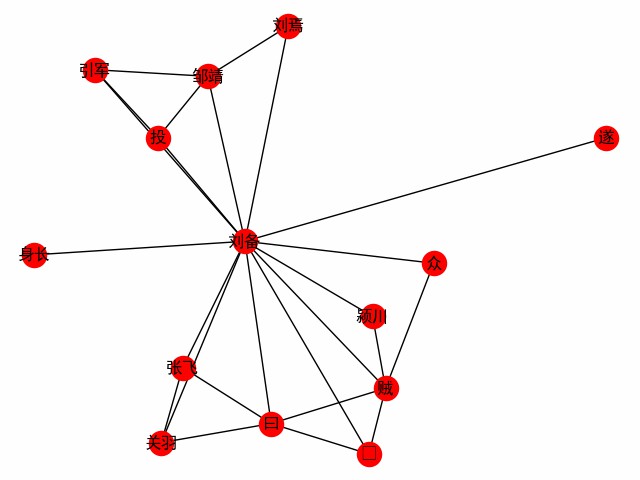
This is the friendship between Liu, Guan and Zhang, the backer whom Liu Bei defected to, and Liu Bei's experience in fighting against the thieves.
(Implemented using networkx) Use the Texttrank algorithm to obtain the extracted representative sentences from the document collection as summary information. You can set sentences that punish duplicates, or you can set word limits (maxlen parameter):
 print ( " n Text summarization" )
docs = [ "武磊威武,中超第一射手!" ,
        "郜林看来不行,已经到上限了。" ,
        "武球王威武,中超最强前锋!" ,
        "武磊和郜林,谁是中国最好的前锋?" ]
for doc in ht . get_summary ( docs , topK = 2 ):
    print ( doc )
print ( " n Text summarization(避免重复)" )
for doc in ht . get_summary ( docs , topK = 3 , avoid_repeat = True ):
    print ( doc )
Text summarization
武球王威武,中超最强前锋!
武磊威武,中超第一射手!
Text summarization(避免重复)
武球王威武,中超最强前锋!
郜林看来不行,已经到上限了。
武磊和郜林,谁是中国最好的前锋?
Currently, there are two algorithms that include textrank and HarvestText to encapsulate jieba and configure parameters and stop jieba_tfidf .
Example (see example for complete):
 # text为林俊杰《关键词》歌词
print ( "《关键词》里的关键词" )
kwds = ht . extract_keywords ( text , 5 , method = "jieba_tfidf" )
print ( "jieba_tfidf" , kwds )
kwds = ht . extract_keywords ( text , 5 , method = "textrank" )
print ( "textrank" , kwds )
《关键词》里的关键词
jieba_tfidf ['自私', '慷慨', '落叶', '消逝', '故事']
textrank ['自私', '落叶', '慷慨', '故事', '位置']
CSL.ipynb provides different algorithms, as well as the comparison of the implementation of this library with textrank4zh on the CSL dataset. Since there is only one dataset and the dataset is not friendly to the above algorithms, the performance is for reference only.
| algorithm | P@5 | R@5 | F@5 |
|---|---|---|---|
| textrank4zh | 0.0836 | 0.1174 | 0.0977 |
| ht_texttransk | 0.0955 | 0.1342 | 0.1116 |
| ht_jieba_tfidf | 0.1035 | 0.1453 | 0.1209 |
Now some resources are integrated in this library to facilitate use and establish demos.
Resources include:
get_qh_sent_dict : Complimentary and negative dictionary Li Jun from Tsinghua University compiled it from http://nlp.csai.tsinghua.edu.cn/site2/index.php/13-smsget_baidu_stopwords : Baidu stop word dictionary comes from the Internet: https://wenku.baidu.com/view/98c46383e53a580216fcfed9.htmlget_qh_typed_words : Domain dictionary from Tsinghua THUNLP: http://thuocl.thunlp.org/ All types ['IT', '动物', '医药', '历史人名', '地名', '成语', '法律', '财经', '食物']get_english_senti_lexicon : English emotional dictionaryget_jieba_dict : (need to download) Jieba word frequency dictionaryIn addition, a special resource is provided - "Romance of the Three Kingdoms", including:
You can explore what interesting discoveries can be obtained from it?
 def load_resources ():
	from harvesttext . resources import get_qh_sent_dict , get_baidu_stopwords , get_sanguo , get_sanguo_entity_dict
    sdict = get_qh_sent_dict ()              # {"pos":[积极词...],"neg":[消极词...]}
    print ( "pos_words:" , list ( sdict [ "pos" ])[ 10 : 15 ])
    print ( "neg_words:" , list ( sdict [ "neg" ])[ 5 : 10 ])

    stopwords = get_baidu_stopwords ()
    print ( "stopwords:" , list ( stopwords )[ 5 : 10 ])

    docs = get_sanguo ()                 # 文本列表,每个元素为一章的文本
    print ( "三国演义最后一章末16字: n " , docs [ - 1 ][ - 16 :])
    entity_mention_dict , entity_type_dict = get_sanguo_entity_dict ()
    print ( "刘备 指称:" , entity_mention_dict [ "刘备" ])
    print ( "刘备 类别:" , entity_type_dict [ "刘备" ])
    print ( "蜀 类别:" , entity_type_dict [ "蜀" ])
    print ( "益州 类别:" , entity_type_dict [ "益州" ])
load_resources ()
pos_words: ['宰相肚里好撑船', '查实', '忠实', '名手', '聪明']
neg_words: ['散漫', '谗言', '迂执', '肠肥脑满', '出卖']
stopwords: ['apart', '左右', '结果', 'probably', 'think']
三国演义最后一章末16字:
鼎足三分已成梦,后人凭吊空牢骚。
刘备 指称: ['刘备', '刘玄德', '玄德']
刘备 类别: 人名
蜀 类别: 势力
益州 类别: 州名
Load the Tsinghua Field Dictionary and use stop words.
 def using_typed_words ():
    from harvesttext . resources import get_qh_typed_words , get_baidu_stopwords
    ht0 = HarvestText ()
    typed_words , stopwords = get_qh_typed_words (), get_baidu_stopwords ()
    ht0 . add_typed_words ( typed_words )
    sentence = "THUOCL是自然语言处理的一套中文词库,词表来自主流网站的社会标签、搜索热词、输入法词库等。"
    print ( sentence )
    print ( ht0 . posseg ( sentence , stopwords = stopwords ))
using_typed_words ()
THUOCL是自然语言处理的一套中文词库,词表来自主流网站的社会标签、搜索热词、输入法词库等。
[('THUOCL', 'eng'), ('自然语言处理', 'IT'), ('一套', 'm'), ('中文', 'nz'), ('词库', 'n'), ('词表', 'n'), ('来自', 'v'), ('主流', 'b'), ('网站', 'n'), ('社会', 'n'), ('标签', '财经'), ('搜索', 'v'), ('热词', 'n'), ('输入法', 'IT'), ('词库', 'n')]
Some words are given special types of IT, while words such as "yes" are screened out.
Use some statistical indicators to discover new words from a relatively large number of texts. (Optional) Words that determine the degree of quality can be found by providing some seed words. (That is, at least all seed words will be found, on the premise that certain basic requirements are met.)
 para = "上港的武磊和恒大的郜林,谁是中国最好的前锋?那当然是武磊武球王了,他是射手榜第一,原来是弱点的单刀也有了进步"
#返回关于新词质量的一系列信息,允许手工改进筛选(pd.DataFrame型)
new_words_info = ht . word_discover ( para )
#new_words_info = ht.word_discover(para, threshold_seeds=["武磊"])
new_words = new_words_info . index . tolist ()
print ( new_words )
["Wu Lei"]
The algorithm uses the default empirical parameters. If you are not satisfied with the number of results, you can set auto_param=False to adjust the parameters yourself and adjust the number of final results. The relevant parameters are as follows:
 :param max_word_len: 允许被发现的最长的新词长度
:param min_freq: 被发现的新词,在给定文本中需要达到的最低频率
:param min_entropy: 被发现的新词,在给定文本中需要达到的最低左右交叉熵
:param min_aggregation: 被发现的新词,在给定文本中需要达到的最低凝聚度
For example, if you want to get more results than the default (for example, some new words are not discovered), you can down-regulate them based on the default parameters, and the following default parameters:
 min_entropy = np.log(length) / 10
min_freq = min(0.00005, 20.0 / length)
min_aggregation = np.sqrt(length) / 15
Specific algorithm details and parameter meanings, refer to: http://www.matrix67.com/blog/archives/5044
According to feedback update, it originally accepted a separate string by default. Now it can also accept string list input, and it will be automatically spliced
According to feedback update, the default order of word frequency can now be sorted by default. You can also pass sort_by='score' parameter to sort by comprehensive quality score.
Many of the new words found may be special keywords in the text, so the new words found can be logged in so that subsequent participles will give priority to these words.
 def new_word_register ():
    new_words = [ "落叶球" , "666" ]
    ht . add_new_words ( new_words )   # 作为广义上的"新词"登录
    ht . add_new_entity ( "落叶球" , mention0 = "落叶球" , type0 = "术语" )  # 作为特定类型登录
    print ( ht . seg ( "这个落叶球踢得真是666" , return_sent = True ))
    for word , flag in ht . posseg ( "这个落叶球踢得真是666" ):
        print ( "%s:%s" % ( word , flag ), end = " " )
This fallen leaf ball is really 666
This:r Leaf Ball: Term Kick:v Get:ud Really:d 666: New Word
You can also use some special rules to find the required keywords and directly assign them to the type, such as all in English, or have specific pres and suffixes, etc.
 # find_with_rules()
from harvesttext . match_patterns import UpperFirst , AllEnglish , Contains , StartsWith , EndsWith
text0 = "我喜欢Python,因为requests库很适合爬虫"
ht0 = HarvestText ()

found_entities = ht0 . find_entity_with_rule ( text0 , rulesets = [ AllEnglish ()], type0 = "英文名" )
print ( found_entities )
print ( ht0 . posseg ( text0 ))
{'Python', 'requests'}
[('我', 'r'), ('喜欢', 'v'), ('Python', '英文名'), (',', 'x'), ('因为', 'c'), ('requests', '英文名'), ('库', 'n'), ('很', 'd'), ('适合', 'v'), ('爬虫', 'n')]
Use the TextTiling algorithm to automatically segment text without segments, or further organize/resegment based on existing paragraphs.
 ht0 = HarvestText ()
text = """备受社会关注的湖南常德滴滴司机遇害案,将于1月3日9时许,在汉寿县人民法院开庭审理。此前,犯罪嫌疑人、19岁大学生杨某淇被鉴定为作案时患有抑郁症,为“有限定刑事责任能力”。
新京报此前报道,2019年3月24日凌晨,滴滴司机陈师傅,搭载19岁大学生杨某淇到常南汽车总站附近。坐在后排的杨某淇趁陈某不备,朝陈某连捅数刀致其死亡。事发监控显示,杨某淇杀人后下车离开。随后,杨某淇到公安机关自首,并供述称“因悲观厌世,精神崩溃,无故将司机杀害”。据杨某淇就读学校的工作人员称,他家有四口人,姐姐是聋哑人。
今日上午,田女士告诉新京报记者,明日开庭时间不变,此前已提出刑事附带民事赔偿,但通过与法院的沟通后获知,对方父母已经没有赔偿的意愿。当时按照人身死亡赔偿金计算共计80多万元,那时也想考虑对方家庭的经济状况。
田女士说,她相信法律,对最后的结果也做好心理准备。对方一家从未道歉,此前庭前会议中,对方提出了嫌疑人杨某淇作案时患有抑郁症的辩护意见。另具警方出具的鉴定书显示,嫌疑人作案时有限定刑事责任能力。
新京报记者从陈师傅的家属处获知,陈师傅有两个儿子,大儿子今年18岁,小儿子还不到5岁。“这对我来说是一起悲剧,对我们生活的影响,肯定是很大的”,田女士告诉新京报记者,丈夫遇害后,他们一家的主劳动力没有了,她自己带着两个孩子和两个老人一起过,“生活很艰辛”,她说,“还好有妹妹的陪伴,现在已经好些了。”"""
print ( "原始文本[5段]" )
print ( text + " n " )
print ( "预测文本[手动设置分3段]" )
predicted_paras = ht0 . cut_paragraphs ( text , num_paras = 3 )
print ( " n " . join ( predicted_paras ) + " n " )
原始文本[5段]
备受社会关注的湖南常德滴滴司机遇害案,将于1月3日9时许,在汉寿县人民法院开庭审理。此前,犯罪嫌疑人、19岁大学生杨某淇被鉴定为作案时患有抑郁症,为“有限定刑事责任能力”。
新京报此前报道,2019年3月24日凌晨,滴滴司机陈师傅,搭载19岁大学生杨某淇到常南汽车总站附近。坐在后排的杨某淇趁陈某不备,朝陈某连捅数刀致其死亡。事发监控显示,杨某淇杀人后下车离开。随后,杨某淇到公安机关自首,并供述称“因悲观厌世,精神崩溃,无故将司机杀害”。据杨某淇就读学校的工作人员称,他家有四口人,姐姐是聋哑人。
今日上午,田女士告诉新京报记者,明日开庭时间不变,此前已提出刑事附带民事赔偿,但通过与法院的沟通后获知,对方父母已经没有赔偿的意愿。当时按照人身死亡赔偿金计算共计80多万元,那时也想考虑对方家庭的经济状况。
田女士说,她相信法律,对最后的结果也做好心理准备。对方一家从未道歉,此前庭前会议中,对方提出了嫌疑人杨某淇作案时患有抑郁症的辩护意见。另具警方出具的鉴定书显示,嫌疑人作案时有限定刑事责任能力。
新京报记者从陈师傅的家属处获知,陈师傅有两个儿子,大儿子今年18岁,小儿子还不到5岁。“这对我来说是一起悲剧,对我们生活的影响,肯定是很大的”,田女士告诉新京报记者,丈夫遇害后,他们一家的主劳动力没有了,她自己带着两个孩子和两个老人一起过,“生活很艰辛”,她说,“还好有妹妹的陪伴,现在已经好些了。”
预测文本[手动设置分3段]
备受社会关注的湖南常德滴滴司机遇害案,将于1月3日9时许,在汉寿县人民法院开庭审理。此前,犯罪嫌疑人、19岁大学生杨某淇被鉴定为作案时患有抑郁症,为“有限定刑事责任能力”。
新京报此前报道,2019年3月24日凌晨,滴滴司机陈师傅,搭载19岁大学生杨某淇到常南汽车总站附近。坐在后排的杨某淇趁陈某不备,朝陈某连捅数刀致其死亡。事发监控显示,杨某淇杀人后下车离开。随后,杨某淇到公安机关自首,并供述称“因悲观厌世,精神崩溃,无故将司机杀害”。据杨某淇就读学校的工作人员称,他家有四口人,姐姐是聋哑人。
今日上午,田女士告诉新京报记者,明日开庭时间不变,此前已提出刑事附带民事赔偿,但通过与法院的沟通后获知,对方父母已经没有赔偿的意愿。当时按照人身死亡赔偿金计算共计80多万元,那时也想考虑对方家庭的经济状况。田女士说,她相信法律,对最后的结果也做好心理准备。对方一家从未道歉,此前庭前会议中,对方提出了嫌疑人杨某淇作案时患有抑郁症的辩护意见。另具警方出具的鉴定书显示,嫌疑人作案时有限定刑事责任能力。新京报记者从陈师傅的家属处获知,陈师傅有两个儿子,大儿子今年18岁,小儿子还不到5岁。“这对我来说是一起悲剧,对我们生活的影响,肯定是很大的”,田女士告诉新京报记者,丈夫遇害后,他们一家的主劳动力没有了,她自己带着两个孩子和两个老人一起过,“生活很艰辛”,她说,“还好有妹妹的陪伴,现在已经好些了。”
Unlike in the original paper, the sentence result is used as the basic unit, and the use of characters is not a fixed number, which is more semantically clearer and saves the trouble of setting parameters. Therefore, the algorithm under the default setting does not support text without punctuation. However, you can use the settings of the original paper by setting seq_chars to a positive integer to segment text without punctuation. If there is no paragraph wrapping, please set align_boundary=False . For example, see cut_paragraph() in examples/basic.py :
 print ( "去除标点以后的分段" )
text2 = extract_only_chinese ( text )
predicted_paras2 = ht0 . cut_paragraphs ( text2 , num_paras = 5 , seq_chars = 10 , align_boundary = False )
print ( " n " . join ( predicted_paras2 ) + " n " )
去除标点以后的分段
备受社会关注的湖南常德滴滴司机遇害案将于月日时许在汉寿县人民法院开庭审理此前犯罪嫌疑人岁大学生杨某淇被鉴定为作案时患有抑郁症为有
限定刑事责任能力新京报此前报道年
月日凌晨滴滴司机陈师
傅搭载岁大学生杨某淇到常南汽车总站附近坐在后排的杨某淇趁陈某不备朝陈某连捅数刀致其死亡事发监控显示杨某淇杀人后下车离开随后杨某淇
到公安机关自首并供述称因悲观厌世精神崩溃无故将司机杀害据杨某淇就读学校的工作人员称他家有四口人姐姐是聋哑人今日上午田女士告诉新京
报记者明日开庭时间不变此前已提出刑事附带民事赔偿但通过与法院的沟通后获知对方父母已经没有赔偿的意愿当时按照人身死亡赔偿金计算共计
多万元那时也想考虑对方家庭的经济状况田女士说她相信法律对最后的结果也做好心理准备对方一家从未道歉此前庭前会议中对方提
出了嫌疑人杨某淇作案时患有抑郁症的辩护意见另具警方出具的鉴定书显示嫌疑人作案时有限定刑事责任能力新京
报记者从陈师傅的家属处获知陈师傅有两个儿子大儿子今年岁小儿子还不到岁这对我来说是一起悲剧对我们生活的影响肯定是很大的田女士告诉新
京报记者丈夫遇害后他们一家的主劳动力没有了她自己带着两个孩子和两个老人一起过生活很艰辛她说还好有妹妹的陪伴现在已经好些了
The model can be saved locally and read multiplexing, or the records of the current model can be eliminated.
 from harvesttext import loadHT , saveHT
para = "上港的武磊和恒大的郜林,谁是中国最好的前锋?那当然是武磊武球王了,他是射手榜第一,原来是弱点的单刀也有了进步"
saveHT ( ht , "ht_model1" )
ht2 = loadHT ( "ht_model1" )

# 消除记录
ht2 . clear ()
print ( "cut with cleared model" )
print ( ht2 . seg ( para ))Specific implementations and examples are in naiveKGQA.py, and some schematics are given below:
 QA = NaiveKGQA ( SVOs , entity_type_dict = entity_type_dict )
questions = [ "你好" , "孙中山干了什么事?" , "谁发动了什么?" , "清政府签订了哪些条约?" ,
			 "英国与鸦片战争的关系是什么?" , "谁复辟了帝制?" ]
for question0 in questions :
	print ( "问:" + question0 )
	print ( "答:" + QA . answer ( question0 ))
问:孙中山干了什么事?
答:就任临时大总统、发动护法运动、让位于袁世凯
问:谁发动了什么?
答:英法联军侵略中国、国民党人二次革命、英国鸦片战争、日本侵略朝鲜、孙中山护法运动、法国侵略越南、英国侵略中国西藏战争、慈禧太后戊戌政变
问:清政府签订了哪些条约?
答:北京条约、天津条约
问:英国与鸦片战争的关系是什么?
答:发动
问:谁复辟了帝制?
答:袁世凯
This library is mainly designed to support data mining in Chinese, but has added a small amount of English support, including sentiment analysis.
To use these functions, you need to create a HarvestText object with a special English pattern.
 # ♪ "Until the Day" by JJ Lin
test_text = """
In the middle of the night.
Lonely souls travel in time.
Familiar hearts start to entwine.
We imagine what we'll find, in another life.
""" . lower ()
ht_eng = HarvestText ( language = "en" )
sentences = ht_eng . cut_sentences ( test_text )  # 分句
print ( " n " . join ( sentences ))
print ( ht_eng . seg ( sentences [ - 1 ]))             # 分词[及词性标注]
print ( ht_eng . posseg ( sentences [ 0 ], stopwords = { "in" }))
# 情感分析
sent_dict = ht_eng . build_sent_dict ( sentences , pos_seeds = [ "familiar" ], neg_seeds = [ "lonely" ],
                                   min_times = 1 , stopwords = { 'in' , 'to' })
print ( "sentiment analysis" )
for sent0 in sentences :
    print ( sent0 , "%.3f" % ht_eng . analyse_sent ( sent0 ))
# 自动分段
print ( "Segmentation" )
print ( " n " . join ( ht_eng . cut_paragraphs ( test_text , num_paras = 2 )))

# 情感分析也提供了一个内置英文词典资源
# from harvesttext.resources import get_english_senti_lexicon
# sent_lexicon = get_english_senti_lexicon()
# sent_dict = ht_eng.build_sent_dict(sentences, pos_seeds=sent_lexicon["pos"], neg_seeds=sent_lexicon["neg"], min_times=1)
in the middle of the night.
lonely souls travel in time.
familiar hearts start to entwine.
we imagine what we'll find, in another life.
['we', 'imagine', 'what', 'we', "'ll", 'find', ',', 'in', 'another', 'life', '.']
[('the', 'DET'), ('middle', 'NOUN'), ('of', 'ADP'), ('the', 'DET'), ('night', 'NOUN'), ('.', '.')]
sentiment analysis
in the middle of the night. 0.000
lonely souls travel in time. -1.600
familiar hearts start to entwine. 1.600
we imagine what we'll find, in another life. 0.000
Segmentation
in the middle of the night. lonely souls travel in time. familiar hearts start to entwine.
we imagine what we'll find, in another life.
Currently, the support for English is not perfect. Except for the functions in the above examples, other functions are not guaranteed to be used.
If you find this library helpful for your academic work, please refer to the following format
 @misc{zhangHarvestText,
	author = {Zhiling Zhang},
	title = {HarvestText: A Toolkit for Text Mining and Preprocessing},
	journal = {GitHub repository},
	howpublished = {url{https://github.com/blmoistawinde/HarvestText}},
	year = {2023}
}
This library is under development, and improvements to existing features and additions to more features may come one after another. Welcome to provide suggestions in issues. If you think it's easy to use, you might as well have a Star~
Thanks to the following repo for inspiration:
snownlp
pyhanLP
funNLP
ChineseWordSegmentation
EventTriplesExtraction
textrank4ZH





