genai
v2.1.0

Installieren | Lizenz | Verhaltenskodex | Beitragen
? Holen Sie sich GPT -Hilfe bei Code, SQL -Abfragen, Datenrahmen, Ausnahmen und mehr in Ipython.
? Unterstützt alle Jupyter -Umgebungen, einschließlich Ipython, Jupyterlab, Jupyter Notebook und Bemerkenswert.
Tl; dr und fange jetzt an
 %pip install genai
%load_ext genai
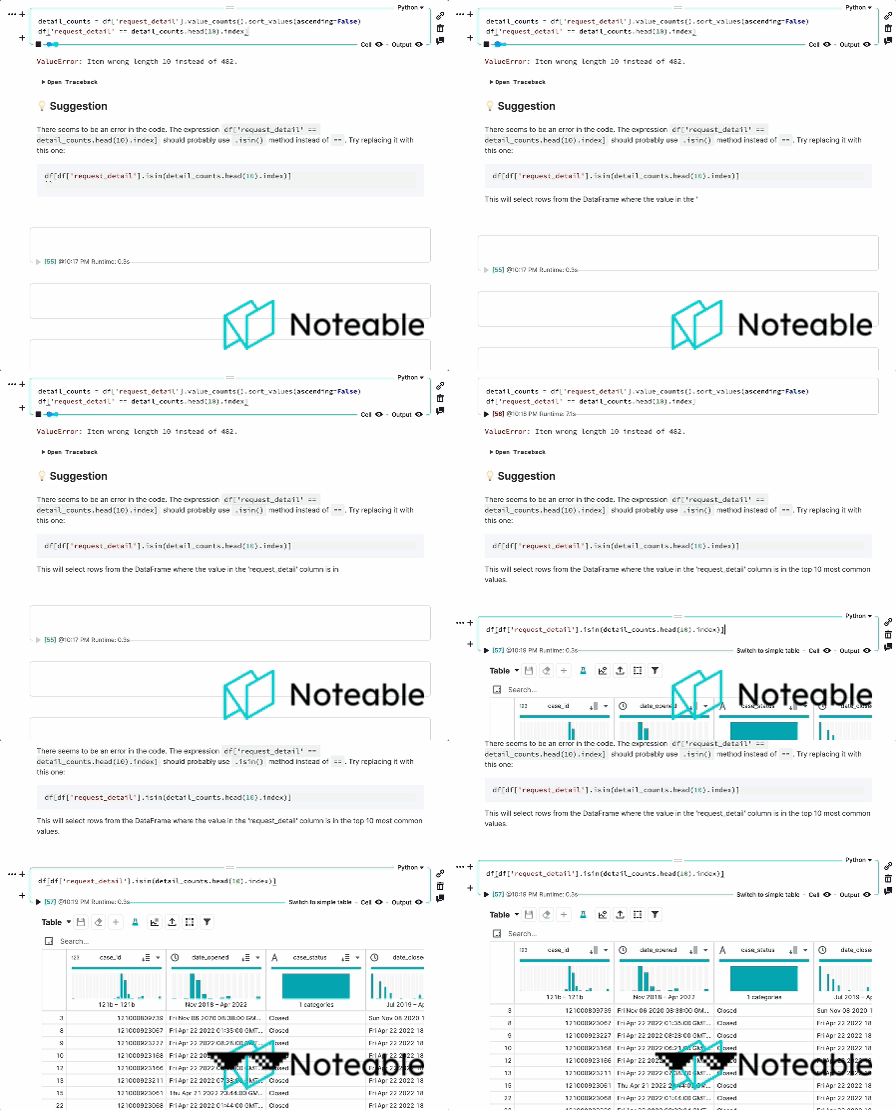
Wir haben den Kontext von Ipython genommen, ihn mit OpenAIs großen Sprachmodellen gemischt und bieten Ihnen ein fundierteres Notebook -Erlebnis, das in allen Jupyter -Umgebungen funktioniert, einschließlich Ipython, Jupyterlab, Jupyter Notebook und Bemerkenswert. ?
Python 3.8+
poetry add genaipip install genai Stellen Sie sicher, dass Sie zuerst die Umgebungsvariable OPENAI_API_KEY einstellen, bevor Sie sie in Ipython oder Ihrer bevorzugten Notebook -Plattform der Wahl verwenden.
%load_ext genai
%%assist den magischen Befehl, um Code aus der natürlichen Sprache zu generieren In [ 1 ]: % load_ext genai
In [ 2 ]: import pandas as pd
In [ 3 ]: df = pd . DataFrame ( dict ( col1 = [ 'a' , 'b' , 'c' ]), index = [ 'first' , 'second' , 'third' ])
In [ 4 ]: df . sort_values ()
- - - - - - - - - - - - - - - - - - - - - - - - - - - - - - - - - - - - - - - - - - - - - - - - - - - - - - - - - - - - - - - - - - - - - - - - - - -
TypeError Traceback ( most recent call last )
Cell In [ 4 ], line 1
- - - - > 1 df . sort_values ()
File ~ / . pyenv / versions / 3.9 . 9 / lib / python3 . 9 / site - packages / pandas / util / _decorators . py : 331 , in deprecate_nonkeyword_arguments . < locals > . decorate . < locals > . wrapper ( * args , ** kwargs )
325 if len ( args ) > num_allow_args :
326 warnings . warn (
327 msg . format ( arguments = _format_argument_list ( allow_args )),
328 FutureWarning ,
329 stacklevel = find_stack_level (),
330 )
- - > 331 return func ( * args , ** kwargs )
TypeError : sort_values () missing 1 required positional argument : 'by' Die Fehlermeldung zeigt an, dass die Methode sort_values() eines Pandas -Datenframees ein erforderliches Positionsargument fehlt.
Für die Methode sort_values() müssen Sie einen Spaltennamen oder eine Liste der Spaltennamen als by übergeben. Dies wird verwendet, um zu bestimmen, wie die Sortierung durchgeführt wird.
Hier ist ein Beispiel:
 import pandas as pd

df = pd . DataFrame ({
    'Name' : [ 'Alice' , 'Bob' , 'Carol' , 'David' , 'Eva' ],
    'Age' : [ 32 , 24 , 28 , 35 , 29 ],
    'Salary' : [ 60000 , 40000 , 35000 , 80000 , 45000 ]
})

# sort by Age column:
df_sorted = df . sort_values ( by = 'Age' )
print ( df_sorted )
In diesem Beispiel ist das by -Argument auf 'Age' festgelegt, das den Datenrahmen nach Alter in aufsteigender Reihenfolge sortiert. Beachten Sie, dass Sie auch eine Liste der Spaltennamen übergeben können, wenn Sie nach mehreren Spalten sortieren möchten.
 In [ 1 ]: % load_ext genai

In [ 2 ]: % % assist
   ...:
   ...: Can you explain this query to me so I can be sure we ' re doing the right things ?
   ...:
   ...: `` ` sql
   ...: SELECT
   ...:   COUNT ( * ) AS num_downloads ,
   ...:   DATE_TRUNC ( DATE ( timestamp ), DAY ) AS day
   ...: FROM `bigquery-public-data.pypi.file_downloads`
   ...: WHERE
   ...:   file . project = 'genai'
   ...:   - - Only query the last 6 months of history
   ...:   AND DATE ( timestamp )
   ...:     BETWEEN DATE_TRUNC ( DATE_SUB ( CURRENT_DATE (), INTERVAL 6 MONTH ), MONTH )
   ...:     AND CURRENT_DATE ()
   ...: GROUP BY day
   ...: ORDER BY day DESC
"This is a SQL query that counts the number of downloads for the 'genai' project on the Python Package Index (PyPI) over the last 6 months, grouped by day. The query selects the count and the date, truncating the date to the day level so that it's easier to read.
Here is a breakdown of each part of the query:
- ` SELECT COUNT(*) AS num_downloads, DATE_TRUNC(DATE(timestamp), DAY) AS day ` : This selects the count of the number of rows matched by the query as ` num_downloads ` , and the date truncated to the day level as ` day ` .
- ` FROM ` bigquery-public-data.pypi.file_downloads``: This specifies the table to query from.
- ` WHERE file.project = 'genai' ` : This filters the rows by only including downloads for the 'genai' project.
- ` AND DATE(timestamp) BETWEEN DATE_TRUNC(DATE_SUB(CURRENT_DATE(), INTERVAL 6 MONTH), MONTH) AND CURRENT_DATE() ` : This filters the rows by only including downloads from the last 6 months. The ` DATE_SUB ` function subtracts 6 months from the current date ( ` CURRENT_DATE() ` ), ` DATE_TRUNC ` truncates the result to be the start of the month and ` DATE ` converts the timestamp column to a date so the ` BETWEEN ` condition can filter rows between the start of 6 months ago and "today."
- ` GROUP BY day ` : This groups the rows by day so that the counts are aggregated by date.
- ` ORDER BY day DESC ` : This orders the rows so that the most recent date appears first in the result."




