OpenDelta
v0.3.2

用于参数有效调整的开源框架(Delta Tuning)。
概述•安装•基本用法•文档•性能•
Opendelta是一种用于参数有效调整方法的工具包(我们将其称为三角洲调整),用户可以通过它灵活地分配(或添加)少量参数来更新,同时保持最多的参数冻结。通过使用OpenDelta,用户可以轻松地实现前缀调整,适配器,LORA或其他任何其他类型的Delta Tunting,并使用首选的PTMS进行调整。
Opendelta的最新版本在Python == 3.8.13,Pytorch == 1.12.1,Transformers == 4.22.2上进行了测试。其他版本也可能得到支持。如果您在使用自己的软件包版本时会遇到错误,请提出问题,我们将尽快调查。
使用Opendelta修改PLM(例如BART)的演示。 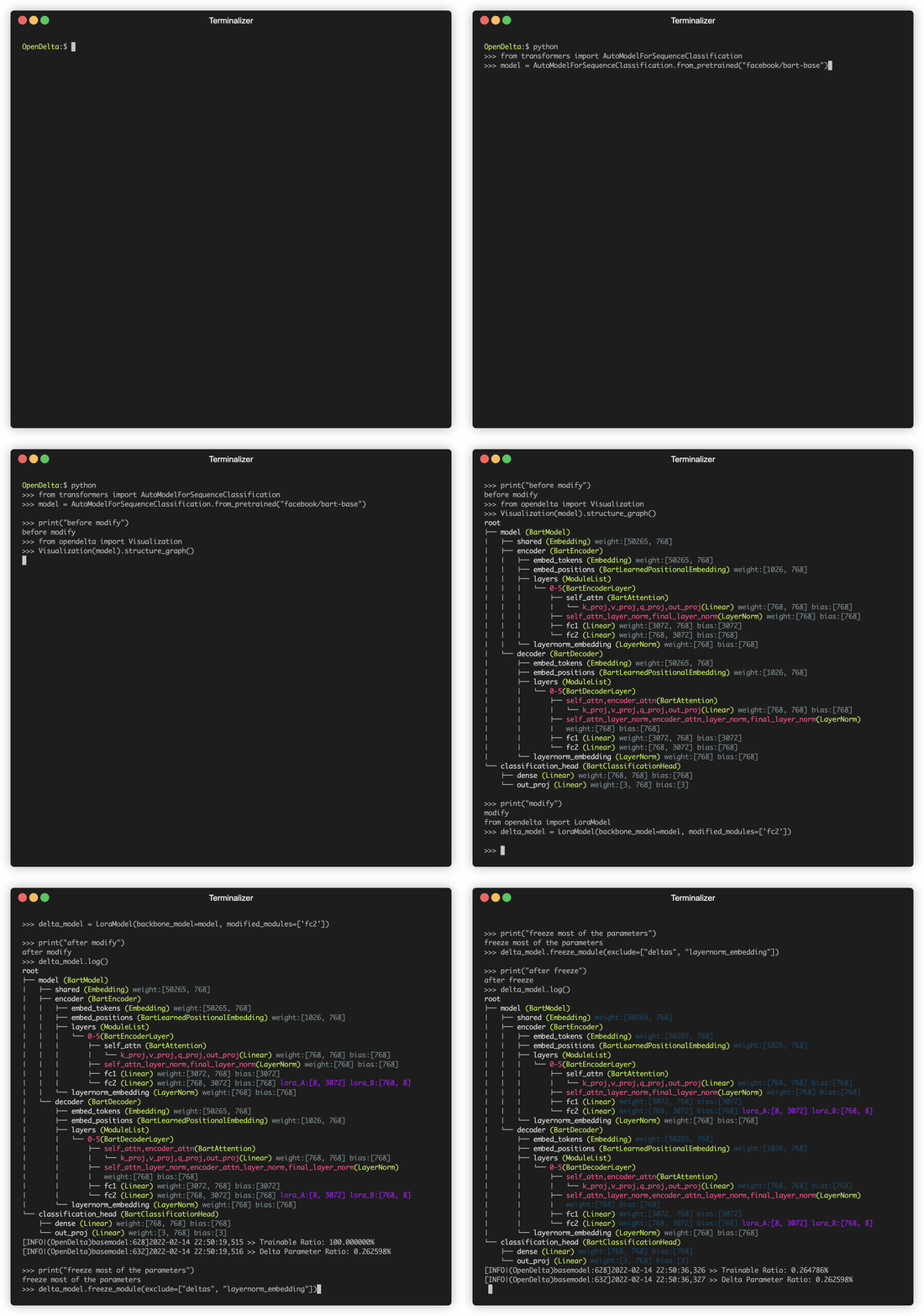
conda create -n opendelta_env python=3.8
conda activate opendelta_envpip install git+https://github.com/thunlp/OpenDelta.git或安装最新的PIP版本(更稳定)
pip install opendelta或从源构建
git clone [email protected]:thunlp/OpenDelta.git
cd OpenDelta
python setup.py install
# python setup.py develop # if you want to do some modifications on the code for your research:
以下代码和评论可以使您了解Opendelta的关键功能。它也位于colab中的use_try.py和use_try.ipynb中。
 # use transformers as usual.
from transformers import AutoModelForSeq2SeqLM , AutoTokenizer
t5 = AutoModelForSeq2SeqLM . from_pretrained ( "t5-large" )
t5_tokenizer = AutoTokenizer . from_pretrained ( "t5-large" )
# A running example
inputs_ids = t5_tokenizer . encode ( "Is Harry Potter written by J.K. Rowling" , return_tensors = "pt" )
t5_tokenizer . decode ( t5 . generate ( inputs_ids )[ 0 ])
# >>> '<pad><extra_id_0>? Is it Harry Potter?</s>'


# use existing delta models
from opendelta import AutoDeltaModel , AutoDeltaConfig
# use existing delta models from DeltaCenter
delta = AutoDeltaModel . from_finetuned ( "thunlp/Spelling_Correction_T5_LRAdapter_demo" , backbone_model = t5 )
# freeze the whole backbone model except the delta models.
delta . freeze_module ()
# visualize the change
delta . log ()


t5_tokenizer . decode ( t5 . generate ( inputs_ids )[ 0 ])
# >>> <pad> Is Harry Potter written by J.K. Rowling?</s>


# Now save merely the delta models, not the whole backbone model, to tmp/
delta . save_finetuned ( ".tmp" )
import os ; os . listdir ( ".tmp" )
# >>>  The state dict size is 1.443 MB
# >>>  We encourage users to push their final and public models to delta center to share them with the community!


# reload the model from local url and add it to pre-trained T5.
t5 = AutoModelForSeq2SeqLM . from_pretrained ( "t5-large" )
delta1 = AutoDeltaModel . from_finetuned ( ".tmp" , backbone_model = t5 )
import shutil ; shutil . rmtree ( ".tmp" ) # don't forget to remove the tmp files.
t5_tokenizer . decode ( t5 . generate ( inputs_ids )[ 0 ])
# >>> <pad> Is Harry Potter written by J.K. Rowling?</s>

# detach the delta models, the model returns to the unmodified status.
delta1 . detach ()
t5_tokenizer . decode ( t5 . generate ( inputs_ids )[ 0 ])
# >>> '<pad><extra_id_0>? Is it Harry Potter?</s>'

# use default configuration for customized wrapped models which have PLMs inside. This is a common need for users.
import torch . nn as nn
class WrappedModel ( nn . Module ):
  def __init__ ( self , inner_model ):
    super (). __init__ ()
    self . inner = inner_model
  def forward ( self , * args , ** kwargs ):
    return self . inner ( * args , ** kwargs )

wrapped_model = WrappedModel ( WrappedModel ( t5 ))

# say we use LoRA
delta_config = AutoDeltaConfig . from_dict ({ "delta_type" : "lora" })
delta2 = AutoDeltaModel . from_config ( delta_config , backbone_model = wrapped_model )
delta2 . log ()
# >>> root
#       -- inner
#          -- inner
#             ...
#             ... lora_A:[8,1024], lora_B:[1024,8]
delta2 . detach ()

# use a not default configuration
# say we add lora to the last four layer of the decoder of t5, with lora rank=5
delta_config3 = AutoDeltaConfig . from_dict ({ "delta_type" : "lora" , "modified_modules" :[ "[r]decoder.*((20)|(21)|(22)|(23)).*DenseReluDense.wi" ], "lora_r" : 5 })
delta3 = AutoDeltaModel . from_config ( delta_config3 , backbone_model = wrapped_model )
delta3 . log ()您可以尝试在基于Pytorch的任何骨干模型上使用Opendelta。
但是,由于不支持骨干模型的子模型的界面,因此不支持不支持。因此,我们验证了Opendelta一定可以支持的一些常用模型。
我们将继续测试越来越多的新兴模型。
当您成功将Opendelta应用于自己的骨干模型时,请欢迎拉动请求。
 @article { hu2023opendelta ,
  title = { OpenDelta: A Plug-and-play Library for Parameter-efficient Adaptation of Pre-trained Models } ,
  author = { Hu, Shengding and Ding, Ning and Zhao, Weilin and Lv, Xingtai and Zhang, Zhen and Liu, Zhiyuan and Sun, Maosong } ,
  journal = { arXiv preprint arXiv:2307.03084 } ,
  year = { 2023 }
}
@article { ding2022delta ,
title = { Delta tuning: A comprehensive study of parameter efficient methods for pre-trained language models } ,
author = { Ding, Ning and Qin, Yujia and Yang, Guang and Wei, Fuchao and Yang, Zonghan and Su, Yusheng and Hu, Shengding and Chen, Yulin and Chan, Chi-Min and Chen, Weize and others } ,
journal = { arXiv preprint arXiv:2203.06904 } ,
year = { 2022 }
}




