OpenDelta
v0.3.2

เฟรมเวิร์กโอเพ่นซอร์สสำหรับการปรับค่าพารามิเตอร์ (การปรับจูนเดลต้า)
ภาพรวม•การติดตั้ง•การใช้งานพื้นฐาน•เอกสาร•ประสิทธิภาพ•
Opendelta เป็นชุดเครื่องมือสำหรับวิธีการปรับแต่งพารามิเตอร์ที่มีประสิทธิภาพ (เราพากย์ว่าเป็นการ ปรับจูนเดลต้า ) ซึ่งผู้ใช้สามารถกำหนด (หรือเพิ่ม) พารามิเตอร์จำนวนเล็กน้อยเพื่ออัปเดตในขณะที่เก็บพารามิเตอร์ส่วนใหญ่แช่แข็ง ด้วยการใช้ Opendelta ผู้ใช้สามารถใช้การปรับแต่งคำนำหน้าอะแดปเตอร์ LORA หรือการปรับจูนเดลต้าประเภทอื่น ๆ ด้วย PTM ที่ต้องการ
Opendelta เวอร์ชันล่าสุดได้รับการทดสอบบน Python == 3.8.13, Pytorch == 1.12.1, Transformers == 4.22.2 รุ่นอื่น ๆ มีแนวโน้มที่จะได้รับการสนับสนุนเช่นกัน หากคุณพบข้อบกพร่องเมื่อใช้เวอร์ชันแพ็คเกจของคุณเองโปรดเพิ่มปัญหาเราจะตรวจสอบโดยเร็วที่สุด
การสาธิตการใช้ Opendelta เพื่อแก้ไข PLM (เช่น BART) 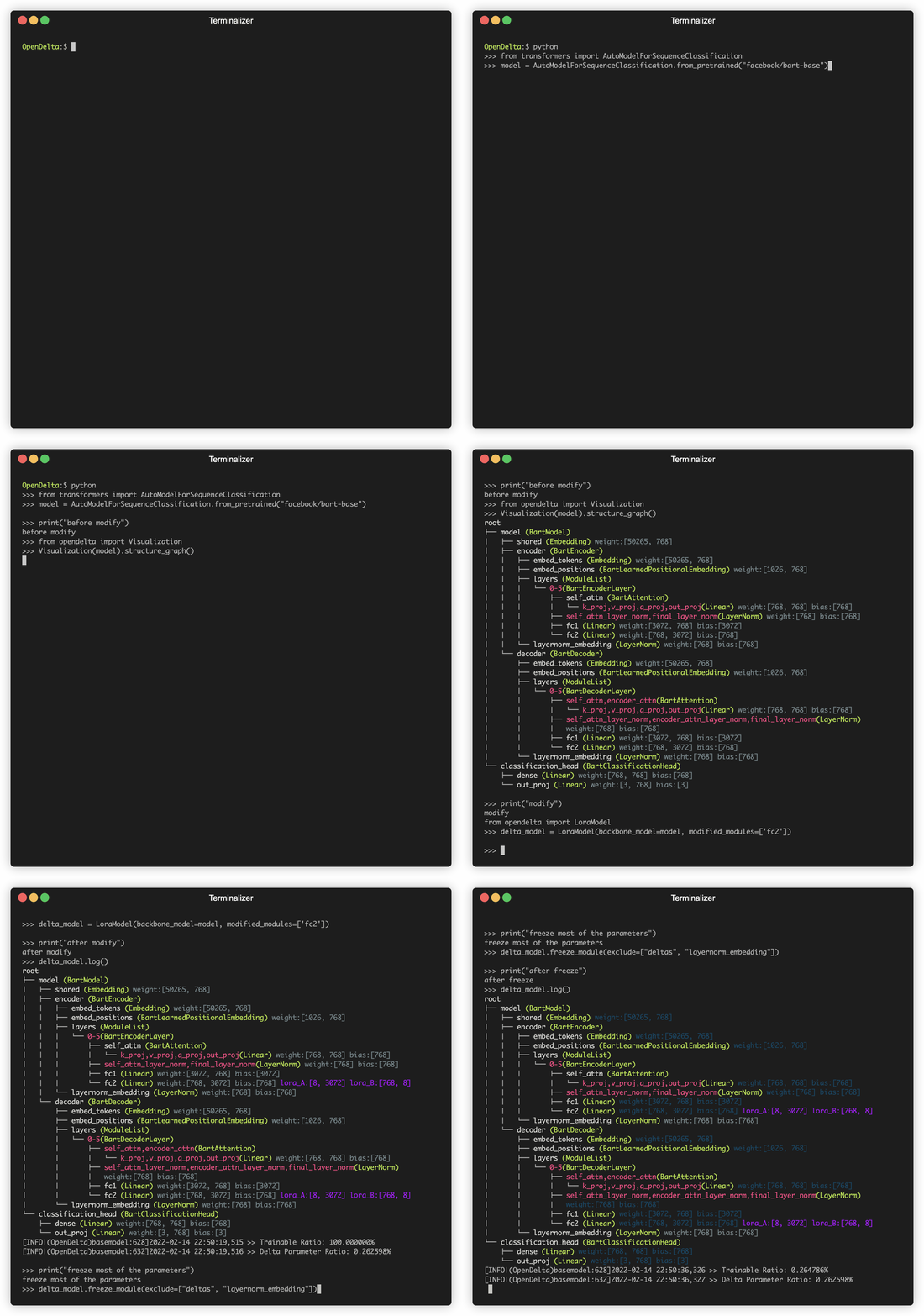
conda create -n opendelta_env python=3.8
conda activate opendelta_envpip install git+https://github.com/thunlp/OpenDelta.gitหรือ ติดตั้งเวอร์ชัน PIP ล่าสุด (เสถียรมากขึ้น)
pip install opendeltaหรือ สร้างจากแหล่งที่มา
git clone [email protected]:thunlp/OpenDelta.git
cd OpenDelta
python setup.py install
# python setup.py develop # if you want to do some modifications on the code for your research:
รหัสและความคิดเห็นต่อไปนี้จะนำคุณผ่านฟังก์ชั่นสำคัญของ Opendelta นอกจากนี้ยังอยู่ใน Must_try.py และ Must_try.ipynb ใน colab
 # use transformers as usual.
from transformers import AutoModelForSeq2SeqLM , AutoTokenizer
t5 = AutoModelForSeq2SeqLM . from_pretrained ( "t5-large" )
t5_tokenizer = AutoTokenizer . from_pretrained ( "t5-large" )
# A running example
inputs_ids = t5_tokenizer . encode ( "Is Harry Potter written by J.K. Rowling" , return_tensors = "pt" )
t5_tokenizer . decode ( t5 . generate ( inputs_ids )[ 0 ])
# >>> '<pad><extra_id_0>? Is it Harry Potter?</s>'


# use existing delta models
from opendelta import AutoDeltaModel , AutoDeltaConfig
# use existing delta models from DeltaCenter
delta = AutoDeltaModel . from_finetuned ( "thunlp/Spelling_Correction_T5_LRAdapter_demo" , backbone_model = t5 )
# freeze the whole backbone model except the delta models.
delta . freeze_module ()
# visualize the change
delta . log ()


t5_tokenizer . decode ( t5 . generate ( inputs_ids )[ 0 ])
# >>> <pad> Is Harry Potter written by J.K. Rowling?</s>


# Now save merely the delta models, not the whole backbone model, to tmp/
delta . save_finetuned ( ".tmp" )
import os ; os . listdir ( ".tmp" )
# >>>  The state dict size is 1.443 MB
# >>>  We encourage users to push their final and public models to delta center to share them with the community!


# reload the model from local url and add it to pre-trained T5.
t5 = AutoModelForSeq2SeqLM . from_pretrained ( "t5-large" )
delta1 = AutoDeltaModel . from_finetuned ( ".tmp" , backbone_model = t5 )
import shutil ; shutil . rmtree ( ".tmp" ) # don't forget to remove the tmp files.
t5_tokenizer . decode ( t5 . generate ( inputs_ids )[ 0 ])
# >>> <pad> Is Harry Potter written by J.K. Rowling?</s>

# detach the delta models, the model returns to the unmodified status.
delta1 . detach ()
t5_tokenizer . decode ( t5 . generate ( inputs_ids )[ 0 ])
# >>> '<pad><extra_id_0>? Is it Harry Potter?</s>'

# use default configuration for customized wrapped models which have PLMs inside. This is a common need for users.
import torch . nn as nn
class WrappedModel ( nn . Module ):
  def __init__ ( self , inner_model ):
    super (). __init__ ()
    self . inner = inner_model
  def forward ( self , * args , ** kwargs ):
    return self . inner ( * args , ** kwargs )

wrapped_model = WrappedModel ( WrappedModel ( t5 ))

# say we use LoRA
delta_config = AutoDeltaConfig . from_dict ({ "delta_type" : "lora" })
delta2 = AutoDeltaModel . from_config ( delta_config , backbone_model = wrapped_model )
delta2 . log ()
# >>> root
#       -- inner
#          -- inner
#             ...
#             ... lora_A:[8,1024], lora_B:[1024,8]
delta2 . detach ()

# use a not default configuration
# say we add lora to the last four layer of the decoder of t5, with lora rank=5
delta_config3 = AutoDeltaConfig . from_dict ({ "delta_type" : "lora" , "modified_modules" :[ "[r]decoder.*((20)|(21)|(22)|(23)).*DenseReluDense.wi" ], "lora_r" : 5 })
delta3 = AutoDeltaModel . from_config ( delta_config3 , backbone_model = wrapped_model )
delta3 . log ()คุณสามารถลองใช้ OpEndelta ในรุ่นแบ็ ค โบนตาม Pytorch
อย่างไรก็ตามมีโอกาสเล็กน้อยที่อินเทอร์เฟซของ submodules ของโมเดลกระดูกสันหลังไม่รองรับ ดังนั้นเราจึงตรวจสอบโมเดลที่ใช้กันทั่วไปบางรุ่นที่ Opendelta มั่นใจว่าจะสนับสนุน
เราจะทำการทดสอบแบบจำลองที่เกิดขึ้นใหม่มากขึ้นเรื่อย ๆ
ยินดีรับคำขอดึงเมื่อคุณใช้ Opendelta บนโมเดลกระดูกสันหลังของคุณเองสำเร็จ
 @article { hu2023opendelta ,
  title = { OpenDelta: A Plug-and-play Library for Parameter-efficient Adaptation of Pre-trained Models } ,
  author = { Hu, Shengding and Ding, Ning and Zhao, Weilin and Lv, Xingtai and Zhang, Zhen and Liu, Zhiyuan and Sun, Maosong } ,
  journal = { arXiv preprint arXiv:2307.03084 } ,
  year = { 2023 }
}
@article { ding2022delta ,
title = { Delta tuning: A comprehensive study of parameter efficient methods for pre-trained language models } ,
author = { Ding, Ning and Qin, Yujia and Yang, Guang and Wei, Fuchao and Yang, Zonghan and Su, Yusheng and Hu, Shengding and Chen, Yulin and Chan, Chi-Min and Chen, Weize and others } ,
journal = { arXiv preprint arXiv:2203.06904 } ,
year = { 2022 }
}




