
Recently, the technology media The Decoder released a report on OpenAI's latest model GPT-4.5, which triggered widespread discussion in the industry about its cost-effectiveness. According to official data, despite the performance improvement of GPT-4.5, its cost is significantly higher than the previous version of GPT-4o, which has raised doubts from users and developers.
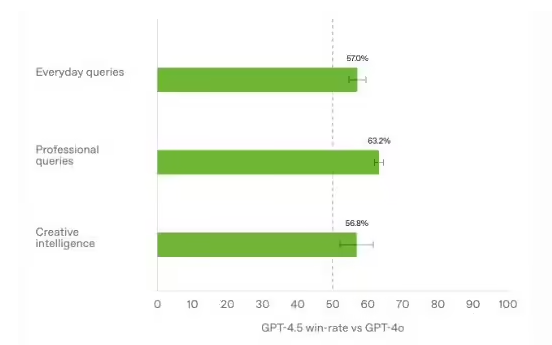
From the perspective of performance, GPT-4.5 is better than GPT-4o in multiple task categories. Specific data shows that its performance in professional inquiry, daily inquiry and creative tasks increased by 63.2%, 57% and 56.8% respectively. However, these improvements are relatively limited, ranging from 6.8% to 13.2%. At the same time, the cost of GPT-4.5 has increased significantly. The cost of entering a token is as high as $75 per million, and the cost of exporting a token is $150. By comparison, the GPT-4o costs only $2.50 for input and $10 for output. This means that the input cost of GPT-4.5 is 30 times that of GPT-4o and the output cost is 15 times.
OpenAI said in response that GPT-4.5 will not replace GPT-4o and is currently evaluating the feasibility of providing the model through the API for a long time. The company is also actively collecting user feedback to determine whether GPT-4.5 can show enough unique value to support its high operating costs. It is worth noting that if GPT-4.5 ultimately decides to stop the service, those application developers who rely on the model for development may face some dilemma.
Faced with the current challenges, OpenAI may launch an optimized version of GPT-4.5 Turbo to reduce usage costs. However, given the limited performance improvement of GPT-4.5, it remains questionable whether it can bring significant advantages. Although the GPT-4 Turbo in the past has been optimized in terms of speed and price, its quality is generally not as good as the original GPT-4, which also makes users reserved for future optimized versions.
Against the backdrop of rapid development of AI technology, OpenAI faces major challenges in how to balance model performance and usage costs. In the future, whether a reasonable path can be found will directly affect its market competitiveness and user acceptance. For developers and enterprises, choosing the right model not only requires performance considerations, but also trade-offs on costs and benefits to maximize return on investment.