
The research team of Nanyang Technological University recently launched a super-large 3D city model generation technology called "GaussianCity", an innovative achievement has attracted widespread attention in the academic and industrial circles. This technology not only achieved a significant improvement in generation speed by 60 times, but also broke through the limitations of traditional methods in scale, supporting borderless 3D city generation, bringing revolutionary breakthroughs to areas such as virtual reality, autonomous driving and digital twins.
GaussianCity's R&D results have been accepted by CVPR2025 (Top Conference on Computer Vision and Pattern Recognition), marking its technological leadership. The core of this technology lies in its innovative algorithm design, which enables the 3D urban model that generates drone perspectives and street perspectives to reach the most advanced level. Its rendering speed is as high as 10.72 frames per second (FPS), which is 60 times faster than the existing CityDreamer solution, greatly improving computing efficiency and scale expansion capabilities.
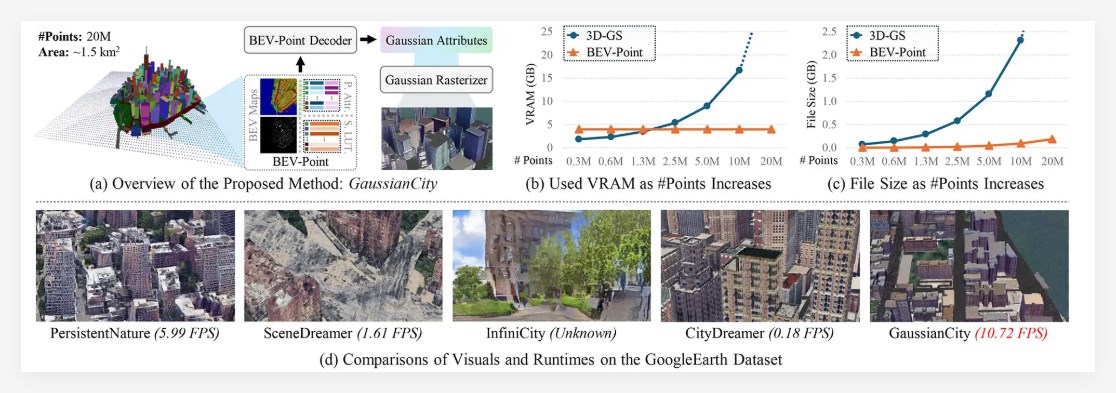
GaussianCity’s two key technological breakthroughs are the key to its success. First, it adopts a compact 3D scene representation method "BEV-Point" (bird's-eye view point), which greatly reduces the memory demand and makes large-scale scene generation no longer limited to hardware resources. Traditional 3D Gaussian Splating (3DGS) technology requires billions of points when dealing with unlimited-scale cities, which often occupies hundreds of GB of video memory. GaussianCity maintains the use of video memory constant through BEV-Point, achieving true boundaryless generation. Secondly, the research team developed a space-aware Gaussian attribute decoder, using point serializer to integrate the structure and contextual features of BEV points to ensure that the generated urban model is both efficient and realistic.
It is worth mentioning that the research and development team of GaussianCity announced that the papers, codes and related materials of the project have been fully open source, providing valuable resources for the academic and industrial circles. The emergence of GaussianCity has brought new possibilities to multiple fields. In virtual reality (VR) and augmented reality (AR), it can quickly generate high-quality large-scale urban environments, providing users with an immersive experience; in the field of autonomous driving, GaussianCity can be used to rebuild geometrically accurate 3D scenes, providing realistic digital twin cities for training and testing; in urban planning and game development, its efficiency and scalability will also greatly improve creative efficiency.
Project entrance: https://github.com/hzxie/GaussianCity