
A study from the University of Reading in the UK has raised concerns about the application of AI in academic fields. The study found that in real university exams, 94% of answers generated by AI were not seen by teachers, and AI scores were significantly higher than human students in 83.4% of cases. This study was not conducted in a laboratory, but used real-life examination environments and scoring standards. The results are shocking and pose serious challenges to academic integrity and the education system. This study used GPT-4 to generate answers without any modifications to ensure the "authenticity" of AI and fully demonstrated the power of AI in academic writing.
In the examination room of university examinations, the "invasion" of AI has quietly occurred. Research from the University of Reading in the UK revealed an astonishing phenomenon: In actual university examinations, 94% of AI-generated answers escaped the eyes of teachers and were not seen through. What’s even more shocking is that these AI “classmates” scored significantly higher than human students in 83.4% of the cases. This seems to indicate that AI not only shows potential in replacing human work, but also begins to surpass college students in cognitive tasks.
This research did not take place in a closed laboratory, but in a real examination environment. The research team conducted a "Turing test" at the University of Reading's School of Psychology and Clinical Speech Sciences without informing the raters. The exam includes short-answer questions and essay questions, with AI-generated content mixed in, accounting for about 5%. The researchers used standardized prompt words to let GPT-4 generate answers, but did not make any modifications to the content to ensure the "authenticity" of the AI.
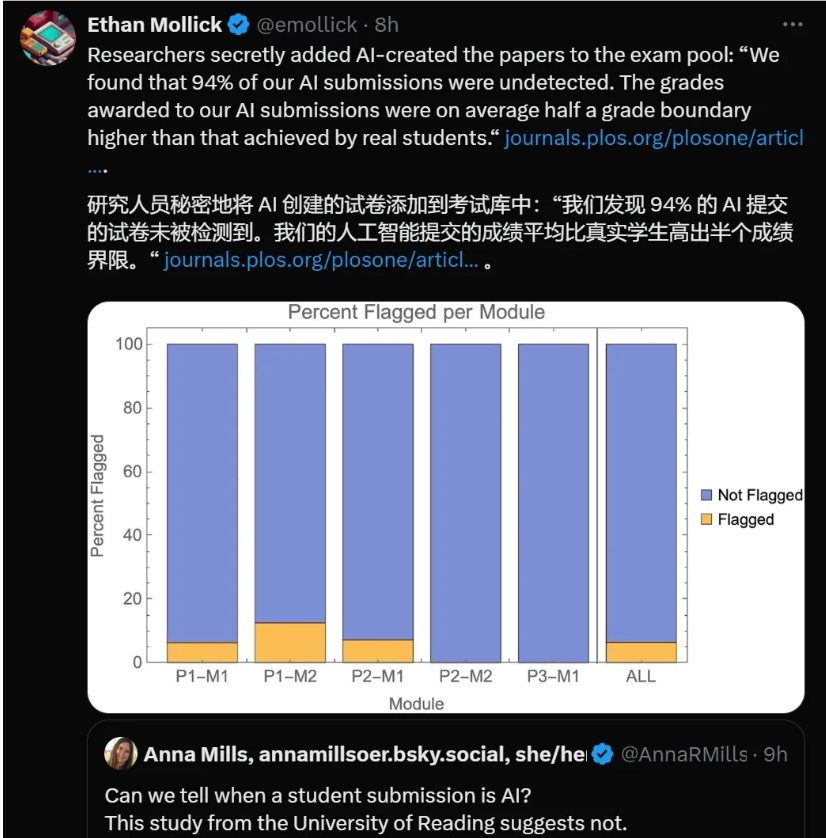
The marking process follows the University of Reading's rigorous standards and includes preliminary marking, independent review and calibration meetings with the marking team. However, even under such scrutiny, assignments submitted by AI are still difficult to see through. Research results show that AI-generated assignments are not found in multiple modules, and scores are often concentrated in high-scoring areas.
This discovery prompted profound reflections on academic integrity and educational goals. If students can use AI to generate high-quality content that is difficult to discover, then how should we reform the education system to adapt to this emerging technology? Last year, a paper in Nature also pointed out that AI is more effective in completing college coursework Already demonstrated the ability to search, integrate and critically analyze information, which coincides with the training objectives of the university.
The study's conclusions are certainly concerning. The ability of GPT-4 makes it difficult for students to detect cheating using AI, and there is a very high probability of achieving better results. This not only poses a challenge to academic integrity, but also prompts us to think about the future direction of education. Although some netizens jokingly questioned whether this research was also completed by AI, the author solemnly stated that the research content was entirely conducted by humans.
The results of this study force us to re-examine educational assessment methods and mechanisms for maintaining academic integrity. In the face of the rapid development of AI technology, how to cultivate students' critical thinking and innovative abilities, and how to ensure the fairness and justice of examinations will become issues that need to be focused on in the education field in the future. We need to actively explore new teaching models and assessment methods to adapt to the new challenges in the artificial intelligence era.