
Recently, Jinjiang Literature City issued a statement on AI infringement incidents and vigorously defended rights, attracting industry attention. The incident originated from a Xiaohongshu blogger using Jinjiang’s original works to train an AI model and publicly disseminating tutorials, triggering widespread discussions on AI technology applications and copyright protection. The editor of Downcodes will interpret this incident in detail and analyze the problems and challenges behind it.
On August 30, Jinjiang Literature City, a well-known online literature platform, issued an important statement, expressing its firm rights protection stance in response to recent AI infringement incidents. This incident highlights the new copyright challenges caused by artificial intelligence technology in the field of content creation, which has attracted widespread attention in the industry.
The incident started when the Jinjiang legal team discovered that a blogger on the Xiaohongshu platform was using original content (V-text) from Jinjiang Literature City to promote AI text generation technology. These bloggers not only listed in detail the steps of how to decompose the works of Jinjiang authors to train the AI model, but also publicly demonstrated the process of using multiple well-known Jinjiang novels to generate AI text. What's more, they formed a group to disseminate detailed tutorials to attract traffic, and made controversial remarks such as let the AI continue writing, since it doesn't need to eat anyway.
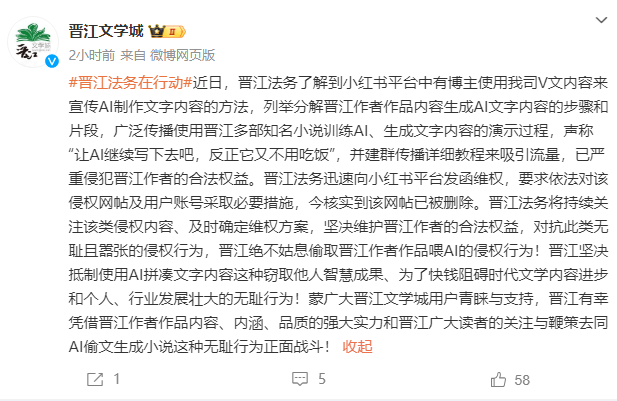
Jinjiang Literature City believes that these actions seriously infringe upon the legitimate rights and interests of platform authors. In response, Jinjiang’s legal team quickly sent a rights protection letter to the Xiaohongshu platform, requiring the platform to take necessary measures against the infringing content and related user accounts in accordance with the law. After verification, the relevant online post has been deleted.
In the statement, Jinjiang Literature City stated that it will continue to pay attention to such infringements and formulate rights protection plans in a timely manner. The platform emphasized its determination to resolutely safeguard the legitimate rights and interests of authors, saying that it will fight against such shameless and arrogant infringements, and made it clear that Jinjiang will never tolerate the infringement of stealing Jinjiang authors' works to feed AI.
This incident reflects the new challenges faced by copyright protection with the widespread application of AI technology in the field of content creation. How to find a balance between encouraging technological innovation and protecting the rights and interests of original authors has become an urgent problem that the industry needs to solve. Jinjiang Literature City’s positive actions not only protect the interests of platform authors, but also set an example for the entire online literature industry in dealing with AI infringement issues.
As the situation develops, the industry will pay close attention to how such incidents are handled and their impact on future AI content creation specifications. At the same time, this also reminds content platforms and creators to increase their awareness of copyright protection and jointly maintain a healthy and orderly creative environment.
This incident not only warned of copyright risks in the application of AI technology, but also prompted us to think about how to better balance technological development and intellectual property protection. In the future, how to establish a more complete AI copyright protection mechanism will become a common challenge faced by the industry. The editor of Downcodes will continue to pay attention to the progress of the incident and bring you more relevant reports.