elisp def
1.0.0

Vá para a definição do símbolo no ponto. Suporta definições globais, definições locais e até código macro-pesado!
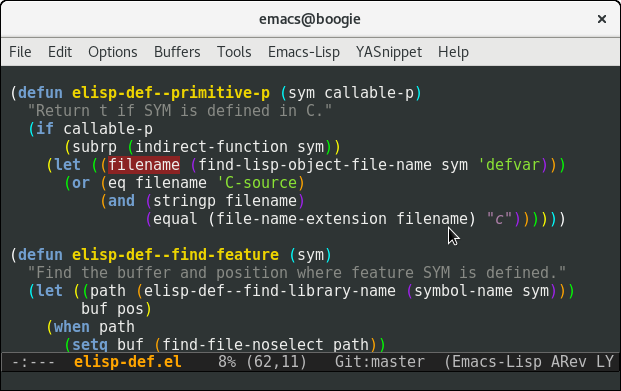
elisp-def analisa estaticamente seu código e volta às heurísticas onde isso não é possível. Ele deve funcionar 99% do tempo, então, por favor, arquive bugs se não conseguir encontrar definições para o seu código.
Instale no Melpa e adicione o seguinte à sua configuração do EMACS:
( dolist (hook '(emacs-lisp-mode-hook ielm-mode-hook))
( add-hook hook # 'elisp-def-mode )) elisp-def encontrará a definição de funções globais e variáveis globais no ponto.
( defun demo/foo ()
  1 )

( defun demo/bar ()
  ; ; M-x eval-buffer, then elisp-def on this:
  (demo/foo))
Ele também usará informações do Edebug para encontrar definições de função, por isso encontra definições com mais frequência que o XREF.
elisp-def entende a diferença entre símbolos e funções e saltos para a definição correta.
( require 'cc-mode )

; ; `c-version' is both a variable and a function.

( defun demo/foo ()
  ; ; `elisp-def` will find the function here.
  ( c-version ))

( defun demo/foo ()
  ; ; `elisp-def` will find the variable here.
( setq c-version t )) elisp-def entende macros, para que possa detectar com precisão referências de função.
( require 'dash )

( defvar demo/foo nil )

( defun demo/foo ( x )
  x)

( defun demo/bar ()
  (-> > 123
       ; ; `elisp-def' knows that this is a function, even though there are
       ; ; no parens.
       demo/foo))
Também pode entender macros que definem funções ou variáveis.
( define-derived-mode demo/foo-mode fundamental-mode " demo " )

; ; `elisp-def' will expand macros to discover where major mode hooks
; ; are defined.
demo/foo-mode-hook

( cl-defstruct demo/point x y)

; ; `elisp-def' can find this function even though the defstruct
; ; call doesn't contain this symbol name.
(make-demo/point 1 2 ) elisp-def encontrará bibliotecas, exibindo as declarações de provide , se possível.
 ; ; `elisp-def' will open python.el here.
( require 'python )

; ; Unlike `xref-find-definition' , `elisp-def' will not confuse this
; ; library name with the macro named `use-package' .
( require 'use-package )

; ; `elisp-def' will even find python.el here, because the macro
; ; expands to a call to `require' .
( use-package python
  :config
( setq python-indent-guess-indent-offset-verbose nil )) elisp-def entende encaderções e parâmetros locais.
( defun demo/foo ( bar )
  ( let ((foo 1 ))
    ; ; `elisp-def' on the FOO below will move point to the let
    ; ; binding.
    ( setq foo 2 )
    ; ; `elisp-def' on the BAR below will move point to the function
    ; ; parameters line.
    ( setq bar 3 )))

( defun demo/bar ()
  ( let* ((foo 1 )
         (bar 2 )
         (foo 3 )
         ; ; `elisp-def' on the second FOO on the following line will
         ; ; move point to the relevant binding, which is the line
         ; ; immediately above.
         (foo ( + foo 1 ))
         (foo 5 ))
    nil ))
Isso até funciona com macros que introduzem ligações.
( require 'dash )
( eval-when-compile
  ( require 'cl-lib ))

( defun demo/foo ( items )
  ( cl-destructuring-bind ( first second) items
    ; ; `elisp-def' knowns that FIRST is bound on line above.
    ( message " first is %s " first))
  (-let [( first . rest) items]
    ; ; `elisp-def' knowns that FIRST is bound on line above.
( message " first is %s " first))) elisp-def permite que você coloque pontos em símbolos citados, símbolos de docstring ou símbolos calculados no fundo.
( defun demo/foo ( x )
  ; ; `elisp-def' on X in the docstring will find the parameter.
  " Adds one to X and returns it. "
  ( 1+ x))

( defun demo/bar ()
  ; ; `elisp-def' can find demo/foo even when point is on the #.
  ( funcall # 'demo/foo 1 )
  ; ; `elisp-def' on demo/foo below will find the function.
  ; ;
  ; ; See `demo/foo' for more information.
  nil )

( defun demo/baz ( foo )
  ; ; `elisp-def' understands that @ is not part of foo here.
  `(blah ,@foo ))
Quando encontrar o símbolo, o Elisp-Def também o destaca temporariamente para visibilidade.
elisp-def é limitado em sua capacidade de analisar símbolos citados.
 ; ; `elisp-def' is able to find these quoted symbols because they're
; ; only globally bound in one namespace.
( mapcar 'symbol-name '(foo bar baz))
( add-to-list 'auto-mode-alist '( " \ .java \ ' " . java-mode))

( require 'cc-mode )
( defun demo/calls-fn ( sym )
  ( funcall sym))

; ; Since `c-version' is both a function and a variable, and we're not
; ; using a sharp-quote #'c-version, we have to prompt the user.
(demo/calls-fn 'c-version )

( defun demo/foo ( c-version )
  ; ; Here we have no idea whether we're using `c-version' as a
  ; ; function (e.g. funcall), as a variable (e.g. set) or as a
  ; ; parameter (e.g. eval).
  (bar 'c-version nil ))
elisp-def não consegue encontrar definições em macros com semântica let* e variáveis duplicadas.
( require 'dash )

( defun demo/foo ()
  (-let ((x 1 )
         (x 2 ))
    ; ; `elisp-def' on X below will move to the first X binding, rather
    ; ; than the second.
    x))
elisp-def também não pode lidar com macros que reescrevem formas de modo que o símbolo desapareça completamente.
( eval-when-compile ( require 'cl-lib ))

( cl-labels ((foo (x y) ( + x y)))
  ; ; `cl-labels' completely rewrites this body to (--cl-foo-- 1 2), so
  ; ; `elisp-def' can't find the definition of FOO.
(foo 1 2 ))elisp-slime-nav-find-elisp-thing-at-point ELISP-SLIME-NAVxref-find-definitions em emacs-lisp-mode (parte do núcleo da EMACS)semantic-ia-fast-jump de semantic/ia.el (incluído no emacs) O pessoal do #emacs para responder minhas perguntas sobre a esoterica Elisp, principalmente o Wasamasa.
A biblioteca de elogios para a conclusão de clojure tem uma noção de contexto, que é muito semelhante à forma como os extratos e análises do Elisp-Def.
Hacklang tem uma noção semelhante de um espaço reservado para analisar as conclusões em um ponto do código.
GPLV3+.
Estou fornecendo código no repositório para você sob uma licença de código aberto. Como este é o meu repositório pessoal, a licença que você recebe ao meu código é de mim e não do meu empregador.