elisp def
1.0.0

Vaya a la definición del símbolo en el punto. ¡Admite definiciones globales, definiciones locales e incluso código macro pesado!
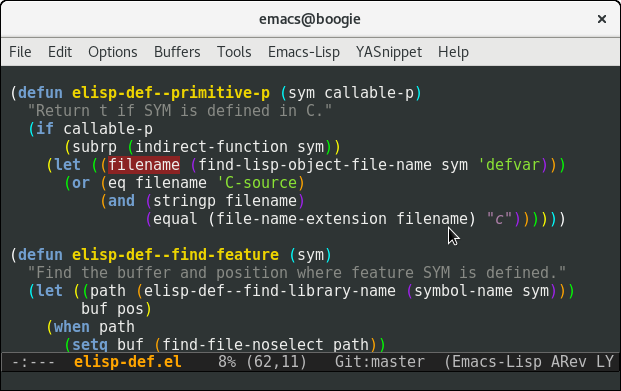
elisp-def analiza estáticamente su código y recurre a la heurística donde eso no es posible. Debe funcionar el 99% del tiempo, así que presente los errores si no puede encontrar definiciones para su código.
Instale desde MELPA, luego agregue lo siguiente a su configuración de emacs:
( dolist (hook '(emacs-lisp-mode-hook ielm-mode-hook))
( add-hook hook # 'elisp-def-mode )) elisp-def encontrará la definición de funciones globales y variables globales en el punto.
( defun demo/foo ()
  1 )

( defun demo/bar ()
  ; ; M-x eval-buffer, then elisp-def on this:
  (demo/foo))
También utilizará información de Edebug para encontrar definiciones de funciones, por lo que encuentra definiciones con más frecuencia que XREF.
elisp-def comprende la diferencia entre símbolos y funciones y salta a la definición correcta.
( require 'cc-mode )

; ; `c-version' is both a variable and a function.

( defun demo/foo ()
  ; ; `elisp-def` will find the function here.
  ( c-version ))

( defun demo/foo ()
  ; ; `elisp-def` will find the variable here.
( setq c-version t )) elisp-def comprende las macros, por lo que puede detectar con precisión las referencias de funciones.
( require 'dash )

( defvar demo/foo nil )

( defun demo/foo ( x )
  x)

( defun demo/bar ()
  (-> > 123
       ; ; `elisp-def' knows that this is a function, even though there are
       ; ; no parens.
       demo/foo))
También puede comprender las macros que definen funciones o variables.
( define-derived-mode demo/foo-mode fundamental-mode " demo " )

; ; `elisp-def' will expand macros to discover where major mode hooks
; ; are defined.
demo/foo-mode-hook

( cl-defstruct demo/point x y)

; ; `elisp-def' can find this function even though the defstruct
; ; call doesn't contain this symbol name.
(make-demo/point 1 2 ) elisp-def encontrará bibliotecas, mostrando las declaraciones provide si es posible.
 ; ; `elisp-def' will open python.el here.
( require 'python )

; ; Unlike `xref-find-definition' , `elisp-def' will not confuse this
; ; library name with the macro named `use-package' .
( require 'use-package )

; ; `elisp-def' will even find python.el here, because the macro
; ; expands to a call to `require' .
( use-package python
  :config
( setq python-indent-guess-indent-offset-verbose nil )) elisp-def comprende los enlaces y parámetros locales.
( defun demo/foo ( bar )
  ( let ((foo 1 ))
    ; ; `elisp-def' on the FOO below will move point to the let
    ; ; binding.
    ( setq foo 2 )
    ; ; `elisp-def' on the BAR below will move point to the function
    ; ; parameters line.
    ( setq bar 3 )))

( defun demo/bar ()
  ( let* ((foo 1 )
         (bar 2 )
         (foo 3 )
         ; ; `elisp-def' on the second FOO on the following line will
         ; ; move point to the relevant binding, which is the line
         ; ; immediately above.
         (foo ( + foo 1 ))
         (foo 5 ))
    nil ))
Esto incluso funciona con macros que introducen enlaces.
( require 'dash )
( eval-when-compile
  ( require 'cl-lib ))

( defun demo/foo ( items )
  ( cl-destructuring-bind ( first second) items
    ; ; `elisp-def' knowns that FIRST is bound on line above.
    ( message " first is %s " first))
  (-let [( first . rest) items]
    ; ; `elisp-def' knowns that FIRST is bound on line above.
( message " first is %s " first))) elisp-def le permite poner puntos en símbolos citados, símbolos de documentos o símbolos retrocedidos.
( defun demo/foo ( x )
  ; ; `elisp-def' on X in the docstring will find the parameter.
  " Adds one to X and returns it. "
  ( 1+ x))

( defun demo/bar ()
  ; ; `elisp-def' can find demo/foo even when point is on the #.
  ( funcall # 'demo/foo 1 )
  ; ; `elisp-def' on demo/foo below will find the function.
  ; ;
  ; ; See `demo/foo' for more information.
  nil )

( defun demo/baz ( foo )
  ; ; `elisp-def' understands that @ is not part of foo here.
  `(blah ,@foo ))
Cuando encuentre el símbolo, Elisp-DEF también lo resaltará temporalmente para la visibilidad.
elisp-def es limitado en su capacidad para analizar los símbolos citados.
 ; ; `elisp-def' is able to find these quoted symbols because they're
; ; only globally bound in one namespace.
( mapcar 'symbol-name '(foo bar baz))
( add-to-list 'auto-mode-alist '( " \ .java \ ' " . java-mode))

( require 'cc-mode )
( defun demo/calls-fn ( sym )
  ( funcall sym))

; ; Since `c-version' is both a function and a variable, and we're not
; ; using a sharp-quote #'c-version, we have to prompt the user.
(demo/calls-fn 'c-version )

( defun demo/foo ( c-version )
  ; ; Here we have no idea whether we're using `c-version' as a
  ; ; function (e.g. funcall), as a variable (e.g. set) or as a
  ; ; parameter (e.g. eval).
  (bar 'c-version nil ))
elisp-def no puede encontrar definiciones en macros con let* semántica y variables duplicadas.
( require 'dash )

( defun demo/foo ()
  (-let ((x 1 )
         (x 2 ))
    ; ; `elisp-def' on X below will move to the first X binding, rather
    ; ; than the second.
    x))
elisp-def tampoco puede manejar macros que reescriban formas de tal manera que el símbolo desaparece por completo.
( eval-when-compile ( require 'cl-lib ))

( cl-labels ((foo (x y) ( + x y)))
  ; ; `cl-labels' completely rewrites this body to (--cl-foo-- 1 2), so
  ; ; `elisp-def' can't find the definition of FOO.
(foo 1 2 ))elisp-slime-nav-find-elisp-thing-at-point de Elisp-Slime-Navxref-find-definitions en emacs-lisp-mode (parte del núcleo de emacs)semantic-ia-fast-jump de semantic/ia.el (incluido en emacs) La buena gente en #emacs por responder mis preguntas sobre Elisp Esoterica, particularmente Wasamasa.
La biblioteca de cumplidos para la finalización de Clojure tiene una noción de contexto que es muy similar a la forma en que ELISP-DEF extrae y analiza los formularios.
Hacklang tiene una noción similar de un marcador de posición para analizar las finalizaciones en un punto del código.
GPLV3+.
Le estoy proporcionando código en el repositorio bajo una licencia de código abierto. Debido a que este es mi repositorio personal, la licencia que recibe a mi código es de mí y no de mi empleador.