awd lstm tensorflow
1.0.0

AWD-LSTM from ("Regularizing and Optimizing LSTM Language Models") for tensorflow.
Training-award quantization for integer-arithmetic-only inference ("Quantization and Training of Neural Networks for Efficient Integer-Arithmetic-Only Inference") is also provided.
This code is implemmented and tested with tensorflow 1.11.0. and 1.13.0.
LayerRNNCell.from weight_drop_lstm import WeightDropLSTMCell
lstm_cell = WeightDropLSTMCell(
num_units=CELL_NUM, weight_drop_kr=WEIGHT_DP_KR,
use_vd=True, input_size=INPUT_SIZE)
Arguments are define as follows:
num_units: the number of cell in LSTM layer. [ints]
weight_drop_kr: the number of steps that fast weights go forward. [int]
use_vd: If true, using variational dropout on weight drop-connect, standard dropout otherwise. [bool]
input_size: Ifuse_vd=True, input_size (dimension of last channel) should be provided. [int]
The remaining keyword arguments is exactly the same as tf.nn.LSTMCell.
Noted that, if the weight_drop_kr is not provided or provided with 1.0, WeightDropLSTMCell is reducted as LSTMCell.
# By simply sess.run in each training step
sess.run(lstm_cell.get_vd_update_op())

# Or use control_dependencies
vd_update_ops = lstm_cell.get_vd_update_op()
with tf.control_dependencies(vd_update_ops):
    tf.train.AdamOptimizer(learning_rate).minimize(loss)
You can also add get_vd_update_op() to GraphKeys.UPDATE_OPS when calling WeightDropLSTMCell.
Noted that, if you use control_dependencies, please be careful for the order of execution.
The variational dropout kernel should not be update before the optimizer step.
The main idea of AWD-LSTM is the drop-connect weights and concatinated inputs.
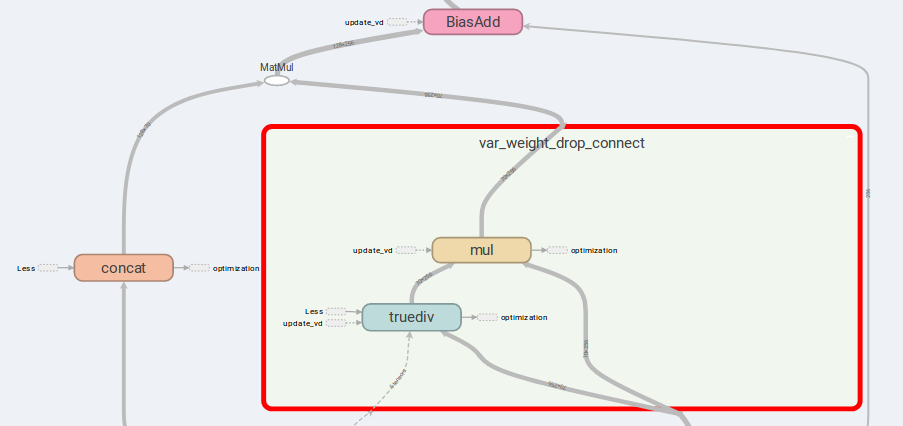
If is_vd=True, variables will be used to saved the dropout kernel.
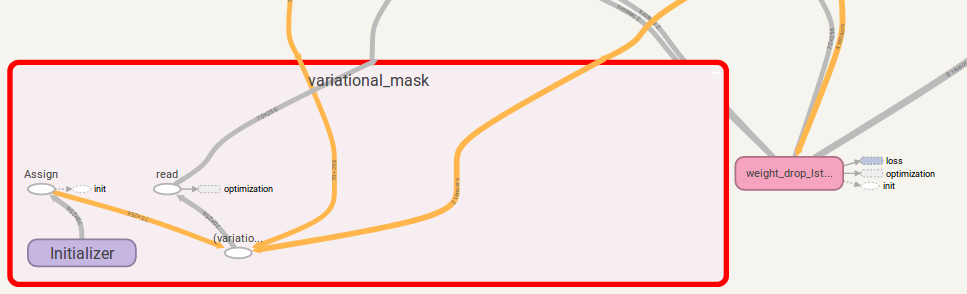
I have conduct experiments on a many-to-many recursive task this implementation and carry out a better results than simple LSTMCell.
lstm_cell = WeightDropLSTMCell(
    num_units=CELL_NUM, weight_drop_kr=WEIGHT_DP_KR,
    is_quant=True, is_train=True)

tf.contrib.quantize.create_training_graph(sess.graph, quant_delay=0)
tf.while with version higher than 1.12.0I also provided a tensorflow implementation of variational dropout, which is more flexible than DropoutWrapper in tensorflow.
The usage is similar to using WeightDropLSTMCell:
from variational_dropout import VariationalDropout

vd = VariationalDropout(input_shape=[5], keep_prob=0.5)

# Directly sess.run() to update
sess.run(vd.get_update_mask_op())

# Or use control_dependencies
with tf.control_dependencies(vd.get_update_mask_op()):
    step, results_array = tf.while_loop(
        cond=lambda step, _: step < 5,
        body=main_loop,
        loop_vars=(step, results_array))
"""
    This is just a simple example.
    Usually, control_dependencies will be placed where optimizer stepping.
"""
You can also add get_update_mask_op() to GraphKeys.UPDATE_OPS when calling VariationalDropout.
Once again, if you use control_dependencies, please be careful for the order of execution.
If you have any suggestion, please let me know. I'll be pretty grateful!
Code work by Jia-Yau Shiau [email protected].
Quantization code work is advised and forked from Peter Huang [email protected]







