ArticutAPI
v1.3.7

| name | ArticleAPI | MP_ArticutAPI | WS_ArticutAPI |
|---|---|---|---|
| product | Online / Docker | Docker | Docker |
| technology | HTTP Request | MultiProcessing | WebSocket |
| feature | Simple and easy to use | Batch processing | Instant processing |
| Applicable scenarios | any | Text Analysis | Chatbot |
| name | ArticleAPI | MP_ArticutAPI | WS_ArticutAPI |
|---|---|---|---|
| time | 0.1252 seconds | 0.1206 seconds | 0.0677 seconds |
| Number of sentences | ArticleAPI | MP_ArticutAPI | WS_ArticutAPI |
|---|---|---|---|
| method | parse() | bulk_parse(20) | parse() |
| 1K | 155 seconds | 8 seconds | 18 seconds |
| 2K | 306 seconds | 14 seconds | 35 seconds |
| 3K | 455 seconds | 17 seconds | 43 seconds |
MP_ArticutAPI uses the bulk_parse(bulkSize=20) method.WS_ArticutAPI uses the parse() method.pip3 install ArticutAPIPlease refer to Docs/index.html for function description
 from ArticutAPI import Articut
from pprint import pprint
username = "" #這裡填入您在 https://api.droidtown.co 使用的帳號 email。若使用空字串,則預設使用每小時 2000 字的公用額度。
apikey   = "" #這裡填入您在 https://api.droidtown.co 登入後取得的 api Key。若使用空字串,則預設使用每小時 2000 字的公用額度。
articut = Articut(username, apikey)
inputSTR = "會被大家盯上,才證明你有實力。"
resultDICT = articut.parse(inputSTR)
pprint(resultDICT)
 {"exec_time": 0.06723856925964355,
 "level": "lv2",
 "msg": "Success!",

 "result_pos": ["<MODAL>會</MODAL><ACTION_lightVerb>被</ACTION_lightVerb><ENTITY_nouny>大家</ENTITY_nouny><ACTION_verb>盯上</ACTION_verb>",
                ",",
                "<MODAL>才</MODAL><ACTION_verb>證明</ACTION_verb><ENTITY_pronoun>你</ENTITY_pronoun><ACTION_verb>有</ACTION_verb><ENTITY_noun>實力</ENTITY_noun>",
                "。"],
 "result_segmentation": "會/被/大家/盯上/,/才/證明/你/有/實力/。/",
 "status": True,
 "version": "v118",
 "word_count_balance": 9985,
 "product": "https://api.droidtown.co/product/",
 "document": "https://api.droidtown.co/document/"
}
You can find words that have complete meanings of words such as "noun", "verb" or "adjective" according to your needs.
 inputSTR = "你計劃過地球人類補完計劃"
resultDICT = articut.parse(inputSTR, level="lv1")
pprint(resultDICT["result_pos"])

#列出所有的 content word.
contentWordLIST = articut.getContentWordLIST(resultDICT)
pprint(contentWordLIST)

#列出所有的 verb word. (動詞)
verbStemLIST = articut.getVerbStemLIST(resultDICT)
pprint(verbStemLIST)

#列出所有的 noun word. (名詞)
nounStemLIST = articut.getNounStemLIST(resultDICT)
pprint(nounStemLIST)

#列出所有的 location word. (地方名稱)
locationStemLIST = articut.getLocationStemLIST(resultDICT)
pprint(locationStemLIST)
 #resultDICT["result_pos"]
["<ENTITY_pronoun>你</ENTITY_pronoun><ACTION_verb>計劃</ACTION_verb><ASPECT>過</ASPECT><LOCATION>地球</LOCATION><ENTITY_oov>人類</ENTITY_oov><ACTION_verb>補完</ACTION_verb><ENTITY_nounHead>計劃</ENTITY_nounHead>"]

#列出所有的 content word.
[[(47, 49, '計劃'), (117, 119, '人類'), (146, 147, '補'), (196, 198, '計劃')]]

#列出所有的 verb word. (動詞)
[[(47, 49, '計劃'), (146, 147, '補')]]

#列出所有的 noun word. (名詞)
[[(117, 119, '人類'), (196, 198, '計劃')]]

#列出所有的 location word. (地方名稱)
[[(91, 93, '地球')]]
 resultDICT = articut.versions()
pprint(resultDICT)
 {"msg": "Success!",
 "status": True,
 "versions": [{"level": ["lv1", "lv2"],
               "release_date": "2019-04-25",
               "version": "latest"},
              {"level": ["lv1", "lv2"],
               "release_date": "2019-04-25",
               "version": "v118"},
              {"level": ["lv1", "lv2"],
               "release_date": "2019-04-24",
               "version": "v117"},...
}
 inputSTR = "小紅帽"
resultDICT = articut.parse(inputSTR, level="lv1")
pprint(resultDICT)
Extreme verb verb, suitable for NLU or machine automatic translation use. Present the results to subdivide each element in the sentence as much as possible.
 {"exec_time": 0.04814624786376953,
 "level": "lv1",
 "msg": "Success!",
 "result_pos": ["<MODIFIER>小</MODIFIER><MODIFIER_color>紅</MODIFIER_color><ENTITY_nounHead>帽</ENTITY_nounHead>"],
 "result_segmentation": "小/紅/帽/",
 "status": True,
 "version": "v118",
 "word_count_balance": 9997,...}
Phrase phonology is suitable for text analysis, feature value calculation, keyword extraction, etc. The presentation results will be presented in a smallest unit of meaning.
 {"exec_time": 0.04195523262023926,
 "level": "lv2",
 "msg": "Success!",
 "result_pos": ["<ENTITY_nouny>小紅帽</ENTITY_nouny>"],
 "result_segmentation": "小紅帽/",
 "status": True,
 "version": "v118",
 "word_count_balance": 9997,...}
Because Article only deals with "language knowledge" and not "encyclopedia knowledge". We provide the function of "user customization" vocabulary, which is used in Dictionary format, please write it yourself.
UserDefinedFile.json
 {"雷姆":["小老婆"],
 "艾蜜莉亞":["大老婆"],
 "初音未來": ["初音", "只是個軟體"],
 "李敏鎬": ["全民歐巴", "歐巴"]}
runArticut.py
 from ArticutAPI import Articut
from pprint import pprint

articut = Articut()
userDefined = "./UserDefinedFile.json"
inputSTR = "我的最愛是小老婆,不是初音未來。"

# 使用自定義詞典
resultDICT = articut.parse(inputSTR, userDefinedDictFILE=userDefined)
pprint(resultDICT)

# 未使用自定義詞典
resultDICT = articut.parse(inputSTR)
pprint(resultDICT)
 # 使用自定義詞典
{"result_pos": ["<ENTITY_pronoun>我</ENTITY_pronoun><FUNC_inner>的</FUNC_inner><ACTION_verb>最愛</ACTION_verb><AUX>是</AUX><UserDefined>小老婆</UserDefined>",
                ",",
                "<FUNC_negation>不</FUNC_negation><AUX>是</AUX><UserDefined>初音未來</UserDefined>",
                "。"],
 "result_segmentation": "我/的/最愛/是/小老婆/,/不/是/初音未來/。/",...}

# 未使用自定義詞典
{"result_pos": ["<ENTITY_pronoun>我</ENTITY_pronoun><FUNC_inner>的</FUNC_inner><ACTION_verb>最愛</ACTION_verb><AUX>是</AUX><ENTITY_nouny>小老婆</ENTITY_nouny>",
                ",",
                "<FUNC_negation>不</FUNC_negation><AUX>是</AUX><ENTITY_nouny>初音</ENTITY_nouny><TIME_justtime>未來</TIME_justtime>",
                "。"],
 "result_segmentation": "我/的/最愛/是/小老婆/,/不/是/初音/未來/。/",...}
The government open platform contains "The Tourism Bureau of the Ministry of Transportation collects spatial tourism information released by various government agencies." Article can use the information in it and mark it as <KNOWLEDGE_place>
Upload content (JSON format)
 {
	"username": "[email protected]",
	"api_key": "anapikeyfordocthatdoesnwork@all",
	"input_str": "花蓮的原野牧場有一間餐廳",
	"version": "v137",
	"level": "lv1",
	"opendata_place": true
}
Return content (JSON format)
 {
	"exec_time": 0.013453006744384766,
	"level": "lv1",
	"msg": "Success!",
	"result_pos": ["<LOCATION>花蓮</LOCATION><FUNC_inner>的</FUNC_inner><KNOWLEDGE_place>原野牧場</KNOWLEDGE_place><ACTION_verb>有</ACTION_verb><ENTITY_classifier>一間</ENTITY_classifier><ENTITY_noun>餐廳</ENTITY_noun>"],
	"result_segmentation": "花蓮/的/原野牧場/有/一間/餐廳/",
	"status": True,
	"version": "v137",
	"word_count_balance": 99987
}
Example of usage: https://github.com/Droidtown/ArticutAPI/blob/master/ArticutAPI.py#L624
Algorithm paper: TextRank: Bringing Order into Texts
Example of usage: https://github.com/Droidtown/ArticutAPI/blob/master/ArticutAPI.py#L629
Environmental Requirements
 Python 3.6.1
$ pip install graphene
$ pip install starlette
$ pip install jinja2
$ pip install uvicorn
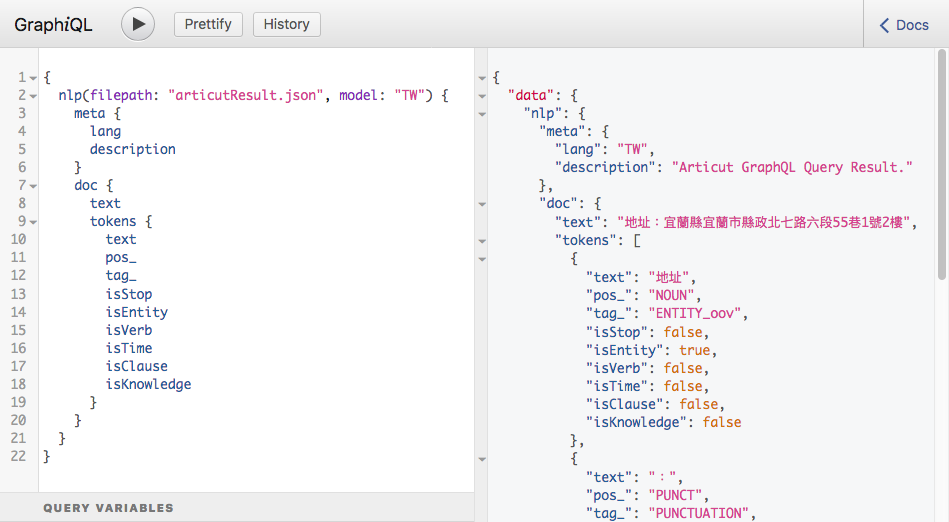
Execute ArticleGraphQL.py to bring the Archive path to the Articut word breaking result, and open the browser to enter the URL http://0.0.0.0:8000/
$ python ArticutGraphQL.py articutResult.json
Install graphene module
$ pip install graphene
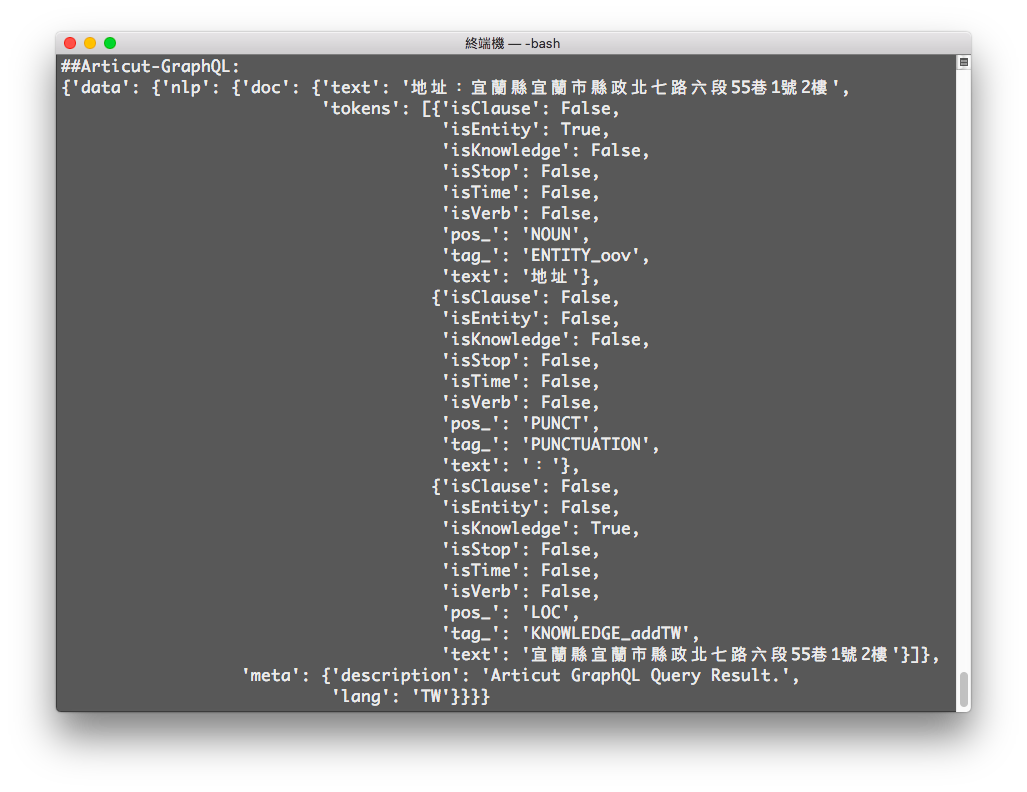
 inputSTR = "地址:宜蘭縣宜蘭市縣政北七路六段55巷1號2樓"
result = articut.parse(inputSTR)
with open("articutResult.json", "w", encoding="utf-8") as resultFile:
    json.dump(result, resultFile, ensure_ascii=False)

graphQLResult = articut.graphQL.query(
    filePath="articutResult.json",
    query="""
	{
	  meta {
	    lang
	    description
	  }
	  doc {
	    text
	    tokens {
	      text
	      pos_
	      tag_
	      isStop
	      isEntity
	      isVerb
	      isTime
	      isClause
	      isKnowledge
	    }
	  }
	}""")
pprint(graphQLResult)
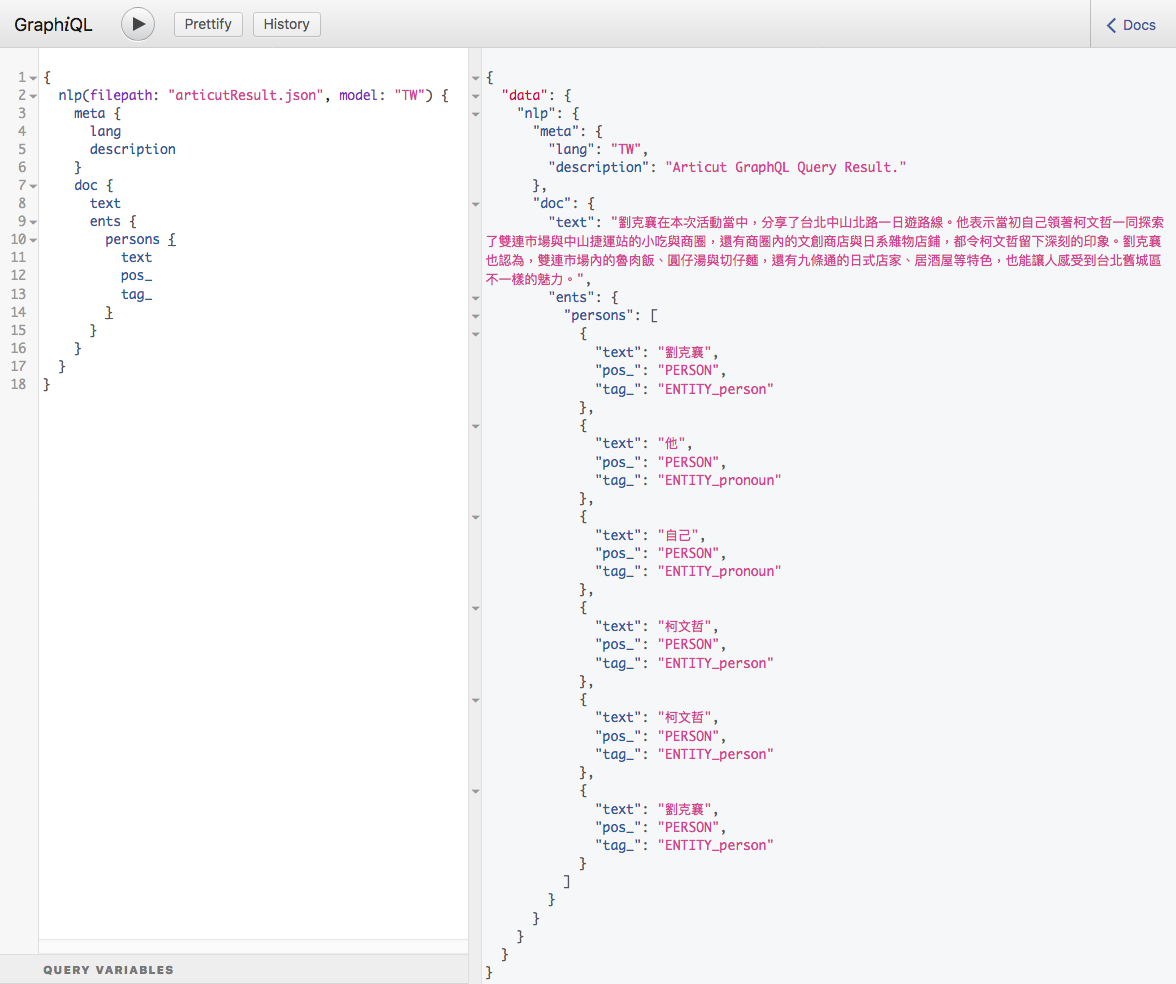
 inputSTR = "劉克襄在本次活動當中,分享了台北中山北路一日遊路線。他表示當初自己領著柯文哲一同探索了雙連市場與中山捷運站的小吃與商圈,還有商圈內的文創商店與日系雜物店鋪,都令柯文哲留下深刻的印象。劉克襄也認為,雙連市場內的魯肉飯、圓仔湯與切仔麵,還有九條通的日式店家、居酒屋等特色,也能讓人感受到台北舊城區不一樣的魅力。"
result = articut.parse(inputSTR)
with open("articutResult.json", "w", encoding="utf-8") as resultFile:
    json.dump(result, resultFile, ensure_ascii=False)

graphQLResult = articut.graphQL.query(
    filePath="articutResult.json",
    query="""
	{
	  meta {
	    lang
	    description
	  }
	  doc {
	    text
	    ents {
	      persons {
	        text
	        pos_
	        tag_
	      }
	    }
	  }
	}""")
pprint(graphQLResult)