wechsel
1.0.0

Code für WeChsel: Effektive Initialisierung von Subword-Einbettungen für die intersprachige Übertragung einsprachiger Sprachmodelle, die bei NAACL2022 veröffentlicht wurden.
Papier: https://aclanthology.org/2022.naacl-main.293/
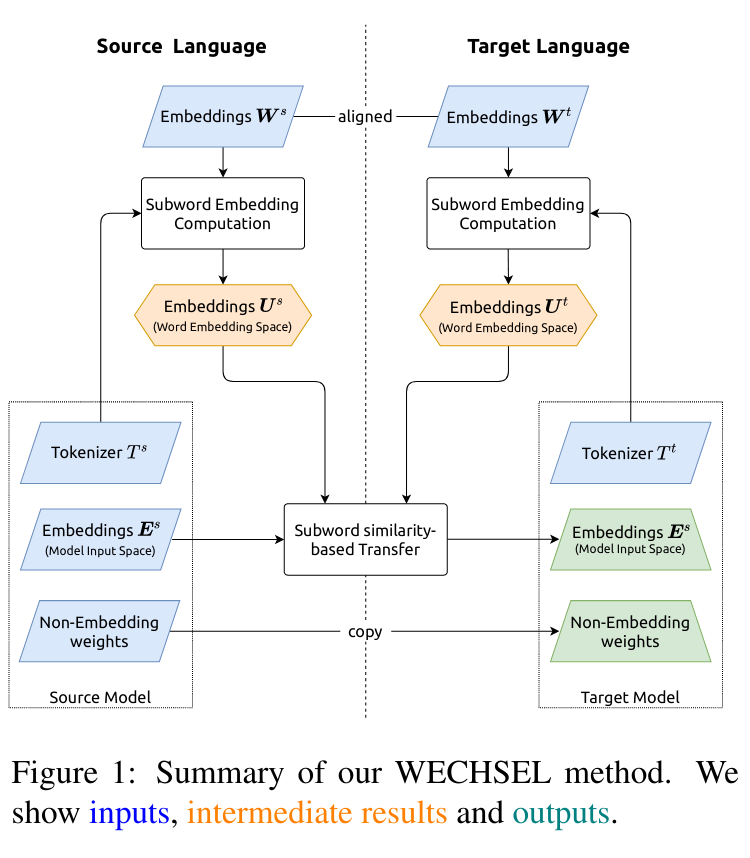
Modelle aus dem Papier sind auf dem Hubface -Hub erhältlich:
roberta-base-wechsel-frenchroberta-base-wechsel-germanroberta-base-wechsel-chineseroberta-base-wechsel-swahiligpt2-wechsel-frenchgpt2-wechsel-germangpt2-wechsel-chinesegpt2-wechsel-swahili Wir verteilen ein Python -Paket über PYPI:
pip install wechsel
Alternativ klonen Sie das Repository, installieren Sie requirements.txt und führen Sie den Code in wechsel/ aus.
Übertragung der englischen roberta-base nach Swahili:
 import torch
from transformers import AutoModel , AutoTokenizer
from datasets import load_dataset
from wechsel import WECHSEL , load_embeddings

source_tokenizer = AutoTokenizer . from_pretrained ( "roberta-base" )
model = AutoModel . from_pretrained ( "roberta-base" )

target_tokenizer = source_tokenizer . train_new_from_iterator (
    load_dataset ( "oscar" , "unshuffled_deduplicated_sw" , split = "train" )[ "text" ],
    vocab_size = len ( source_tokenizer )
)

wechsel = WECHSEL (
    load_embeddings ( "en" ),
    load_embeddings ( "sw" ),
    bilingual_dictionary = "swahili"
)

target_embeddings , info = wechsel . apply (
    source_tokenizer ,
    target_tokenizer ,
    model . get_input_embeddings (). weight . detach (). numpy (),
)

model . get_input_embeddings (). weight . data = torch . from_numpy ( target_embeddings )
model . config . vocab_size = len ( target_embeddings )

# if the model has separate output embeddings, also copy those
if not model . config . tie_word_embeddings :
    target_out_embeddings , info = wechsel . apply (
        source_tokenizer ,
        target_tokenizer ,
        model . get_output_embeddings (). weight . detach (). numpy (),
    )
    model . get_output_embeddings (). weight . data = torch . from_numpy ( target_out_embeddings )

# use `model` and `target_tokenizer` to continue training in Swahili! Wir verteilen 3276 zweisprachige Wörterbücher von Englisch in andere Sprachen, um mit Wechsel in dicts/ zu verwenden.
Bitte zitieren Sie Wechsel als
 @inproceedings{minixhofer-etal-2022-wechsel,
    title = "{WECHSEL}: Effective initialization of subword embeddings for cross-lingual transfer of monolingual language models",
    author = "Minixhofer, Benjamin  and
      Paischer, Fabian  and
      Rekabsaz, Navid",
    booktitle = "Proceedings of the 2022 Conference of the North American Chapter of the Association for Computational Linguistics: Human Language Technologies",
    month = jul,
    year = "2022",
    address = "Seattle, United States",
    publisher = "Association for Computational Linguistics",
    url = "https://aclanthology.org/2022.naacl-main.293",
    pages = "3992--4006",
    abstract = "Large pretrained language models (LMs) have become the central building block of many NLP applications. Training these models requires ever more computational resources and most of the existing models are trained on English text only. It is exceedingly expensive to train these models in other languages. To alleviate this problem, we introduce a novel method {--} called WECHSEL {--} to efficiently and effectively transfer pretrained LMs to new languages. WECHSEL can be applied to any model which uses subword-based tokenization and learns an embedding for each subword. The tokenizer of the source model (in English) is replaced with a tokenizer in the target language and token embeddings are initialized such that they are semantically similar to the English tokens by utilizing multilingual static word embeddings covering English and the target language. We use WECHSEL to transfer the English RoBERTa and GPT-2 models to four languages (French, German, Chinese and Swahili). We also study the benefits of our method on very low-resource languages. WECHSEL improves over proposed methods for cross-lingual parameter transfer and outperforms models of comparable size trained from scratch with up to 64x less training effort. Our method makes training large language models for new languages more accessible and less damaging to the environment. We make our code and models publicly available.",
}
Forschungen, die mit Cloud -TPUs von Googles TPU Research Cloud (TRC) unterstützt wurden. Wir danken Andy Koh und Artus Krohn-Grimberghe für die Bereitstellung zusätzlicher Rechenressourcen. Die Ellis -Einheit Linz, das LIT AI Lab, das Institut für maschinelles Lernen, werden vom Bundesstaat Oberösterreich unterstützt. Wir danken dem Projekt Incontrol-RL (FFG-881064).







