
Google recently officially released AI co-scientist, an AI research assistant system based on Gemini2.0 technology. This innovative tool aims to provide scientists with virtual collaborative support to help them generate novel research hypotheses and suggestions. The launch of this system marks an important step in the application of artificial intelligence in the field of scientific research and brings new possibilities to scientific research.
AI co-scientist not only has conventional literature review and summary functions, but also breaks through the limitations of traditional tools and adds the ability to discover original knowledge. It can simulate the reasoning process of scientific methods and provide scientific researchers with innovative research assumptions and solutions based on existing research evidence and specific research goals. This capability makes AI co-scientist not just an auxiliary tool, but more like a virtual research partner, able to provide scientists with in-depth intellectual support.
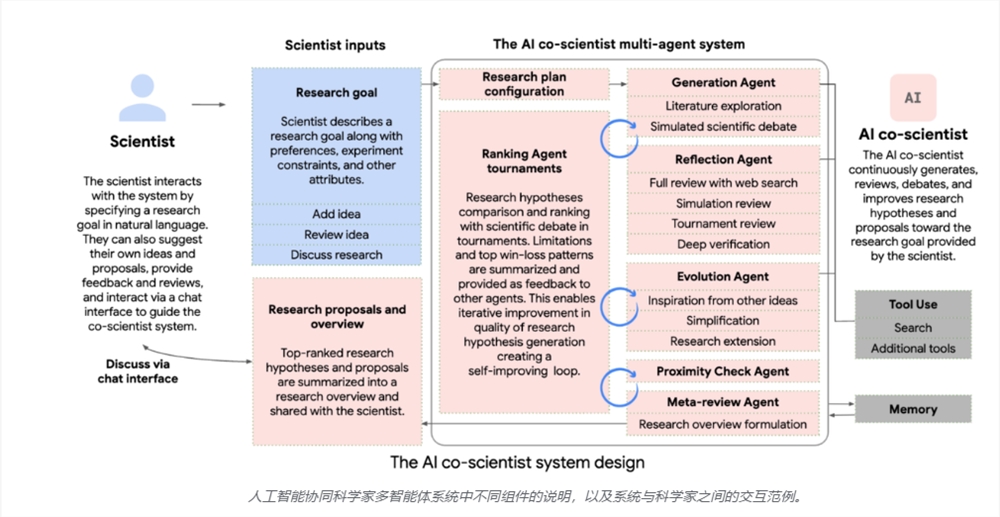
In practical applications, AI co-scientist has achieved remarkable results in many biomedical fields. For example, in the drug reuse study of acute myeloid leukemia, the AI system successfully proposed a new drug candidate and verified its effectiveness through experiments. In addition, in terms of liver fibrosis target discovery, AI co-scientist successfully identified fiber resistance targets based on preclinical system evidence, providing a new direction for future therapeutic strategies. The system also helped explain the mechanism of action of antibiotics, proposed new hypotheses related to bacterial gene growth through computer simulations, and was experimentally verified.
Google said AI co-scientist will open access to research institutions through the Trusted Tester Program. This move means that AI-assisted scientific research tools will officially enter the practical application stage, which is expected to bring higher efficiency and more innovative breakthroughs to scientific research. With the continuous development of AI technology, future scientific research will rely more on this intelligent collaboration tool to promote the further acceleration of scientific research.
For more details, please visit: https://research.google/blog/accelerating-scientific-breakthroughs-with-an-ai-co-scientist/