
NVIDIA has released a new AI video search and summary blueprint. This technology has achieved deep understanding and natural interaction of video content by integrating generative AI, visual language model (VLM) and large language model (LLM), breaking through the tradition. Limitations of video analysis. This solution is based on the NVIDIA NIM microservice architecture. It uses technologies such as video segmentation processing, intensive description generation and knowledge graph construction to accurately understand and analyze ultra-long video content, and supports users to generate and interact with video summary through a simple REST API interface. Q&A and live video streaming monitoring. Its core components include stream processors, NeMo Guardrails, VLM pipelines based on NVIDIA DeepStream SDK, vector databases, Context-Aware RAG modules and Graph-RAG modules, jointly implementing an efficient video analysis process.
NVIDIA recently released a new AI video search and summary blueprint (AI Blueprint for Video Search and Summarization), a technical solution that will completely change the limitations of traditional video analysis. Unlike the fixed model that only recognized preset objects in the past, the new solution achieves a deep understanding and natural interaction of video content by combining generative AI, visual language model (VLM) and large language model (LLM).
This system is built on the NVIDIA NIM microservice architecture, and its core advantage lies in its powerful video understanding capabilities. By organically combining technologies such as video segmentation processing, intensive description generation and knowledge graph construction, the system can accurately understand and analyze ultra-long video content. Users can use a simple REST API interface to realize video summary generation, interactive Q&A, and custom event monitoring of real-time video streams.
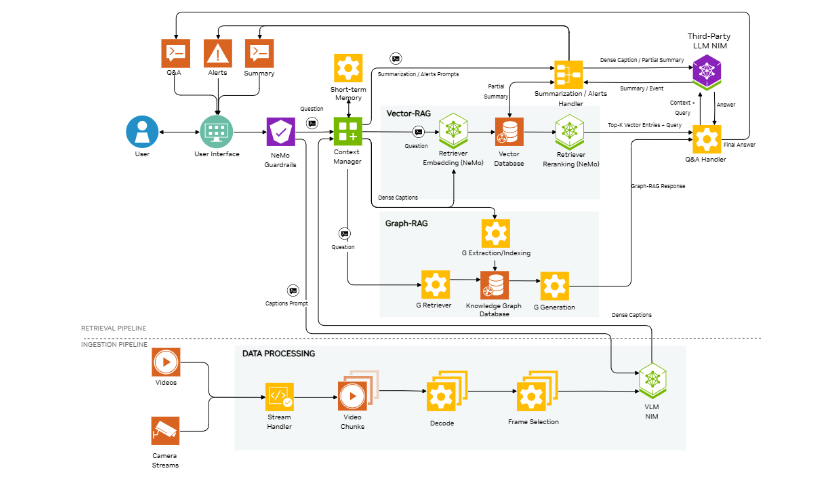
From the technical architecture, this solution includes multiple key components: the stream processor is responsible for the interaction and synchronization between components; NeMo Guardrails ensures compliance with user input; the VLM pipeline based on NVIDIA DeepStream SDK is responsible for video decoding and feature extraction; vectors The database stores intermediate results; the Context-Aware RAG module integrates to generate a unified summary; the Graph-RAG module captures complex relationships in videos through the graph database.
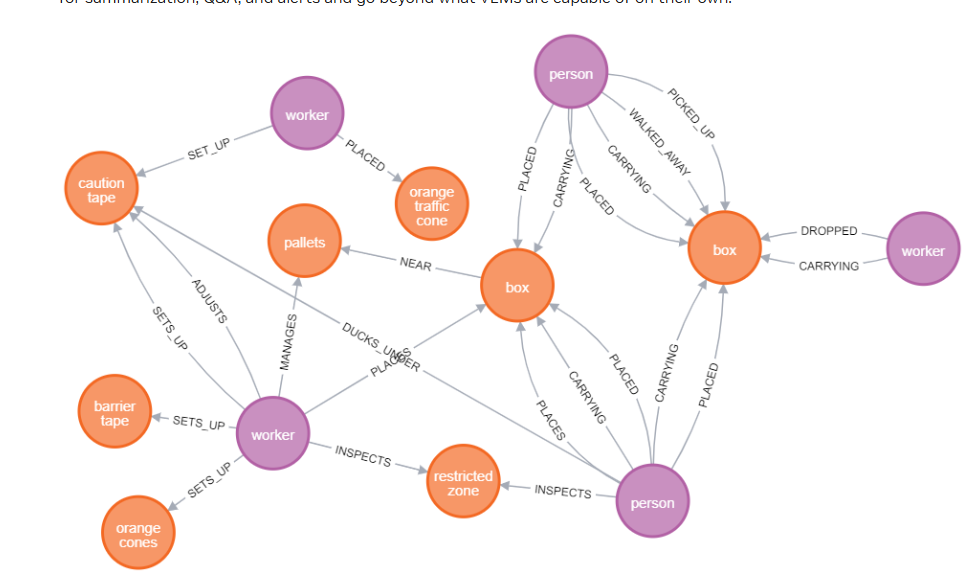
In practical applications, the system first divides the video into smaller segments, generates intensive descriptions through VLM, and then uses LLM to summarize and analyze the results. For live streams, the system can continuously process video clips and generate a summary in real time. At the same time, by building a knowledge graph, the system can accurately capture complex information in the video and support deeper question-and-answer interactions.
This technological breakthrough will bring revolutionary changes to factories, warehouses, retail stores, airports and transportation hubs. Operations teams can gain richer video analytics insights through natural language interactions to make smarter decisions.
At present, NVIDIA has opened early access applications for this technical program. Developers can select appropriate models through the API directory provided by NVIDIA, either using NVIDIA-hosted services or choosing local deployment solutions. This flexible deployment option will help enterprises create customized video analytics solutions based on actual needs.
With the continuous advancement of AI technology, we are witnessing earth-shaking changes in the field of video analysis. The launch of NVIDIA, the latest technical solution, will undoubtedly accelerate the implementation of intelligent video analysis in various industries.
Details: https://developer.nvidia.com/blog/build-a-video-search-and-summarization-agent-with-nvidia-ai-blueprint
In short, NVIDIA's AI video search and summary blueprint provides a powerful and flexible video analysis solution, bringing smarter and more effective video data processing capabilities to all industries, and accelerating the implementation of AI technology in practical applications. . The open access of this solution also provides developers with more possibilities and looks forward to seeing more innovative applications based on this technology in the future.