
In the field of game development, large models are playing an increasingly important role. However, existing models still have shortcomings in game scene understanding, image recognition, and content description. In order to solve these problems, the editor of Downcodes brings good news! A research team in Alberta, Canada, has open sourced a large model specially built for games-VideoGameBunny (VGB). It has powerful text generation capabilities, high customizability, multi-language support, and is compatible with multiple development environments, which greatly facilitates the use of game developers.
In the world of game development, large models are gradually becoming an irreplaceable "think tank", covering almost everything from generating AI characters to scene construction.
However, despite their impressive capabilities, their understanding of game scenes, image recognition, and content description still need to be improved. In order to solve these problems, a research team in Alberta, Canada, not to be outdone, launched a large open source model specially built for games-VideoGameBunny ("VGB" for short).
Feature Highlights
-Support multiple languages: Able to process and generate multiple languages, suitable for international applications.
- Highly customizable: model parameters and configuration files can be adjusted according to specific needs.
- Powerful text generation capabilities: Ability to generate coherent and natural conversations, making it excellent in games and chatbots.
- Open source and easily accessible: Available on the Hugging Face platform, making it easy for anyone to use and contribute.
- Compatible with multiple development environments: Python and other popular programming languages, making it easy to integrate into different projects.
- Rich model files: Provides model files in multiple formats to support users in different training and applications.
- Active community support: Users seek help and communication in the community, promoting technology sharing and cooperation.
Project address: https://huggingface.co/VideoGameBunny/VideoGameBunny-V1/tree/main
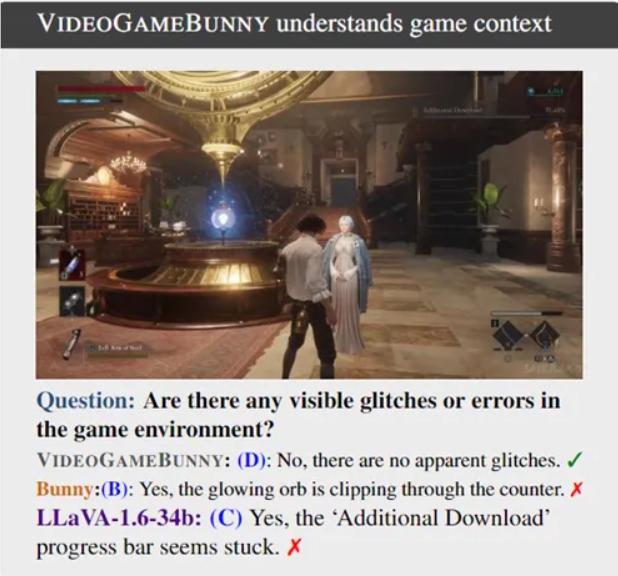
VGB has great potential. It is like a smart visual AI assistant that can understand the game environment and provide instant feedback. In those open-world 3A games, it can help players quickly identify key items or answer various questions, allowing you to master game skills faster, greatly enhancing the interactivity and immersion of the game.
What's even more powerful is that VGB can also analyze a large number of game images and detect graphics rendering errors and physics engine inconsistencies, becoming a powerful assistant for developers to troubleshoot bugs and anomalies.
Applicable scenarios
- Game dialogue system: can be used to develop more natural and intelligent NPC dialogues, improving player immersion.
- Educational applications: Generate interactive content or exercises for educational software to improve learning efficiency.
- Customer service chatbot: used in online customer service systems to provide real-time customer support and answers.
The basis of VGB is the Bunny model, which is a "good partner" with high efficiency and low consumption. Its design inspiration is similar to LLaVA, which converts visual information from strong pre-trained visual models into image tags through a multi-layer perceptron network to ensure that the language model can process data efficiently. The Bunny model supports image resolutions up to 1152×1152 pixels, which is particularly important when processing game images, because the game screen contains various visual elements from small UI icons to huge game objects. Multi-scale feature extraction capabilities allow VGB to better understand game content.
In order to allow VGB to better understand the visual content of the game, the research team adopted Meta's open source LLama-3-8B as a language model and combined it with the SigLIP visual encoder and S2 wrapper. This combination enables the model to capture visual elements at different scales in the game, from tiny interface icons to large game objects, providing rich contextual information.
In addition, in order to generate command data that matches the game images, the researchers used a variety of advanced models, including Gemini-1.0-Pro-Vision, GPT-4V, and GPT-4o. These models generate multiple types of instructions, such as short and detailed titles, image-to-JSON descriptions, and image-based Q&A, helping VGB better understand player queries and instructions.
All in all, the emergence of VideoGameBunny has brought new possibilities to game development. It can not only improve the game experience, but also help developers develop games and fix bugs more efficiently. We look forward to VGB being more widely used and developed in the future!