
AlphaChip, the latest AI system released by Google DeepMind, aims to revolutionize the development process of computer chips by accelerating and optimizing it. Unlike previous AI applications, AlphaChip focuses on the field of hardware design and uses reinforcement learning technology to automatically generate optimized chip layouts, significantly improving the efficiency and performance of chip design. The editor of Downcodes will give you an in-depth understanding of AlphaChip's operating mechanism, application cases and open source resources, revealing how it will change the future of chip design.
Recently, Google DeepMind announced its latest AI system-AlphaChip. This system is dedicated to accelerating and optimizing the development of computer chips. The chip layout designed by AlphaChip has been used in Google's AI accelerator.
The working principle of AlphaChip is similar to the AlphaGo and AlphaZero we have heard before, using reinforcement learning technology to quickly generate optimized chip layouts.
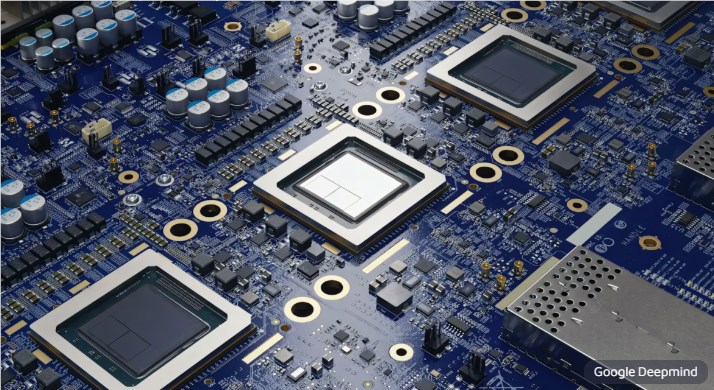
According to Google DeepMind, AlphaChip has been used in the past three generations of tensor processing unit (TPU) AI accelerators. Among them, in the latest sixth-generation TPU - Trillium, AlphaChip implemented a layout design of 25 modules, reducing the wire length by 6.2% compared to human experts. This shows that AlphaChip has achieved significant improvements in performance.
AlphaChip's design process can be imagined as a game, with the system like placing circuit components one after another on a grid. To help the system learn the relationships between connected components and generalize across different chips, DeepMind developed a graph neural network. It is worth mentioning that not only Google, but other companies such as chip manufacturer MediaTek are also using AlphaChip, especially in developing their most advanced chips, such as the Dimensity flagship 5G chip for Samsung smartphones.
In addition to improving the speed and efficiency of chip design, Google DeepMind also sees the potential to further optimize the entire chip design cycle. Future versions of AlphaChip are expected to cover every aspect from computer architecture to manufacturing, with the goal of making chips faster, cheaper and more energy-efficient.
To this end, DeepMind has also open sourced some AlphaChip resources . They released a software library that fully reproduces the method described in the original study. External researchers can use this library to pre-train different chip modules and then apply it to new modules.
In addition, DeepMind also provides a pre-trained model checkpoint trained on 20 TPU modules, and it is recommended that external researchers pre-train on specific application modules to achieve the best results. Regarding how to use these open source resources for pre-training, DeepMind also provides corresponding tutorials and uploads them to GitHub.
Highlight:
AlphaChip is an AI system launched by Google DeepMind, designed to accelerate and optimize chip design.
This system has been implemented in Google's latest TPU series and has achieved significant layout optimization.
DeepMind has made some AlphaChip resources open source, and external researchers can use these resources for pre-training and application.
The open source of AlphaChip marks a further breakthrough of AI technology in the field of chip design, and also indicates that future chip design will be more efficient and intelligent. The editor of Downcodes hopes that AlphaChip can promote the progress of the entire industry and bring us more powerful and energy-saving chip products.