iOS APM Secrets
1.0.0


Although APM is becoming more and more popular, professional APM manufacturers of all sizes have emerged like mushrooms after a rain, and there are also many technical articles on APM on the market, most of them are just a simple taste and have not dig deep into the implementation details. This article aims to expose the internal working principle of the iOS SDK of well-known APM manufacturers by analyzing the specific implementation details of the SDK. I believe that before reading this article, readers were also curious about the implementation details of the APM SDK just like the author. Fortunately, the article you are reading will take you to uncover the true context of APM step by step. The APM SDKs analyzed in this article include Tingyun , OneAPM and Firebase Performance Monitoring , etc. The author is a little talented and knowledgeable. If there are any mistakes, he will not correct them in order to reprint them and make them more perfect.
The version of Tingyun SDK analyzed in this article is 2.3.5, which is slightly different from the latest version. However, I roughly read the code of the new version, but the difference is not big and does not affect the analysis.
The monitoring of page rendering seems very simple, but there will still be many problems in the actual development process. What is easier to think of is several key life cycle methods of hook pages, such as viewDidLoad , viewDidAppear: etc., to calculate the page rendering time and finally find the slow-loaded page. However, if you really start to achieve it through the above ideas, you will encounter difficulties. How can I hook the life cycle of all pages be applied in the APM SDK? What if I try to hook UIViewController ? The hook UIViewController method is obviously not feasible because it only works on UIViewController method, and most view controllers in the application inherit from UIViewController , so this method is not feasible. But Tingyun SDK can be implemented. The logic of the page Hook is mainly implemented in the _priv_NBSUIAgent class. The following is the definition of the _priv_NBSUIAgent class, among which hook_viewDidLoad and other methods are clues.
 @class _priv_NBSUIAgent : NSObject {
                       +hookUIImage
                       +hookNSManagedObjectContext
                       +hookNSJSONSerialization
                       +hookNSData
                       +hookNSArray
                       +hookNSDictionary
                       +hook_viewDidLoad:
                       +hook_viewWillAppear:
                       +hook_viewDidAppear:
                       +hook_viewWillLayoutSubviews:
                       +hook_viewDidLayoutSubviews:
                       +nbs_jump_initialize:
                       +hookSubOfController
                       +hookFMDB
                       +start
                   }
Let's first turn our attention to another more suspicious method: hookSubOfController , the specific implementation is as follows:
 void +[_priv_NBSUIAgent hookSubOfController](void * self, void * _cmd) {
    r14 = self;
    r12 = [_subMetaClassNamesInMainBundle_c("UIViewController") retain];
    var_C0 = r12;
    if ((r12 != 0x0) && ([r12 count] != 0x0)) {
            var_C8 = object_getClass(r14);
            if ([r12 count] != 0x0) {
                    r15 = @selector(nbs_jump_initialize:);
                    rdx = 0x0;
                    do {
                            var_98 = rdx;
                            r12 = [[r12 objectAtIndexedSubscript:rdx, rcx, r8] retain];
                            [r12 release];
                            if ([r12 respondsToSelector:r15, rcx, r8] == 0x0) {
                                    _hookClass_CopyAMetaMethod();
                            }
                            r13 = class_getName(r12);
                            rax = [NSString stringWithFormat:@"nbs_%s_initialize", r13];
                            rax = [rax retain];
                            var_A0 = rax;
                            rax = NSSelectorFromString(rax);
                            var_B0 = rax;
                            rax = objc_retainBlock(__NSConcreteStackBlock);
                            var_A8 = rax;
                            r15 = objc_retainBlock(rax);
                            var_B8 = imp_implementationWithBlock(r15);
                            [r15 release];
                            rax = class_getSuperclass(r12);
                            r15 = objc_retainBlock(__NSConcreteStackBlock);
                            rbx = objc_retainBlock(r15);
                            r13 = imp_implementationWithBlock(rbx);
                            [rbx release];
                            rcx = r13;
                            r8 = var_B8;
                            _nbs_Swizzle_orReplaceWithIMPs(r12, @selector(initialize), var_B0, rcx, r8);
                            rdi = r15;
                            r15 = @selector(nbs_jump_initialize:);
                            [rdi release];
                            [var_A8 release];
                            [var_A0 release];
                            rax = [var_C0 count];
                            r12 = var_C0;
                            rdx = var_98 + 0x1;
                    } while (var_98 + 0x1 < rax);
            }
    }
    [r12 release];
    return;
}
From the naming of _subMetaClassNamesInMainBundle_c and the incoming "UIViewController" parameter, it can be basically inferred that this C function is a subclass of all UIViewController in MainBundle. In fact, if you breakpoint the assembly line after the function Call is completed through LLDB, you will find that the returned array is indeed a subclass of UIViewController . The following if statement determines that the r12 register is not nil and count of the r12 register is not equal to 0 before the logic in if is executed. The r12 register stores the return value of the _subMetaClassNamesInMainBundle_c function, which is the array of UIViewController subclass.
_subMetaClassNamesInMainBundle_c function code is as follows:
 void _subMetaClassNamesInMainBundle_c(int arg0) {
    rbx = objc_getClass(arg0);
    rdi = 0x0;
    if (rbx == 0x0) goto loc_10001dbde;

loc_10001db4d:
    r15 = _classNamesInMainBundle_c(var_2C);
    var_38 = [NSMutableArray new];
    if (var_2C == 0x0) goto loc_10001dbd2;

loc_10001db77:
    r14 = 0x0;
    goto loc_10001db7a;

loc_10001db7a:
    r13 = objc_getClass(*(r15 + r14 * 0x8));
    r12 = r13;
    if (r13 == 0x0) goto loc_10001dbc9;

loc_10001db8e:
    rax = class_getSuperclass(r12);
    if (rax == rbx) goto loc_10001dba5;

loc_10001db9b:
    COND = rax != r12;
    r12 = rax;
    if (COND) goto loc_10001db8e;

loc_10001dbc9:
    r14 = r14 + 0x1;
    if (r14 < var_2C) goto loc_10001db7a;

loc_10001dbd2:
    free(r15);
    rdi = var_38;
    goto loc_10001dbde;

loc_10001dbde:
    [rdi autorelease];
    return;

loc_10001dba5:
    rax = class_getName(r13);
    rax = objc_getMetaClass(rax);
    [var_38 addObject:rax];
    goto loc_10001dbc9;
}
The loc_10001db4d subroutine in _subMetaClassNamesInMainBundle_c function calls the _classNamesInMainBundle_c function, and the function code is as follows:
 int _classNamesInMainBundle_c(int arg0) {
    rbx = [[NSBundle mainBundle] retain];
    r15 = [[rbx executablePath] retain];
    [rbx release];
    rbx = objc_retainAutorelease(r15);
    r14 = objc_copyClassNamesForImage([rbx UTF8String], arg0);
    [rbx release];
    rax = r14;
    return rax;
}
The implementation of the _classNamesInMainBundle_c function is obvious, it is nothing more than calling objc_copyClassNamesForImage to get the names of all classes of mainBundle executable path. The number of sets is assigned to the outCount variable, and the caller can use outCount to traverse it.
 static inline char ** WDTClassNamesInMainBundle ( unsigned int *outCount) {
    NSString *executablePath = [[ NSBundle mainBundle ] executablePath ];
    char **classNames = objc_copyClassNamesForImage ([executablePath UTF8String ], outCount);
    return classNames;
}
If you don't care about the details, then the implementation of the _subMetaClassNamesInMainBundle_c function is also very clear, which is to traverse the return value of the objc_copyClassNamesForImage function. If the item is a subclass of UIViewController , then metaClass of the class is obtained and added to the variable array var_38 .
Next, let’s focus on the do-while loop statement inside. The statement for loop judgment is var_98 + 0x1 < rax . var_98 assigns the rdx register at the beginning of the loop, and the rdx register is initialized to 0 outside the loop, so var_98 is the counter, and the rax register is count method assigned to the r12 register. Based on this do-while loop is actually traversing the array of UIViewController subclass. The traversal behavior is to exchange initialize and nbs_jump_initialize: methods through _nbs_Swizzle_orReplaceWithIMPs .
The code for nbs_jump_initialize is as follows:
 void +[_priv_NBSUIAgent nbs_jump_initialize:](void * self, void * _cmd, void * arg2) {
    rbx = arg2;
    r15 = self;
    r14 = [NSStringFromSelector(rbx) retain];
    if ((r14 != 0x0) && ([r14 isEqualToString:@""] == 0x0)) {
            [r15 class];
            rax = _nbs_getClassImpOf();
            (rax)(r15, @selector(initialize));
    }
    rax = class_getName(r15);
    r13 = [[NSString stringWithUTF8String:rax] retain];
    rdx = @"_Aspects_";
    if ([r13 hasSuffix:rdx] == 0x0) goto loc_100050137;

loc_10005011e:
    if (*(int8_t *)_is_tiaoshi_kai == 0x0) goto loc_100050218;

loc_10005012e:
    rsi = cfstring__V__A;
    goto loc_100050195;

loc_100050195:
    __NBSDebugLog(0x3, rsi, rdx, rcx, r8, r9, stack[2048]);
    goto loc_100050218;

loc_100050218:
    [r13 release];
    rdi = r14;
    [rdi release];
    return;

loc_100050137:
    rdx = @"RACSelectorSignal";
    if ([r13 hasSuffix:rdx] == 0x0) goto loc_10005016b;

loc_100050152:
    if (*(int8_t *)_is_tiaoshi_kai == 0x0) goto loc_100050218;

loc_100050162:
    rsi = cfstring__V__R;
    goto loc_100050195;

loc_10005016b:
    if (_classSelf_isImpOf(r15, "nbs_vc_flag") == 0x0) goto loc_1000501a3;

loc_10005017e:
    if (*(int8_t *)_is_tiaoshi_kai == 0x0) goto loc_100050218;

loc_10005018e:
    rsi = cfstring____Yh;
    goto loc_100050195;

loc_1000501a3:
    rbx = objc_retainBlock(void ^(void * _block, void * arg1) {
        return;
    });
    rax = imp_implementationWithBlock(rbx);
    class_addMethod(r15, @selector(nbs_vc_flag), rax, "v@:");
    [rbx release];
    [_priv_NBSUIAgent hook_viewDidLoad:r15];
    [_priv_NBSUIAgent hook_viewWillAppear:r15];
    [_priv_NBSUIAgent hook_viewDidAppear:r15];
    goto loc_100050218;
}
The code of nbs_jump_initialize is a bit long, but from the routine of loc_1000501a3 , it can be observed that the main logic will execute three methods, hook_viewDidLoad , hook_viewWillAppear and hook_viewDidAppear , thereby hooking these three methods of UIViewController subclass.
First, use hook_viewDidLoad: method as an example to explain. The following code may be a bit obscure and requires careful analysis.
 void +[_priv_NBSUIAgent hook_viewDidLoad:](void * self, void * _cmd, void * arg2) {
    rax = [_priv_NBSUIHookMatrix class];
    var_D8 = _nbs_getInstanceImpOf();
    var_D0 = _nbs_getInstanceImpOf();
    rbx = class_getName(arg2);
    r14 = class_getSuperclass(arg2);
    rax = [NSString stringWithFormat:@"nbs_%s_viewDidLoad", rbx];
    rax = [rax retain];
    var_B8 = rax;
    var_C0 = NSSelectorFromString(rax);
    r12 = objc_retainBlock(__NSConcreteStackBlock);
    var_D0 = imp_implementationWithBlock(r12);
    [r12 release];
    rbx = objc_retainBlock(__NSConcreteStackBlock);
    r14 = imp_implementationWithBlock(rbx);
    [rbx release];
    _nbs_Swizzle_orReplaceWithIMPs(arg2, @selector(viewDidLoad), var_C0, r14, var_D0);
    [var_B8 release];
    return;
}
hook_viewDidLoad: The parameter arg2 in the method is the class of ViewController to hook, obtain the class name of arg2 and assign it to the rbx register, and then use rbx to construct the string nbs_%s_viewDidLoad , such as nbs_XXViewController_viewDidLoad , obtain the selector of the string and assign it to var_C0 . __NSConcreteStackBlock in the following sentences is the block object of the storage stack created. This block will then obtain the IMP function pointer through the imp_implementationWithBlock method. _nbs_Swizzle_orReplaceWithIMPs is a function that implements method exchange, and the parameters are: arg2 is the class of ViewController ; @selector(viewDidLoad) is the selector of viewDidLoad ; var_C0 is the selector of nbs_%s_viewDidLoad , r14 is the IMP of the second __NSConcreteStackBlock ; var_D0 is the IMP of the first __NSConcreteStackBlock .
The entire logic of hook_viewDidLoad: is roughly clear, but there is a question here why not directly exchange two IMPs, but instead construct two blocks first and then exchange the IMPs of two blocks? The reason is that the result of the parent class of ViewController , that is, class_getSuperclass , needs to be passed as parameters to the exchanged method. In this way, the number of parameters signed by the two exchanged selectors is inconsistent, and this problem needs to be solved cleverly by constructing a block. In fact, the first __NSConcreteStackBlock executes nbs_jump_viewDidLoad:superClass: method of _priv_NBSUIHookMatrix . As mentioned before, there is superClass in the parameters of this method. As for why this parameter is needed, I will introduce it later.
Why does the second __NSConcreteStackBlock execute nbs_jump_viewDidLoad:superClass: method? Uncheck the Remove potentially dead code option of Hopper, the code is as follows:
 void +[_priv_NBSUIAgent hook_viewDidLoad:](void * self, void * _cmd, void * arg2) {
    rsi = _cmd;
    rdi = self;
    r12 = _objc_msgSend;
    rax = [_priv_NBSUIHookMatrix class];
    rsi = @selector(nbs_jump_viewDidLoad:superClass:);
    rdi = rax;
    var_D8 = _nbs_getInstanceImpOf();
    rdi = arg2;
    rsi = @selector(viewDidLoad);
    var_D0 = _nbs_getInstanceImpOf();
    rbx = class_getName(arg2);
    r14 = class_getSuperclass(arg2);
    LODWORD(rax) = 0x0;
    rax = [NSString stringWithFormat:@"nbs_%s_viewDidLoad", rbx];
    rax = [rax retain];
    var_B8 = rax;
    var_C0 = NSSelectorFromString(rax);
    var_60 = 0xc0000000;
    var_5C = 0x0;
    var_58 = ___37+[_priv_NBSUIAgent hook_viewDidLoad:]_block_invoke;
    var_50 = ___block_descriptor_tmp;
    var_48 = var_D8;
    var_40 = @selector(viewDidLoad);
    var_38 = var_D0;
    var_30 = r14;
    r12 = objc_retainBlock(__NSConcreteStackBlock);
    var_D0 = imp_implementationWithBlock(r12);
    r13 = _objc_release;
    rax = [r12 release];
    var_A8 = 0xc0000000;
    var_A4 = 0x0;
    var_A0 = ___37+[_priv_NBSUIAgent hook_viewDidLoad:]_block_invoke_2;
    var_98 = ___block_descriptor_tmp47;
    var_90 = rbx;
    var_88 = var_D8;
    var_80 = @selector(viewDidLoad);
    var_78 = r14;
    var_70 = arg2;
    rbx = objc_retainBlock(__NSConcreteStackBlock);
    r14 = imp_implementationWithBlock(rbx);
    rax = [rbx release];
    rax = _nbs_Swizzle_orReplaceWithIMPs(arg2, @selector(viewDidLoad), var_C0, r14, var_D0);
    rax = [var_B8 release];
    rsp = rsp + 0xb8;
    rbx = stack[2047];
    r12 = stack[2046];
    r13 = stack[2045];
    r14 = stack[2044];
    r15 = stack[2043];
    rbp = stack[2042];
    return;
}
Let's look at the code of _nbs_getInstanceImpOf :
 void _nbs_getInstanceImpOf() {
    rax = class_getInstanceMethod(rdi, rsi);
    method_getImplementation(rax);
    return;
}
The function of the _nbs_getInstanceImpOf function is very obvious. To obtain the IMP of rsi selector in rdi class, readers will find that _nbs_getInstanceImpOf has been called twice in hook_viewDidLoad: method. The first rdi is the _priv_NBSUIHookMatrix class, rdx is @selector(nbs_jump_viewDidLoad:superClass:) , the second rdi is ViewController class, rdx is @selector(viewDidLoad) .
Next, let’s look at the first __NSConcreteStackBlock , which means the block that will call nbs_jump_viewDidLoad:superClass: The code is as follows:
 int ___37+[_priv_NBSUIAgent hook_viewDidLoad:]_block_invoke(int arg0, int arg1) {
    r8 = *(arg0 + 0x20);
    rax = *(arg0 + 0x28);
    rdx = *(arg0 + 0x30);
    rcx = *(arg0 + 0x38);
    rax = (r8)(arg1, rax, rdx, rcx, r8);
    return rax;
}
The r8 register is the IMP of nbs_jump_viewDidLoad:superClass: and this code just calls this IMP. The parameters of the IMP function are the same as nbs_jump_viewDidLoad:superClass: :.
 void -[_priv_NBSUIHookMatrix nbs_jump_viewDidLoad:superClass:](void * self, void * _cmd, void * * arg2, void * arg3) {
    rbx = arg3;
    var_70 = arg2;
    var_68 = _cmd;
    r14 = self;
    rax = [self class];
    rax = class_getSuperclass(rax);
    if ((rbx != 0x0) && (rax != rbx)) {
            rax = var_70;
            if (rax != 0x0) {
                    rdi = r14;
                    (rax)(rdi, @selector(viewDidLoad));
            }
            else {
                    NSLog(@"");
                    [[r14 super] viewDidLoad];
            }
    }
    else {
            var_B8 = rbx;
            objc_storeWeak(_currentViewController, 0x0);
            r14 = 0x0;
            [[NSString stringWithFormat:@"%d#loading", 0x0] retain];
            r12 = 0x0;
            if (0x0 != 0x0) {
                    rcx = class_getName([r12 class]);
                    r14 = [[NSString stringWithFormat:@"MobileView/Controller/%s#%@", rcx, @"loading"] retain];
            }
            var_A0 = r14;
            r14 = [[_priv_NBSUILogCenter_assistant alloc] initWithControllerName:r14];
            var_80 = r14;
            var_60 = _objc_release;
            [r14 setTheVC:_objc_release];
            [r14 setVC_Address:_objc_release];
            [r14 setIsOther:0x0];
            [*_controllerStack push:r14];
            rbx = [_glb_all_activing_VCS() retain];
            var_98 = _objc_msgSend;
            [rbx setObject:r14 forKey:_objc_msgSend];
            [rbx release];
            r12 = [[NSDate date] retain];
            [r12 timeIntervalSince1970];
            xmm0 = intrinsic_mulsd(xmm0, *0x100066938);
            rbx = intrinsic_cvttsd2si(rbx, xmm0);
            [r12 release];
            [r14 setStartTime:rbx];
            rcx = class_getName([var_60 class]);
            r13 = [[NSString stringWithFormat:@"%s", rcx] retain];
            r14 = [NSStringFromSelector(var_68) retain];
            var_88 = [_nbs_embedIn_start() retain];
            [r14 release];
            [r13 release];
            rbx = [[NBSLensInterfaceEventLogger shareObject] retain];
            var_78 = rbx;
            rax = [NBSLensUITraceSegment new];
            var_58 = rax;
            rbx = [[rbx theStack] retain];
            [rbx push:rax];
            [rbx release];
            rcx = class_getName([var_60 class]);
            r13 = [[NSString stringWithFormat:@"%s", rcx] retain];
            r12 = [NSStringFromSelector(var_68) retain];
            r14 = [[NSString stringWithFormat:@"%@#%@", r13, r12] retain];
            var_A8 = r14;
            [r12 release];
            rdi = r13;
            [rdi release];
            [var_58 setSegmentName:r14];
            rax = [NSDictionary dictionary];
            rax = [rax retain];
            var_B0 = rax;
            [var_58 setSegmentParam:rax];
            rbx = [[NSThread currentThread] retain];
            rdx = rbx;
            [var_58 setThreadInfomation:rdx];
            [rbx release];
            rbx = [[NSDate date] retain];
            [rbx timeIntervalSince1970];
            xmm0 = intrinsic_mulsd(xmm0, *0x100066938);
            var_68 = intrinsic_movsd(var_68, xmm0);
            [rbx release];
            xmm0 = intrinsic_movsd(xmm0, var_68);
            [var_58 setStartTime:rdx];
            [var_58 setEntryTime:0x0];
            r14 = [NBSLensUITraceSegment new];
            var_90 = r14;
            xmm0 = intrinsic_movsd(xmm0, var_68);
            [r14 setStartTime:0x0];
            rcx = class_getName([var_60 class]);
            r15 = [[NSString stringWithFormat:@"%s", rcx] retain];
            rbx = [[NSString stringWithFormat:@"%@#viewLoading", r15] retain];
            [r14 setSegmentName:rbx];
            [rbx release];
            [r15 release];
            rcx = var_30;
            rax = [NSDictionary dictionaryWithObjects:rbx forKeys:rcx count:0x0];
            [r14 setSegmentParam:rax];
            rbx = [[NSThread currentThread] retain];
            [r14 setThreadInfomation:rbx];
            [rbx release];
            [r14 setEntryTime:0x0];
            rax = var_70;
            if (rax != 0x0) {
                    (rax)(var_60, @selector(viewDidLoad), 0x0, rcx, 0x0);
            }
            else {
                    NSLog(@"");
                    [[var_60 super] viewDidLoad];
            }
            _nbs_embedIn_finish();
            rdx = [var_88 mach_tm2];
            [var_80 setFinishTime:rdx];
            rbx = [[NSDate date] retain];
            [rbx timeIntervalSince1970];
            xmm0 = intrinsic_mulsd(xmm0, *0x100066938);
            var_70 = intrinsic_movsd(var_70, xmm0);
            [rbx release];
            xmm0 = intrinsic_movsd(xmm0, var_70);
            xmm0 = intrinsic_subsd(xmm0, var_68);
            rdx = intrinsic_cvttsd2si(rdx, xmm0);
            [var_58 setExitTime:rdx];
            rbx = [[var_78 theStack] retain];
            rax = [rbx pop];
            rax = [rax retain];
            [rax release];
            [rbx release];
            rbx = [[var_78 theStack] retain];
            r15 = [rbx isEmpty];
            [rbx release];
            if (r15 == 0x0) {
                    rbx = [[var_78 theStack] retain];
                    r14 = [[rbx peer] retain];
                    [rbx release];
                    [r14 startTime];
                    xmm1 = intrinsic_movsd(xmm1, var_68);
                    xmm1 = intrinsic_subsd(xmm1, xmm0);
                    rdx = intrinsic_cvttsd2si(rdx, xmm1);
                    [var_58 setEntryTime:rdx];
                    [r14 startTime];
                    rdx = intrinsic_cvttsd2si(rdx, intrinsic_subsd(intrinsic_movsd(xmm1, var_70), xmm0));
                    [var_58 setExitTime:rdx];
                    rbx = [[r14 childSegments] retain];
                    rdx = var_58;
                    [rbx addObject:rdx];
                    [rbx release];
                    [r14 release];
            }
            rbx = [[var_90 childSegments] retain];
            [rbx addObject:var_58];
            [rbx release];
            objc_setAssociatedObject(var_60, @"viewLoading", var_90, 0x1);
            rax = [*_controllerStack pop];
            rax = [rax retain];
            [rax release];
            rbx = [[_priv_NBSLENS_VCSBuffer sharedObj] retain];
            [rbx addObj:var_80];
            [rbx release];
            rbx = [_glb_all_activing_VCS() retain];
            [rbx removeObjectForKey:var_98];
            [rbx release];
            [var_90 release];
            [var_B0 release];
            [var_A8 release];
            [var_58 release];
            [var_78 release];
            [var_88 release];
            [var_80 release];
            [var_A0 release];
            [var_98 release];
    }
    return;
}
The startup time is explained with the Firebase Performance Monitoring SDK as an example. The FPM SDK is used as abbreviation to describe it. The FPM SDK implements statistics on cold startup time, and the main logic is implemented in FPRAppActivityTracker class.
First look at the +load method of the class, and the decompilation code is as follows:
 void +[FPRAppActivityTracker load](void * self, void * _cmd) {
    rax = [NSDate date];
    rax = [rax retain];
    rdi = *_appStartTime;
    *_appStartTime = rax;
    [rdi release];
    rbx = [[NSNotificationCenter defaultCenter] retain];
    [rbx addObserver:self selector:@selector(windowDidBecomeVisible:) name:*_UIWindowDidBecomeVisibleNotification object:0x0];
    rdi = rbx;
    [rdi release];
    return;
}
Obviously, _appStartTime is a static NSDate instance used to save the start time of the entire application startup, so the FPM SDK marks the start time of the application startup in the +load of FPRAppActivityTracker . Readers who understand the +load method should know that the method is a hook method before main function is called. The exact time is when the image is loaded to runtime and the +load method is ready, and then +load method will be started to be called. In addition, different types of +load methods are also related to the file order of Build Phases->Compile Sources . We believe that these have no significant impact on the statistics of startup time.
Afterwards, the notification of UIWindowDidBecomeVisibleNotification is registered. This notification is triggered when UIWindow object is activated and displayed on the interface. Readers can register this notification and then print the notification object with LLDB. The example is as follows:
NSConcreteNotification 0x7fc94a716f50 {name = UIWindowDidBecomeVisibleNotification; object = <UIStatusBarWindow: 0x7fc94a5092a0; frame = (0 0; 320 568); opaque = NO; gestureRecognizers = <NSArray: 0x7fc94a619f30>; layer = <UIWindowLayer: 0x7fc94a513f50>>}
The first time I received the UIWindowDidBecomeVisibleNotification notification was earlier than - application:didFinishLaunchingWithOptions: callback, this notification was triggered when window of the status bar was created. This implementation feels a bit tricky and cannot ensure that Apple will adjust the timing of the call in the future.
Below is the official description of UIWindowDidBecomeVisibleNotification .
Posted when an UIWindow object becomes visible. The notification object is the window object that has become visible. This notification does not contain a userInfo dictionary. Switching between apps does not generate visibility-related notifications for windows. Window visibility changes reflect changes to the window's hidden property and reflect only the window's visibility within the app.
The following is the method of handling notifications. I restored the method to Objective-C pseudo-code, which can compare the decompiled pseudo-code.
 void +[FPRAppActivityTracker windowDidBecomeVisible:](void * self, void * _cmd, void * arg2) {
    var_30 = self;
    r13 = _objc_msgSend;
    r12 = [[self sharedInstance] retain];
    [r12 startAppActivityTracking];
    rbx = [[FIRTrace alloc] initInternalTraceWithName:@"_as"];
    [r12 setAppStartTrace:rbx];
    [rbx release];
    r15 = @selector(appStartTrace);
    rbx = [_objc_msgSend(r12, r15) retain];
    [rbx startWithStartTime:*_appStartTime];
    [rbx release];
    rbx = [_objc_msgSend(r12, r15) retain];
    rcx = *_appStartTime;
    rdx = @"_astui";
    [rbx startStageNamed:rdx startTime:rcx];
    [rbx release];
    rax = *(int8_t *)_windowDidBecomeVisible:.FDDStageStarted;
    rax = rax & 0x1;
    COND = rax != 0x0;
    if (!COND) {
            r13 = _objc_msgSend;
            rcx = *_appStartTime;
            rbx = [_objc_msgSend(r12, r15, rdx, rcx) retain];
            rdx = @"_astfd";
            [rbx startStageNamed:rdx, rcx];
            [rbx release];
            *(int8_t *)_windowDidBecomeVisible:.FDDStageStarted = 0x1;
    }
    rbx = [(r13)(@class(NSNotificationCenter), @selector(defaultCenter), rdx, *_UIWindowDidBecomeVisibleNotification) retain];
    (r13)(rbx, @selector(removeObserver:name:object:), var_30, *_UIWindowDidBecomeVisibleNotification, 0x0);
    [rbx release];
    rdi = r12;
    [rdi release];
    return;
}
 + (void)windowDidBecomeVisible:(NSNotification *)notification {
    FPRAppActivityTracker *tracker = [self sharedInstance];
    [tracker startAppActivityTracking];
    FIRTrace *trace = [[FIRTrace alloc] initInternalTraceWithName:@"_as"];
    [tracker setAppStartTrace: trace];
    [[tracker appStartTrace] startWithStartTime:_appStartTime];
    [[tracker appStartTrace] startStageNamed:@"_astui" startTime:_appStartTime];

    if (_windowDidBecomeVisible:.FDDStageStarted) {
        [[tracker appStartTrace] startStageNamed:@"_astfd" startTime:_appStartTime];
        _windowDidBecomeVisible:.FDDStageStarted = 1;
    }

    [[NSNotificationCenter defaultCenter] removeObserver:self name:UIWindowDidBecomeVisibleNotification object:nil];
}
The method will log out the UIWindowDidBecomeVisibleNotification notification at the end, because the notification will be called multiple times, and we only need it to execute it once. First, call the -startAppActivityTracking method to start tracking the activity of the APP. This method will be discussed in depth later.
First of all, we are clear that the network requests we are discussing here do not have any special instructions to refer to HTTP requests. Tingyun SDK mainly uses two methods to implement network monitoring: the first is to hook the API used by iOS network programming, which mainly targets native network requests; the second is to inherit NSURLProtocol to implement network requests, which mainly targets network requests in UIWebView.
The SDK hooks the API for constructing NSURLSessionDataTask , NSURLSessionUploadTask and NSURLSessionDownloadTask in all network requests. The logic of hook is in the C function _nbs_hook_NSURLSession , and the pseudo-code is as follows:
 int _nbs_hook_NSURLSession() {
    _nbs_hook_NSURLSessionTask();
    r13 = [[_priv_NSURLSession_NBS class] retain];
    r14 = [objc_getClass("NSURLSession") retain];
    r15 = [objc_getMetaClass(class_getName(r13)) retain];
    r12 = [objc_getMetaClass("NSURLSession") retain];
    if ((((((_nbs_hookClass_CopyAMethod() != 0x0) && (_nbs_hookClass_CopyAMethod() != 0x0)) && (_nbs_hookClass_CopyAMethod() != 0x0)) && (_nbs_hookClass_CopyAMethod() != 0x0)) && (_nbs_hookClass_CopyAMethod() != 0x0)) && (_nbs_hookClass_CopyAMethod() != 0x0)) {
            if (_nbs_hookClass_CopyAMethod() != 0x0) {
                    if (_nbs_hookClass_CopyAMethod() != 0x0) {
                            if (_nbs_hookClass_CopyAMethod() != 0x0) {
                                    if (_nbs_hookClass_CopyAMethod() != 0x0) {
                                            _nbs_Swizzle(r14, @selector(dataTaskWithRequest:completionHandler:), @selector(nbs_dataTaskWithRequest:completionHandler:));
                                            _nbs_Swizzle(r14, @selector(downloadTaskWithRequest:completionHandler:), @selector(nbs_downloadTaskWithRequest:completionHandler:));
                                            _nbs_Swizzle(r14, @selector(downloadTaskWithResumeData:completionHandler:), @selector(nbs_downloadTaskWithResumeData:completionHandler:));
                                            _nbs_Swizzle(r14, @selector(uploadTaskWithRequest:fromData:completionHandler:), @selector(nbs_uploadTaskWithRequest:fromData:completionHandler:));
                                            _nbs_Swizzle(r14, @selector(uploadTaskWithRequest:fromFile:completionHandler:), @selector(nbs_uploadTaskWithRequest:fromFile:completionHandler:));
                                            _nbs_Swizzle(r14, @selector(downloadTaskWithRequest:), @selector(nbs_downloadTaskWithRequest:));
                                            _nbs_Swizzle(r14, @selector(uploadTaskWithRequest:fromFile:), @selector(nbs_uploadTaskWithRequest:fromFile:));
                                            _nbs_Swizzle(r14, @selector(uploadTaskWithRequest:fromData:), @selector(nbs_uploadTaskWithRequest:fromData:));
                                            _nbs_Swizzle(r12, @selector(sessionWithConfiguration:delegate:delegateQueue:), @selector(nbs_sessionWithConfiguration:delegate:delegateQueue:));
                                            _nbs_Swizzle(r14, @selector(uploadTaskWithStreamedRequest:), @selector(nbs_uploadTaskWithStreamedRequest:));
                                    }
                            }
                    }
            }
    }
    [r12 release];
    [r15 release];
    [r14 release];
    rdi = r13;
    rax = [rdi release];
    return rax;
}
_nbs_Swizzle is the C function that listens to the cloud to implement Method Swizzling.
From the code, we can see that in addition to using _nbs_Swizzle for NSURLSessionDataTask , NSURLSessionUploadTask and NSURLSessionDownloadTask APIs mentioned above, it also replaces the implementation of sessionWithConfiguration:delegate:delegateQueue: method. I will explain why this method is hooked later.
All hook method implementations are defined in the _priv_NSURLSession_NBS class.
The core code of nbs_dataTaskWithRequest:completionHandler: is as follows:
 typedef void (^nbs_URLSessionDataTaskCompletionHandler)(NSData * _Nullable data, NSURLResponse * _Nullable response, NSError * _Nullable error);

- (NSURLSessionDataTask *)nbs_dataTaskWithRequest:(NSURLRequest *)request
                                completionHandler:(void (^)(NSData * _Nullable data, NSURLResponse * _Nullable response, NSError * _Nullable error))completionHandler {
    _priv_NBSHTTPTransaction *httpTransaction = [_priv_NBSHTTPTransaction new];

    nbs_URLSessionDataTaskCompletionHandler wrappedCompletionHandler;
    __block NSURLSessionDataTask *dataTask;

    if (completionHandler) {
        wrappedCompletionHandler = ^(NSData * _Nullable data, NSURLResponse * _Nullable response, NSError * _Nullable error) {
            NSTimeInterval timeInterval = [[NSDate date] timeIntervalSince1970];
            [dataTask.httpTransaction finishAt:timeInterval];
            completionHandler(data, response, error);
        };
    }

    dataTask = [self nbs_dataTaskWithRequest:request
                           completionHandler:wrappedCompletionHandler];

    if (dataTask) {
        dataTask.httpTransaction = httpTransaction;
    }
    return dataTask;
}
_priv_NBSHTTPTransaction is a model of performance parameters related to HTTP requests in the SDK. This class structure is as follows:
 @class _priv_NBSHTTPTransaction : NSObject {
    @property isFileURL
    @property tm_dur_dns
    @property tm_dur_cnnct
    @property tm_pnt_send
    @property tm_dur_firstP
    @property tm_dur_end
    @property tm_dur_ssl
    @property sendSize
    @property receiveSize
    @property headerSize
    @property dataSize
    @property statusCode
    @property errCode
    @property contentLength
    @property errText
    @property url
    @property ip
    @property contentType
    @property anyObj
    @property useContentLength
    @property netType
    @property appData
    @property request
    @property response
    @property responseData
    @property urlParams
    @property dataBody
    @property httpMethodNumber
    @property libClassId
    @property socketItem
    @property threadId
    @property cdn_associate
    @property connectType
    @property cdnVendorName
    @property cdn_flg
    ivar tm_dur_cnnct
    ivar tm_dur_dns
    ivar tm_dur_firstP
    ivar tm_dur_end
    ivar tm_dur_ssl
    ivar tm_pnt_send
    ivar sendSize
    ivar receiveSize
    ivar headerSize
    ivar dataSize
    ivar statusCode
    ivar errCode
    ivar errText
    ivar url
    ivar ip
    ivar contentType
    ivar contentLength
    ivar anyObj
    ivar useContentLength
    ivar netType
    ivar appData
    ivar response
    ivar responseData
    ivar urlParams
    ivar dataBody
    ivar httpMethodNumber
    ivar libClassId
    ivar socketItem
    ivar threadId
    ivar cdn_associate
    ivar cdn_flg
    ivar isFileURL
    ivar connectType
    ivar cdnVendorName
    ivar _request
    -clear
    -init
    -getText
    -addIntoArray:
    -startWithIP:DNSTime:atTimePoint:withObject:
    -updateWithResponse:timePoint:
    -updateWithReceiveData:
    -updateWithTotalReceiveData:
    -updateWithTotalReceiveSize:
    -updateSendSize:
    -updateWithError:
    -finishAt:
    -.cxx_destruct
    -tm_dur_dns
    -setTm_dur_dns:
    -tm_pnt_send
    -setTm_pnt_send:
    -tm_dur_firstP
    -setTm_dur_firstP:
    -tm_dur_end
    -setTm_dur_end:
    -tm_dur_cnnct
    -setTm_dur_cnnct:
    -tm_dur_ssl
    -setTm_dur_ssl:
    -sendSize
    -setSendSize:
    -receiveSize
    -setReceiveSize:
    -errCode
    -setErrCode:
    -contentLength
    -setContentLength:
    -statusCode
    -setStatusCode:
    -headerSize
    -setHeaderSize:
    -dataSize
    -setDataSize:
    -url
    -setUrl:
    -ip
    -setIp:
    -errText
    -setErrText:
    -contentType
    -setContentType:
    -useContentLength
    -setUseContentLength:
    -netType
    -setNetType:
    -appData
    -setAppData:
    -response
    -setResponse:
    -responseData
    -setResponseData:
    -anyObj
    -setAnyObj:
    -urlParams
    -setUrlParams:
    -dataBody
    -setDataBody:
    -httpMethodNumber
    -setHttpMethodNumber:
    -libClassId
    -setLibClassId:
    -isFileURL
    -setIsFileURL:
    -socketItem
    -setSocketItem:
    -threadId
    -setThreadId:
    -connectType
    -setConnectType:
    -cdnVendorName
    -setCdnVendorName:
    -cdn_associate
    -setCdn_associate:
    -cdn_flg
    -setCdn_flg:
    -request
    -setRequest:
}
The following table lists the meanings of some key attributes:
| property | meaning |
|---|---|
| tm_pnt_send | Request start time |
| tm_dur_dns | DNS resolution time |
| tm_dur_cnnct | TCP connection establishment time |
| tm_dur_firstP | First pack time |
| tm_dur_ssl | SSL Handshake Time |
| statusCode | HTTP status code |
Response time is a good quantitative indicator, which can be used to measure the waiting time for users to request services. It is generally defined as the period when the user sends a request and the response content on the server reaches the client.
The following figure is a detailed explanation of HTTP requests
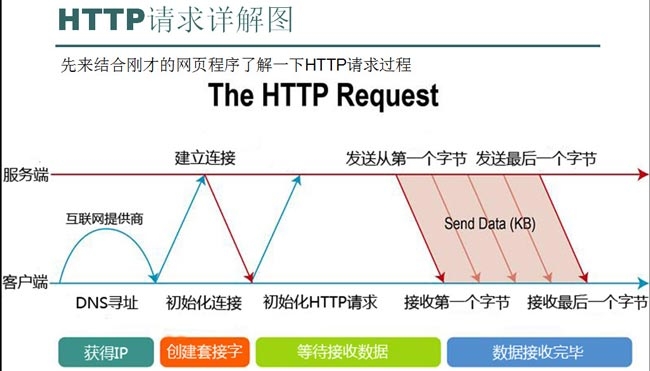
From the above figure, we can observe that the response time includes the DNS domain name resolution time, the connection time established with the server, the server processing time, and the time when the response arrives at the client.
If you use Charles to intercept HTTP requests, you can view the response time data in the Timing column of OverView Tab. Duration in the figure below represents the total response time of the request, which also includes DNS (DNS domain name resolution time), Connect (connection establishment time) and SSL Handshake (SSL handshake time) mentioned above. Because this request is an HTTP request, the SSL Handshake field is left blank.
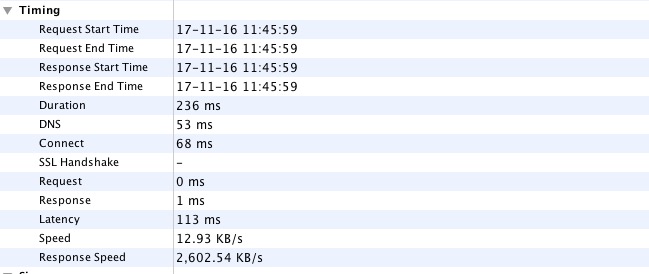
In fact, after developing the feature of response time in the SDK, we can also check the correctness of the results in this way. Of course, the time obtained in the SDK is not exactly equal to Charles, because the two implementation methods are completely different, but the difference between them should be within a reasonable range. This aspect will be discussed in detail below.
Through the above introduction, we can easily think of an idea: through the function when the hook request is issued, record the request time, then hook the callback response in the iOS SDK, record the end time, and calculate the difference to get the response time of this request. The same is true for Tingyun's general idea, but there are many details that need to be paid attention to. Let's discuss its specific implementation plan in detail next.
Listening Cloud is the resume method of NSURLSessionTask in the _nbs_hook_NSURLSessionTask function to achieve the purpose of recording the start of the request.
 void _nbs_hook_NSURLSessionTask() {
    r14 = _objc_msgSend;
    rax = [NSURLSessionConfiguration ephemeralSessionConfiguration];
    rax = [rax retain];
    var_40 = rax;
    rax = [NSURLSession sessionWithConfiguration:rax];
    rax = [rax retain];
    rdx = 0x0;
    var_38 = rax;
    rax = [rax dataTaskWithURL:rdx];
    rax = [rax retain];
    var_30 = rax;
    rbx = [rax class];
    r12 = @selector(resume);
    if (class_getInstanceMethod(rbx, r12) != 0x0) {
            r15 = @selector(superclass);
            r13 = @selector(resume);
            var_48 = r15;
            do {
                    if (_nbs_slow_isClassItSelfHasMethod(rbx, r12) != 0x0) {
                            r15 = class_getInstanceMethod(rbx, r12);
                            rax = method_getImplementation(r15);
                            rax = objc_retainBlock(__NSConcreteStackBlock);
                            var_50 = imp_implementationWithBlock(rax);
                            r13 = r13;
                            [rax release];
                            rdi = r15;
                            r15 = var_48;
                            rax = method_getTypeEncoding(rdi);
                            rdx = var_50;
                            rcx = rax;
                            class_replaceMethod(rbx, r12, rdx, rcx);
                    }
                    r14 = _objc_msgSend;
                    rbx = _objc_msgSend(rbx, r15, rdx, rcx);
                    rax = class_getInstanceMethod(rbx, r13);
                    r12 = r13;
            } while (rax != 0x0);
    }
    (r14)(var_30, @selector(cancel), rdx);
    (r14)(var_38, @selector(finishTasksAndInvalidate), rdx);
    [var_30 release];
    [var_38 release];
    [var_40 release];
    return;
}
Restore the above pseudocode to Objective-C code as follows:
 void _nbs_hook_NSURLSessionTask() {
    NSURLSessionConfiguration *config = [NSURLSessionConfiguration ephemeralSessionConfiguration];
    NSURLSession *session = [NSURLSession sessionWithConfiguration:config];
#pragma clang diagnostic push
#pragma clang diagnostic ignored "-Wnonnull"
    NSURLSessionDataTask *task = [session dataTaskWithURL:nil];
#pragma clang diagnostic pop
    Class cls = task.class;
    if (class_getInstanceMethod(cls, @selector(resume))) {
        Method method;
        do {
            if (_nbs_slow_isClassItSelfHasMethod(cls, @selector(resume))) {
                Method resumeMethod = class_getInstanceMethod(cls, @selector(resume));
                IMP imp = imp_implementationWithBlock(^(id self) {
                });
                class_replaceMethod(cls, @selector(resume), imp, method_getTypeEncoding(resumeMethod));
            }

            cls = [cls superclass];
            method = class_getInstanceMethod(cls, @selector(resume));
        } while (method);

    }
    [task cancel];
    [session finishTasksAndInvalidate];
}
We know that in the Foundation framework, some classes are actually Class Clusters, such as NSDictionary and NSArray . NSURLSessionTask is also a class family, and the inheritance chains are different in different system versions, so obviously you cannot directly hook the NSURLSessionTask class. A clever method is adopted here to build an Ephemeral session through the ephemeralSessionConfiguration method. It is similar to the default session, but no data is stored on disk, and all caches, cookies, credentials, etc. are saved in RAM and associated with the session. This way they will be automatically cleared when the session is invalid. Then, through this brief session, a session object is created, and the task object is finally built, and the real class is obtained through this task object.
The above clever approach is not originally created by Tingyun. It actually refers to AFNetworking's approach. In order to add notifications in AFNetworking, resume and suspend methods of Hook NSURLSessionTask are also implemented in AFURLSessionManager .
    if (NSClassFromString(@"NSURLSessionTask")) {
        /**
         iOS 7 and iOS 8 differ in NSURLSessionTask implementation, which makes the next bit of code a bit tricky.
         Many Unit Tests have been built to validate as much of this behavior has possible.
         Here is what we know:
            - NSURLSessionTasks are implemented with class clusters, meaning the class you request from the API isn't actually the type of class you will get back.
            - Simply referencing `[NSURLSessionTask class]` will not work. You need to ask an `NSURLSession` to actually create an object, and grab the class from there.
            - On iOS 7, `localDataTask` is a `__NSCFLocalDataTask`, which inherits from `__NSCFLocalSessionTask`, which inherits from `__NSCFURLSessionTask`.
            - On iOS 8, `localDataTask` is a `__NSCFLocalDataTask`, which inherits from `__NSCFLocalSessionTask`, which inherits from `NSURLSessionTask`.
            - On iOS 7, `__NSCFLocalSessionTask` and `__NSCFURLSessionTask` are the only two classes that have their own implementations of `resume` and `suspend`, and `__NSCFLocalSessionTask` DOES NOT CALL SUPER. This means both classes need to be swizzled.
            - On iOS 8, `NSURLSessionTask` is the only class that implements `resume` and `suspend`. This means this is the only class that needs to be swizzled.
            - Because `NSURLSessionTask` is not involved in the class hierarchy for every version of iOS, its easier to add the swizzled methods to a dummy class and manage them there.

         Some Assumptions:
            - No implementations of `resume` or `suspend` call super. If this were to change in a future version of iOS, we'd need to handle it.
            - No background task classes override `resume` or `suspend`

         The current solution:
            1) Grab an instance of `__NSCFLocalDataTask` by asking an instance of `NSURLSession` for a data task.
            2) Grab a pointer to the original implementation of `af_resume`
            3) Check to see if the current class has an implementation of resume. If so, continue to step 4.
            4) Grab the super class of the current class.
            5) Grab a pointer for the current class to the current implementation of `resume`.
            6) Grab a pointer for the super class to the current implementation of `resume`.
            7) If the current class implementation of `resume` is not equal to the super class implementation of `resume` AND the current implementation of `resume` is not equal to the original implementation of `af_resume`, THEN swizzle the methods
            8) Set the current class to the super class, and repeat steps 3-8
         */
        NSURLSessionConfiguration *configuration = [NSURLSessionConfiguration ephemeralSessionConfiguration];
        NSURLSession * session = [NSURLSession sessionWithConfiguration:configuration];
#pragma GCC diagnostic push
#pragma GCC diagnostic ignored "-Wnonnull"
        NSURLSessionDataTask *localDataTask = [session dataTaskWithURL:nil];
#pragma clang diagnostic pop
        IMP originalAFResumeIMP = method_getImplementation(class_getInstanceMethod([self class], @selector(af_resume)));
        Class currentClass = [localDataTask class];

        while (class_getInstanceMethod(currentClass, @selector(resume))) {
            Class superClass = [currentClass superclass];
            IMP classResumeIMP = method_getImplementation(class_getInstanceMethod(currentClass, @selector(resume)));
            IMP superclassResumeIMP = method_getImplementation(class_getInstanceMethod(superClass, @selector(resume)));
            if (classResumeIMP != superclassResumeIMP &&
                originalAFResumeIMP != classResumeIMP) {
                [self swizzleResumeAndSuspendMethodForClass:currentClass];
            }
            currentClass = [currentClass superclass];
        }

        [localDataTask cancel];
        [session finishTasksAndInvalidate];
    }
class_copyMethodListmethod will be called in the_nbs_slow_isClassItSelfHasMethodmethod to obtain the method list of this class. Note that the method list obtained by this method does not contain the methods of the parent class, so_nbs_slow_isClassItSelfHasMethodmethod is actually to judge whether theclsclass itself contains@selector(resume).
In fact, the above logic is also implemented in the open source library FLEX, but there are slight differences in implementation. FLEX will distinguish it from hook __NSCFLocalSessionTask , NSURLSessionTask and __NSCFURLSessionTask according to the system version. I personally feel that the implementation of listening cloud is more elegant than the hard coding of FLEX . Because __NSCFLocalSessionTask and __NSCFURLSessionTask are private classes, split and splicing are adopted to avoid audit rejection.
 + (void)injectIntoNSURLSessionTaskResume
{
    static dispatch_once_t onceToken;
    dispatch_once(&onceToken, ^{
        // In iOS 7 resume lives in __NSCFLocalSessionTask
        // In iOS 8 resume lives in NSURLSessionTask
        // In iOS 9 resume lives in __NSCFURLSessionTask
        Class class = Nil;
        if (![[NSProcessInfo processInfo] respondsToSelector:@selector(operatingSystemVersion)]) {
            class = NSClassFromString([@[@"__", @"NSC", @"FLocalS", @"ession", @"Task"] componentsJoinedByString:@""]);
        } else if ([[NSProcessInfo processInfo] operatingSystemVersion].majorVersion < 9) {
            class = [NSURLSessionTask class];
        } else {
            class = NSClassFromString([@[@"__", @"NSC", @"FURLS", @"ession", @"Task"] componentsJoinedByString:@""]);
        }
        SEL selector = @selector(resume);
        SEL swizzledSelector = [FLEXUtility swizzledSelectorForSelector:selector];

        Method originalResume = class_getInstanceMethod(class, selector);

        void (^swizzleBlock)(NSURLSessionTask *) = ^(NSURLSessionTask *slf) {
            [[FLEXNetworkObserver sharedObserver] URLSessionTaskWillResume:slf];
            ((void(*)(id, SEL))objc_msgSend)(slf, swizzledSelector);
        };

        IMP implementation = imp_implementationWithBlock(swizzleBlock);
        class_addMethod(class, swizzledSelector, implementation, method_getTypeEncoding(originalResume));
        Method newResume = class_getInstanceMethod(class, swizzledSelector);
        method_exchangeImplementations(originalResume, newResume);
    });
}
The implementation of replacing the original resume above is implemented through imp_implementationWithBlock , and the replaced block is as follows:
 void ___nbs_hook_NSURLSessionTask_block_invoke(int arg0, int arg1, int arg2) {
    rbx = [[NSDate date] retain];
    [rbx timeIntervalSince1970];
    var_40 = intrinsic_movsd(var_40, xmm0);
    [rbx release];
    r15 = _is_tiaoshi_kai;
    COND = *(int8_t *)r15 == 0x0;
    var_50 = r13;
    if (!COND) {
            rax = [var_30 URL];
            rax = [rax retain];
            r14 = r15;
            r15 = rax;
            rbx = [[r15 absoluteString] retain];
            rdx = rbx;
            __NBSDebugLog(0x3, @"NSURLSession:start:url:%@", rdx, rcx, r8, r9, stack[2048]);
            [rbx release];
            rdi = r15;
            r15 = r14;
            [rdi release];
    }
    rbx = [objc_getAssociatedObject(r12, @"m_SessAssociatedKey") retain];
    if (rbx != 0x0) {
            xmm1 = intrinsic_movsd(xmm1, var_40);
            xmm1 = intrinsic_mulsd(xmm1, *0x1000b9990);
            xmm0 = intrinsic_movsd(xmm0, *0x1000b9da8);
            [rbx startWithIP:0x0 DNSTime:var_30 atTimePoint:r8 withObject:r9];
            [rbx setRequest:var_30];
            [rbx setLibClassId:0x1];
    }
    else {
            if (*(int8_t *)r15 != 0x0) {
                    __NBSDebugLog(0x3, cfstring_r, rdx, rcx, r8, r9, stack[2048]);
            }
    }
}
In the above pseudo-code, the irrelevant logic in ___nbs_hook_NSURLSessionTask_block_invoke is ignored. You can see that a timestamp is generated and the timestamp is used as an entry parameter of [rbx startWithIP:0x0 DNSTime:var_30 atTimePoint:r8 withObject:r9] method. rbx is an instance of _priv_NBSHTTPTransaction , and this instance is obtained through the associated object of NSURLSessionDataTask . The logic of creating _priv_NBSHTTPTransaction instance and setting the associated object is in the -[_priv_NSURLSession_NBS nbs_dataTaskWithRequest:completionHandler:] method.
 r12 = [[var_30 nbs_dataTaskWithRequest:r13 completionHandler:0x0] retain];
r15 = [_priv_NBSHTTPTransaction new];
if (r12 != 0x0) {
        objc_setAssociatedObject(r12, @"m_SessAssociatedKey", r15, 0x301);
}
[r15 release];
-[_priv_NBSHTTPTransaction startWithIP:DNSTime:atTimePoint:withObject:] method will assign the time of the parameter to its tm_pnt_send property.
 -[_priv_NBSHTTPTransaction startWithIP:DNSTime:atTimePoint:withObject:] {
    var_30 = intrinsic_movsd(var_30, arg4, rdx, arg5);
    r12->tm_pnt_send = intrinsic_movsd(r12->tm_pnt_send, intrinsic_movsd(xmm0, var_30));

}
Of course, in addition to the -[_priv_NSURLSession_NBS nbs_dataTaskWithRequest:completionHandler:] method, the following method also contains this logic:
nbs_downloadTaskWithRequest:nbs_downloadTaskWithRequest:completionHandler:nbs_downloadTaskWithResumeData:completionHandler:nbs_uploadTaskWithRequest:fromData:completionHandler:nbs_uploadTaskWithRequest:fromFile:completionHandler:nbs_uploadTaskWithRequest:fromFile:nbs_uploadTaskWithRequest:fromData:nbs_uploadTaskWithStreamedRequest: The final response time is calculated in the finishAt method and assigned it to tm_dur_end attribute.
 void -[_priv_NBSHTTPTransaction finishAt:](void * self, void * _cmd, double arg2) {
	 r14 = self;
    rbx = [r14 retain];
    r14 = @selector(tm_pnt_send);
    _objc_msgSend(rbx, r14);
    xmm1 = intrinsic_xorpd(xmm1, xmm1);
    xmm0 = intrinsic_ucomisd(xmm0, xmm1);
    COND = xmm0 <= 0x0;
    if (!COND) {
            _objc_msgSend(rbx, r14);
            xmm1 = intrinsic_movsd(xmm1, var_30);
            xmm1 = intrinsic_subsd(xmm1, xmm0);
            xmm0 = intrinsic_movapd(xmm0, xmm1);
            [rbx setTm_dur_end:rdx];
    }
}
For network requests initiated by calling dataTaskWithRequest:completionHandler: method, the completed callback is in completionHandler , so finishAt method should be called in the completed callback. Similar methods include ___72-[_priv_NSURLSession_NBS nbs_downloadTaskWithRequest:completionHandler:]_block_invoke , ___79-[_priv_NSURLSession_NBS nbs_uploadTaskWithRequest:fromData:completionHandler:]_block_invoke and other methods.
 int ___68-[_priv_NSURLSession_NBS nbs_dataTaskWithRequest:completionHandler:]_block_invoke(int arg0, int arg1, int arg2, int arg3) {
    rdi = *(r12 + 0x20);
    xmm0 = intrinsic_movsd(xmm0, var_68);
    [rdi finishAt:rdx];
}
However, for network requests that call dataTaskWithRequest: method, you need to hook URLSession:task:didCompleteWithError: method of NSURLSessionTaskDelegate .
 void -[_priv_NBSLensAllMethodsDlgt_urlSess nbs_URLSession:task:didCompleteWithError:](void * self, void * _cmd, void * arg2, void * arg3, void * arg4) {
    rbx = [[NSDate date] retain];
    [rbx timeIntervalSince1970];
    xmm0 = intrinsic_mulsd(xmm0, *0x1000b9990);
    var_40 = intrinsic_movsd(var_40, xmm0);
    [rbx release];
    rax = objc_getAssociatedObject(r13, @"m_SessAssociatedKey");
    rax = [rax retain];
	 _objc_msgSend(r12, @selector(finishAt:), var_58);
}