topicGPT
v0.2.2 Removed redundant parameters

This repository contains scripts and prompts for our paper "TopicGPT: Topic Modeling by Prompting Large Language Models" (NAACL'24). Our topicgpt_python package consists of five main functions:
generate_topic_lvl1 generates high-level and generalizable topics.generate_topic_lvl2 generates low-level and specific topics to each high-level topic.refine_topics refines the generated topics by merging similar topics and removing irrelevant topics.assign_topics assigns the generated topics to the input text, along with a quote that supports the assignment.correct_topics corrects the generated topics by reprompting the model so that the final topic assignment is grounded in the topic list.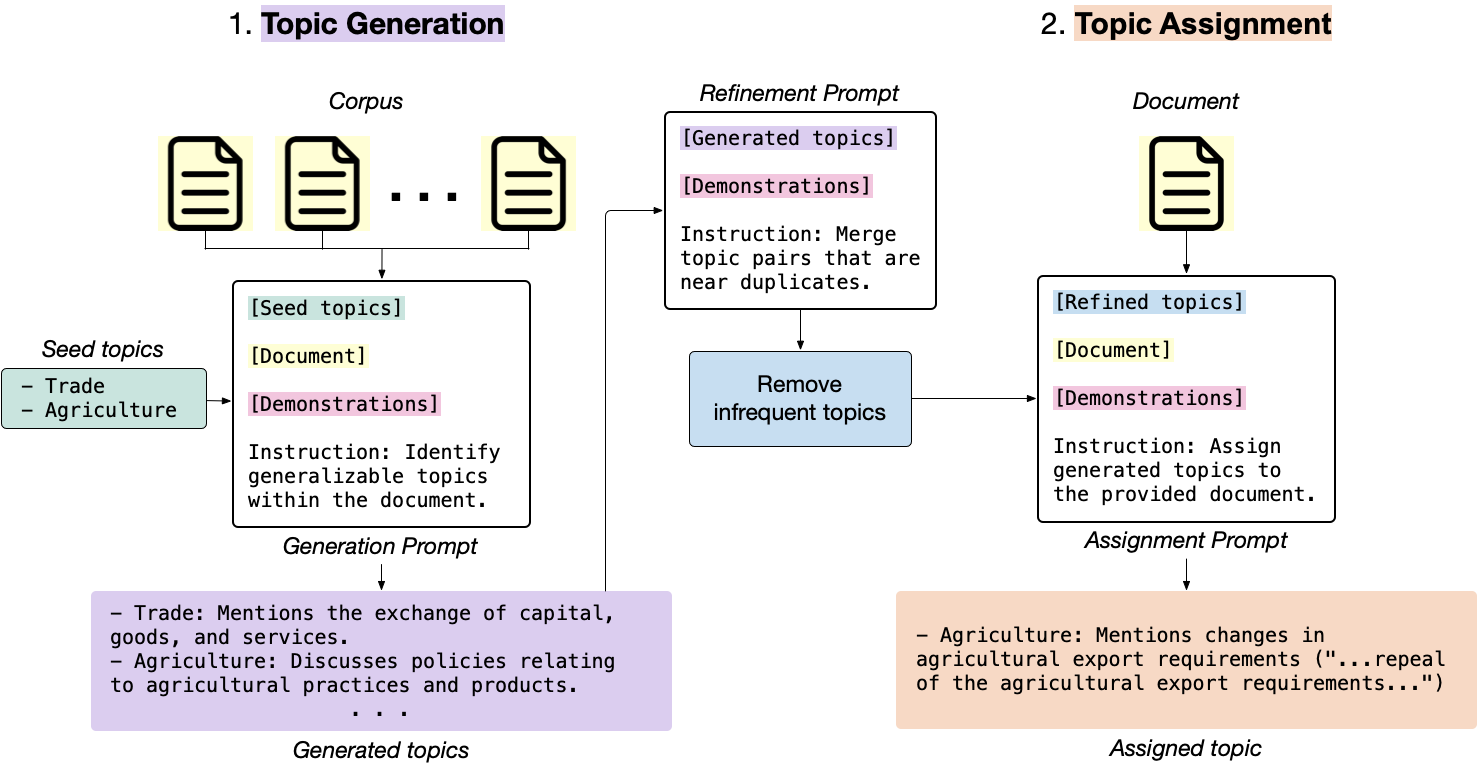
topicgpt_python is released! You can install it via pip install topicgpt_python. We support OpenAI API, VertexAI, Azure API, Gemini API, and vLLM (requires GPUs for inference). See PyPI.pip install topicgpt_python
# Run in shell
# Needed only for the OpenAI API deployment
export OPENAI_API_KEY={your_openai_api_key}

# Needed only for the Vertex AI deployment
export VERTEX_PROJECT={your_vertex_project}   # e.g. my-project
export VERTEX_LOCATION={your_vertex_location} # e.g. us-central1

# Needed only for Gemini deployment
export GEMINI_API_KEY={your_gemini_api_key}

# Needed only for the Azure API deployment
export AZURE_OPENAI_API_KEY={your_azure_api_key}
export AZURE_OPENAI_ENDPOINT={your_azure_endpoint}
.jsonl data file in the following format:
{
    "id": "IDs (optional)",
    "text": "Documents",
    "label": "Ground-truth labels (optional)"
}data/input. There is also a sample data file data/input/sample.jsonl to debug the code.Check out demo.ipynb for a complete pipeline and more detailed instructions. We advise you to try running on a subset with cheaper (or open-source) models first before scaling up to the entire dataset.
(Optional) Define I/O paths in config.yml and load using:
import yaml

with open("config.yml", "r") as f:
    config = yaml.safe_load(f)
Load the package:
from topicgpt_python import *Generate high-level topics:
generate_topic_lvl1(api, model, data, prompt_file, seed_file, out_file, topic_file, verbose)Generate low-level topics (optional)
generate_topic_lvl2(api, model, seed_file, data, prompt_file, out_file, topic_file, verbose)Refine the generated topics by merging near duplicates and removing topics with low frequency (optional):
refine_topics(api, model, prompt_file, generation_file, topic_file, out_file, updated_file, verbose, remove, mapping_file)Assign and correct the topics, usually with a weaker model if using paid APIs to save cost:
assign_topics(
api, model, data, prompt_file, out_file, topic_file, verbose
)
correct_topics(
api, model, data_path, prompt_path, topic_path, output_path, verbose
)
Check out the data/output folder for sample outputs.
We also offer metric calculation functions in topicgpt_python.metrics to evaluate the alignment between the generated topics and the ground-truth labels (Adjusted Rand Index, Harmonic Purity, and Normalized Mutual Information).
@misc{pham2023topicgpt,
      title={TopicGPT: A Prompt-based Topic Modeling Framework},
      author={Chau Minh Pham and Alexander Hoyle and Simeng Sun and Mohit Iyyer},
      year={2023},
      eprint={2311.01449},
      archivePrefix={arXiv},
      primaryClass={cs.CL}
}





