iblessing
1.0.0

       ☠️
       ██╗██████╗ ██╗     ███████╗███████╗███████╗██╗███╗   ██╗ ██████╗
       ██║██╔══██╗██║     ██╔════╝██╔════╝██╔════╝██║████╗  ██║██╔════╝
       ██║██████╔╝██║     █████╗  ███████╗███████╗██║██╔██╗ ██║██║  ███╗
       ██║██╔══██╗██║     ██╔══╝  ╚════██║╚════██║██║██║╚██╗██║██║   ██║
       ██║██████╔╝███████╗███████╗███████║███████║██║██║ ╚████║╚██████╔╝
       ╚═╝╚═════╝ ╚══════╝╚══════╝╚══════╝╚══════╝╚═╝╚═╝  ╚═══╝ ╚═════╝
iblessing ist ein iOS -Sicherheitsnutzungsinstrument, das hauptsächlich Anwendungsinformationen , statische Analysen und dynamische Analyse umfasst.iblessing basiert auf Einhornmotor, Capstone -Motor und Keystone -Motor.Plattformübergreifend: getestet auf macOS und Ubuntu.
iOS -App statische Info -Extrakte, einschließlich Metadaten, Deeplinks, URLs usw.
Mach-o-Parser- und Dyld-Symbol-Bind-Simulator
Objektiv-C-Klasse realisiert und analysiert
Scanner, die eine dynamische Analyse für ARM64 -Assemblercode durchführen und Schlüsselinformationen finden oder Oberfläche angreifen
Scanner, die Unicorn verwenden, um die Mach-O-ARM64-Codeausführung teilweise zu simulieren und einige Funktionen zu finden
Generatoren, mit denen der Bericht des Scanners eine sekundäre Verarbeitung bereitstellt, um einen Abfrageserver zu starten, oder Skript für IDA generieren können
Super OBJC_MSGSend Xrefs Scanner?
Tests
Android Scanners Suport
Diagnoseprotokolle
Flexiblere Scannerinfrastruktur für neue Scanner -Plugins
Falls Sie Unterstützung in Bezug auf IBLESSING oder alles, was damit verbunden ist, benötigen, können Sie:
Um mit dem Kompilieren von Iblessing zu beginnen, befolgen Sie bitte die folgenden Schritte:
 git clone --recursive -j4 https://github.com/Soulghost/iblessing
cd iblessing
./compile-cmake.sh
Grundkonzepte
Scanner
Generatoren
Wenn es Fehler gibt, können Sie Capstone und Unicorn kompilieren, dann ziehen Sie libcapstone.a und libunicorn.a zum Anbieter/den Libs des Xcode -Projekts.
Wenn all dieser Run erfolgreich run, können Sie das Binärdatum im Build -Verzeichnis finden:
 > ls ./build
iblessing

> file ./build/iblessing
./build/iblessing: Mach-O 64-bit executable x86_64
 $ iblessing -h

           ☠️
           ██╗██████╗ ██╗     ███████╗███████╗███████╗██╗███╗   ██╗ ██████╗
           ██║██╔══██╗██║     ██╔════╝██╔════╝██╔════╝██║████╗  ██║██╔════╝
           ██║██████╔╝██║     █████╗  ███████╗███████╗██║██╔██╗ ██║██║  ███╗
           ██║██╔══██╗██║     ██╔══╝  ╚════██║╚════██║██║██║╚██╗██║██║   ██║
           ██║██████╔╝███████╗███████╗███████║███████║██║██║ ╚████║╚██████╔╝
           ╚═╝╚═════╝ ╚══════╝╚══════╝╚══════╝╚══════╝╚═╝╚═╝  ╚═══╝ ╚═════╝

[***] iblessing iOS Security Exploiting Toolkit Beta 0.1.1 (http://blog.asm.im)
[***] Author: Soulghost (高级页面仔) @ (https://github.com/Soulghost)

Usage: iblessing [options...]
Options:
    -m, --mode             mode selection:
                                * scan: use scanner
                                * generator: use generator
    -i, --identifier       choose module by identifier:
                                * <scanner-id>: use specific scanner
                                * <generator-id>: use specific generator
    -f, --file             input file path
    -o, --output           output file path
    -l, --list             list available scanners
    -d, --data             extra data
    -h, --help             Shows this page
Ein Scanner ist eine Komponente, die zum Ausgangsanalysebericht durch statische und dynamische Analyse von Binärdateien verwendet wird. Der OBJC-MSG-XREF-Scanner kann die meisten OBJC_MSGSend-Querreferenzen dynamisch analysieren.
 [*] Scanner List:
    - app-info: extract app infos
    - objc-class-xref: scan for class xrefs
    - objc-msg-xref: generate objc_msgSend xrefs record
    - predicate: scan for NSPredicate xrefs and sql injection surfaces
    - symbol-wrapper: detect symbol wrappers
Ein Generator ist eine Komponente, die eine Sekundärverarbeitung auf dem vom Scanner generierten Bericht durchführt. Zum Beispiel können IDA-Skripte basierend auf dem Bericht des OBJC-MSG-XREF-Scanners basierend auf dem Bericht des OBJC-MSG-XREF-Scanners generieren.
 [*] Generator List:
    - ida-objc-msg-xref: generator ida scripts to add objc_msgSend xrefs from objc-msg-xref scanner's report
    - objc-msg-xref-server: server to query objc-msg xrefs
    - objc-msg-xref-statistic: statistics among objc-msg-send reports
> iblessing -m scan -i app-info -f <path-to-app-bundle>
Nehmen wir WeChat als Beispiel:
 > iblessing -m scan -i app-info -f WeChat.app
[*] set output path to /opt/one-btn/tmp/apps/WeChat/Payload
[*] input file is WeChat.app
[*] start App Info Scanner
[+] find default plist file Info.plist!
[*] find version info: Name: 微信(WeChat)
Version: 7.0.14(18E226)
ExecutableName: WeChat
[*] Bundle Identifier: com.tencent.xin
[*] the app allows HTTP requests **without** exception domains!
[+] find app deeplinks
 |-- wechat://
 |-- weixin://
 |-- fb290293790992170://
 |-- weixinapp://
 |-- prefs://
 |-- wexinVideoAPI://
 |-- QQ41C152CF://
 |-- wx703://
 |-- weixinULAPI://
[*] find app callout whitelist
 |-- qqnews://
 |-- weixinbeta://
 |-- qqnewshd://
 |-- qqmail://
 |-- whatsapp://
 |-- wxwork://
 |-- wxworklocal://
 |-- wxcphonebook://
 |-- mttbrowser://
 |-- mqqapi://
 |-- mqzonev2://
 |-- qqmusic://
 |-- tenvideo2://
 ...
[+] find 507403 string literals in binary
[*] process with string literals, this maybe take some time
[+] find self deeplinks URLs:
 |-- weixin://opennativeurl/devicerankview
 |-- weixin://dl/offlinepay/?appid=%@
 |-- weixin://opennativeurl/rankmyhomepage
 ...
 [+] find other deeplinks URLs:
 |-- wxpay://f2f/f2fdetail
 |-- file://%@?lang=%@&fontRatio=%.2f&scene=%u&version=%u&type=%llu&%@=%d&qqFaceFolderPath=%@&platform=iOS&netType=%@&query=%@&searchId=%@&isHomePage=%d&isWeAppMore=%d&subType=%u&extParams=%@&%@=%@&%@=%@
 ...
 [*] write report to path /opt/one-btn/tmp/apps/WeChat/Payload/WeChat.app_info.iblessing.txt

> ls -alh
-rw-r--r--@ 1 soulghost  wheel    29K Jul 23 14:01 WeChat.app_info.iblessing.txt
Bekanntmachung: Nur ARM64 -Binärdateien
iblessing -m scan -i objc-class-xref -f <path-to-binary> -d 'classes=<classname_to_scan>,<classname_to_scan>,...'
 > restore-symbol WeChat -o WeChat.restored
> iblessing -m scan -i objc-class-xref -f WeChat.restored -d 'classes=NSPredicate'
[*] set output path to /opt/one-btn/tmp/apps/WeChat/Payload
[*] input file is WeChat
[+] detect mach-o header 64
[+] detect litten-endian
[*] start Objc Class Xref Scanner
  [*] try to find _OBJC_CLASS_$_NSPredicate
  [*] Step 1. locate class refs
	[+] find _OBJC_CLASS_$_NSPredicate at 0x108eb81d8
  [*] Step 2. find __TEXT,__text
	[+] find __TEXT,__text at 0x4000
  [*] Step 3. scan in __text
	[*] start disassembler at 0x100004000
	[*]  0x1002e1a50/0x1069d9874 (2.71%)	[+] find _OBJC_CLASS_$_NSPredicate ref at 0x1002e1a54
           ...
  [*] Step 4. symbolicate ref addresses
           [+] _OBJC_CLASS_$_NSPredicate -|
           [+] find _OBJC_CLASS_$_NSPredicate ref -[WCWatchNotificationMgr addYoCount:contact:type:] at 0x1002e1a54
           [+] find _OBJC_CLASS_$_NSPredicate ref -[NotificationActionsMgr handleSendMsgResp:] at 0x1003e0e28
           [+] find _OBJC_CLASS_$_NSPredicate ref -[FLEXClassesTableViewController searchBar:textDidChange:] at 0x1004a090c
           [+] find _OBJC_CLASS_$_NSPredicate ref +[GameCenterUtil parameterValueForKey:fromQueryItems:] at 0x1005a823c
           [+] find _OBJC_CLASS_$_NSPredicate ref +[GameCenterUtil getNavigationBarColorForUrl:defaultColor:] at 0x1005a8cd8
           ...
Bekanntmachung: Nur ARM64 -Binärdateien
iblessing -m scan -i objc-msg-xref -f <path-to-binary>
iblessing -m scan -i objc-msg-xref -f WeChat -d 'antiWrapper=1'
Der Anti-Wrapper-Modus erfasst OBJC_MSGSend-Wrapper und führt Transformationen vor, wie z. B.:
 ; __int64 __usercall objc_msgSend_X0_X22_X20@<X0>(void *obj@<X0>, const char *sel@<X22>, id anyObj@<X20>, ...)
objc_msgSend_X0_X22_X20:
MOV             X1, X22
MOV             X2, X20
B               objc_msgSend
 > iblessing -m scan -i objc-msg-xref -f WeChat -d 'antiWrapper=1'
[*] set output path to /opt/one-btn/tmp/apps/WeChat/Payload
[*] input file is WeChat
[+] detect mach-o header 64
[+] detect litten-endian

[*] !!! Notice: enter anti-wrapper mode, start anti-wrapper scanner
[*] start Symbol Wrapper Scanner
  [*] try to find wrappers for_objc_msgSend
  [*] Step1. find __TEXT,__text
	[+] find __TEXT,__text at 0x100004000
	[+] mapping text segment 0x100000000 ~ 0x107cb0000 to unicorn engine
  [*] Step 2. scan in __text
	[*] start disassembler at 0x100004000
	[*] / 0x1069d986c/0x1069d9874 (100.00%)
	[*] reach to end of __text, stop
  [+] anti-wrapper finished

[*] start ObjcMethodXrefScanner Exploit Scanner
  [*] Step 1. realize all app classes
	[*] realize classes 14631/14631 (100.00%)
	[+] get 667318 methods to analyze
  [*] Step 2. dyld load non-lazy symbols
  [*] Step 3. track all calls
	[*] progress: 667318 / 667318 (100.00%)
  [*] Step 4. serialize call chains to file
  [*] saved to /opt/one-btn/tmp/apps/WeChat/Payload/WeChat_method-xrefs.iblessing.txt

> ls -alh WeChat_method-xrefs.iblessing.txt
-rw-r--r--  1 soulghost  wheel    63M Jul 23 14:46 WeChat_method-xrefs.iblessing.txt

> head WeChat_method-xrefs.iblessing.txt
iblessing methodchains,ver:0.2;
chainId,sel,prefix,className,methodName,prevMethods,nextMethods
182360,0x1008a0ab8,+[A8KeyControl initialize],+,A8KeyControl,initialize,[],[4429#0x1008a1064@4376#0x1008a1050@13769#0x1008a10d0]
182343,0x1008a0ad0,+[A8KeyControl_QueryStringTransferCookie initialize],+,A8KeyControl_QueryStringTransferCookie,initialize,[],[4429#0x1008a1064@4376#0x1008a1050@13769#0x1008a10d0]
145393,0x1008c2220,+[A8KeyResultCookieWriter initWithDomain:weakWebView:andCompleteBlock:],+,A8KeyResultCookieWriter,initWithDomain:weakWebView:andCompleteBlock:,[145386#0x10036367c],[]
145396,0x1008c3df8,+[A8KeyResultCookieWriter setA8KeyCookieExpireTime:],+,A8KeyResultCookieWriter,setA8KeyCookieExpireTime:,[145386#0x1003636e8],[]
145397,0x1008c27e8,+[A8KeyResultCookieWriter writeCompleteMarkerCookieValue:forKey:],+,A8KeyResultCookieWriter,writeCompleteMarkerCookieValue:forKey:,[145386#0x10036380c],[]
253456,0x0,+[AAOperationReq init],+,AAOperationReq,init,[253455#0x1039a9d30],[]
253457,0x0,+[AAOperationReq setBaseRequest:],+,AAOperationReq,setBaseRequest:,[253455#0x1039a9d8c],[]
186847,0x0,+[AAOperationRes length],+,AAOperationRes,length,[186845#0x10342aa54],[]
Der Bericht kann von den Generatoren verwendet werden, jetzt gehen wir los.
Sie können einen Server über den OBJC-MSG-XREF-Server-Generator von Iblesssing starten, um alle OBJC_MSGSend Xrefs abzufragen.
iblessing -m generator -i objc-msg-xref-server -f <path-to-report-generated-by-objc-msg-xref-scanner>
Die Standard -Höradresse lautet 127.0.0.1:2345. Sie können diese nach -doption angeben.
iblessing -m generator -i objc-msg-xref-server -f WeChat_method-xrefs.iblessing.txt -d 'host=0.0.0.0;port=12345'
Hinweis: Der OBJC-MSG-XREF basiert auf Unicorn, um die Analyse zu beschleunigen. Wir folgen keine Anrufe, sodass das Ergebnis teilweise fehlt.
 > iblessing -m generator -i objc-msg-xref-server -f WeChat_method-xrefs.iblessing.txt
[*] set output path to /opt/one-btn/tmp/apps/WeChat/Payload
[*] input file is WeChat_method-xrefs.iblessing.txt
[*] start ObjcMsgXREFServerGenerator
  [*] load method-chain db for version iblessing methodchains,ver:0.2;
  [*] table keys chainId,sel,prefix,className,methodName,prevMethods,nextMethods
	[-] bad line 104467,0x0,+[TPLock P,	],+,TPLock,P,	,[104426#0x1043b9904],[]
	[-] bad line 114905,0x0,?[0x108ce1578 (,],?,0x108ce1578,(,,[114900#0x1011e8c68],[]
	[-] bad line 104464,0x0,?[? P,	],?,?,P,	,[104426#0x1043b98a8],[]
	[-] bad line 139234,0x0,?[? X
	[-] bad line ],?,?,X
	[-] bad line ,[139205#0x1013c222c],[]
	[+] load storage from disk succeeded!
  [*] listening on http://127.0.0.1:2345
Als nächstes können Sie http://127.0.0.1:2345 mit einem Browser zum Abfragen eines beliebigen OBJC_MSGSend Xrefs öffnen, den Sie mögen: 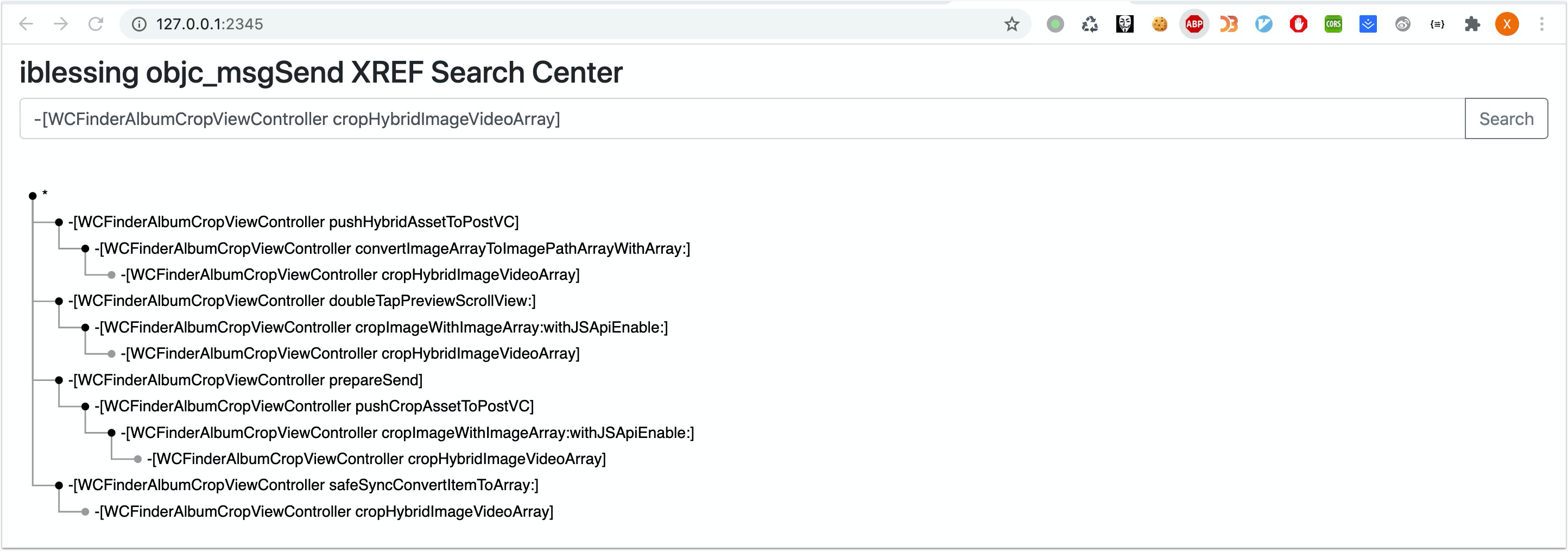
Sie können OBJC_MSGSEND XREFS hinzufügen, die vom OBJC-MSG-XREF-Scanner erzeugt wurden, um Ihre Reverse Engineering-Reise schneller und komfortabler zu gestalten.
iblessing -m generator -i ida-objc-msg-xref -f <path-to-report-generated-by-objc-msg-xref-scanner>
Hinweis: Der OBJC-MSG-XREF basiert auf Unicorn, um die Analyse zu beschleunigen. Wir folgen keine Anrufe, sodass das Ergebnis teilweise fehlt.
 > iblessing -m generator -i ida-objc-msg-xref -f WeChat_method-xrefs.iblessing.txt
[*] set output path to /opt/one-btn/tmp/apps/WeChat/Payload
[*] input file is WeChat_method-xrefs.iblessing.txt
[*] start IDAObjMsgXREFGenerator
  [*] load method-chain db for version iblessing methodchains,ver:0.2;
  [*] table keys chainId,sel,prefix,className,methodName,prevMethods,nextMethods
	[-] bad line 104467,0x0,+[TPLock P,	],+,TPLock,P,	,[104426#0x1043b9904],[]
	[-] bad line 114905,0x0,?[0x108ce1578 (,],?,0x108ce1578,(,,[114900#0x1011e8c68],[]
	[-] bad line 104464,0x0,?[? P,	],?,?,P,	,[104426#0x1043b98a8],[]
	[-] bad line 139234,0x0,?[? X
	[-] bad line ],?,?,X
	[-] bad line ,[139205#0x1013c222c],[]
	 [+] load storage from disk succeeded!
  [*] Generating XREF Scripts ...
  [*] saved to /opt/one-btn/tmp/apps/WeChat/Payload/WeChat_method-xrefs.iblessing.txt_ida_objc_msg_xrefs.iblessing.py

> ls -alh WeChat_method-xrefs.iblessing.txt_ida_objc_msg_xrefs.iblessing.py
-rw-r--r--  1 soulghost  wheel    23M Jul 23 16:16 WeChat_method-xrefs.iblessing.txt_ida_objc_msg_xrefs.iblessing.py

> head WeChat_method-xrefs.iblessing.txt_ida_objc_msg_xrefs.iblessing.py
def add_objc_xrefs():
    ida_xref.add_cref(0x10036367c, 0x1008c2220, XREF_USER)
    ida_xref.add_cref(0x1003636e8, 0x1008c3df8, XREF_USER)
    ida_xref.add_cref(0x10036380c, 0x1008c27e8, XREF_USER)
    ida_xref.add_cref(0x103add16c, 0x700006e187a8, XREF_USER)
    ida_xref.add_cref(0x102cbee0c, 0x101143ee8, XREF_USER)
    ida_xref.add_cref(0x10085c92c, 0x1005e9360, XREF_USER)
    ida_xref.add_cref(0x10085c8bc, 0x1005e9274, XREF_USER)
    ida_xref.add_cref(0x10085c8dc, 0x1005e92bc, XREF_USER)
    ida_xref.add_cref(0x10085c8cc, 0x1005e9298, XREF_USER)
Öffnen Sie als nächstes Ihre IDA -> Datei -> Skriptdatei und laden Sie das Skript. Dieser Schritt kann lange dauern. Und wenn es fertig ist, finden Sie viele Xrefs für die OBJC -Methode: 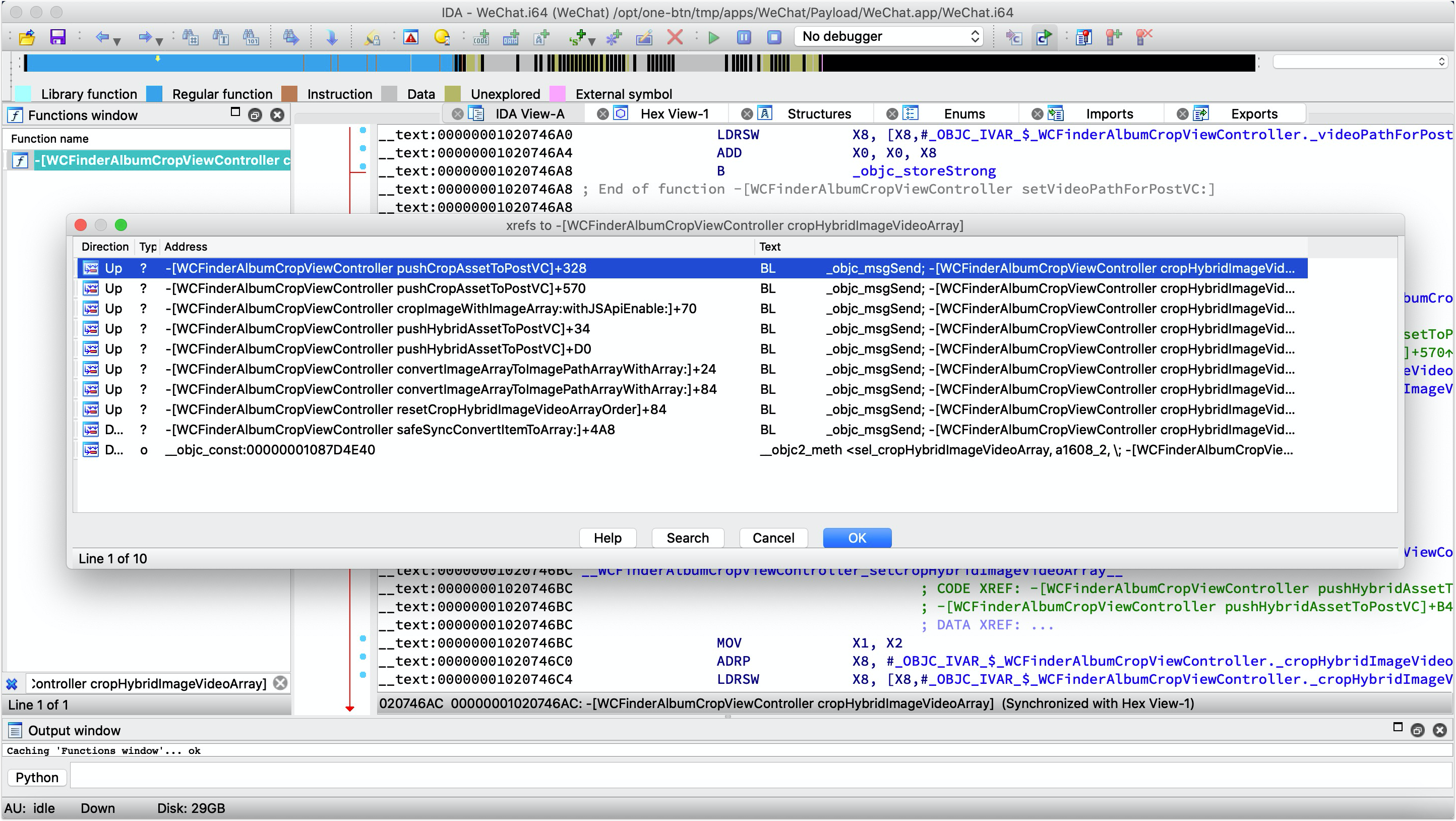
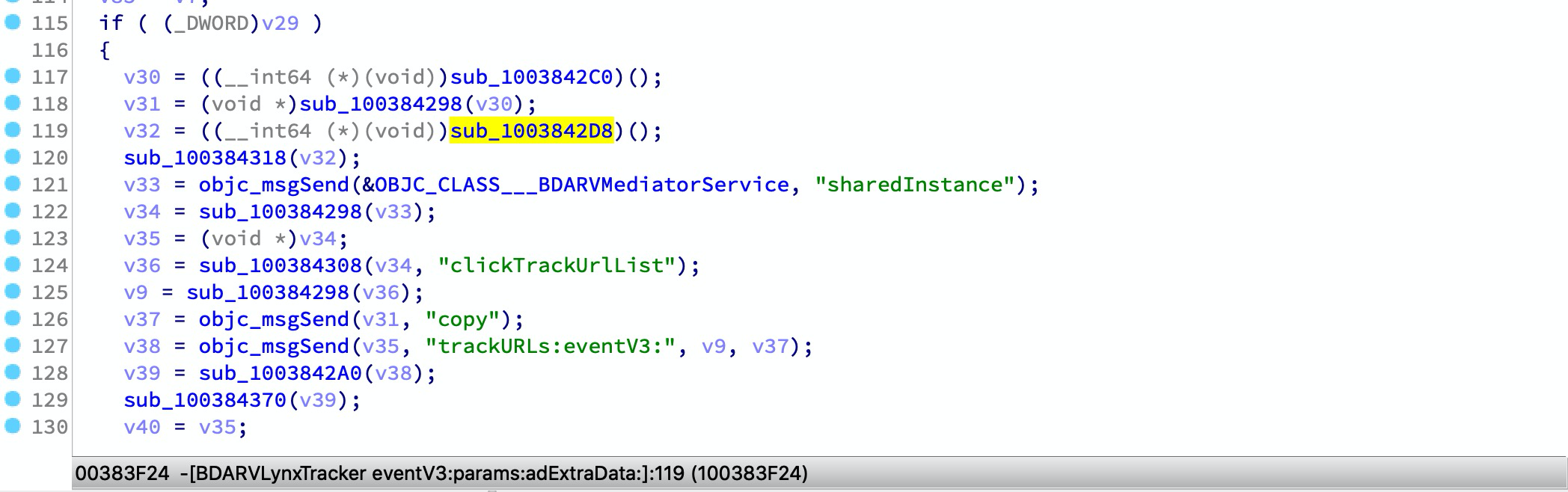
Eine Mach-O-Datei kann mehrere Wrapper der häufig verwendeten dynamischen Bibliotheksymbole enthalten, wie z. B.:
 __text:00000001003842D8 sub_1003842CC                           ; CODE XREF: -[BDARVLynxTracker eventV3:params:adExtraData:]+168↑p
__text:00000001003842D8                                         ; -[BDARVLynxTracker eventV3:params:adExtraData:]+214↑p ...
__text:00000001003842D8                 MOV             X1, X27
__text:00000001003842DC                 MOV             X2, X19
__text:00000001003842E0                 B               objc_msgSend
Wir können den Wrapper mit Usercall konvertieren:
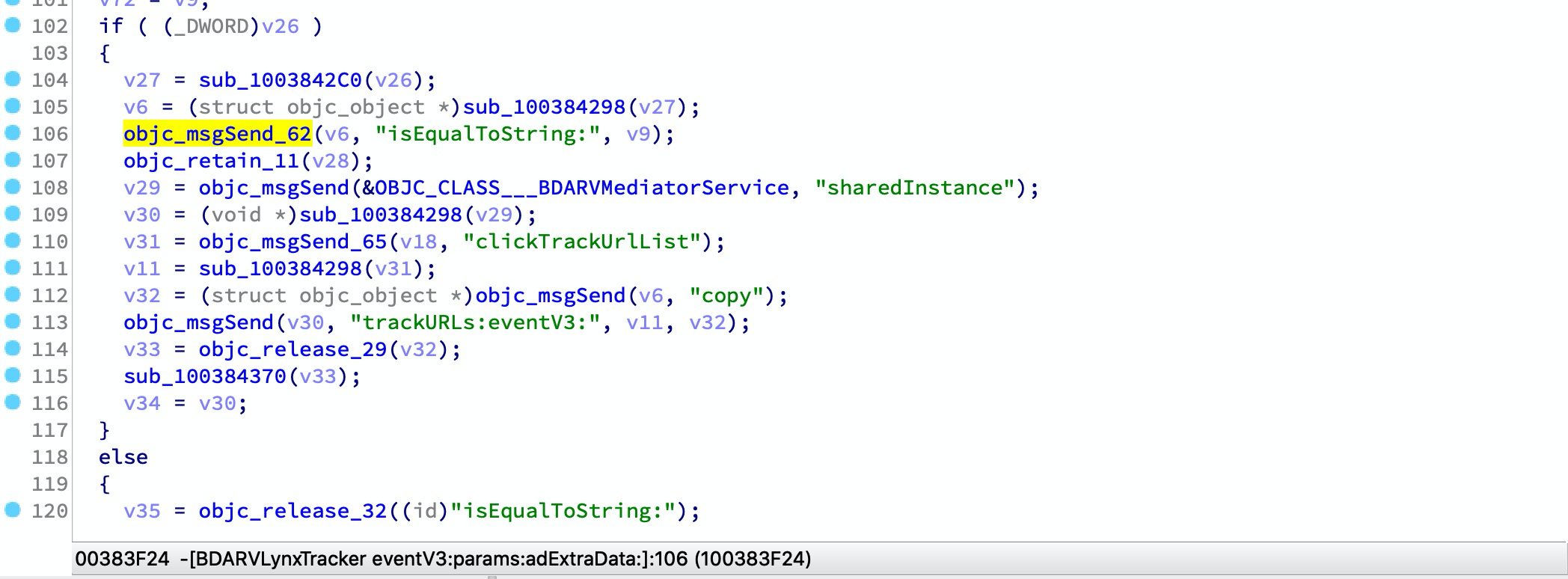
 __text:00000001003842CC ; id __usercall objc_msgSend_61@<X0>(id@<X23>, const char *@<X28>, ...)
__text:00000001003842CC _objc_msgSend_61                        ; CODE XREF: -[BDARVLynxTracker eventV3:params:adExtraData:]+2CC↑p
__text:00000001003842CC                                         ; -[BDARVLynxTracker eventV3:params:adExtraData:]+320↑p ...
__text:00000001003842CC                 MOV             X0, X23
__text:00000001003842D0                 MOV             X1, X28
__text:00000001003842D4                 B               objc_msgSend
Der Scanner kann einen Bericht generieren, um alle Verpackungen aufzuzeichnen. Sie können dann ida-symbol-wrapper-naming Generator verwenden, um IDA-Skripte zu generieren und diese Änderung des Wrapper-Umbenennens und der Prototypen zu implementieren.
 iblessing -m scan -i symbol-wrapper -f <path-to-binary> -d 'symbols=_objc_msgSend,_objc_retain,_objc_release'
iblessing -m scan -i symbol-wrapper -f <path-to-binary> -d 'symbols=*'
Wir werden Tiktok China als Beispiel einnehmen:
 > iblessing -m scan -i symbol-wrapper -f /opt/one-btn/tmp/apps/抖音短视频/Payload/Aweme -d 'symbols=*'
[*] set output path to /Users/soulghost/Desktop/git/iblessing-public/iblessing/build/Debug
[*] input file is /opt/one-btn/tmp/apps/抖音短视频/Payload/Aweme
[+] detect mach-o header 64
[+] detect litten-endian
[*] start Symbol Wrapper Scanner
  [*] try to find wrappers for_objc_autoreleaseReturnValue, _objc_msgSend, _objc_release, _objc_releaseAndReturn, _objc_retain, _objc_retainAutorelease, _objc_retainAutoreleaseAndReturn, _objc_retainAutoreleaseReturnValue, _objc_retainAutoreleasedReturnValue
  [*] Step1. find __TEXT,__text
	[+] find __TEXT,__text at 0x100004000
	[+] mapping text segment 0x100000000 ~ 0x106da0000 to unicorn engine
  [*] Step 2. scan in __text
	[*] start disassembler at 0x100004000
	[*] / 0x106b68a54/0x106b68a58 (100.00%)
	[*] reach to end of __text, stop

  [*] Step 3. serialize wrapper graph to file
	[*] saved to /Users/soulghost/Desktop/git/iblessing-public/iblessing/build/Debug/Aweme_wrapper-graph.iblessing.txt

> head Aweme_wrapper-graph.iblessing.txt
iblessing symbol-wrappers,ver:0.1;
wrapperId;address;name;prototype
0;0x100022190;_objc_retainAutoreleasedReturnValue;id __usercall f@<x0>(id@<x0>)
1;0x100022198;_objc_retainAutoreleasedReturnValue;id __usercall f@<x0>(id@<x0>)
2;0x1000221a0;_objc_release;id __usercall f@<x0>(id@<x22>)
3;0x1000221a8;_objc_msgSend;id __usercall f@<x0>(id@<x0>, const char*@<x20>, ...)
4;0x100022448;_objc_release;id __usercall f@<x0>(id@<x21>)
5;0x10009c19c;_objc_autoreleaseReturnValue;id __usercall f@<x0>(id@<x0>)
6;0x1000b6f94;_objc_msgSend;id __usercall f@<x0>(id@<x0>, const char*@<x1>, ...)
7;0x100100248;_objc_autoreleaseReturnValue;id __usercall f@<x0>(id@<x0>)
Als nächstes können wir IDA -Skripte aus diesem Bericht generieren.
iblessing -m generator -i ida-symbol-wrapper-naming -f <path-to-report-from-symbol-wrapper>
 > iblessing -m generator -i ida-symbol-wrapper-naming -f Aweme_wrapper-graph.iblessing.txt
[*] set output path to /Users/soulghost/Desktop/git/iblessing-public/iblessing/build/Debug
[*] input file is Aweme_wrapper-graph.iblessing.txt
[*] start IDAObjMsgXREFGenerator
  [*] load symbol-wrappers db for version iblessing symbol-wrappers,ver:0.1;
  [*] table keys wrapperId;address;name;prototype
  [*] Generating Naming Scripts ...
  [*] saved to /Users/soulghost/Desktop/git/iblessing-public/iblessing/build/Debug/Aweme_wrapper-graph.iblessing.txt_ida_symbol_wrapper_naming.iblessing.py

> head Aweme_wrapper-graph.iblessing.txt_ida_symbol_wrapper_naming.iblessing.py
def namingWrappers():
    idc.set_name(0x100022190, '_objc_retainAutoreleasedReturnValue', ida_name.SN_FORCE)
    idc.apply_type(0x100022190, idc.parse_decl('id __usercall f@<x0>(id@<x0>)', idc.PT_SILENT))
    idc.set_name(0x100022198, '_objc_retainAutoreleasedReturnValue', ida_name.SN_FORCE)
    idc.apply_type(0x100022198, idc.parse_decl('id __usercall f@<x0>(id@<x0>)', idc.PT_SILENT))
    idc.set_name(0x1000221a0, '_objc_release', ida_name.SN_FORCE)
    idc.apply_type(0x1000221a0, idc.parse_decl('id __usercall f@<x0>(id@<x22>)', idc.PT_SILENT))
    idc.set_name(0x1000221a8, '_objc_msgSend', ida_name.SN_FORCE)
    idc.apply_type(0x1000221a8, idc.parse_decl('id __usercall f@<x0>(id@<x0>, const char*@<x20>, ...)', idc.PT_SILENT))
    idc.set_name(0x100022448, '_objc_release', ida_name.SN_FORCE)
Öffnen Sie als nächstes Ihre IDA -> Datei -> Skriptdatei und laden Sie das Skript. Dieser Schritt kann lange dauern. Und wenn es fertig ist, können Sie einige dekompilierte Codeänderungen beobachten: