用angular Material 做統計表格
安裝Angular Material、元件開發工具(CDK) 和Angular 動畫庫,並運行程式碼原理圖
ng add @angular/material
表格原理圖將建立一個元件,它可以渲染出一個預設了可排序、可分頁資料來源的Angular Material。 【相關教學推薦:《angular教學》】
ng generate @angular/material:table texe1
然後在這的基礎上進行修改。
該組件的html檔
<div class="mat-elevation-z8">
<table mat-table class="full-width-table" matSort aria-label="Elements">
<!-- Id Column -->
<ng-container matColumnDef="id">
<th mat-header-cell *matHeaderCellDef mat-sort-header>序號</th>
<td mat-cell *matCellDef="let row">{{row.id}}</td>
</ng-container>
<!-- Name Column -->
<ng-container matColumnDef="name">
<th mat-header-cell *matHeaderCellDef mat-sort-header> 岩土名</th>
<td mat-cell *matCellDef="let row">{{row.name}}</td>
</ng-container>
<!-- num1 Column -->
<ng-container matColumnDef="num1">
<th mat-header-cell *matHeaderCellDef mat-sort-header> 期望數量</th>
<td mat-cell *matCellDef="let row">{{row.num1}}</td>
</ng-container>
<!-- num2 Column -->
<ng-container matColumnDef="num2">
<th mat-header-cell *matHeaderCellDef mat-sort-header> 目前數量</th>
<td mat-cell *matCellDef="let row">{{row.num2}}</td>
</ng-container>
<tr mat-header-row *matHeaderRowDef="displayedColumns"></tr>
<tr mat-row *matRowDef="let row; columns: displayedColumns;"></tr>
</table>
<!-- 控製表格資料的顯示長度-->
<mat-paginator #paginator
[length]="dataSource?.data?.length"
[pageIndex]="0"
[pageSize]="10"
[pageSizeOptions]="[5, 10, 17]"
aria-label="Select page">
</mat-paginator>
</div>該元件的texe1-datasource.ts檔案
import { DataSource } 從 '@angular/cdk/collections';
import { MatPaginator } from '@angular/material/paginator';
import { MatSort } from '@angular/material/sort';
import { map } from 'rxjs/operators';
import { Observable, of as observableOf, merge } from 'rxjs';

// TODO: Replace this with your own data model type
export interface Texe1Item {
  name: string;
  id: number;
  num1: number;
  num2: number;
}

// TODO: replace this with real data from your application
const EXAMPLE_DATA: Texe1Item[] = [
  {id: 1, name: '粉質黏土', num1:1000, num2:100,},
  {id: 2, name: '淤泥質粉質黏土', num1:1000, num2:100,},
  {id: 3, name: '黏土', num1:1000, num2:100,},
  {id: 4, name: '黏質粉土', num1:1000, num2:100,},
  {id: 5, name: '淤泥質黏土', num1:1000, num2:100,},
  {id: 6, name: '圓礫(角礫)', num1:1000, num2:100,},
  {id: 7, name: '中砂', num1:1000, num2:1000,},
  {id: 8, name: '有機質土', num1:1000, num2:100,},
  {id: 9, name: '泥炭質土A', num1:1000, num2:100,},
  {id: 10, name: '泥炭質土B', num1:1000, num2:100,},
  {id: 11, name: '砂質粉土', num1:1000, num2:100,},
  {id: 12, name: '粉砂', num1:1000, num2:100,},
  {id: 13, name: '細砂', num1:1000, num2:100,},
  {id: 14, name: '粗砂', num1:1000, num2:100,},
  {id: 15, name: '礫砂', num1:1000, num2:100,},
  {id: 16, name: '卵石(碎石)', num1:1000, num2:100,},
  {id: 17, name: '漂石(塊石)', num1:1000, num2:100,},

];

/**
 * Data source for the Texe1 view. This class should
 * encapsulate all logic for fetching and manipulating the displayed data
 * (including sorting, pagination, and filtering).
 */
export class Texe1DataSource extends DataSource<Texe1Item> {
  data: Texe1Item[] = EXAMPLE_DATA;
  paginator: MatPaginator | undefined;
  sort: MatSort | undefined;

  constructor() {
    super();
  }

  /**
   * Connect this data source to the table. The table will only update when
   * the returned stream emits new items.
   * @returns A stream of the items to be rendered.
   */
  connect(): Observable<Texe1Item[]> {
    if (this.paginator && this.sort) {
      // Combine everything that affects the rendered data into one update
      // stream for the data-table to consume.
      return merge(observableOf(this.data), this.paginator.page, this.sort.sortChange)
        .pipe(map(() => {
          return this.getPagedData(this.getSortedData([...this.data ]));
        }));
    } else {
      throw Error('Please set the paginator and sort on the data source before connecting.');
    }
  }

  /**
   * Called when the table is being destroyed. Use this function, to clean up
   * any open connections or free any held resources that were set up during connect.
   */
  disconnect(): void {}

  /**
   * Paginate the data (client-side). If you're using server-side pagination,
   * this would be replaced by requesting the appropriate data from the server.
   */
  private getPagedData(data: Texe1Item[]): Texe1Item[] {
    if (this.paginator) {
      const startIndex = this.paginator.pageIndex * this.paginator.pageSize;
      return data.splice(startIndex, this.paginator.pageSize);
    } else {
      return data;
    }
  }

  /**
   * Sort the data (client-side). If you're using server-side sorting,
   * this would be replaced by requesting the appropriate data from the server.
   */
  private getSortedData(data: Texe1Item[]): Texe1Item[] {
    if (!this.sort || !this.sort.active || this.sort.direction === '') {
      return data;
    }

    return data.sort((a, b) => {
      const isAsc = this.sort?.direction === 'asc';
      switch (this.sort?.active) {
        case 'name': return compare(a.name, b.name, isAsc);
        case 'id': return compare(+a.id, +b.id, isAsc);
        default: return 0;
      }
    });
  }
}

/** Simple sort comparator for example ID/Name columns (for client-side sorting). */
function compare(a: string | number, b: string | number, isAsc: boolean): number {
  return (a < b ? -1 : 1) * (isAsc ? 1 : -1);
}
該元件的texe1.component.ts檔案
import { AfterViewInit, Component, ViewChild } from '@angular/core';
import { MatPaginator } from '@angular/material/paginator';
import { MatSort } from '@angular/material/sort';
import { MatTable } from '@angular/material/table';
import { Texe1DataSource, Texe1Item } from './texe1-datasource';

@Component({
  selector: 'app-texe1',
  templateUrl: './texe1.component.html',
  styleUrls: ['./texe1.component.css']
})
export class Texe1Component implements AfterViewInit {
  @ViewChild(MatPaginator) paginator!: MatPaginator;
  @ViewChild(MatSort) sort!: MatSort;
  @ViewChild(MatTable) table!: MatTable<Texe1Item>;
  dataSource: Texe1DataSource;

  /** Columns displayed in the table. Columns IDs can be added, removed, or reordered. */
  displayedColumns = ['id', 'name','num1','num2'];

  constructor() {
    this.dataSource = new Texe1DataSource();
  }

  ngAfterViewInit(): void {
    this.dataSource.sort = this.sort;
    this.dataSource.paginator = this.paginator;
    this.table.dataSource = this.dataSource;
  }
}
最後再app.component.html檔中顯示。
<app-texe1></app-texe1>
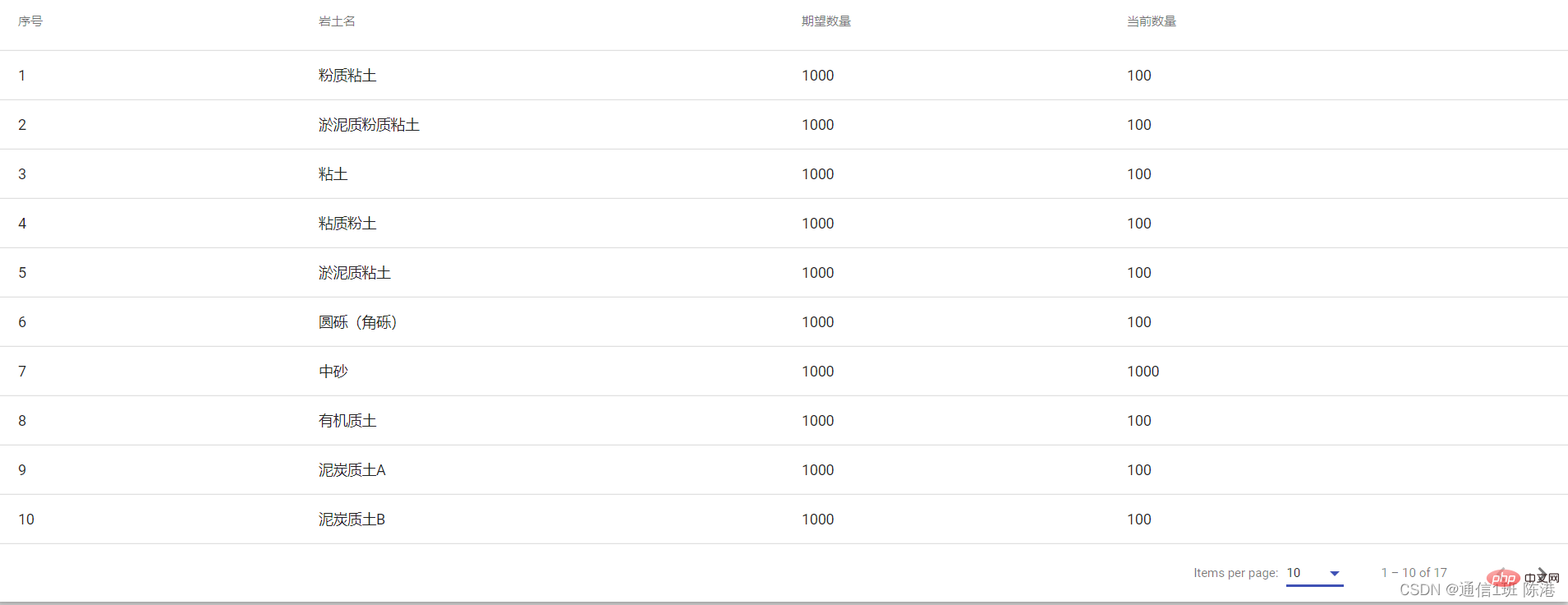
效果圖: