reloading
v1.1.2

python實用程序可在每次迭代中從源中重新加載一個循環主體而不會失去狀態
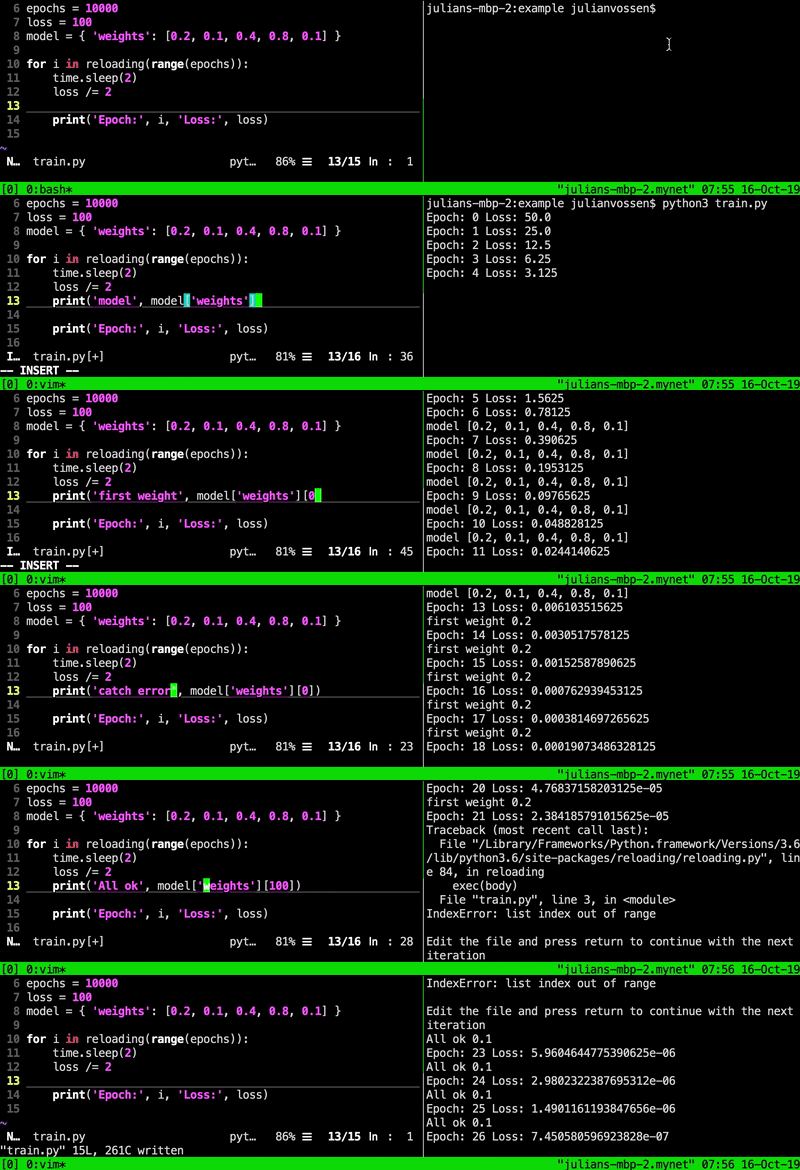
在深度學習模型培訓期間編輯源代碼有用。這使您可以添加日誌記錄,打印統計信息或保存模型,而無需重新啟動培訓,因此不會失去培訓進度。
pip install reloading
要在每次迭代之前從源中重新加載for循環的主體,只需用reloading包裹迭代器
 from reloading import reloading

for i in reloading ( range ( 10 )):
    # this code will be reloaded before each iteration
print ( i )要在每次執行之前從源重新加載函數,請用@reloading對函數定義進行裝飾,例如
 from reloading import reloading

@ reloading
def some_function ():
    # this code will be reloaded before each invocation
pass 將關鍵字參數傳遞every每個n-th-th-thin in-tectocation或迭代中。例如
 for i in reloading ( range ( 1000 ), every = 10 ):
    # this code will only be reloaded before every 10th iteration
    # this can help to speed-up tight loops
    pass

@ reloading ( every = 10 )
def some_function ():
    # this code with only be reloaded before every 10th invocation
pass forever=True而不是創建一個無盡的重載循環,例如
 for i in reloading ( forever = True ):
    # this code will loop forever and reload from source before each iteration
pass 這是如何與您喜歡的圖書館重新裝載的簡短片段。有關完整的示例,請查看示例文件夾。
 for epoch in reloading ( range ( NB_EPOCHS )):
    # the code inside this outer loop will be reloaded before each epoch

    for images , targets in dataloader :
        optimiser . zero_grad ()
        predictions = model ( images )
        loss = F . cross_entropy ( predictions , targets )
        loss . backward ()
        optimiser . step ()
這是一個完整的pytorch示例。
 @ reloading
def update_learner ( learner ):
    # this function will be reloaded from source before each epoch so that you
    # can make changes to the learner while the training is running
    pass

class LearnerUpdater ( LearnerCallback ):
    def on_epoch_begin ( self , ** kwargs ):
        update_learner ( self . learn )

path = untar_data ( URLs . MNIST_SAMPLE )
data = ImageDataBunch . from_folder ( path )
learn = cnn_learner ( data , models . resnet18 , metrics = accuracy ,
                    callback_fns = [ LearnerUpdater ])
learn . fit ( 10 )
這是一個完整的Fastai示例。
 @ reloading
def update_model ( model ):
    # this function will be reloaded from source before each epoch so that you
    # can make changes to the model while the training is running using
    # K.set_value()
    pass

class ModelUpdater ( Callback ):
    def on_epoch_begin ( self , epoch , logs = None ):
        update_model ( self . model )

model = Sequential ()
model . add ( Dense ( 64 , activation = 'relu' , input_dim = 20 ))
model . add ( Dense ( 10 , activation = 'softmax' ))

sgd = SGD ( lr = 0.01 , decay = 1e-6 , momentum = 0.9 , nesterov = True )
model . compile ( loss = 'categorical_crossentropy' ,
              optimizer = sgd ,
              metrics = [ 'accuracy' ])

model . fit ( x_train , y_train ,
          epochs = 200 ,
          batch_size = 128 ,
          callbacks = [ ModelUpdater ()])
這是一個完整的keras示例。
 for epoch in reloading ( range ( NB_EPOCHS )):
    # the code inside this outer loop will be reloaded from source
    # before each epoch so that you can change it during training

    train_loss . reset_states ()
    train_accuracy . reset_states ()
    test_loss . reset_states ()
    test_accuracy . reset_states ()

    for images , labels in tqdm ( train_ds ):
      train_step ( images , labels )

    for test_images , test_labels in tqdm ( test_ds ):
      test_step ( test_images , test_labels )
這是一個完整的TensorFlow示例。
確保您的路徑中有python和python3 ,然後運行:
$ python3 reloading/test_reloading.py