Arch Linux Guide
1.0.0


注意:您可以使用此方便的擴展標記PDF輕鬆地將此標記文件轉換為VSCODE的PDF。

入門
獲取軟件
賭博
設置MacOS工作區
設置Windows 10工作區
在Linux上使用Android和Android應用
專業音頻/視頻編輯
Kubernetes
機器學習
機器人技術
開源安全性
DevOps
撲動的發展
聯網
資料庫
Gnome擴展
高級主題
Arch Linux是一個獨立開發的X86-64通用GNU/Linux分佈,足以適合任何角色。發展著重於簡單,極簡主義和代碼優雅。 ARCH被安裝為最小基本系統,由用戶配置,僅通過安裝其獨特目的所需或所需的內容來組裝自己的理想環境。
Archwiki是網絡上Arch Linux文檔的最佳來源。
WSL上的Arch Linux(Linux的Windows子系統)
Etcher是一種開源的跨平台軟件,可輕鬆將操作系統圖像刷到microSD卡或USB設備。
Manjaro Linux

Endeavouros
Gauruda Linux
Arcolinux
Steam OS 3.0是使用KDE等離子桌面的不變操作系統(OS)。這使您可以使用Flatpak將應用程序安裝在容器中,而不是在根文件系統上。這不僅意味著應用程序的安裝是從核心文件系統中隔離的,而且還要大大降低了惡意應用程序妥協/破壞系統的能力。
https://aur.archlinux.org/gnome-tweaks-git.git
打開終端並運行:
sudo pacman -S gnome-tweak-tool //let ' s you customize your desktop layout. Pop Shell是用於GNOME Shell的鍵盤驅動的層,可快速且明智的導航和Windows的管理。流行外殼的核心功能是添加類似於i3WM的高級瓷磚窗口管理。
https://aur.archlinux.org/packages/gnome-shell-extension-pop-shell-git.git使用防火牆
打開終端並運行:
sudo firewall-cmd --state
sudo systemctl status firewalld回到頂部
Arch Linux用戶存儲庫(AUR)包含數千個構建腳本,用於使用Arch Linux MakePKG應用程序從源中編譯近68,000個可安裝的軟件包。
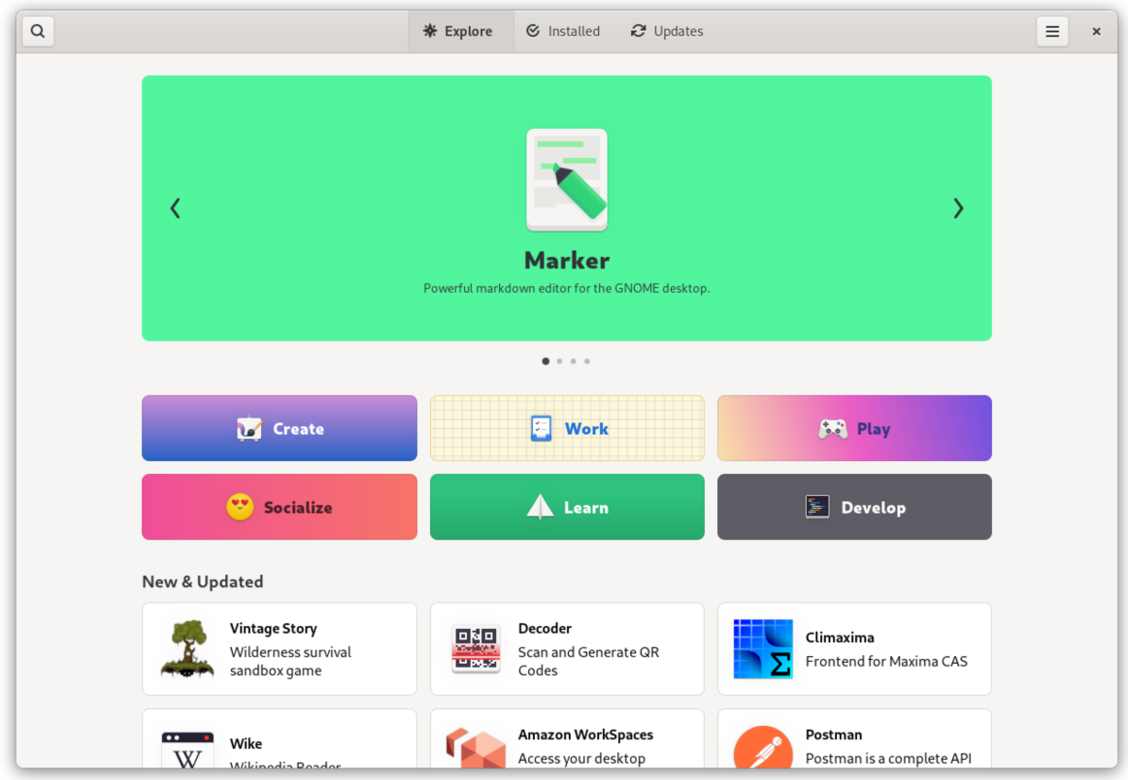
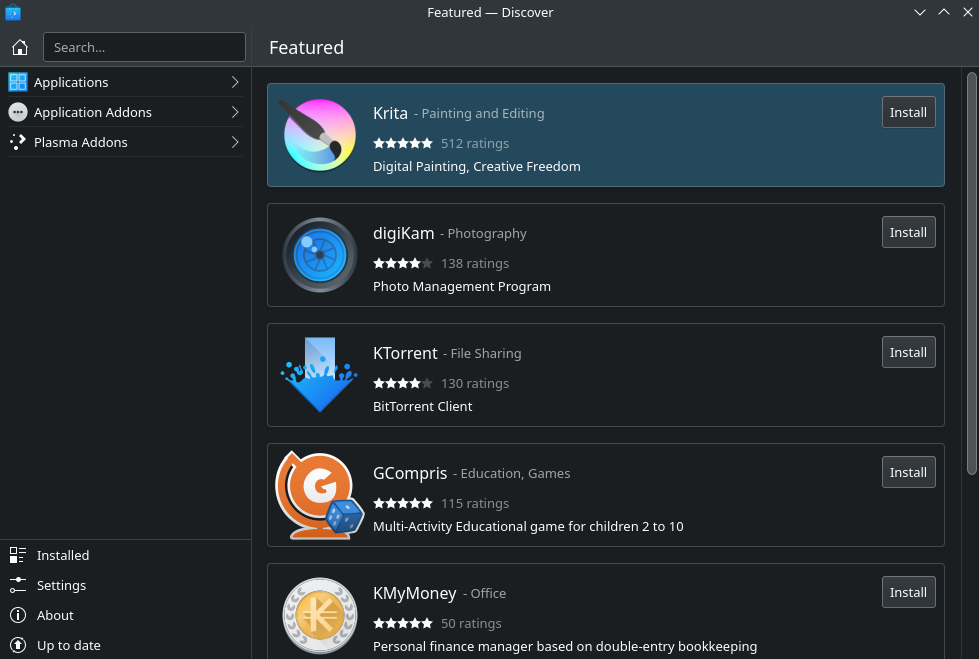
注1:所有這些軟件也可以在其他流行的Linux發行版中獲得,例如Debian,Linux Mint,Elementary OS,Fedora,Manjaro Linux,EndeaVouros和Arch Linux。
App Outlet是一家受Linux App Store在線服務啟發的通用應用程序商店(Flatpaks,快照和附屬)。
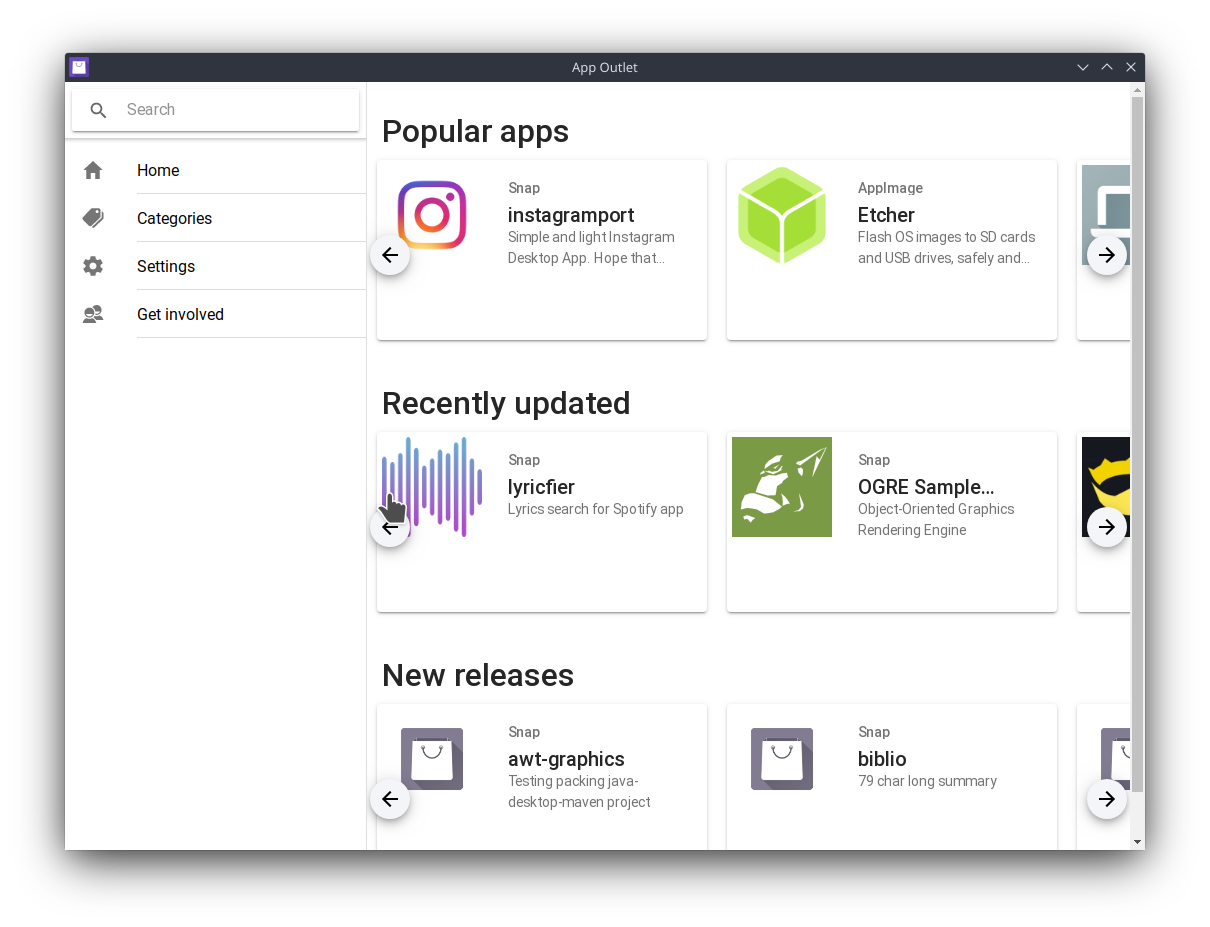
sudo pacman -S flatpakFlathub是Flatpak應用程序的構建和分銷服務。
Flathub論壇
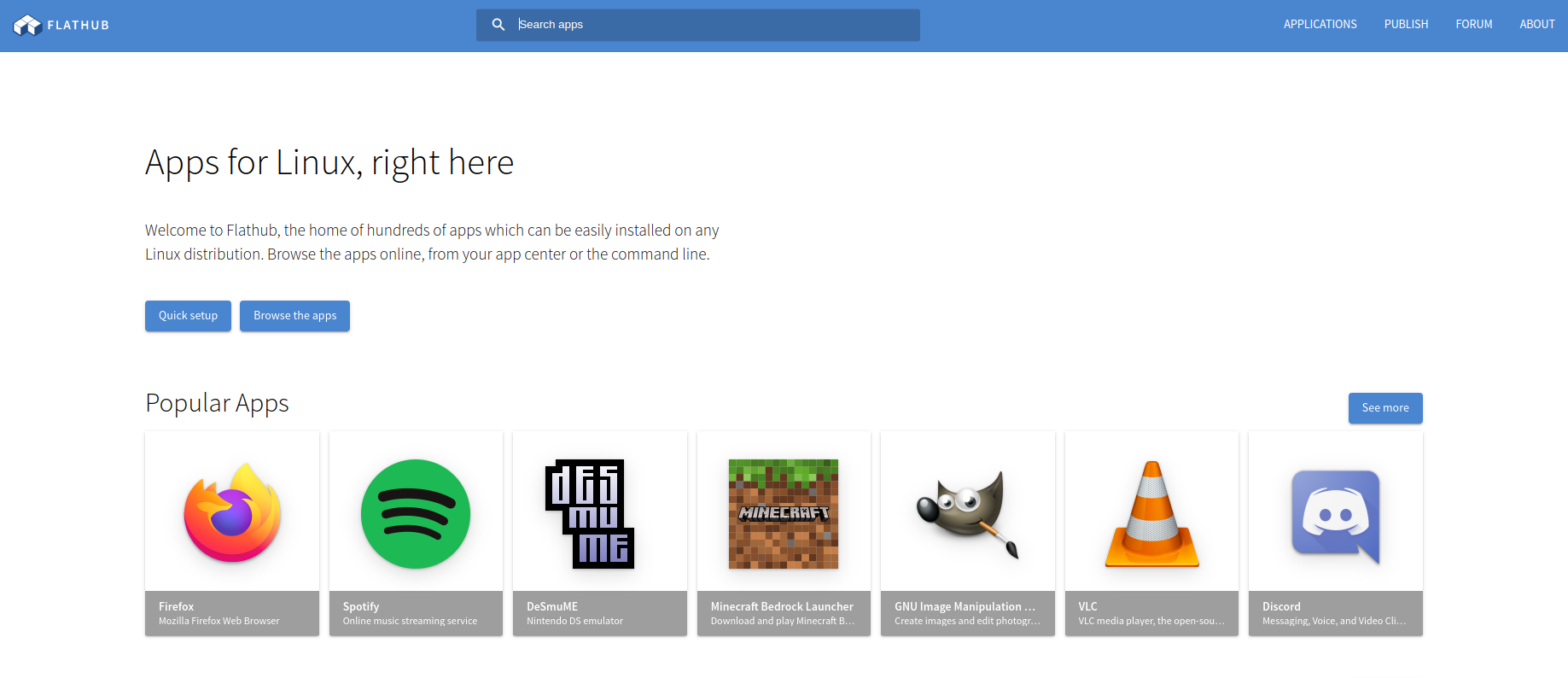
在Arch Linux上安裝快照
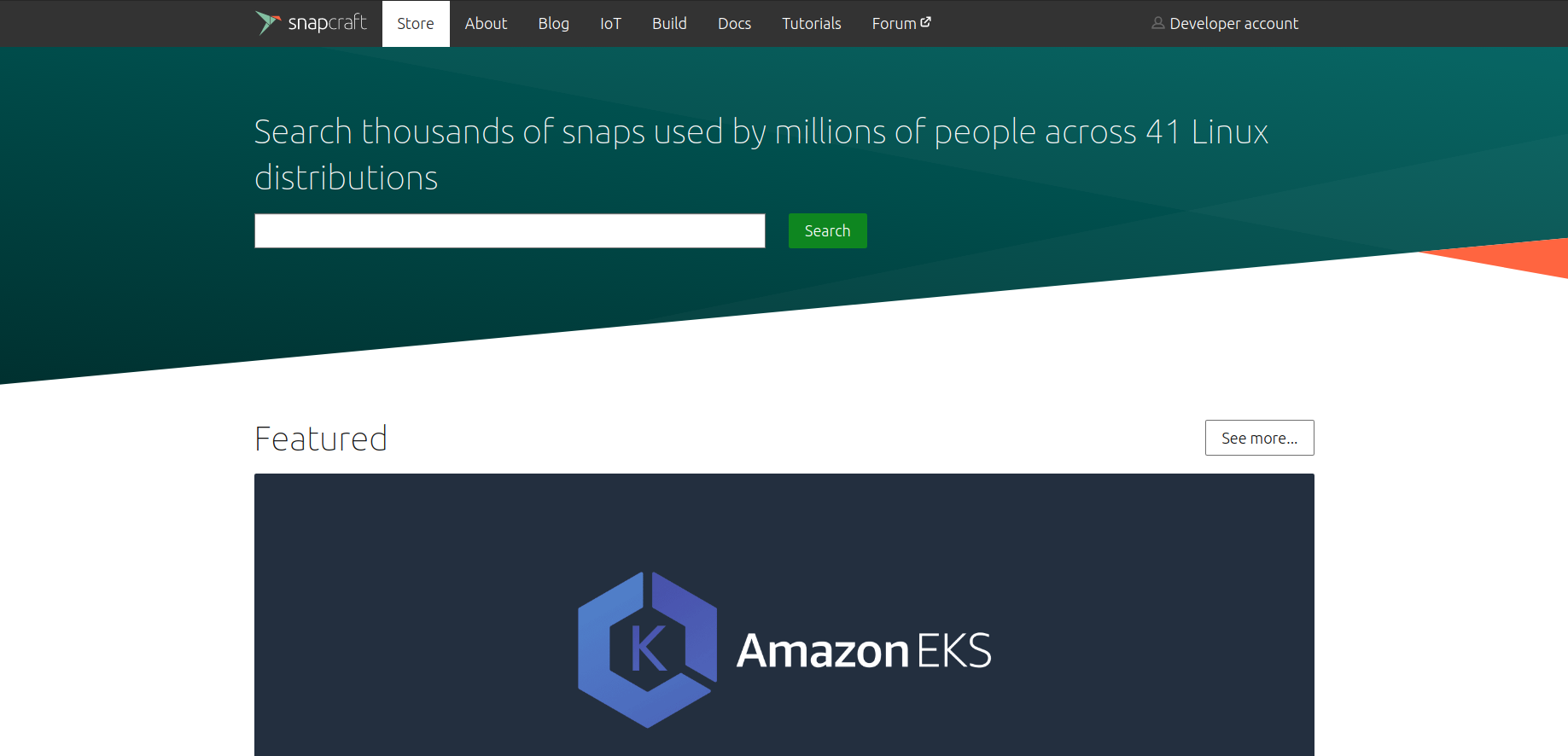
Snap Store是用於快照應用程序的構建和分銷服務。
快照論壇
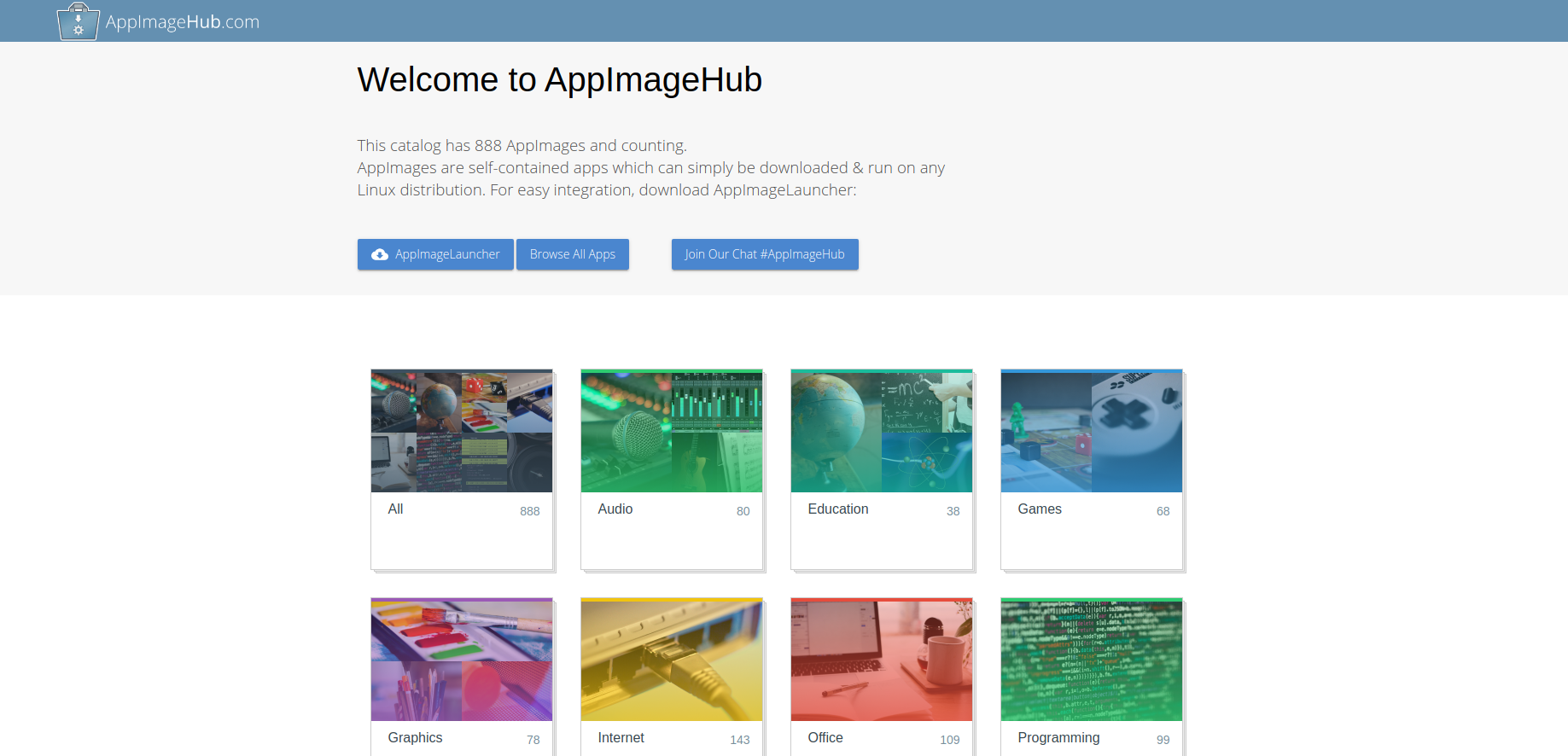
AppimageHub是適用應用程序的構建和分銷服務。
Appimage Manager是適應的軟件包管理器。
附屬論壇
回到頂部
蒸汽在Archwiki中
Steam Flatpak
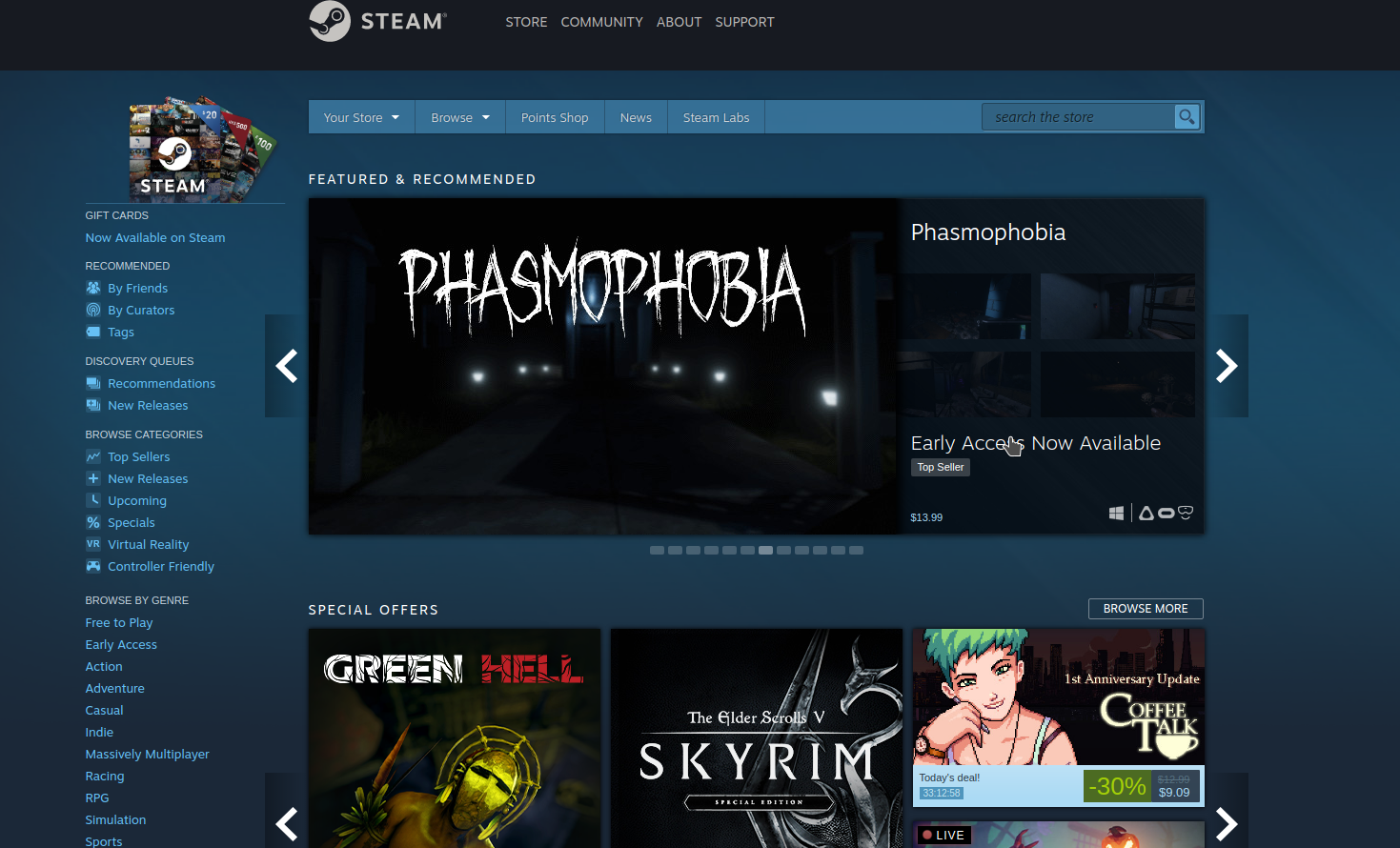
Proton是與Steam客戶端一起使用的工具,該工具允許Windows在Linux操作系統上運行的遊戲。它使用葡萄酒來促進這一點。
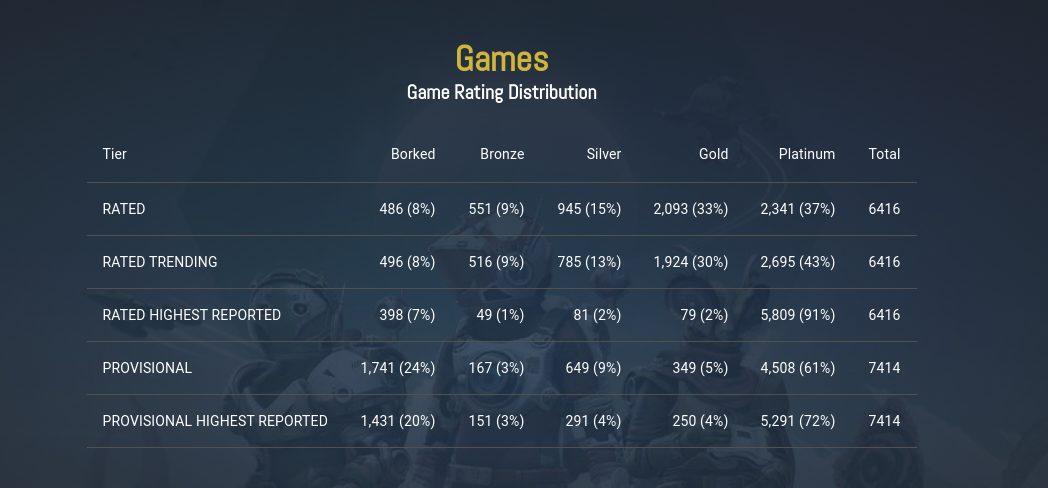
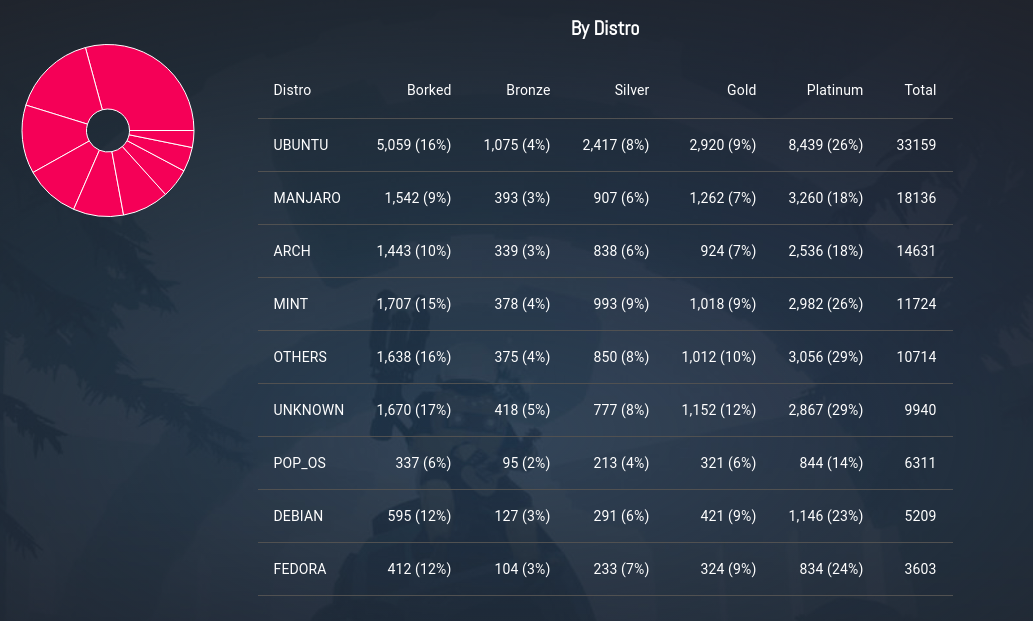
ProtondB是其他遊戲玩家的100,000多個遊戲報告的集合,他們在Linux上使用Proton測試遊戲,並提供了遊戲表現的總分。越來越多的建議提供了調整,您可以在質子繼續開發時嘗試使遊戲工作。除此之外,您還可以探索本網站上的Steam Game目錄以瀏覽並發現以前在Linux上使用的廣泛標題。
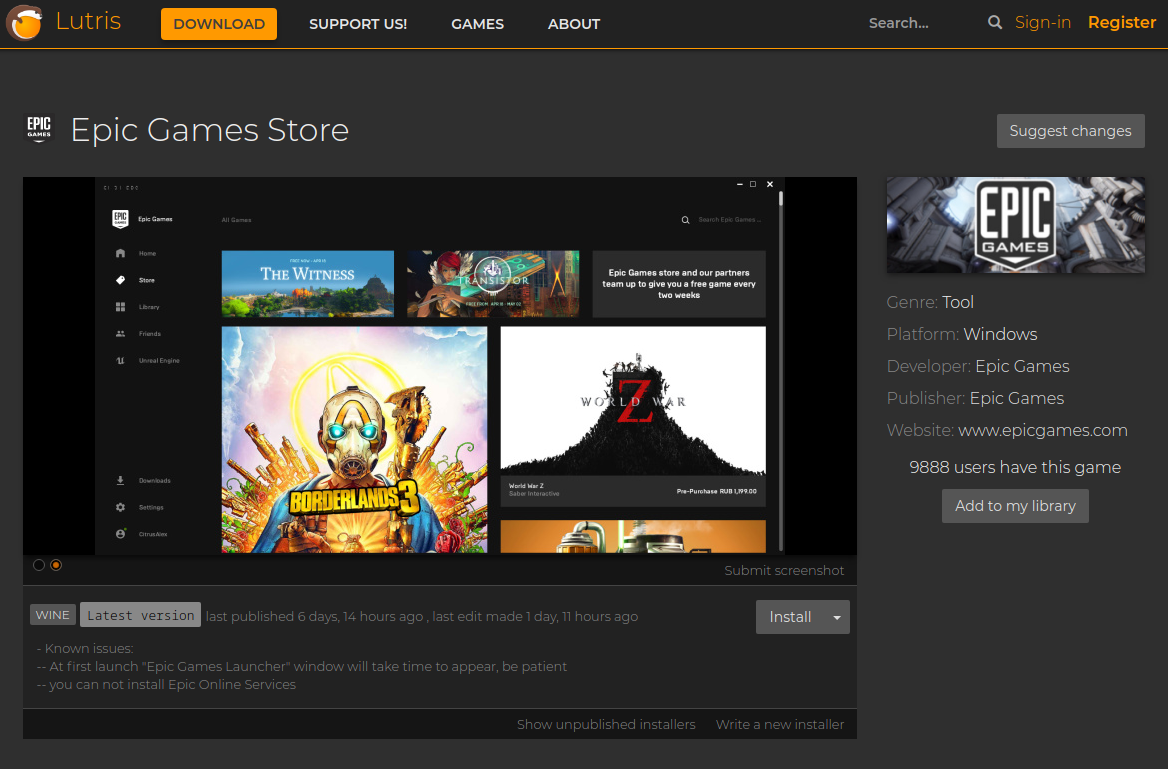
Lutrisis是Linux的遊戲客戶端。除了當前的控制台生成外,它還可以讓您訪問所有視頻遊戲。另外,與其他商店很好地集成了,例如GOG,Steam,Battle.net,Origin,Uplay和許多其他來源,這些資源使您可以導入現有的遊戲庫和社區維護的安裝腳本,為您提供了完全自動化的設置。
添加Epic Games商店
GameHub是您所有遊戲的統一庫。它使您可以將游戲從不同的平台存儲到一個程序中,以使您更容易管理遊戲。
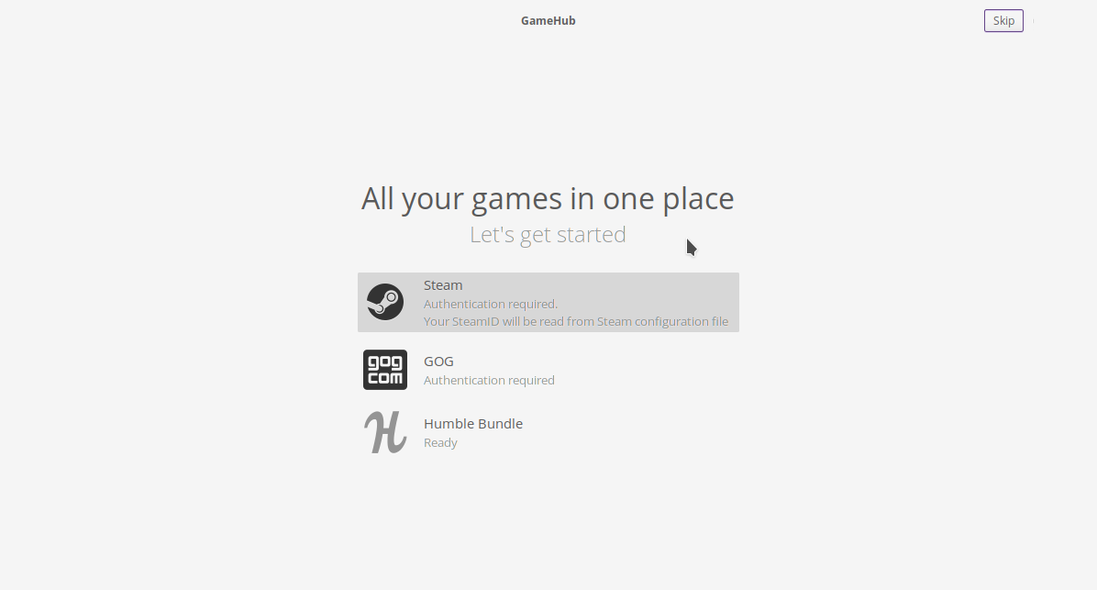
GameHub支持:
Linux的本地遊戲
多個兼容層:
多個遊戲平台:
GeForce現在使用Chromebook版本在Google Chrome或任何基於鉻的Web瀏覽器(例如Brave,Vivaldi和Microsoft Edge)中玩所有遊戲。另外,現在可以在Snap Store Geforce中作為電子桌面應用程序。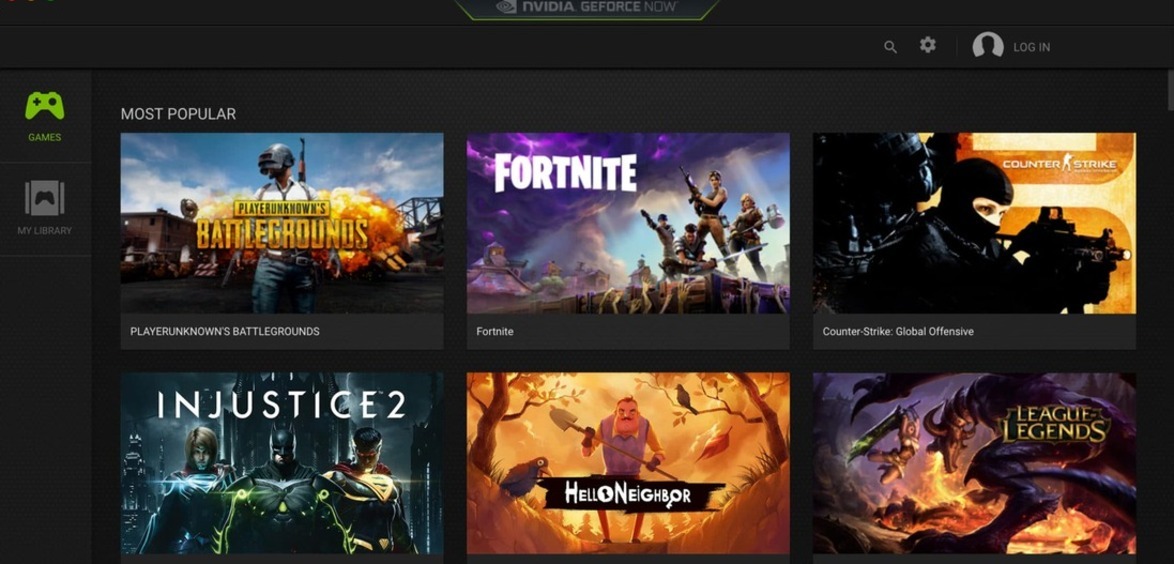
Moonlight Game Streaming是一個程序,可讓您通過Internet從PC遊戲中流式傳輸,而無需配置。無論您是在另一個房間還是距遊戲鑽機,幾乎所有設備都從任何設備中流式傳輸。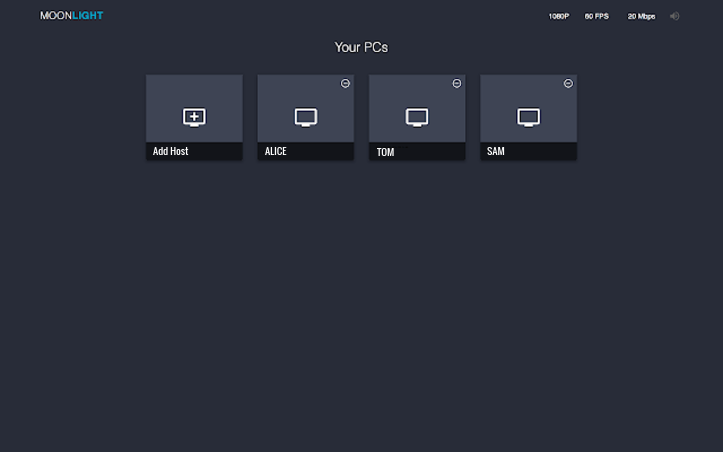
Chiaki是PlayStation 4和PlayStation 5遠程播放的免費開源軟件客戶端,用於Linux,FreeBSD,OpenBSD,Android,MacOS,Windows,Nintendo Switch以及可能的平台。
Xbox Project XCloud是Microsoft基於雲的Xbox遊戲流式技術技術(目前在Beta中) 。玩Forza Horizon 4,Halo 5:Guardians,War 4 Wars Gears of War,Thieves,Cuphead,Red Dead Redemption 2和您的移動設備或Chrome Web瀏覽器上的100多種遊戲之類的遊戲。 Microsoft的Xbox Project XCloud確實需要Xbox Game通過Ultimate訂閱。

Retroarch是模擬器,遊戲引擎和媒體玩家的前端。它使您可以通過其光滑的圖形接口在各種計算機和遊戲機上運行經典遊戲。設置也是統一的,因此一勞永逸地進行配置。
海豚是最近兩個Nintendo視頻遊戲機的模擬器:GameCube和Wii。它使PC遊戲玩家可以在全高清(1080p)中享受這兩個遊戲機的遊戲,並具有多種增強功能:與所有PC控制器,渦輪速度,網絡多人遊戲等等。
Citra是Nintendo 3DS的開源仿真器,能夠玩許多您喜歡的遊戲。
Yuzu是從Citra創建者的Nintendo切換的Nintendo切換的實驗開源仿真器。
DOSBOX是一種開源DOS模擬器,主要側重於運行DOS遊戲。
MAME是街機機仿真器。
Xemu是原始的Xbox模擬器。
Greenwithenvy(GWE)是由Roberto Leinardi設計的GTK系統實用程序,可提供信息,控製粉絲並超頻您的NVIDIA視頻卡,以提高性能。可在流行店以Flatpak的價格購買。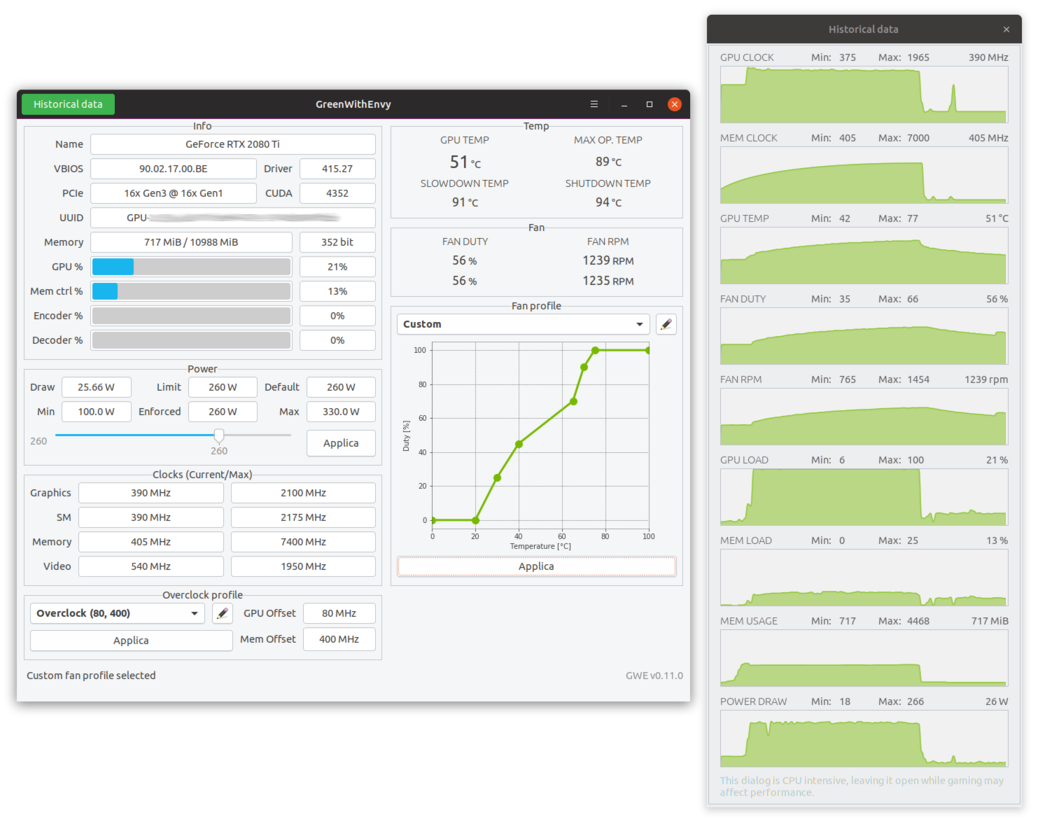
CorectRL是一個免費的開源Linux應用程序,可讓您輕鬆使用本機和Windows應用程序的應用程序配置文件來控制計算機硬件,具有基本的CPU控件和完整的AMD GPU控件(對於舊型號和新型號)。
與Yay一起運行:
yay -Sy corectrl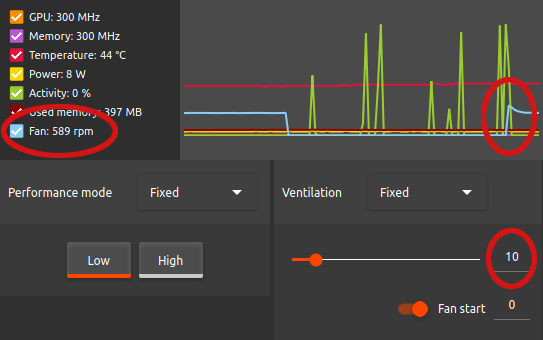
Geekbench 5是一個跨平台基準測試,可通過按下按鈕來衡量系統的性能。
Unigine疊加是PC硬件的極端性能和穩定性測試:視頻卡,電源,冷卻系統。

葡萄酒(Wine不是模擬器)是一個兼容層,能夠在幾個符合POSIX的操作系統(例如Linux,MacOS和BSD)上運行Windows應用程序。 Wine不再像虛擬機或模擬器那樣模擬內部Windows邏輯,而是將Windows API調用轉換為POSIX呼叫,從而消除了其他方法的性能和內存懲罰,並允許您將Windows應用程序清晰地集成到桌面中。
回到頂部
要求
打開終端並運行:
sudo pacman -S qemu uml-utilities virt-manager dmg2img git wget libguestfs-tools p7zip Sosumi是一個應用程序,可以讓您在VM中下載並安裝MACOS。應用基於MacOS-Simple-KVM。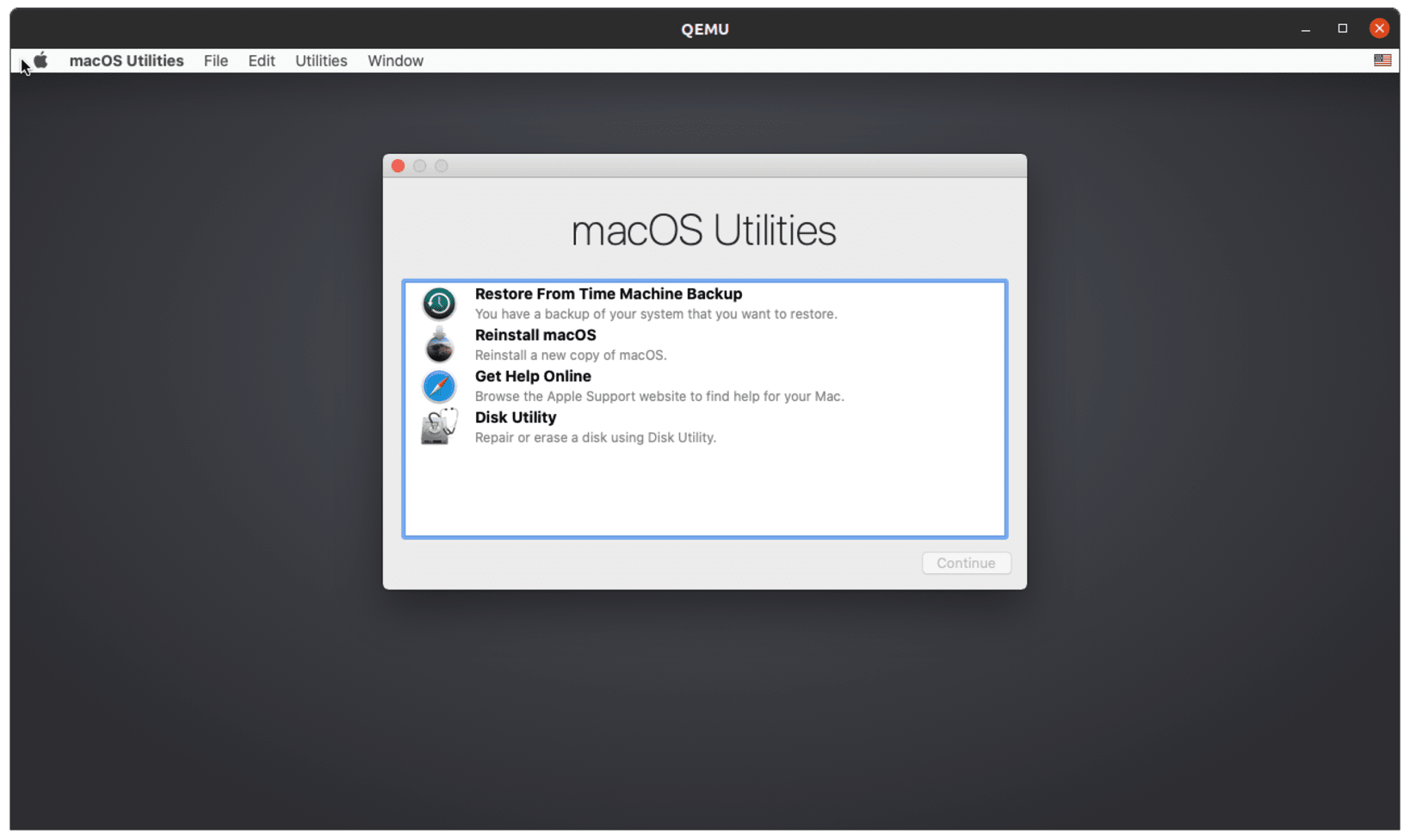
MacOS的Opencore
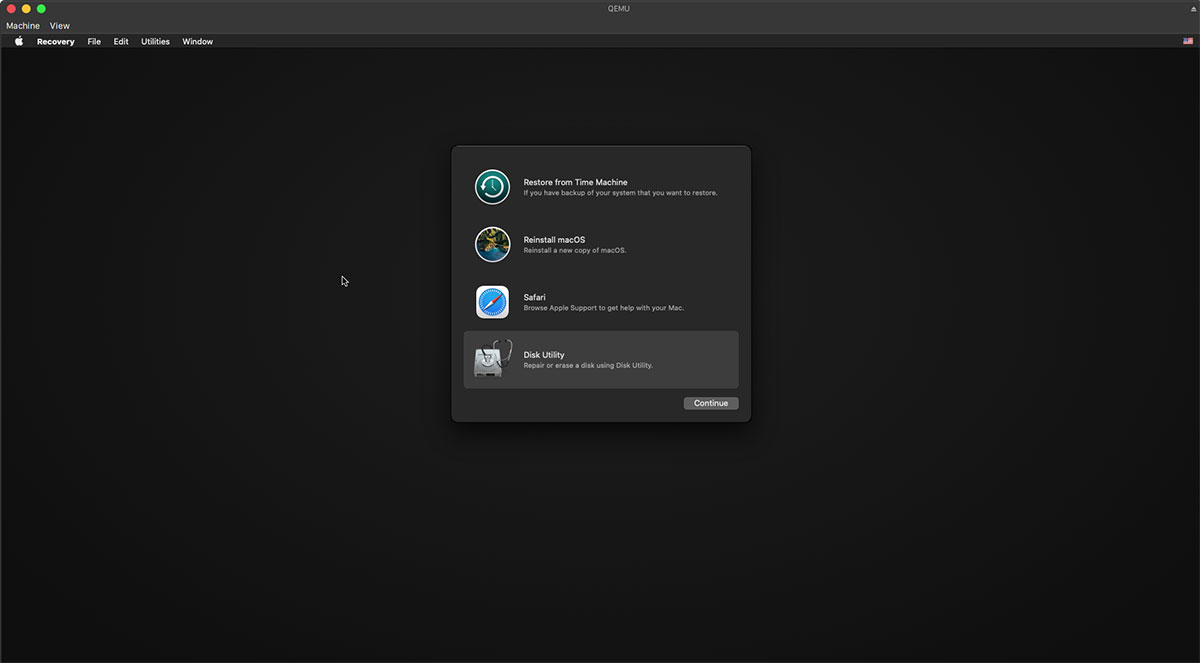
回到頂部
要求
打開終端並運行:
sudo pacman -S qemu uml-utilities virt-manager gnome-boxesGNOME盒子是一個應用程序,可讓您訪問本地或遠程運行的虛擬機。它還允許您連接到遠程計算機的顯示。
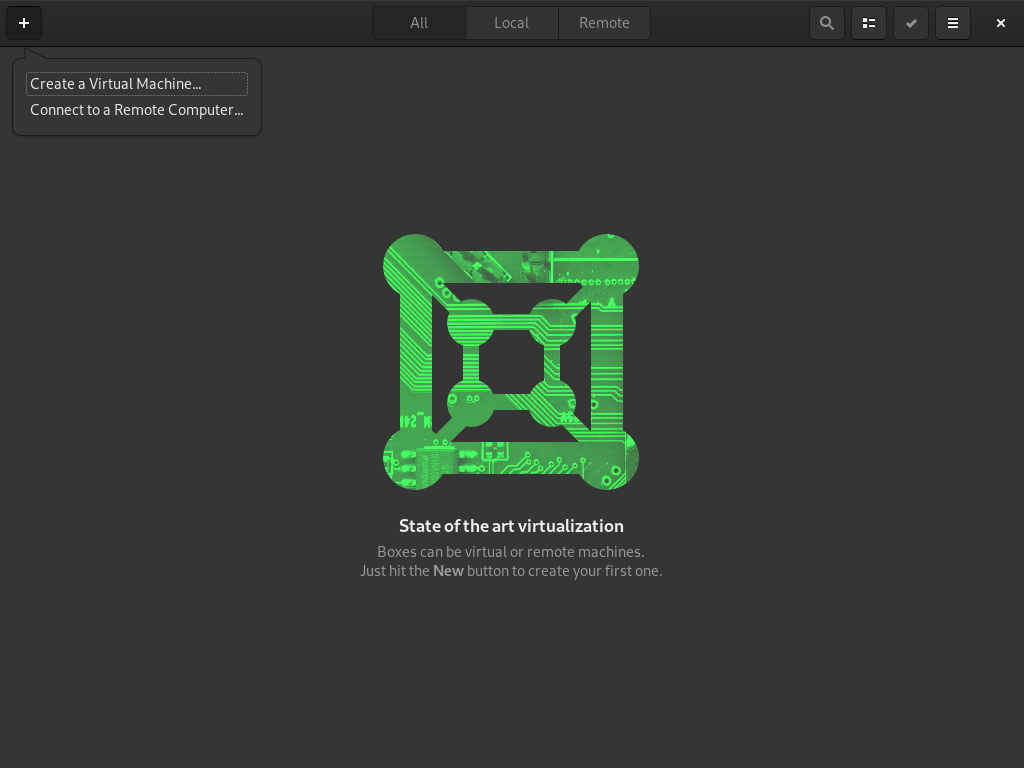
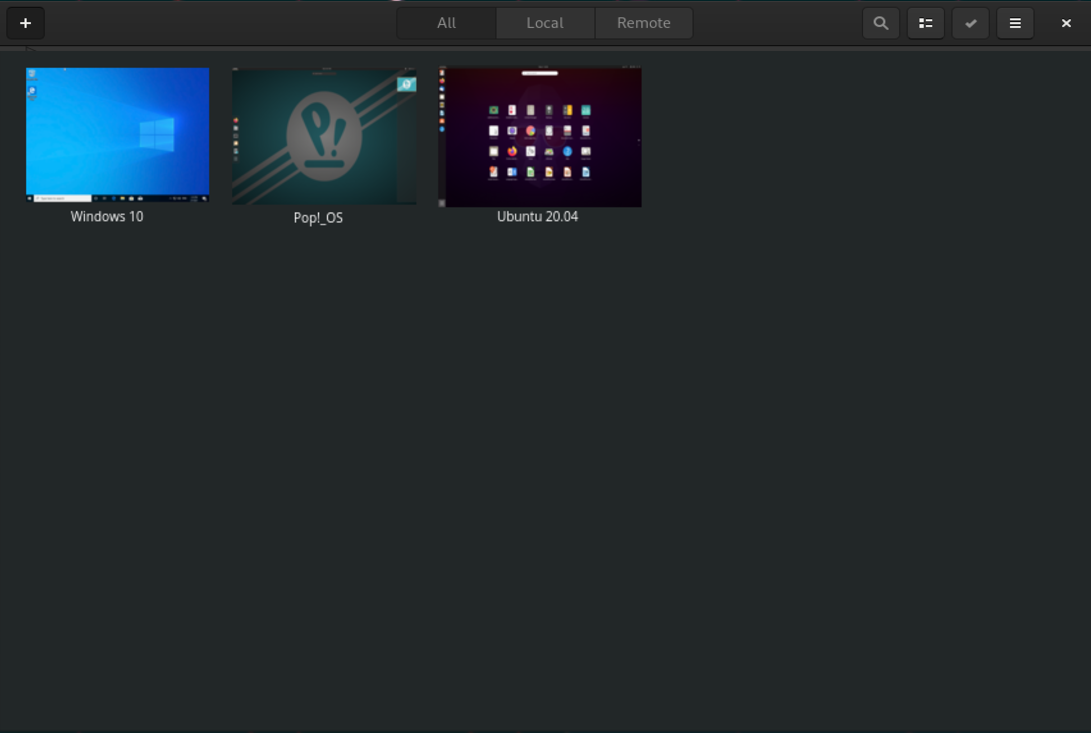
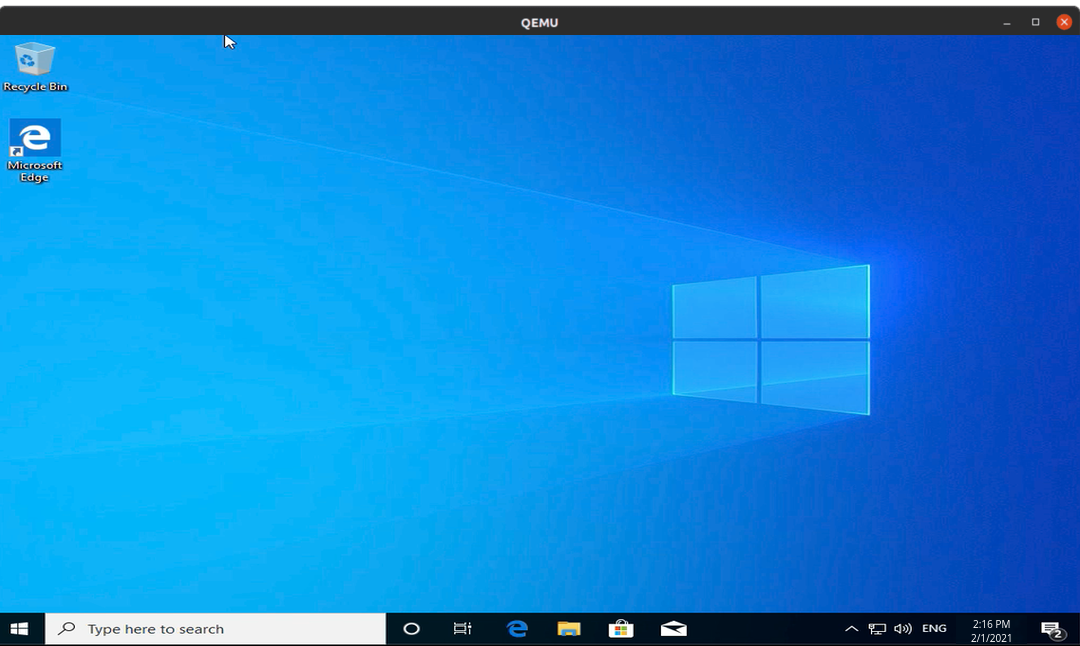
Windows 10的OpenCore
回到頂部
Android Studio是Google Android操作系統(OS)的開發套件。它建立在Jetbrains Intellij Idea軟件上,並專門為Android開發設計。它可在Windows,MacOS和Linux上下載。
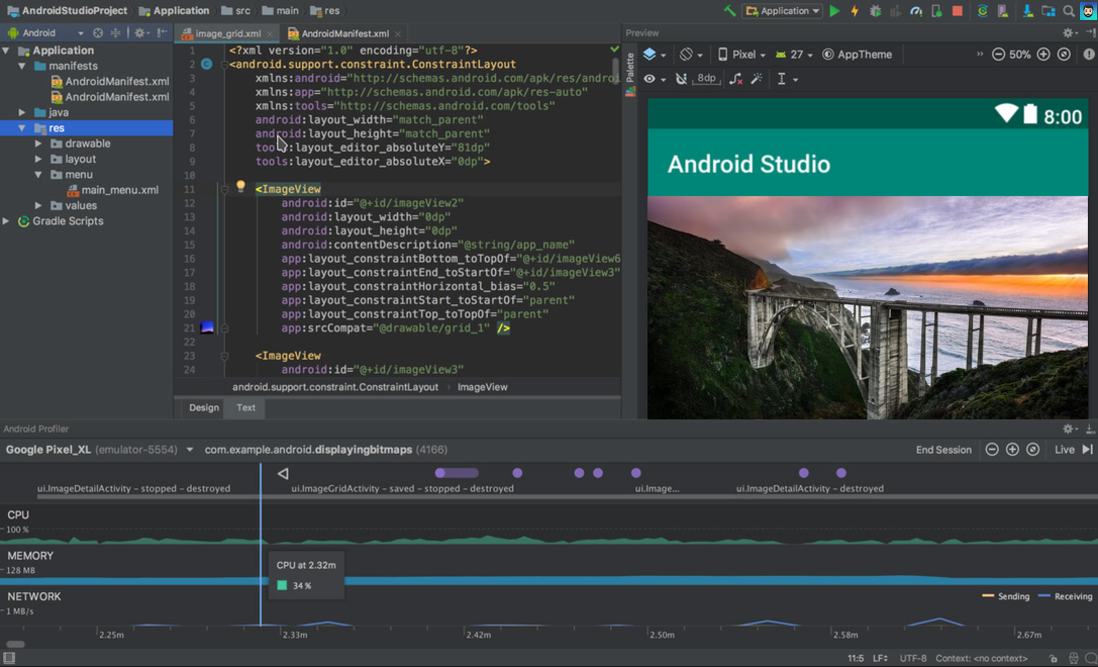
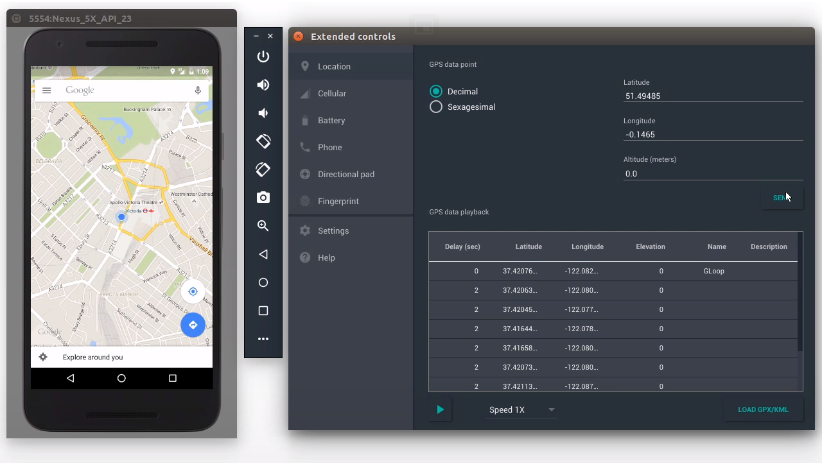
Android虛擬設備(AVD)是Android Studio中的一種配置,它定義了要在Android Emulator中模擬的Android手機,平板電腦,佩戴OS,Android TV或Automotive OS設備的特性。 Android模擬器在計算機上模擬Android設備,以便您可以在各種設備和Android API級別上測試您的應用程序,而無需使用每個物理設備。
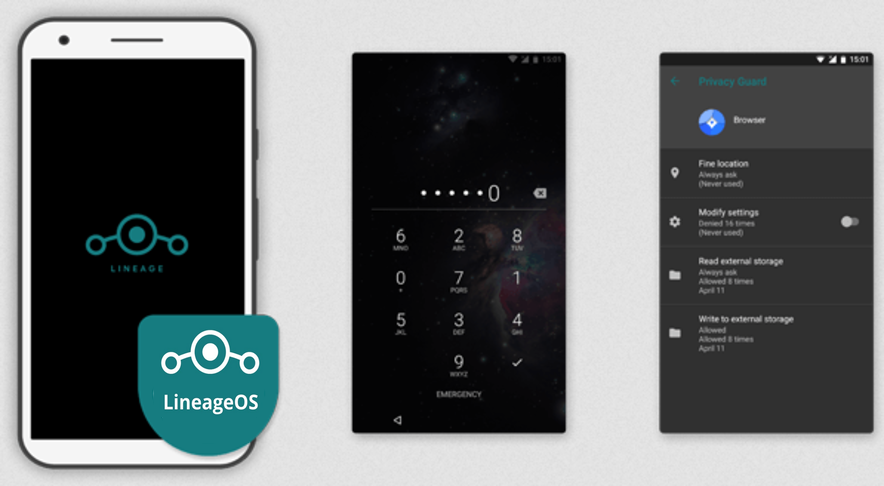
Lineageos是基於Android移動平台的各種設備的免費和開源操作系統。
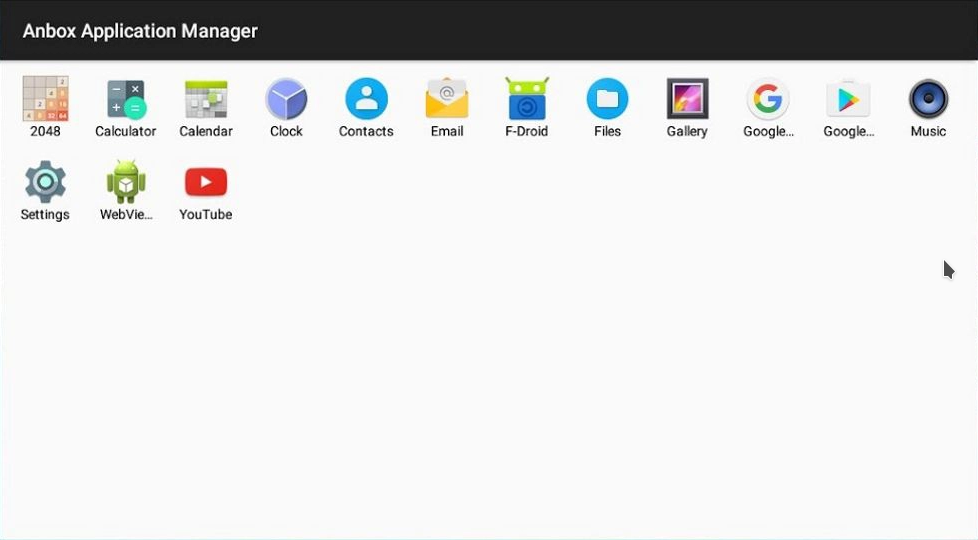
Anbox是一種應用程序,它提供了一種基於容器的方法,可以在Ubuntu,Debian Fedora和OpenSuse等常規GNU/Linux系統上引導完整的Android系統。
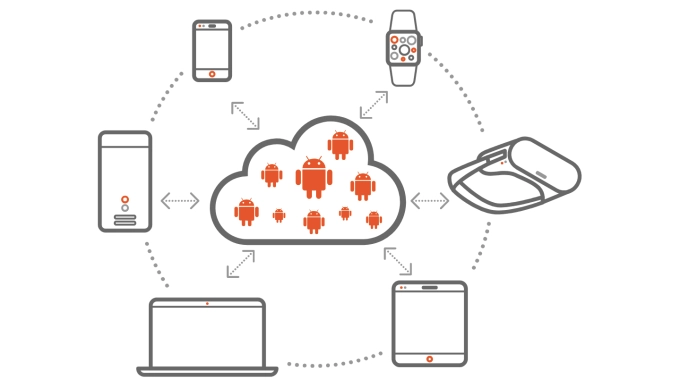
Anbox Cloud是由Canonical提供的移動雲計算平台。在雲中運行Android,以高度和任何類型的硬件運行。
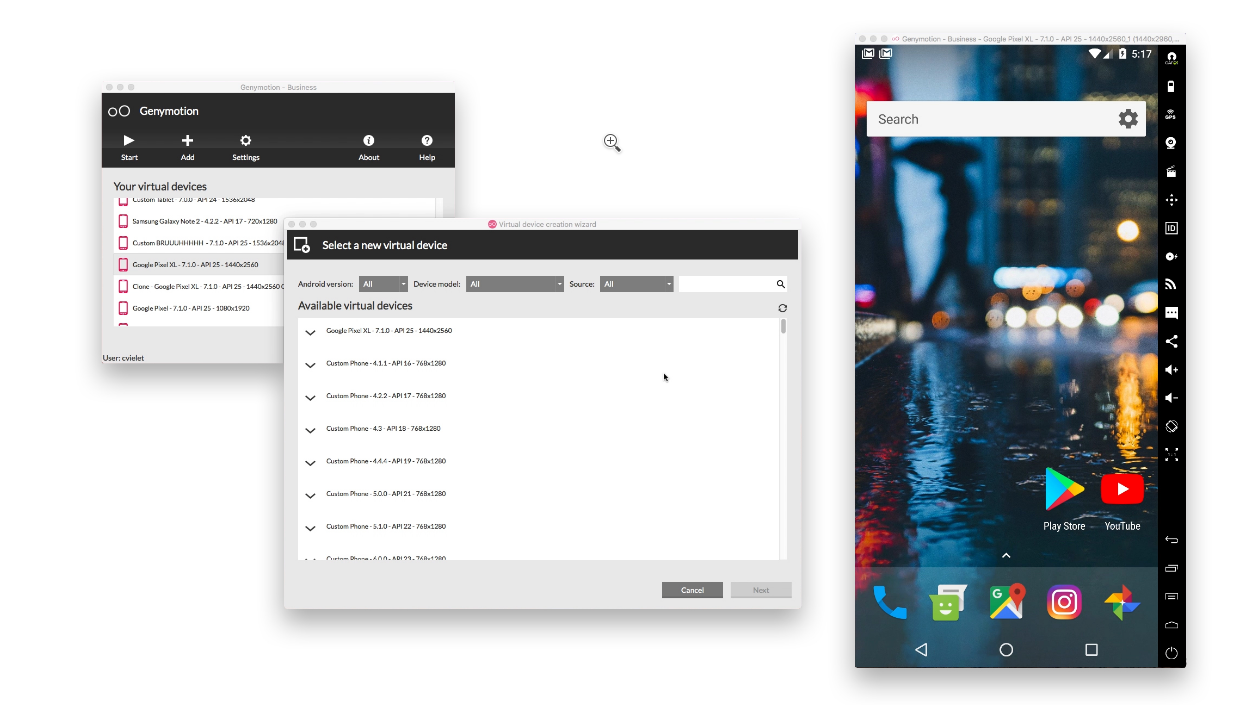
Genymotion是一種非常快速的Android模擬器。該程序本身基於VirtualBox,以其有效的快速速度而聞名,對於在Windows,Mac和Linux桌面上運行Android應用程序是有用的。
桌面
具有高性能的本地虛擬設備。
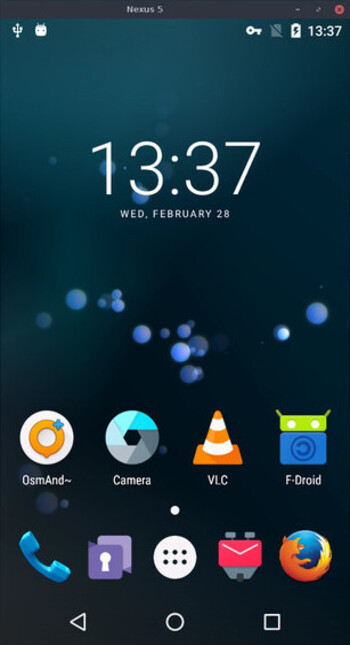
SCRCPY是一種逐軸的應用,可提供連接在USB(或TCP/IP上)的Android設備的顯示和控制。它不需要任何根訪問,並且可以在GNU/Linux,Windows和MacOS上使用。 Android設備至少需要API 21(Android 5.0)。
回到頂部
H.264(AVC)是基於面向塊的和運動補償的整數DCT編碼的視頻壓縮標準,該標准定義了多個支持8K的多個配置文件(工具)和級別(工具)和級別(最大比特率和分辨率)。
H.265(HEVC)是視頻壓縮標準,是H.264(AVC)的繼任者。它在相同的視頻質量級別上提供25%至50%的數據壓縮,或者以相同的位速率改進視頻質量。
FFMPEG是一個領先的多媒體框架,可以解碼,編碼,transcode,mux,demux,stream,filter和play人類和計算機創建的所有內容。它支持最晦澀的古代格式,直到較最前沿的格式,例如Windows,MacOS和Linux等多個平台。
Handbrake是一種工具,用於從幾乎所有格式轉碼視頻,並選擇了廣泛支持的編解碼器。它在窗口,MacOS和Linux上受支持。
HTTP(DASH)上的動態自適應流是一種自適應流協議,它允許視頻流根據網絡性能在比特率之間切換,以保持視頻播放。
OpenMax™是一種跨平台API,通過啟用可以在多個操作系統和矽平台上開發,集成和編程的加速多媒體組件來提供全面的流媒體編解碼器和應用程序可移植性。
Davinci Resolve是世界上唯一的解決方案,它結合了專業的8K編輯,顏色校正,視覺效果和音頻後的生產,全部將其全部組合為一個軟件工具!您可以單擊一次在編輯,顏色,效果和音頻之間立即移動。 Davinci Resolve Studio也是為多用戶協作而設計的唯一解決方案,因此編輯,助手,色彩師,VFX藝術家和聲音設計師都可以同時在同一項目上進行現場工作。
Blender帶有內置的視頻序列編輯器,可讓您執行基本動作,例如剪切和剪接,以及更複雜的任務,例如視頻掩蓋或顏色分級。視頻編輯器包括:實時預覽,Luma波形,Chroma vectorscope和直方圖顯示。音頻混合,同步,擦洗和波形可視化。
Kdenlive是一種開源視頻編輯工具,支持無限的多媒體文件。它基於MLT框架KDE和QT。正在尋找包含功能的非常通用的視頻編輯工具的人。最新的20.08版本具有諸如接口佈局,多個音頻流支持,緩存的數據管理和Zoombars和Zoombars和效果面板中的漂亮功能,但有人可能會說此版本的亮點是穩定性和接口改進。
OpenShot是一種開源視頻編輯工具,專為編輯環境中的新用戶設計。它具有簡單的功能,例如簡單的拖放功能,它提供了易於使用且快速學習的用戶界面。功能強大的視頻編輯器提供了許多有效的方法來剪切和修剪視頻。您可以自由使用無限的曲目,視頻效果引擎,標題編輯器,3D動畫,慢動作和時間效果。它支持由FFMPEG(例如WebM(VP9),AVCHD(LIBX264),HEVC(LIBX265)和MMP3(Libmp3lame)和AAC(LIBFAAC)等音頻編解碼器所支持的常用視頻編解碼器。該程序可以渲染MPEG4,OGV,Blu-ray和DVD視頻,以及用於上傳到YouTube等Internet視頻網站的完整高清視頻。
LightWorks是一種非線性視頻編輯鼓掌,用於編輯和掌握電影行業使用的數字視頻。它的專業版已用於票房熱門歌曲,例如Shutter Island,Pulp Fiction和Mission Essible。恐嚇用戶界面。像專業的視頻編輯器(例如Adobe Premiere Pro)一樣,LightWorks對於新用戶使用也很複雜。
ShotCut是開源的多平台視頻編輯器。您可以執行各種操作,例如視頻編輯(包括4K視頻質量),添加效果,創建新電影,導入大多數圖像文件格式,導出到幾乎所有文件格式等等。
Olive是一款免費的非線性視頻編輯器,旨在為高端專業視頻編輯軟件提供功能齊全的替代方案。
OBS(開放廣播軟件)是免費的開源軟件,用於視頻錄製和直播。流到Twitch,YouTube和許多其他提供商或使用高質量的H264 / AAC編碼錄製自己的視頻。
Reaper是針對計算機的完整數字音頻生產應用程序,它提供了完整的多站音頻和MIDI錄製,編輯,處理,混合和掌握工具集。 REAPER支持廣泛的硬件,數字格式和插件,並且可以全面擴展,腳本化和修改。
Jack Audio Connection Kit aka Jack是一款專業的聲音服務器守護程序,在實現其API的應用程序之間為音頻和MIDI數據提供實時,低延遲連接。可以將Jack配置為通過網絡將音頻數據發送到“主”計算機,然後將音頻輸出到物理設備。這對於在不需要其他電纜或硬件混音器的情況下將音頻從許多“從屬”計算機中混合而有用,並儘可能長時間保持音頻路徑數字。
Bitwig Studio是一個數字音頻工作站,具有線性和非線性工作流,用於聲音設計,錄製,實時性能等。以及90多種儀器,效果和其他創意工具。它是受支持的Windows,MacOS和Linux。
PipeWire是一種服務器和用戶空間API,可處理多媒體管道。它在音頻和視頻設備上提供了低延遲的基於圖形的處理引擎,可用於支持Pulseaudio和Jack當前處理的用例。 PipeWire的設計採用強大的安全模型,使來自容器化應用程序的音頻和視頻設備變得容易。圖中的節點可以作為單獨的過程實現,與插座通信並使用FD傳遞交換多媒體內容。
Yabridge是一種在Linux上使用Windows VST2和VST3插件的現代透明方法。 Yabridge在64位Linux VST主機中使用32位和64位Windows VST2和VST3插件同時無縫支撐,就像它們是本機VST2和VST3插件一樣,對插件組的可選支持以啟用用於VST2插件的Plugin Inter-Plugin通信,以獲取VST2插件和快速啟動時間。
Sonobus是一種易於使用的應用程序,用於在Internet或本地網絡之間在設備之間流式傳輸高質量的低延遲點對點音頻。
Avid Pro Tools是一種為詞曲作者,音樂家,製作人和工程師提供的行業標準音頻製作軟件。
LMMS是一種開源數字音頻工作站應用程序。當LMM與適當的計算機硬件配對時,它可以通過安排樣品,合成聲音,在MIDI鍵盤上播放以及結合跟踪器和音序器的功能來製作音樂。該程序由Paul Giblock和Tobias Junghans開發,代表“ Linux Multimedia Studio”,並支持便利的插件,使其能夠在不同的操作系統上工作。
Ardor是全球團隊的開源,包括音樂家,程序員和專業錄音工程師的合作努力。開發是透明的 - 任何人都可以觀察我們的工作。就像一塊好老式硬件一樣,您可以打開盒子並在裡面看。
Audacity是Windows,Mac OS X,GNU/Linux和其他操作系統的易於使用的多軌音頻編輯器和錄音機。由一群志願者開發為開源,並免費提供。驚人的支持社區。
瞥見是基於用於Linux,MacOS和Windows的GNU圖像操作程序的跨平台柵格圖形編輯器。製作YouTube視頻縮略圖的好工具。
回到頂部

Kubernetes(K8S)是一種開源系統,用於自動化容器應用程序的部署,擴展和管理。
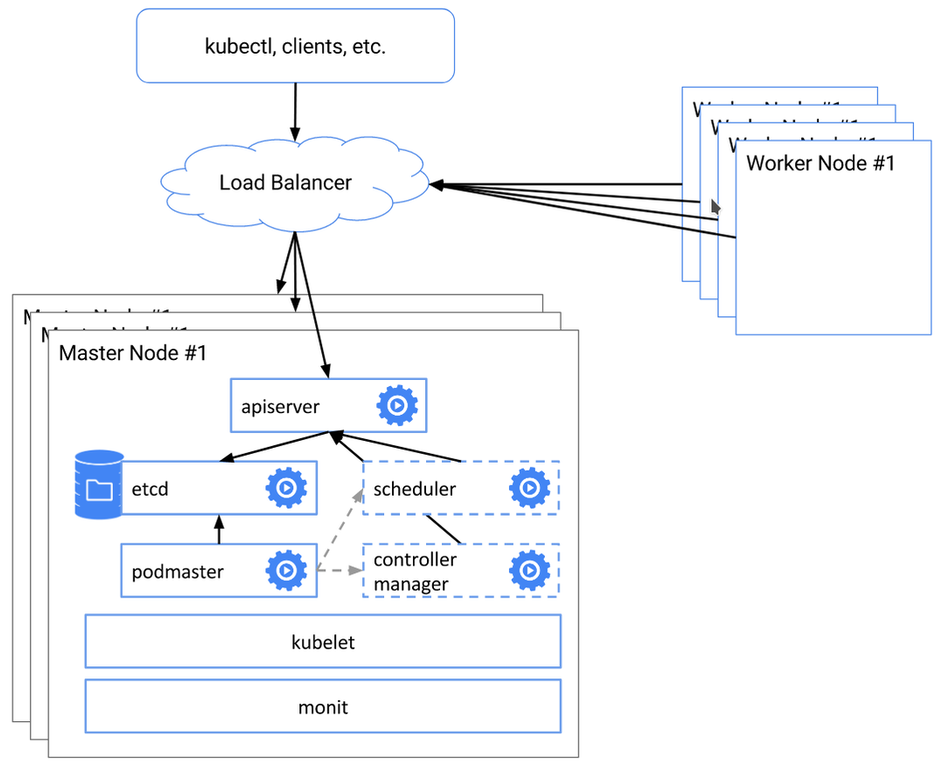
使用Kubeadm構建高可用性(HA)集群。資料來源:Kubernetes.io,2020年
Anthos是一個現代的應用程序管理平台,為雲和本地環境提供一致的開發和運營經驗。
Red Hat OpenShift是一個完全管理的Kubernetes平台,為本地,混合和多雲部署提供了基礎。
OKD是優化用於連續應用程序開發和多租戶部署的Kubernetes的社區分佈。 OKD在Kubernetes之上添加了以開發人員和以操作為中心的工具,以實現快速的應用程序開發,易於部署和擴展以及針對小型和大型團隊的長期生命週期維護。
ODO是在Kubernetes和OpenShift上編寫,構建和部署應用程序的開發人員的快速,迭代且直接的CLI工具。
KATA操作員是在OpenShift以及Kubernetes群集上執行Kata運行時進行生命週期管理(安裝/升級/卸載)的操作員。
Thanos是一組組件,可以組成具有無限存儲容量的高度可用的度量系統,可以在現有的Prometheus部署之上無縫添加。
OpenShift Hive是一家運營商,可在Kubernetes/OpenShift頂部運行。 Hive服務可用於提供和執行OpenShift 4群集的初始配置。
ROOK是一種將分佈式存儲系統變成自我管理,自我縮放,自我修復存儲服務的工具。它可以自動化存儲管理員的任務:部署,自舉,配置,配置,縮放,升級,升級,遷移,災難恢復,監視和資源管理。
VMware Tanzu是一個集中的管理平台,可在多個團隊和私人/公共雲中始終如一地運營和確保您的Kubernetes基礎架構和現代應用程序。
Kubespray是一種結合Kubernetes和Ansible的工具,可以輕鬆安裝可以部署在AWS,GCE,Azure,OpenStack,vsphere,vSphere,vsphere,bare tacke(Bare Metal),Oracle Cloud Cloud Infrstructure(實驗性)或Baremetal或Baremetal或Baremetal上的Kubernetes群集。
Kubeinit為部署和配置多個Kubernetes發行版提供了Ansible劇本和角色。
牧場主是用於採用容器的團隊的完整軟件堆棧。它解決了管理多個Kubernetes群集的操作和安全挑戰,同時為DevOps團隊提供了用於運行容器化工作負載的集成工具。
K3S是一款高度可用的,經過認證的Kubernetes發行版,旨在在無人看管的,資源受限的,遠程位置或物聯網電器內部的生產工作負載。
Helm是Kubernetes軟件包管理器工具,它使安裝和管理Kubernetes應用程序變得更加容易。
Knative是一個基於Kubernetes的平台,用於構建,部署和管理現代的無服務器工作負載。 Knative照顧網絡,自動化(甚至為零)和修訂跟踪的操作開銷細節。
KubeFlow是一種致力於在Kubernetes上進行機器學習(ML)工作流程的工具,簡單,便攜式和可擴展。
ETCD是一個分佈式鍵值商店,它提供了一種可靠的方式來存儲需要由分佈式系統或機器群訪問的數據。 ETCD用作服務發現的後端,並存儲kubernetes的群集狀態和配置。
OpenEBS是一種基於Kubernetes的工具,可使用包含容器的存儲創建狀態應用程序。
容器存儲界面(CSI)是一種API,可讓像Kubernetes這樣的容器編排平台通過插件與存儲的數據無縫通信。
Microk8s是提供完整的Kubernetes體驗的工具。在完全容器的部署中,具有壓縮的超空更新,以實現超可靠操作。它在Linux,Windows和MacOS上受支持。
Charmed Kubernetes是一個整體良好的,鍵合的Kubernetes平台,可針對Canonical開發的多雲環境進行了優化。
Grafana Kubernetes應用程序是一項損失,可讓您監視Kubernetes群集的性能。它包括4個儀表板,群集,節點,POD/容器和部署。它允許自動部署所需的Prometheus出口商和默認的Scrape配置,以與您的集群Prometheus部署一起使用。
Kubeedge是一種開源系統,用於將本機容器化的應用程序編排功能擴展到Edge的主機。 IT是建立在Kubernetes上的,並為網絡,應用程序提供基本基礎架構支持。雲和邊緣之間的部署和元數據同步。
對於需要每天與Kubernetes群集打交道的人們,鏡頭是最強大的IDE。它支持MacOS,Windows和Linux操作系統。
類型是使用Docker容器“節點”運行本地Kubernetes群集的工具。它主要設計用於測試Kubernetes本身,但可用於本地開發或CI。
Flux CD是一種工具,可以自動確保Kubernetes群集的狀態與您在GIT中提供的配置匹配。它使用集群中的操作員在Kubernetes內部觸發部署,這意味著您不需要單獨的連續交付工具。
獲得Kubernetes認證
AWS上的Kubernetes入門
Microsoft Azure上的Kubernetes
Azure Kubernetes服務的介紹
Google Cloud入門
紅帽上的Kubernetes入門
IBM上的Kubernetes入門
kubernetes中的YAML基礎知識
彈性雲在Kubernetes上
Docker和Kubernetes
將模型部署到Azure Kubernetes服務群集
用亞馬遜薩格人操作員簡化了對Kubernetes的機器學習推斷
在Kubernetes上運行Apache Spark
跨VMware vRealize自動化的kubernetes
VMware Tanzu Kubernetes網格
VMware Tanzu與AWS合作的所有方式
VMware Tanzu教育
在雲原生的Kubernetes環境中使用Ansible
使用Ansible管理Kubernetes(K8S)對象
使用Vagrant和Ansible設置Kubernetes群集
與kubernetes一起運行mongodb
Kubernetes Fluentd
了解新的gitlab kubernetes代理
Kubernetes貢獻者
來自VMware的Kubeacademy
回到頂部
TensorFlow是機器學習的端到端開源平台。它擁有一個全面,靈活的工具,圖書館和社區資源的生態系統,使研究人員可以推動ML的最新技術,開發人員可以輕鬆構建和部署ML供電的應用程序。
Tensorman是通過System76開發的TensorFlow容器容易管理的實用程序。 Tensorman允許張量集在系統其餘部分中包含的隔離環境中運行。此虛擬環境可以獨立於基本系統操作,從而使您可以在支持Docker運行時的任何版本的Linux發行版上使用任何版本的Tensorflow。
Keras是一種高級神經網絡API,用Python編寫,能夠在Tensorflow,CNTK或Theano的頂部運行。它是開發出來的,重點是實現快速實驗。它能夠在Tensorflow,Microsoft認知工具包,R,Theano或Plaidml上運行。
Pytorch是一個可以深入學習不規則輸入數據的庫,例如圖形,點雲和歧管。主要由Facebook的AI研究實驗室開發。
Amazon Sagemaker是一項完全管理的服務,可為每個開發人員和數據科學家提供迅速構建,訓練和部署機器學習(ML)模型的能力。 Sagemaker從機器學習過程的每個步驟中刪除了繁重的舉動,以使開發高質量模型變得更加容易。
Azure Databricks是一款為數據科學和數據工程設計的快速且協作的基於Apache Spark的大數據分析服務。 Azure Databricks,在幾分鐘內設置您的Apache Spark環境,自動賽車並在交互式工作區中的共享項目進行協作。 Azure Databricks支持Python,Scala,R,Java和SQL,以及數據科學框架和庫,包括Tensorflow,Pytorch和Scikit-Learn。
Microsoft認知工具包(CNTK)是用於商業級分佈深度學習的開源工具包。它將神經網絡描述為通過有向圖的一系列計算步驟。 CNTK允許用戶輕鬆實現並結合流行的模型類型,例如饋電DNN,卷積神經網絡(CNNS)和經常性神經網絡(RNN/LSTMS)。 CNTK實現了隨機梯度下降(SGD,錯誤反向傳播)學習,並在多個GPU和服務器上進行自動分化和並行化。
Apache AirFlow是一個由社區創建的開源工作流管理平台,可編程作者,計劃和監視工作流程。安裝。原則。可擴展。氣流具有模塊化體系結構,並使用消息隊列來協調任意數量的工人。氣流可以擴展到無窮大。
開放的神經網絡交換(ONNX)是一個開放的生態系統,它使AI開發人員能夠隨著項目的發展而選擇正確的工具。 ONNX為AI模型提供了開源格式,包括深度學習和傳統ML。它定義了可擴展的計算圖模型,以及內置運算符和標準數據類型的定義。
Apache MXNET是一個旨在效率和靈活性的深度學習框架。它使您可以混合符號和命令性編程,以最大程度地提高效率和生產力。 MXNET以其核心包含一個動態依賴調度程序,該調度程序會自動將符號和當務之急的操作自動平行。頂部的圖形優化層使符號執行速度快速且內存有效。 MXNET是便攜式且輕巧的,可有效地縮放到多台GPU和多個機器。支持Python,R,Julia,Scala,Go,JavaScript等。
Autogluon是用於深度學習的工具包,可自動化機器學習任務,使您能夠輕鬆地在應用程序中實現強大的預測性能。只需幾行代碼,您就可以在表格,圖像和文本數據上訓練和部署高準確的深度學習模型。
Anaconda是一個非常流行的數據科學平台,用於機器學習和深度學習,使用戶能夠開發模型,訓練和部署它們。
PLAIDML是一種高級且便攜式張量編譯器,可在筆記本電腦,嵌入式設備或其他設備上進行深入學習,在這些設備上,可用的計算硬件不得到很好的支持,或者可用的軟件堆棧包含不可展示的許可證限制。
OpenCV是一個高度優化的庫,重點是實時計算機視覺應用程序。 C ++,Python和Java接口支持Linux,MacOS,Windows,iOS和Android。
Scikit-Learn是用於構建在Scipy,Numpy和Matplotlib之上的機器學習的Python模塊,使得更容易應用許多流行的機器學習算法的強大而簡單的實現。
WEKA是一種開源機器學習軟件,可以通過圖形用戶界面,標準終端應用程序或Java API訪問。它被廣泛用於教學,研究和工業應用,其中包含了許多用於標準機器學習任務的內置工具,並還可以透明地訪問Scikit-Learn,r和Deep Leactning4J等知名工具箱。
Caffe是一個深入的學習框架,以表達,速度和模塊化製成。它是由伯克利AI研究(BAIR)/伯克利願景與學習中心(BVLC)和社區貢獻者開發的。
Theano是一個Python庫,可讓您有效地定義,優化和評估涉及多維陣列的數學表達式,包括與Numpy的緊密集成。
Ngraph是一個開源C ++庫,編譯器和用於深度學習的運行時。 The nGraph Compiler aims to accelerate developing AI workloads using any deep learning framework and deploying to a variety of hardware targets.It provides the freedom, performance, and ease-of-use to AI developers.
NVIDIA cuDNN is a GPU-accelerated library of primitives for deep neural networks. cuDNN provides highly tuned implementations for standard routines such as forward and backward convolution, pooling, normalization, and activation layers. cuDNN accelerates widely used deep learning frameworks, including Caffe2, Chainer, Keras, MATLAB, MxNet, PyTorch, and TensorFlow.
Jupyter Notebook is an open-source web application that allows you to create and share documents that contain live code, equations, visualizations and narrative text. Jupyter is used widely in industries that do data cleaning and transformation, numerical simulation, statistical modeling, data visualization, data science, and machine learning.
Apache Spark is a unified analytics engine for large-scale data processing. It provides high-level APIs in Scala, Java, Python, and R, and an optimized engine that supports general computation graphs for data analysis. It also supports a rich set of higher-level tools including Spark SQL for SQL and DataFrames, MLlib for machine learning, GraphX for graph processing, and Structured Streaming for stream processing.
Apache Spark Connector for SQL Server and Azure SQL is a high-performance connector that enables you to use transactional data in big data analytics and persists results for ad-hoc queries or reporting. The connector allows you to use any SQL database, on-premises or in the cloud, as an input data source or output data sink for Spark jobs.
Apache PredictionIO is an open source machine learning framework for developers, data scientists, and end users. It supports event collection, deployment of algorithms, evaluation, querying predictive results via REST APIs. It is based on scalable open source services like Hadoop, HBase (and other DBs), Elasticsearch, Spark and implements what is called a Lambda Architecture.
Cluster Manager for Apache Kafka(CMAK) is a tool for managing Apache Kafka clusters.
BigDL is a distributed deep learning library for Apache Spark. With BigDL, users can write their deep learning applications as standard Spark programs, which can directly run on top of existing Spark or Hadoop clusters.
Koalas is project makes data scientists more productive when interacting with big data, by implementing the pandas DataFrame API on top of Apache Spark.
Apache Spark™ MLflow is an open source platform to manage the ML lifecycle, including experimentation, reproducibility, deployment, and a central model registry. MLflow currently offers four components:
MLflow Tracking : Record and query experiments: code, data, config, and results.
MLflow Projects : Package data science code in a format to reproduce runs on any platform.
MLflow Models : Deploy machine learning models in diverse serving environments.
Model Registry : Store, annotate, discover, and manage models in a central repository.
Eclipse Deeplearning4J (DL4J) is a set of projects intended to support all the needs of a JVM-based(Scala, Kotlin, Clojure, and Groovy) deep learning application. This means starting with the raw data, loading and preprocessing it from wherever and whatever format it is in to building and tuning a wide variety of simple and complex deep learning networks.
Numba is an open source, NumPy-aware optimizing compiler for Python sponsored by Anaconda, Inc. It uses the LLVM compiler project to generate machine code from Python syntax. Numba can compile a large subset of numerically-focused Python, including many NumPy functions. Additionally, Numba has support for automatic parallelization of loops, generation of GPU-accelerated code, and creation of ufuncs and C callbacks.
Chainer is a Python-based deep learning framework aiming at flexibility. It provides automatic differentiation APIs based on the define-by-run approach (dynamic computational graphs) as well as object-oriented high-level APIs to build and train neural networks. It also supports CUDA/cuDNN using CuPy for high performance training and inference.
cuML is a suite of libraries that implement machine learning algorithms and mathematical primitives functions that share compatible APIs with other RAPIDS projects. cuML enables data scientists, researchers, and software engineers to run traditional tabular ML tasks on GPUs without going into the details of CUDA programming. In most cases, cuML's Python API matches the API from scikit-learn.
Machine Learning by Stanford University from Coursera
Machine Learning Courses Online from Coursera
Machine Learning Courses Online from Udemy
Learn Machine Learning with Online Courses and Classes from edX
回到頂部

ROS is robotics middleware. Although ROS is not an operating system, it provides services designed for a heterogeneous computer cluster such as hardware abstraction, low-level device control, implementation of commonly used functionality, message-passing between processes, and package management.
ROS2 is a set of software libraries and tools that help you build robot applications. From drivers to state-of-the-art algorithms, and with powerful developer tools, ROS has what you need for your next robotics project. And it's all open source.
Robot Framework is a generic open source automation framework. It can be used for test automation and robotic process automation. It has easy syntax, utilizing human-readable keywords. Its capabilities can be extended by libraries implemented with Python or Java.
The Robotics Library (RL) is a self-contained C++ library for robot kinematics, motion planning and control. It covers mathematics, kinematics and dynamics, hardware abstraction, motion planning, collision detection, and visualization.RL runs on many different systems, including Linux, macOS, and Windows. It uses CMake as a build system and can be compiled with Clang, GCC, and Visual Studio.
MoveIt is the most widely used software for manipulation and has been used on over 100 robots. It provides an easy-to-use robotics platform for developing advanced applications, evaluating new designs and building integrated products for industrial, commercial, R&D, and other domains.
AutoGluon is toolkit for Deep learning that automates machine learning tasks enabling you to easily achieve strong predictive performance in your applications. With just a few lines of code, you can train and deploy high-accuracy deep learning models on tabular, image, and text data.
Gazebo accurately and efficiently simulates indoor and outdoor robots. You get a robust physics engine, high-quality graphics, and programmatic and graphical interfaces.
Robotics System Toolbox provides tools and algorithms for designing, simulating, and testing manipulators, mobile robots, and humanoid robots. For manipulators and humanoid robots, the toolbox includes algorithms for collision checking, trajectory generation, forward and inverse kinematics, and dynamics using a rigid body tree representation. For mobile robots, it includes algorithms for mapping, localization, path planning, path following, and motion control. The toolbox provides reference examples of common industrial robot applications. It also includes a library of commercially available industrial robot models that you can import, visualize, and simulate.
Intel Robot DevKit is the tool to generate Robotics Software Development Kit (RDK) designed for autonomous devices, including the ROS2 core and capacibilities packages like perception, planning, control driver etc. It provides flexible build/runtime configurations to meet different autonomous requirement on top of diversity hardware choices, for example use different hareware engine CPU/GPU/VPU to accelerate AI related features.
Arduino is an open-source platform used for building electronics projects. Arduino consists of both a physical programmable circuit board (often referred to as a microcontroller) and a piece of software, or IDE (Integrated Development Environment) that runs on your computer, used to write and upload computer code to the physical board.
ArduPilot enables the creation and use of trusted, autonomous, unmanned vehicle systems for the peaceful benefit of all. ArduPilot provides a comprehensive suite of tools suitable for almost any vehicle and application.
AirSim is a simulator for drones, cars and more, built on Unreal Engine (we now also have an experimental Unity release). It is open-source, cross platform, and supports hardware-in-loop with popular flight controllers such as PX4 for physically and visually realistic simulations.
F´ (F Prime) is a component-driven framework that enables rapid development and deployment of spaceflight and other embedded software applications. Originally developed at the Jet Propulsion Laboratory, F´ has been successfully deployed on several space applications.
The JPL Open Source Rover is an open source, build it yourself, scaled down version of the 6 wheel rover design that JPL uses to explore the surface of Mars. The Open Source Rover is designed almost entirely out of consumer off the shelf (COTS) parts. This project is intended to be a teaching and learning experience for those who want to get involved in mechanical engineering, software, electronics, or robotics.
Light Detection and Ranging(LiDAR) is a remote sensing method that uses light in the form of a pulsed laser at an object, and uses the time and wavelength of the reflected beam of light to estimate the distance and in some applications (Laser Imaging), to create a 3D representation of the object and its surface characteristics. This technology is commonly used in aircraft and self-driving vehicles.
AliceVision is a Photogrammetric Computer Vision Framework which provides a 3D Reconstruction and Camera Tracking algorithms. AliceVision aims to provide strong software basis with state-of-the-art computer vision algorithms that can be tested, analyzed and reused. The project is a result of collaboration between academia and industry to provide cutting-edge algorithms with the robustness and the quality required for production usage.
CARLA is an open-source simulator for autonomous driving research. CARLA has been developed from the ground up to support development, training, and validation of autonomous driving systems. In addition to open-source code and protocols, CARLA provides open digital assets (urban layouts, buildings, vehicles) that were created for this purpose and can be used freely. The simulation platform supports flexible specification of sensor suites and environmental conditions.
ROS bridge is a package to bridge ROS for CARLA Simulator.
ROS-Industrial is an open source project that extends the advanced capabilities of ROS software to manufacturing.
AWS RoboMaker is the most complete cloud solution for robotic developers to simulate, test and securely deploy robotic applications at scale. RoboMaker provides a fully-managed, scalable infrastructure for simulation that customers use for multi-robot simulation and CI/CD integration with regression testing in simulation.
Microsoft Robotics Developer Studio is a free .NET-based programming environment for building robotics applications.
Visual Studio Code Extension for ROS is an extension provides support for Robot Operating System (ROS) development.
Azure Kinect ROS Driver is a node which publishes sensor data from the Azure Kinect Developer Kit to the Robot Operating System (ROS). Developers working with ROS can use this node to connect an Azure Kinect Developer Kit to an existing ROS installation.
Azure IoT Hub for ROS is a ROS package works with the Microsoft Azure IoT Hub service to relay telemetry messages from the Robot to Azure IoT Hub or reflect properties from the Digital Twin to the robot using dynamic reconfigure.
ROS 2 with ONNX Runtime is a program that uses ROS 2 to run on different hardware platforms using their respective AI acceleration libraries for optimized execution of the ONNX model.
Azure Cognitive Services LUIS ROS Node is a ROS node that bridges between ROS and the Azure Language Understanding Service. it can be configured to process audio directly from a microphone, or can subscribe to a ROS audio topic, then processes speech and generates "intent" ROS messages which can be processed by another ROS node to generate ROS commands.
Robotics courses from Coursera
Learn Robotics with Online Courses and Classes from edX
Top Robotics Courses Online from Udemy
Free Online AI & Robotics Courses
REC Foundation Robotics Industry Certification
Carnegie Mellon Robotics Academy
RIA Robotic Integrator Certification Program
AWS RoboMaker – Develop, Test, Deploy, and Manage Intelligent Robotics Apps
Microsoft AI School
Language Understanding (LUIS) for Azure Cognitive Services
Azure VM templates to bootstrap ROS and ROS 2 environments
Google Robotics Research
回到頂部

Open Source Security Foundation (OpenSSF) is a cross-industry collaboration that brings together leaders to improve the security of open source software by building a broader community, targeted initiatives, and best practices. The OpenSSF brings together open source security initiatives under one foundation to accelerate work through cross-industry support. Along with the Core Infrastructure Initiative and the Open Source Security Coalition, and will include new working groups that address vulnerability disclosures, security tooling and more.
STIGs Benchmarks - Security Technical Implementation Guides
CIS Benchmarks - CIS Center for Internet Security
NIST - Current FIPS
ISO Standards Catalogue
Common Criteria for Information Technology Security Evaluation (CC) is an international standard (ISO / IEC 15408) for computer security. It allows an objective evaluation to validate that a particular product satisfies a defined set of security requirements.
ISO 22301 is the international standard that provides a best-practice framework for implementing an optimised BCMS (business continuity management system).
ISO27001 is the international standard that describes the requirements for an ISMS (information security management system). The framework is designed to help organizations manage their security practices in one place, consistently and cost-effectively.
ISO 27701 specifies the requirements for a PIMS (privacy information management system) based on the requirements of ISO 27001. It is extended by a set of privacy-specific requirements, control objectives and controls. Companies that have implemented ISO 27001 will be able to use ISO 27701 to extend their security efforts to cover privacy management.
EU GDPR (General Data Protection Regulation) is a privacy and data protection law that supersedes existing national data protection laws across the EU, bringing uniformity by introducing just one main data protection law for companies/organizations to comply with.
CCPA (California Consumer Privacy Act) is a data privacy law that took effect on January 1, 2020 in the State of California. It applies to businesses that collect California residents' personal information, and its privacy requirements are similar to those of the EU's GDPR (General Data Protection Regulation).
Payment Card Industry (PCI) Data Security Standards (DSS) is a global information security standard designed to prevent fraud through increased control of credit card data.
SOC 2 is an auditing procedure that ensures your service providers securely manage your data to protect the interests of your comapny/organization and the privacy of their clients.
NIST CSF is a voluntary framework primarily intended for critical infrastructure organizations to manage and mitigate cybersecurity risk based on existing best practice.
AppArmor is an effective and easy-to-use Linux application security system. AppArmor proactively protects the operating system and applications from external or internal threats, even zero-day attacks, by enforcing good behavior and preventing both known and unknown application flaws from being exploited. AppArmor supplements the traditional Unix discretionary access control (DAC) model by providing mandatory access control (MAC). It has been included in the mainline Linux kernel since version 2.6.36 and its development has been supported by Canonical since 2009.
SELinux is a security enhancement to Linux which allows users and administrators more control over access control. Access can be constrained on such variables as which users and applications can access which resources. These resources may take the form of files. Standard Linux access controls, such as file modes (-rwxr-xr-x) are modifiable by the user and the applications which the user runs. Conversely, SELinux access controls are determined by a policy loaded on the system which may not be changed by careless users or misbehaving applications.
Control Groups(Cgroups) is a Linux kernel feature that allows you to allocate resources such as CPU time, system memory, network bandwidth, or any combination of these resources for user-defined groups of tasks (processes) running on a system.
EarlyOOM is a daemon for Linux that enables users to more quickly recover and regain control over their system in low-memory situations with heavy swap usage.
Libgcrypt is a general purpose cryptographic library originally based on code from GnuPG.
Kali Linux is an open source project that is maintained and funded by Offensive Security, a provider of world-class information security training and penetration testing services.
Pi-hole is a DNS sinkhole that protects your devices from unwanted content, without installing any client-side software, intended for use on a private network. It is designed for use on embedded devices with network capability, such as the Raspberry Pi, but it can be used on other machines running Linux and cloud implementations.
Aircrack-ng is a network software suite consisting of a detector, packet sniffer, WEP and WPA/WPA2-PSK cracker and analysis tool for 802.11 wireless LANs. It works with any wireless network interface controller whose driver supports raw monitoring mode and can sniff 802.11a, 802.11b and 802.11g traffic.
Burp Suite is a leading range of cybersecurity tools.
KernelCI is a community-based open source distributed test automation system focused on upstream kernel development. The primary goal of KernelCI is to use an open testing philosophy to ensure the quality, stability and long-term maintenance of the Linux kernel.
Continuous Kernel Integration project helps find bugs in kernel patches before they are commited to an upstram kernel tree. We are team of kernel developers, kernel testers, and automation engineers.
eBPF is a revolutionary technology that can run sandboxed programs in the Linux kernel without changing kernel source code or loading kernel modules. By making the Linux kernel programmable, infrastructure software can leverage existing layers, making them more intelligent and feature-rich without continuing to add additional layers of complexity to the system.
Cilium uses eBPF to accelerate getting data in and out of L7 proxies such as Envoy, enabling efficient visibility into API protocols like HTTP, gRPC, and Kafka.
Hubble is a Network, Service & Security Observability for Kubernetes using eBPF.
Istio is an open platform to connect, manage, and secure microservices. Istio's control plane provides an abstraction layer over the underlying cluster management platform, such as Kubernetes and Mesos.
Certgen is a convenience tool to generate and store certificates for Hubble Relay mTLS.
Scapy is a python-based interactive packet manipulation program & library.
syzkaller is an unsupervised, coverage-guided kernel fuzzer.
SchedViz is a tool for gathering and visualizing kernel scheduling traces on Linux machines.
oss-fuzz aims to make common open source software more secure and stable by combining modern fuzzing techniques with scalable, distributed execution.
OSSEC is a free, open-source host-based intrusion detection system. It performs log analysis, integrity checking, Windows registry monitoring, rootkit detection, time-based alerting, and active response.
Metasploit Project is a computer security project that provides information about security vulnerabilities and aids in penetration testing and IDS signature development.
Wfuzz was created to facilitate the task in web applications assessments and it is based on a simple concept: it replaces any reference to the FUZZ keyword by the value of a given payload.
Nmap is a security scanner used to discover hosts and services on a computer network, thus building a "map" of the network.
Patchwork is a web-based patch tracking system designed to facilitate the contribution and management of contributions to an open-source project.
pfSense is a free and open source firewall and router that also features unified threat management, load balancing, multi WAN, and more.
Snowpatch is a continuous integration tool for projects using a patch-based, mailing-list-centric git workflow. This workflow is used by a number of well-known open source projects such as the Linux kernel.
Snort is an open-source, free and lightweight network intrusion detection system (NIDS) software for Linux and Windows to detect emerging threats.
Wireshark is a free and open-source packet analyzer. It is used for network troubleshooting, analysis, software and communications protocol development, and education.
OpenSCAP is US standard maintained by National Institute of Standards and Technology (NIST). It provides multiple tools to assist administrators and auditors with assessment, measurement, and enforcement of security baselines. OpenSCAP maintains great flexibility and interoperability by reducing the costs of performing security audits. Whether you want to evaluate DISA STIGs, NIST's USGCB, or Red Hat's Security Response Team's content, all are supported by OpenSCAP.
Tink is a multi-language, cross-platform, open source library that provides cryptographic APIs that are secure, easy to use correctly, and harder to misuse.
OWASP is an online community, produces freely-available articles, methodologies, documentation, tools, and technologies in the field of web application security.
Open Vulnerability and Assessment Language is a community effort to standardize how to assess and report upon the machine state of computer systems. OVAL includes a language to encode system details, and community repositories of content. Tools and services that use OVAL provide enterprises with accurate, consistent, and actionable information to improve their security.
ClamAV is an open source antivirus engine for detecting trojans, viruses, malware & other malicious threats.
Microsoft Open Source Software Security
Cloudflare Open Source Security
The Seven Properties of Highly Secure Devices
How Layer 7 of the Internet Works
The 7 Kinds of Security
The Libgcrypt Reference Manual
The Open Web Application Security Project(OWASP) Foundation Top 10
Best Practices for Using Open Source Code from The Linux Foundation
AWS Certified Security - Specialty Certification
Microsoft Certified: Azure Security Engineer Associate
Google Cloud Certified Professional Cloud Security Engineer
Cisco Security Certifications
The Red Hat Certified Specialist in Security: Linux
Linux Professional Institute LPIC-3 Enterprise Security Certification
Cybersecurity Training and Courses from IBM Skills
Cybersecurity Courses and Certifications by Offensive Security
RSA Certification Program
Check Point Certified Security Expert(CCSE) Certification
Check Point Certified Security Administrator(CCSA) Certification
Check Point Certified Security Master (CCSM) Certification
Certified Cloud Security Professional(CCSP) Certification
Certified Information Systems Security Professional (CISSP) Certification
CCNP Routing and Switching
Certified Information Security Manager(CISM)
Wireshark Certified Network Analyst (WCNA)
Juniper Networks Certification Program Enterprise (JNCP)
Security Training Certifications and Courses from Udemy
Security Training Certifications and Courses from Coursera
Security Certifications Training from Pluarlsight
回到頂部
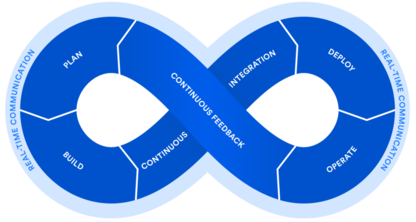
GitHub provides hosting for software development version control using Git. It offers all of the distributed version control and source code management functionality of Git as well as adding its own features. It provides access control and several collaboration features such as bug tracking, feature requests, task management, and wikis for every project.
GitHub Codespaces is an integrated development environment(IDE) on GitHub. That allows developers to develop entirely in the cloud using Visual Studio and Visual Studio Code.
GitHub Actions will automate, customize, and execute your software development workflows right in your repository with GitHub Actions. You can discover, create, and share actions to perform any job you'd like, including CI/CD, and combine actions in a completely customized workflow.GitHub Actions for Azure you can create workflows that you can set up in your repository to build, test, package, release and deploy to Azure.Learn more about all other integrations with Azure.
GitLab is a web-based DevOps lifecycle tool that provides a Git-repository manager providing wiki, issue-tracking and CI/CD pipeline features, using an open-source license, developed by GitLab Inc.
Jenkins is a free and open source automation server. Jenkins helps to automate the non-human part of the software development process, with continuous integration and facilitating technical aspects of continuous delivery.
Bitbucket is a web-based version control repository hosting service owned by Atlassian, for source code and development projects that use either Mercurial or Git revision control systems. Bitbucket offers both commercial plans and free accounts. It offers free accounts with an unlimited number of private repositories. Bitbucket integrates with other Atlassian software like Jira, HipChat, Confluence and Bamboo.
Bamboo is a continuous integration (CI) server that can be used to automate the release management for a software application, creating a continuous delivery pipeline.
Codecov is the leading, dedicated code coverage solution. It provides highly integrated tools to group, merge, archive and compare coverage reports. Whether your team is comparing changes in a pull request or reviewing a single commit, Codecov will improve the code review workflow and quality.
Drone is a Continuous Delivery system built on container technology. Drone uses a simple YAML configuration file, a superset of docker-compose, to define and execute Pipelines inside Docker containers.
Travis CI is a hosted continuous integration service used to build and test software projects hosted at GitHub.
Circle CI is a continuous integration and continuous delivery platform that helps software teams work smarter, faster.
Zuul-CI is a program that drives continuous integration, delivery, and deployment systems with a focus on project gating and interrelated projects. Using the same Ansible playbooks to deploy your system and run your tests.
Artifactory is a Universal Artifact Repository Manager developed by JFrog. It supports all major packages, enterprise ready security, clustered, HA, Docker registry, multi-site replication and scalable.
Azure DevOps is a set of services for teams to share code, track work, and ship software; CLIs Build, deploy, diagnose, and manage multi-platform, scalable apps and services; Azure Pipelines Continuously build, test, and deploy to any platform and cloud; Azure Lab Services Set up labs for classrooms, trials, development and testing, and other scenarios.
Team City is a build management and continuous integration server from JetBrains.
Shippable simplifies DevOps and makes it systematic with an Assembly Line platform that is heterogeneous, flexible, and provides complete visibility across your DevOps workflows.
Spinnaker is an open source, multi-cloud continuous delivery platform for releasing software changes with high velocity and confidence.
AWS CodeBuild is a fully managed continuous integration service that compiles source code, runs tests, and produces software packages that are ready to deploy. With CodeBuild, you don't need to provision, manage, and scale your own build servers.
Selenium is a free (open source) automated testing suite for web applications across different browsers and platforms.
Cucumber is a tool based on Behavior Driven Development (BDD) framework which is used to write acceptance tests for the web application. It allows automation of functional validation in easily readable and understandable format (like plain English) to Business Analysts, Developers, and Testers.
JUnit is a unit testing framework for the Java programming language.
Mocha is a JavaScript test framework for Node.js programs, featuring browser support, asynchronous testing, test coverage reports, and use of any assertion library.
Karma is a simple tool that allows you to execute JavaScript code in multiple real browsers.
Jasmine is an open source testing framework for JavaScript. It aims to run on any JavaScript-enabled platform, to not intrude on the application nor the IDE, and to have easy-to-read syntax.
Maven is a build automation tool used primarily for Java projects. Maven can also be used to build and manage projects written in C#, Ruby, Scala, and other languages. The Maven project is hosted by the Apache Software Foundation.
Gradle is an open-source build-automation system that builds upon the concepts of Apache Ant and Apache Maven and introduces a Groovy-based domain-specific language instead of the XML form used by Apache Maven for declaring the project configuration.
Chef is an effortless Infrastructure Suite offers visibility into security and compliance status across all infrastructure and makes it easy to detect and correct issues long before they reach production.
Puppet is an open source tool that makes continuous integration and delivery of your software on traditional or containerized infrastructure easy by pulling together all your existing tools and giving you flexibility to deploy your way.
Ansible is an open-source software provisioning, configuration management, and application-deployment tool. It runs on many Unix-like systems, and can configure both Unix-like systems as well as Microsoft Windows.
KubeInit provides Ansible playbooks and roles for the deployment and configuration of multiple Kubernetes distributions.
Salt is Python-based, open-source software for event-driven IT automation, remote task execution, and configuration management. Supporting the "Infrastructure as Code" approach to data center system and network deployment and management, configuration automation, SecOps orchestration, vulnerability remediation, and hybrid cloud control.
Terraform is an open-source infrastructure as code software tool created by HashiCorp.It enables users to define and provision a datacenter infrastructure using a high-level configuration language known as Hashicorp Configuration Language (HCL), or optionally JSON.
Consul is a service networking solution to connect and secure services across any runtime platform and public or private cloud.
Packer is lightweight, runs on every major operating system, and is highly performant, creating machine images for multiple platforms in parallel. Packer does not replace configuration management like Chef or Puppet. In fact, when building images, Packer is able to use tools like Chef or Puppet to install software onto the image.
Nomad is a highly available, distributed, data-center aware cluster and application scheduler designed to support the modern datacenter with support for long-running services, batch jobs, and much more.
Vagrant is a tool for building and managing virtual machine environments in a single workflow. With an easy-to-use workflow and focus on automation, Vagrant lowers development environment setup time and increases production parity.
Vault is a tool for securely accessing secrets. A secret is anything that you want to tightly control access to, such as API keys, passwords, certificates, and more. Vault provides a unified interface to any secret, while providing tight access control and recording a detailed audit log.
CFEngine is an open-source configuration management system, written by Mark Burgess.Its primary function is to provide automated configuration and maintenance of large-scale computer systems, including the unified management of servers, desktops, consumer and industrial devices, embedded networked devices, mobile smartphones, and tablet computers.
Octpus Deploy is the deployment automation server for your entire team, designed to make it easy to orchestrate releases and deploy applications, whether on-premises or in the cloud.
AWS CodeDeploy is a fully managed deployment service that automates software deployments to a variety of compute services such as Amazon EC2, AWS Fargate, AWS Lambda, and your on-premises servers. AWS CodeDeploy makes it easier for you to rapidly release new features, helps you avoid downtime during application deployment, and handles the complexity of updating your applications.
Kubernetes is an open-source container-orchestration system for automating application deployment, scaling, and management. It was originally designed by Google, and is now maintained by the Cloud Native Computing Foundation.
Docker is a set of platform as a service products that use OS-level virtualization to deliver software in packages called containers. Containers are isolated from one another and bundle their own software, libraries and configuration files; they can communicate with each other through well-defined channels. All containers are run by a single operating-system kernel and are thus more lightweight than virtual machines.
PowerShell/PowerShell Core is a cross-platform (Windows, Linux, and macOS) automation and configuration tool/framework that works well with your existing tools and is optimized for dealing with structured data (eg JSON, CSV, XML, etc.), REST APIs, and object models. It includes a command-line shell, an associated scripting language and a framework for processing cmdlets.
Hyper-V creates virtual machines on Windows 10. Hyper-V can be enabled in many ways including using the Windows 10 control panel, PowerShell or using the Deployment Imaging Servicing and Management tool (DISM).
Cloud Hypervisor is an open source Virtual Machine Monitor (VMM) that runs on top of KVM. The project focuses on exclusively running modern, cloud workloads, on top of a limited set of hardware architectures and platforms. Cloud workloads refers to those that are usually run by customers inside a cloud provider. Cloud Hypervisor is implemented in Rust and is based on the rust-vmm crates.
VMware vSphere Hypervisor is a bare-metal hypervisor that virtualizes servers; allowing you to consolidate your applications while saving time and money managing your IT infrastructure.
VMware vSphere is the industry-leading compute virtualization platform, and your first step to application modernization. It has been rearchitected with native Kubernetes to allow customers to modernize the 70 million+ workloads now running on vSphere.
VMware Tanzu is a centralized management platform for consistently operating and securing your Kubernetes infrastructure and modern applications across multiple teams and private/public clouds.
Rancher is a complete software stack for teams adopting containers. It addresses the operational and security challenges of managing multiple Kubernetes clusters, while providing DevOps teams with integrated tools for running containerized workloads.
K3s is a highly available, certified Kubernetes distribution designed for production workloads in unattended, resource-constrained, remote locations or inside IoT appliances.
Rook is an open source cloud-native storage orchestrator for Kubernetes that turns distributed storage systems into self-managing, self-scaling, self-healing storage services. It automates the tasks of a storage administrator: deployment, bootstrapping, configuration, provisioning, scaling, upgrading, migration, disaster recovery, monitoring, and resource management.
Google Kubernetes Engine (GKE) is a managed, production-ready environment for deploying containerized applications.
Anthos is a modern application management platform that provides a consistent development and operations experience for cloud and on-premises environments.
AWS ECS is a highly scalable, high-performance container orchestration service that supports Docker containers and allows you to easily run and scale containerized applications on AWS. Amazon ECS eliminates the need for you to install and operate your own container orchestration software, manage and scale a cluster of virtual machines, or schedule containers on those virtual machines.
Apache Mesos is a cluster manager that provides efficient resource isolation and sharing across distributed applications, or frameworks. It can run Hadoop, Jenkins, Spark, Aurora, and other frameworks on a dynamically shared pool of nodes.
Apache Spark is a unified analytics engine for big data processing, with built-in modules for streaming, SQL, machine learning and graph processing.
Apache Hadoop is a framework that allows for the distributed processing of large data sets across clusters of computers using simple programming models. It is designed to scale up from single servers to thousands of machines, each offering local computation and storage. Rather than rely on hardware to deliver high-availability, the library itself is designed to detect and handle failures at the application layer, so delivering a highly-available service on top of a cluster of computers, each of which may be prone to failures.
Microsoft Azure is a cloud computing service created by Microsoft for building, testing, deploying, and managing applications and services through Microsoft-managed data centers.
Azure Functions is a solution for easily running small pieces of code, or "functions," in the cloud. You can write just the code you need for the problem at hand, without worrying about a whole application or the infrastructure to run it.
Rkt is a pod-native container engine for Linux. It is composable, secure, and built on standards.
AWS Lambda is an event-driven, serverless computing platform provided by Amazon as a part of the Amazon Web Services. It is a computing service that runs code in response to events and automatically manages the computing resources required by that code.
Helm is the Kubernetes Package Manager.
Kubespray is a tool that combines Kubernetes and Ansible to easily install Kubernetes clusters that can be deployed on AWS, GCE, Azure, OpenStack, vSphere, Packet (bare metal), Oracle Cloud Infrastructure (Experimental), or Baremetal
Red Hat OpenShift is focused on security at every level of the container stack and throughout the application lifecycle. It includes long-term, enterprise support from one of the leading Kubernetes contributors and open source software companies.
OpenShift Hive is an operator which runs as a service on top of Kubernetes/OpenShift. The Hive service can be used to provision and perform initial configuration of OpenShift 4 clusters.
OKD is a community distribution of Kubernetes optimized for continuous application development and multi-tenant deployment. OKD adds developer and operations-centric tools on top of Kubernetes to enable rapid application development, easy deployment and scaling, and long-term lifecycle maintenance for small and large teams.
Odo is a fast, iterative, and straightforward CLI tool for developers who write, build, and deploy applications on Kubernetes and OpenShift.
Kata Operator is an operator to perform lifecycle management (install/upgrade/uninstall) of Kata Runtime on Openshift as well as Kubernetes cluster.
Knative is a Kubernetes-based platform to build, deploy, and manage modern serverless workloads. Knative takes care of the operational overhead details of networking, autoscaling (even to zero), and revision tracking.
Etcd is a distributed key-value store that provides a reliable way to store data that needs to be accessed by a distributed system or cluster of machines. Etcd is used as the backend for service discovery and stores cluster state and configuration for Kubernetes.
OpenStack is a free and open-source software platform for cloud computing, mostly deployed as infrastructure-as-a-service that controls large pools of compute, storage, and networking resources throughout a datacenter, managed through a dashboard or via the OpenStack API. OpenStack works with popular enterprise and open source technologies making it ideal for heterogeneous infrastructure.
Cloud Foundry is an open source, multi cloud application platform as a service that makes it faster and easier to build, test, deploy and scale applications, providing a choice of clouds, developer frameworks, and application services. It is an open source project and is available through a variety of private cloud distributions and public cloud instances.
Splunk software is used for searching, monitoring, and analyzing machine-generated big data, via a Web-style interface.
Prometheus is a free software application used for event monitoring and alerting. It records real-time metrics in a time series database (allowing for high dimensionality) built using a HTTP pull model, with flexible queries and real-time alerting.
Loki is a horizontally-scalable, highly-available, multi-tenant log aggregation system inspired by Prometheus. It is designed to be very cost effective and easy to operate. It does not index the contents of the logs, but rather a set of labels for each log stream.
Thanos is a set of components that can be composed into a highly available metric system with unlimited storage capacity, which can be added seamlessly on top of existing Prometheus deployments.
Container Storage Interface (CSI) is an API that lets container orchestration platforms like Kubernetes seamlessly communicate with stored data via a plug-in.
OpenEBS is a Kubernetes-based tool to create stateful applications using Container Attached Storage.
ElasticSearch is a search engine based on the Lucene library. It provides a distributed, multitenant-capable full-text search engine with an HTTP web interface and schema-free JSON documents. Elasticsearch is developed in Java.
Logstash is a tool for managing events and logs. When used generically, the term encompasses a larger system of log collection, processing, storage and searching activities.
Kibana is an open source data visualization plugin for Elasticsearch. It provides visualization capabilities on top of the content indexed on an Elasticsearch cluster. Users can create bar, line and scatter plots, or pie charts and maps on top of large volumes of data.
New Relic is a SaaS-based monitoring tool that fully supports the way DevOps teams work in the modern enterprise by streamlining your workflows with today's collaboration software and orchestration tools like Puppet, Chef, and Ansible.
Nagios is a free and open source computer-software application that monitors systems, networks and infrastructure. Nagios offers monitoring and alerting services for servers, switches, applications and services. It alerts users when things go wrong and alerts them a second time when the problem has been resolved.
SonarQube is an open-source platform developed by SonarSource for continuous inspection of code quality to perform automatic reviews with static analysis of code to detect bugs, code smells, and security vulnerabilities on 20+ programming languages.
Genie is a federated job orchestration engine developed by Netflix. Genie provides REST APIs to run a variety of big data jobs like Hadoop, Pig, Hive, Spark, Presto, Sqoop and more. It also provides APIs for managing the metadata of many distributed processing clusters and the commands and applications which run on them.
Inviso is a lightweight tool that provides the ability to search for Hadoop jobs, visualize the performance, and view cluster utilization.
Fenzo is a scheduler Java library for Apache Mesos frameworks that supports plugins for scheduling optimizations and facilitates cluster autoscaling.
Dynomite is a thin, distributed dynamo layer for different storage engines and protocols, which includes Redis and Memcached. Dynomite supports multi-datacenter replication and is designed for High Availability(HA).
Dyno is a tool that is used to scale a Java client application utilizing Dynomite.
Raigad is a process/tool that runs alongside Elasticsearch to automate backup/recovery, Deployments and Centralized Configuration management.
Priam is a process/tool that runs alongside Apache Cassandra to automate backup/recovery, Deployments and Centralized Configuration management.
Chaos Monkey is a resiliency tool used to randomly terminates virtual machine instances and containers that run inside of your production environment. Chaos Monkey should work with any backend that Spinnaker supports (AWS, Google Compute Engine, Microsoft Azure, Kubernetes, and Cloud Foundry).
Falcor is a JavaScript library for efficient data fetching. Falcor lets you represent all your remote data sources as a single domain model via a virtual JSON graph, whether in memory on the client or over the network on the server.
Restify is a framework, utilizing connect style middleware for building REST APIs.
Traefik is an open source Edge Router that makes publishing your services a fun and easy experience. It receives requests on behalf of your system and finds out which components are responsible for handling them. What sets Traefik apart, besides its many features, is that it automatically discovers the right configuration for your services.
Jira is a proprietary issue tracking product developed by Atlassian that allows bug tracking and agile project management.
Pivotal Tracker is the agile project management tool of choice for developers around the world for real-time collaboration around a shared, prioritized backlog.
Trello is a web-based Kanban-style list-making application that gives you perspective over all your projects, at work and at home.
Microsoft Teams is the hub for team collaboration in Office 365 that integrates the people, content, and tools your team needs to be more engaged and effective.
Slack is a cloud-based proprietary instant messaging platform developed by Slack Technologies.
OpsGenie is a cloud-based service for dev & ops teams, providing reliable alerts, on-call schedule management and escalations. OpsGenie integrates with monitoring tools & services, ensures the right people are notified.
Pagerduty automates processes built on best practices, allowing you to focus on higher value parts of incident response. Granular and scalable permissions enable teams to administer and operate independently while controlling visibility.
Veracode is a leading provider of enterprise-class application security, seamlessly integrating agile security solutions for organizations around the globe. In addition to application security services and secure devops services, Veracode provides a full security assessment to ensure your website and applications are secure, and ensures full enterprise data protection.
DevOps Engineering on AWS from AWS Training
AWS Certified DevOps Engineer - Professional from A Cloud Guru
Microsoft Certified: DevOps Engineer Expert Cert.
Introduction to Azure DevOps from A Cloud Guru
Architecting with Google Compute Engine
Architecting with Google Kubernetes Engine in Google Cloud
VMware Training and Certification Program
Cloudera Certification Program
Salesforce Certification Program
Salesforce Superbadges
Red Hat Training and Certification Program
Linux Foundation Training and Certification Program
Linux Professional Institute(LPI) Training and Certification
Learn DevOps with Online Courses and Lessons from edX
Top DevOps Courses Online from Udemy
Devops Courses from Coursera
回到頂部

Flutter是Google的UI工具包,用於從單個代碼庫中為移動(Andorid和iOS),Web,MacOS,Linux和Google Fuchsia製作精美,本地編譯的應用程序。 Flutter與現有代碼合作,由世界各地的開發人員和組織使用,並且是免費和開源的。
Flutter Gems是用於撲朔迷離的包裝指南,可在功能上對Pub.Dev Flutter Gems提供的一些最有用,最受歡迎的撲麵包裝進行分類。
DART是一種使用Flutter Framework構建Web,Server和Mobile應用程序的開源,可擴展的編程語言,具有魯棒的庫和運行時間。
撲打文檔
撲來樣式指南
創建您的第一個幻想應用程序
使用Flutter構建和釋放Android應用
撲打工具和技術
飛鏢和顫抖:《 Udemy的完整開發商指南》
在Coursera上與Flutter創建一個互動故事
為初學者播放PluralSight的課程
LinkedIn學習的撲動在線培訓課程
完整的Flutter App開發訓練營與App Brewery的飛鏢
將firebase添加到您的Flutter應用程序中
使用firebase和firestore揮舞著
Fuchsia Project
開始使用紫紅色
紫紅色參考
為紫紅色做出貢獻
Firebase是一個後端-A服務(BAAS)應用程序開發平台,可提供託管的後端服務,例如實時數據庫,雲存儲,身份驗證,崩潰報告,機器學習,遠程配置以及靜態文件的託管。
FlutterFire是一組撲朔迷離的插件,它使Flutter應用程序能夠使用Firebase服務。您可以遵循一個示例,該示例顯示瞭如何在Firebase中使用這些插件進行flutter codelab。
FlutterBoost是一個撲朔迷離的插件,可以在最低限度的努力下為您現有的本機應用程序的混合集成。
Go-Flutter是一個包裝,可以將顫動撲向桌面。 Project使用在Windows,MacOS和Linux上運行的單個代碼庫來實現顫動的嵌入API。對於渲染,GLFW適合工作,因為它為每個平台提供了OpenGL的緩衝/鼠標/鍵盤上正確的抽象。
AppWrite是用於Web,移動設備和Flutter開發人員的安全端到端后端服務器,該服務器被包裝為一組Docker容器,以方便部署。
Fluro是一個撲動路由庫,它添加了靈活的路由選項,例如通配符,名稱參數和清晰的路由定義。
回到頂部
AWS Certified Security - Specialty Certification
Microsoft Certified: Azure Security Engineer Associate
Google Cloud Certified Professional Cloud Security Engineer
Cisco Security Certifications
The Red Hat Certified Specialist in Security: Linux
Linux Professional Institute LPIC-3 Enterprise Security Certification
Cybersecurity Training and Courses from IBM Skills
Cybersecurity Courses and Certifications by Offensive Security
Citrix Certified Associate – Networking(CCA-N)
Citrix Certified Professional – Virtualization(CCP-V)
CCNP Routing and Switching
Certified Information Security Manager(CISM)
Wireshark Certified Network Analyst (WCNA)
Juniper Networks Certification Program Enterprise (JNCP)
Networking courses and specializations from Coursera
Network & Security Courses from Udemy
Network & Security Courses from edX
 • Connection: In networking, a connection refers to pieces of related information that are transferred through a network. This generally infers that a connection is built before the data transfer (by following the procedures laid out in a protocol) and then is deconstructed at the at the end of the data transfer.

• Packet: A packet is, generally speaking, the most basic unit that is transferred over a network. When communicating over a network, packets are the envelopes that carry your data (in pieces) from one end point to the other.
Packets have a header portion that contains information about the packet including the source and destination, timestamps, network hops. The main portion of a packet contains the actual data being transferred. It is sometimes called the body or the payload.
• Network Interface: A network interface can refer to any kind of software interface to networking hardware. For instance, if you have two network cards in your computer, you can control and configure each network interface associated with them individually.
A network interface may be associated with a physical device, or it may be a representation of a virtual interface. The "loop-back" device, which is a virtual interface to the local machine, is an example of this.
 • LAN: LAN stands for "local area network". It refers to a network or a portion of a network that is not publicly accessible to the greater internet. A home or office network is an example of a LAN.

• WAN: WAN stands for "wide area network". It means a network that is much more extensive than a LAN. While WAN is the relevant term to use to describe large, dispersed networks in general, it is usually meant to mean the internet, as a whole.
If an interface is connected to the WAN, it is generally assumed that it is reachable through the internet.
• Protocol: A protocol is a set of rules and standards that basically define a language that devices can use to communicate. There are a great number of protocols in use extensively in networking, and they are often implemented in different layers.
Some low level protocols are TCP, UDP, IP, and ICMP. Some familiar examples of application layer protocols, built on these lower protocols, are HTTP (for accessing web content), SSH, TLS/SSL, and FTP.
 • Port: A port is an address on a single machine that can be tied to a specific piece of software. It is not a physical interface or location, but it allows your server to be able to communicate using more than one application.

• Firewall: A firewall is a program that decides whether traffic coming into a server or going out should be allowed. A firewall usually works by creating rules for which type of traffic is acceptable on which ports. Generally, firewalls block ports that are not used by a specific application on a server.

• NAT: Network address translation is a way to translate requests that are incoming into a routing server to the relevant devices or servers that it knows about in the LAN. This is usually implemented in physical LANs as a way to route requests through one IP address to the necessary backend servers.

• VPN: Virtual private network is a means of connecting separate LANs through the internet, while maintaining privacy. This is used as a means of connecting remote systems as if they were on a local network, often for security reasons.
 While networking is often discussed in terms of topology in a horizontal way, between hosts, its implementation is layered in a vertical fashion throughout a computer or network. This means is that there are multiple technologies and protocols that are built on top of each other in order for communication to function more easily. Each successive, higher layer abstracts the raw data a little bit more, and makes it simpler to use for applications and users. It also allows you to leverage lower layers in new ways without having to invest the time and energy to develop the protocols and applications that handle those types of traffic.

As data is sent out of one machine, it begins at the top of the stack and filters downwards. At the lowest level, actual transmission to another machine takes place. At this point, the data travels back up through the layers of the other computer. Each layer has the ability to add its own "wrapper" around the data that it receives from the adjacent layer, which will help the layers that come after decide what to do with the data when it is passed off.

One method of talking about the different layers of network communication is the OSI model. OSI stands for Open Systems Interconnect.This model defines seven separate layers. The layers in this model are:

• Application: The application layer is the layer that the users and user-applications most often interact with. Network communication is discussed in terms of availability of resources, partners to communicate with, and data synchronization.

• Presentation: The presentation layer is responsible for mapping resources and creating context. It is used to translate lower level networking data into data that applications expect to see.

• Session: The session layer is a connection handler. It creates, maintains, and destroys connections between nodes in a persistent way.

• Transport: The transport layer is responsible for handing the layers above it a reliable connection. In this context, reliable refers to the ability to verify that a piece of data was received intact at the other end of the connection. This layer can resend information that has been dropped or corrupted and can acknowledge the receipt of data to remote computers.

• Network: The network layer is used to route data between different nodes on the network. It uses addresses to be able to tell which computer to send information to. This layer can also break apart larger messages into smaller chunks to be reassembled on the opposite end.

• Data Link: This layer is implemented as a method of establishing and maintaining reliable links between different nodes or devices on a network using existing physical connections.

• Physical: The physical layer is responsible for handling the actual physical devices that are used to make a connection. This layer involves the bare software that manages physical connections as well as the hardware itself (like Ethernet).
The TCP/IP model, more commonly known as the Internet protocol suite, is another layering model that is simpler and has been widely adopted.It defines the four separate layers, some of which overlap with the OSI model:
• Application: In this model, the application layer is responsible for creating and transmitting user data between applications. The applications can be on remote systems, and should appear to operate as if locally to the end user.
The communication takes place between peers network.
 • Transport: The transport layer is responsible for communication between processes. This level of networking utilizes ports to address different services. It can build up unreliable or reliable connections depending on the type of protocol used.

• Internet: The internet layer is used to transport data from node to node in a network. This layer is aware of the endpoints of the connections, but does not worry about the actual connection needed to get from one place to another. IP addresses are defined in this layer as a way of reaching remote systems in an addressable manner.

• Link: The link layer implements the actual topology of the local network that allows the internet layer to present an addressable interface. It establishes connections between neighboring nodes to send data.
Interfaces are networking communication points for your computer. Each interface is associated with a physical or virtual networking device. Typically, your server will have one configurable network interface for each Ethernet or wireless internet card you have. In addition, it will define a virtual network interface called the "loopback" or localhost interface. This is used as an interface to connect applications and processes on a single computer to other applications and processes. You can see this referenced as the "lo" interface in many tools.
Networking works by piggybacks on a number of different protocols on top of each other. In this way, one piece of data can be transmitted using multiple protocols encapsulated within one another.
Media access control is a communications protocol that is used to distinguish specific devices. Each device is supposed to get a unique MAC address during the manufacturing process that differentiates it from every other device on the internet. Addressing hardware by the MAC address allows you to reference a device by a unique value even when the software on top may change the name for that specific device during operation. Media access control is one of the only protocols from the link layer that you are likely to interact with on a regular basis.
The IP protocol is one of the fundamental protocols that allow the internet to work. IP addresses are unique on each network and they allow machines to address each other across a network. It is implemented on the internet layer in the IP/TCP model. Networks can be linked together, but traffic must be routed when crossing network boundaries. This protocol assumes an unreliable network and multiple paths to the same destination that it can dynamically change between. There are a number of different implementations of the protocol. The most common implementation today is IPv4, although IPv6 is growing in popularity as an alternative due to the scarcity of IPv4 addresses available and improvements in the protocols capabilities.
ICMP: internet control message protocol is used to send messages between devices to indicate the availability or error conditions. These packets are used in a variety of network diagnostic tools, such as ping and traceroute. Usually ICMP packets are transmitted when a packet of a different kind meets some kind of a problem. Basically, they are used as a feedback mechanism for network communications.
TCP: Transmission control protocol is implemented in the transport layer of the IP/TCP model and is used to establish reliable connections. TCP is one of the protocols that encapsulates data into packets. It then transfers these to the remote end of the connection using the methods available on the lower layers. On the other end, it can check for errors, request certain pieces to be resent, and reassemble the information into one logical piece to send to the application layer. The protocol builds up a connection prior to data transfer using a system called a three-way handshake. This is a way for the two ends of the communication to acknowledge the request and agree upon a method of ensuring data reliability. After the data has been sent, the connection is torn down using a similar four-way handshake. TCP is the protocol of choice for many of the most popular uses for the internet, including WWW, FTP, SSH, and email. It is safe to say that the internet we know today would not be here without TCP.
UDP: User datagram protocol is a popular companion protocol to TCP and is also implemented in the transport layer. The fundamental difference between UDP and TCP is that UDP offers unreliable data transfer. It does not verify that data has been received on the other end of the connection. This might sound like a bad thing, and for many purposes, it is. However, it is also extremely important for some functions. It's not required to wait for confirmation that the data was received and forced to resend data, UDP is much faster than TCP. It does not establish a connection with the remote host, it simply fires off the data to that host and doesn't care if it is accepted or not. Since UDP is a simple transaction, it is useful for simple communications like querying for network resources. It also doesn't maintain a state, which makes it great for transmitting data from one machine to many real-time clients. This makes it ideal for VOIP, games, and other applications that cannot afford delays.
HTTP: Hypertext transfer protocol is a protocol defined in the application layer that forms the basis for communication on the web. HTTP defines a number of functions that tell the remote system what you are requesting. For instance, GET, POST, and DELETE all interact with the requested data in a different way.
JSON Web Token (JWT) is a compact URL-safe means of representing claims to be transferred between two parties. The claims in a JWT are encoded as a JSON object that is digitally signed using JSON Web Signature (JWS).
OAuth 2.0 is an open source authorization framework that enables applications to obtain limited access to user accounts on an HTTP service, such as Amazon, Google, Facebook, Microsoft, Twitter GitHub, and DigitalOcean. It works by delegating user authentication to the service that hosts the user account, and authorizing third-party applications to access the user account.
FTP: File transfer protocol is in the application layer and provides a way of transferring complete files from one host to another. It is inherently insecure, so it is not recommended for any externally facing network unless it is implemented as a public, download-only resource.
DNS: Domain name system is an application layer protocol used to provide a human-friendly naming mechanism for internet resources. It is what ties a domain name to an IP address and allows you to access sites by name in your browser.
SSH: Secure shell is an encrypted protocol implemented in the application layer that can be used to communicate with a remote server in a secure way. Many additional technologies are built around this protocol because of its end-to-end encryption and ubiquity. There are many other protocols that we haven't covered that are equally important. However, this should give you a good overview of some of the fundamental technologies that make the internet and networking possible.
KVM (for Kernel-based Virtual Machine) is a full virtualization solution for Linux on x86 hardware containing virtualization extensions (Intel VT or AMD-V). It consists of a loadable kernel module, kvm.ko, that provides the core virtualization infrastructure and a processor specific module, kvm-intel.ko or kvm-amd.ko.
QEMU is a fast processor emulator using a portable dynamic translator. QEMU emulates a full system, including a processor and various peripherals. It can be used to launch a different Operating System without rebooting the PC or to debug system code.
Hyper-V enables running virtualized computer systems on top of a physical host. These virtualized systems can be used and managed just as if they were physical computer systems, however they exist in virtualized and isolated environment. Special software called a hypervisor manages access between the virtual systems and the physical hardware resources. Virtualization enables quick deployment of computer systems, a way to quickly restore systems to a previously known good state, and the ability to migrate systems between physical hosts.
VirtManager is a graphical tool for managing virtual machines via libvirt. Most usage is with QEMU/KVM virtual machines, but Xen and libvirt LXC containers are well supported. Common operations for any libvirt driver should work.
oVirt is an open-source distributed virtualization solution, designed to manage your entire enterprise infrastructure. oVirt uses the trusted KVM hypervisor and is built upon several other community projects, including libvirt, Gluster, PatternFly, and Ansible.Founded by Red Hat as a community project on which Red Hat Enterprise Virtualization is based allowing for centralized management of virtual machines, compute, storage and networking resources, from an easy-to-use web-based front-end with platform independent access.
Xen is focused on advancing virtualization in a number of different commercial and open source applications, including server virtualization, Infrastructure as a Services (IaaS), desktop virtualization, security applications, embedded and hardware appliances, and automotive/aviation.
Ganeti is a virtual machine cluster management tool built on top of existing virtualization technologies such as Xen or KVM and other open source software. Once installed, the tool assumes management of the virtual instances (Xen DomU).
Packer is an open source tool for creating identical machine images for multiple platforms from a single source configuration. Packer is lightweight, runs on every major operating system, and is highly performant, creating machine images for multiple platforms in parallel. Packer does not replace configuration management like Chef or Puppet. In fact, when building images, Packer is able to use tools like Chef or Puppet to install software onto the image.
Vagrant is a tool for building and managing virtual machine environments in a single workflow. With an easy-to-use workflow and focus on automation, Vagrant lowers development environment setup time, increases production parity, and makes the "works on my machine" excuse a relic of the past. It provides easy to configure, reproducible, and portable work environments built on top of industry-standard technology and controlled by a single consistent workflow to help maximize the productivity and flexibility of you and your team.
VMware Workstation is a hosted hypervisor that runs on x64 versions of Windows and Linux operating systems; it enables users to set up virtual machines on a single physical machine, and use them simultaneously along with the actual machine.
VirtualBox is a powerful x86 and AMD64/Intel64 virtualization product for enterprise as well as home use. Not only is VirtualBox an extremely feature rich, high performance product for enterprise customers.
回到頂部
SQL is a standard language for storing, manipulating and retrieving data in relational databases.
SQL Tutorial by W3Schools
Learn SQL Skills Online from Coursera
SQL Courses Online from Udemy
SQL Online Training Courses from LinkedIn Learning
Learn SQL For Free from Codecademy
GitLab's SQL Style Guide
OracleDB SQL Style Guide Basics
Tableau CRM: BI Software and Tools
Databases on AWS
Best Practices and Recommendations for SQL Server Clustering in AWS EC2.
Connecting from Google Kubernetes Engine to a Cloud SQL instance.
Educational Microsoft Azure SQL resources
MySQL Certifications
SQL vs. NoSQL Databases: What's the Difference?
What is NoSQL?
Azure Data Studio is an open source data management tool that enables working with SQL Server, Azure SQL DB and SQL DW from Windows, macOS and Linux.
Azure SQL Database is the intelligent, scalable, relational database service built for the cloud. It's evergreen and always up to date, with AI-powered and automated features that optimize performance and durability for you. Serverless compute and Hyperscale storage options automatically scale resources on demand, so you can focus on building new applications without worrying about storage size or resource management.
Azure SQL Managed Instance is a fully managed SQL Server Database engine instance that's hosted in Azure and placed in your network. This deployment model makes it easy to lift and shift your on-premises applications to the cloud with very few application and database changes. Managed instance has split compute and storage components.
Azure Synapse Analytics is a limitless analytics service that brings together enterprise data warehousing and Big Data analytics. It gives you the freedom to query data on your terms, using either serverless or provisioned resources at scale. It brings together the best of the SQL technologies used in enterprise data warehousing, Spark technologies used in big data analytics, and Pipelines for data integration and ETL/ELT.
MSSQL for Visual Studio Code is an extension for developing Microsoft SQL Server, Azure SQL Database and SQL Data Warehouse everywhere with a rich set of functionalities.
SQL Server Data Tools (SSDT) is a development tool for building SQL Server relational databases, Azure SQL Databases, Analysis Services (AS) data models, Integration Services (IS) packages, and Reporting Services (RS) reports. With SSDT, a developer can design and deploy any SQL Server content type with the same ease as they would develop an application in Visual Studio or Visual Studio Code.
Bulk Copy Program is a command-line tool that comes with Microsoft SQL Server. BCP, allows you to import and export large amounts of data in and out of SQL Server databases quickly snd efficeiently.
SQL Server Migration Assistant is a tool from Microsoft that simplifies database migration process from Oracle to SQL Server, Azure SQL Database, Azure SQL Database Managed Instance and Azure SQL Data Warehouse.
SQL Server Integration Services is a development platform for building enterprise-level data integration and data transformations solutions. Use Integration Services to solve complex business problems by copying or downloading files, loading data warehouses, cleansing and mining data, and managing SQL Server objects and data.
SQL Server Business Intelligence(BI) is a collection of tools in Microsoft's SQL Server for transforming raw data into information businesses can use to make decisions.
Tableau is a Data Visualization software used in relational databases, cloud databases, and spreadsheets. Tableau was acquired by Salesforce in August 2019.
DataGrip is a professional DataBase IDE developed by Jet Brains that provides context-sensitive code completion, helping you to write SQL code faster. Completion is aware of the tables structure, foreign keys, and even database objects created in code you're editing.
RStudio is an integrated development environment for R and Python, with a console, syntax-highlighting editor that supports direct code execution, and tools for plotting, history, debugging and workspace management.
MySQL is a fully managed database service to deploy cloud-native applications using the world's most popular open source database.
PostgreSQL is a powerful, open source object-relational database system with over 30 years of active development that has earned it a strong reputation for reliability, feature robustness, and performance.
Amazon DynamoDB is a key-value and document database that delivers single-digit millisecond performance at any scale. It is a fully managed, multiregion, multimaster, durable database with built-in security, backup and restore, and in-memory caching for internet-scale applications.
FoundationDB is an open source distributed database designed to handle large volumes of structured data across clusters of commodity servers. It organizes data as an ordered key-value store and employs ACID transactions for all operations. It is especially well-suited for read/write workloads but also has excellent performance for write-intensive workloads. FoundationDB was acquired by Apple in 2015.
CouchbaseDB is an open source distributed multi-model NoSQL document-oriented database. It creates a key-value store with managed cache for sub-millisecond data operations, with purpose-built indexers for efficient queries and a powerful query engine for executing SQL queries.
IBM DB2 is a collection of hybrid data management products offering a complete suite of AI-empowered capabilities designed to help you manage both structured and unstructured data on premises as well as in private and public cloud environments. Db2 is built on an intelligent common SQL engine designed for scalability and flexibility.
MongoDB is a document database meaning it stores data in JSON-like documents.
OracleDB is a powerful fully managed database helps developers manage business-critical data with the highest availability, reliability, and security.
MariaDB is an enterprise open source database solution for modern, mission-critical applications.
SQLite is a C-language library that implements a small, fast, self-contained, high-reliability, full-featured, SQL database engine.SQLite is the most used database engine in the world. SQLite is built into all mobile phones and most computers and comes bundled inside countless other applications that people use every day.
SQLite Database Browser is an open source SQL tool that allows users to create, design and edits SQLite database files. It lets users show a log of all the SQL commands that have been issued by them and by the application itself.
dbWatch is a complete database monitoring/management solution for SQL Server, Oracle, PostgreSQL, Sybase, MySQL and Azure. Designed for proactive management and automation of routine maintenance in large scale on-premise, hybrid/cloud database environments.
Cosmos DB Profiler is a real-time visual debugger allowing a development team to gain valuable insight and perspective into their usage of Cosmos DB database. It identifies over a dozen suspicious behaviors from your application's interaction with Cosmos DB.
Adminer is an SQL management client tool for managing databases, tables, relations, indexes, users. Adminer has support for all the popular database management systems such as MySQL, MariaDB, PostgreSQL, SQLite, MS SQL, Oracle, Firebird, SimpleDB, Elasticsearch and MongoDB.
DBeaver is an open source database tool for developers and database administrators. It offers supports for JDBC compliant databases such as MySQL, Oracle, IBM DB2, SQL Server, Firebird, SQLite, Sybase, Teradata, Firebird, Apache Hive, Phoenix, and Presto.
DbVisualizer is a SQL management tool that allows users to manage a wide range of databases such as Oracle, Sybase, SQL Server, MySQL, H3, and SQLite.
AppDynamics Database is a management product for Microsoft SQL Server. With AppDynamics you can monitor and trend key performance metrics such as resource consumption, database objects, schema statistics and more, allowing you to proactively tune and fix issues in a High-Volume Production Environment.
Toad is a SQL Server DBMS toolset developed by Quest. It increases productivity by using extensive automation, intuitive workflows, and built-in expertise. This SQL management tool resolve issues, manage change and promote the highest levels of code quality for both relational and non-relational databases.
Lepide SQL Server is an open source storage manager utility to analyse the performance of SQL Servers. It provides a complete overview of all configuration and permission changes being made to your SQL Server environment through an easy-to-use, graphical user interface.
Sequel Pro is a fast MacOS database management tool for working with MySQL. This SQL management tool helpful for interacting with your database by easily to adding new databases, new tables, and new rows.
回到頂部
Note: GNOME Extenions allow you customize your Desktop layout anyway you want.
Easily turn GNOME Extensions On/Off using the GNOME Shell integration add-on in the Firefox web browser.
Caffeine is a GNOME Shell extension that disables the screensaver and auto suspend
Arc Menu is a GNOME Shell extension that adds an Application Menu for GNOME.
Material Shell is a GNOME Shell extension that adds a modern desktop interface for Linux - packaged as an extension for GNOME Shell. Improve your user experience and get rid of the anarchy of traditional desktop workflows. Designed to simplify navigation and reduce the need to manipulate windows in order to improve productivity. It's meant to be 100% predictable and bring the benefits of tools coveted by professionals to everyone.
Clipboard Indicator is a GNOME Shell extension that adds a clipboard indicator to the top panel, and caches clipboard history.
Blur My Shell is a GNOME Shell extension that adds a blur look to different parts of the GNOME Shell, including the top panel, dash and overview.
GSConnect is a GNOME Shell extension that adds a complete implementation of KDE Connect especially for GNOME Shell with Nautilus, Chrome and Firefox integration. It does not rely on the KDE Connect desktop application and will not work with it installed.
Compiz alike windows effect is a GNOME Shell extension that adds wobbly windows effect inspired by the Compiz one
CPU Power Manager is a GNOME Shell extension that enables you to manage Intel_pstate CPU Frequency scaling driver.
CPU Power Governor is a GNOME Shell extension that enables the ability to swap between kernel governors for the CPU useful for laptops.
CPUFreq is a GNOME Shell extension for System Monitor and Power Manager.
Dash to Panel is a GNOME Shell extension that shows an icon taskbar for the Gnome Shell. This extension moves the dash into the gnome main panel so that the application launchers and system tray are combined into a single panel, similar to that found in KDE Plasma and Windows 7+. A separate dock is no longer needed for easy access to running and favorited applications.
Dash to Dock is a GNOME Shell extension that shows a dock for the Gnome Shell. This extension moves the dash out of the overview transforming it in a dock for an easier launching of applications and a faster switching between windows and desktops. Side and bottom placement options are available.
Removable Drive Menu is a GNOME Shell extension that shows a status menu for accessing and unmounting removable devices.
Snap Manager is a GNOME Shell extension that shows a popup menu in the top bar to easily manage snap tasks (list, changes, refresh, remove, install...). Update notification at session startup.
Sound Input & Output Device Chooser is a GNOME Shell extension that shows a list of sound output and input devices (similar to gnome sound settings) in the status menu below the volume slider. Various active ports like HDMI , Speakers etc. of the same device are also displayed for selection. V20+ needs python as dependency. If you want to continue with the old method without Python, use options to switch off New Port identification. But it works with only English
User Themes is a GNOME Shell extension that lets you load shell themes from user directory.
WinTile: Windows 10 window tiling for GNOME is a hotkey driven window tiling system for GNOME that imitates the standard Win-Arrow keys of Windows 10, allowing you to maximize, maximize to sides, or 1/4 sized to corner across a single or multiple monitors using just Super+Arrow.
Gnome Extensions Sync is a GNOME Shell extension that syncs gnome shell keybindings, tweaks settings and extensions with their configuration across all gnome installations.
Tray Icons: Reloaded is a GNOME Shell extension which bring back Tray Icons to top panel, with additional features.
GitLab extension is a GNOME Shell extension that lets you utilizes the official GitLab API to provide a comfortable overview about your projects, commits & pipelines.
回到頂部
根據Creative Commons歸因4.0國際(CC By 4.0)公共許可證分發。





