PhysicsExp
1.0.0

The package is also released on pypi.
For readers from pypi, here please.
关于本人的实验数据和数据处理脚本、图片、计算结果(从一级到四级),请见 USTCPhysExpData 项目。 My experiment data, data processing scripts, figures, and some results(from experiment level I to IV), please visit the USTCPhysExpData project.
Don't want to use OriginLab or Excel? Try Python!
最终目的是建造一套用于自动化处理大物实验数据、绘制图像、生成可打印文档、将文档提交到在线打印系统的工具;针对常用数据处理需求实现简化和自动化,只要简单的几行代码,就能完成通用的绘图、拟合、不确定度计算等大物实验常用任务。
理想与现实差距还很大,目前仅仅包装了matplotlib绘图库、简单拟合、文件输入、docx生成,简化重复劳动。
Now I only wrapped matplotlib plotting library, implemented simple regression, easy file input, and docx generation. To simplify repetious works.
相关博客:USTC LUG上的页面 本人主页上的页面
Install the package
Use TUNA mirror to accelerate. Depencencies like numpy and matplotlib will be installed automatically.
pip install -i https://mirrors.tuna.tsinghua.edu.cn/pypi/web/simple physicsexp
Test the installation(Optional)
>>> from physicsexp.mainfunc import *
>>> from physicsexp.gendocx import *
>>>
If no error then you are ready! If error occurs feel free to open an issue.
Run the example script(Recommended)
python3 ./physicsexp/example/plot.py
You'll see graphs poped out and saved to .png, a generated gen.docx ready to print, and calculations printed to output, in the ./physicsexp/example directory. You can also clone USTCPhysExpData to try some real-life cases. Then you can modify the code or write your own code to process your data!
It is a real-case example of input several lines of data, plot the data and do linear regression, and generate a printable docx document containing plot and analyse results.
If you really want to know, the experiment is about verifying the relativistic kinetic energy vs. momentum relationship of electron(beta-ray) and measuring the extraction of beta-ray by aluminum pieces of different thickness.
First, put your data in data.txt, like this:
# 位置x
e -2
23.     24.2    25.5    26.5    27.7    29.     30.5    31.8
# 峰位N
245.77  291.79  336.40  378.52  417.94  456.14  510.12  544.95
# 铝片数量M
0       1       2       3       4       5
# 选区计数N
43901   34258   28725   23670   19386   16866
You can use # to add some comment lines, and e * to specify the order of magnitude -- thus be able to directly write down the original on-paper data without conversion.
Then it's time to write python
Headers & imports
#!/usr/bin/env python3
# -*- coding: utf-8 -*-

from physicsexp.mainfunc import *
from physicsexp.gendocx import *
Read the file easily with the readoneline function
fin = open('./data.txt', 'r', encoding='utf-8')
pos = readoneline(fin)
N = readoneline(fin)
Al_num = readoneline(fin)
Cnt = readoneline(fin)
fin.close()
Calculate and print some results. This is python, you can do whatever you like easily. (This part is not related to the library, you can skip this)
a = 2.373e-3
b = -.0161
dEk = .20

c0 = 299792458.
MeV = 1e6 * electron

Emeasure = a * N + b + dEk
x0 = .10
R = (pos - x0) / 2
B = 640.01e-4
Momentum = 300 * B * R
Eclassic = ((Momentum * MeV)**2 / (2 * me * c0**2)) / MeV
Erela = np.array([math.sqrt((i * MeV)**2 + (me * c0**2)**2) - me * c0**2 for i in Momentum]) / MeV
print('post', pos)
print('Rt', R*100)
print('pct', Momentum)
print('Nt', N)
print('Eclast', Eclassic)
print('Erelat', Erela)
print('Emest', Emeasure)
Now, plot!
First graph: three curve in one figure. Using simple_plot. You can use LaTeX in plot labels. Graph is saved to 1.png. Use show=0 to plot multiple lines on one figure.
simple_plot(Momentum, Emeasure, show=0, issetrange=0, dot='+', lab='测量动能')
simple_plot(Momentum, Eclassic, show=0, issetrange=0, dot='*', lab='经典动能')
simple_plot(Momentum, Erela, dot='o', save='1.png', issetrange=0, xlab='$pc/MeV$', ylab='$E/MeV$', title='电子动能随动量变化曲线', lab='相对论动能')
Second graph, a simple curve, saved to 2.png:
Len = 150
Cnt = Cnt / Len
simple_plot(Al_num, Cnt, xlab='铝片数', ylab='选区计数率(射线强度)', title='$\beta$射线强度随铝片数衰减曲线', save='2.png')
Third graph, a curve with a linear fit, using simple_linear_plot, saved to 3.png:
CntLn = np.log(Cnt)
d = 50
Al_Real = Al_num * d
slope, intercept = simple_linear_plot(Al_Real, CntLn, xlab='质量厚度$g/cm^{-2}$', ylab='选区计数率对数(射线强度)', title='半对数曲线曲线', save='3.png')
print(-slope)
print(math.log(1e4) / (-slope))
print((math.log(Cnt[0]) - 4 * math.log(10) - intercept) / slope)
Don't bother putting pictures in documents yourself!
With a single line of code, generate a printable docx document with the above three pictures and the fit results.
gendocx('gen.docx', '1.png', '2.png', '3.png', 'slope, intercept: %f %f' % (slope, intercept))Results
Output:
pos	 [0.23  0.242 0.255 0.265 0.277 0.29  0.305 0.318]
R	 [ 6.5   7.1   7.75  8.25  8.85  9.5  10.25 10.9 ]
pc	 [1.2480195  1.3632213  1.48802325 1.58402475 1.69922655 1.8240285
 1.96803075 2.0928327 ]
N	 [245.77 291.79 336.4  378.52 417.94 456.14 510.12 544.95]
Eclas	 [1.52375616 1.81804848 2.16616816 2.45469003 2.82471934 3.25488743
 3.78910372 4.28491053]
Erela	 [0.83752628 0.94478965 1.0622588  1.15334615 1.26333503 1.3831891
 1.52222218 1.64324566]
Emes	 [0.76711221 0.87631767 0.9821772  1.08212796 1.17567162 1.26632022
 1.39441476 1.47706635]
0.0038199159787357996
2411.136900195471
2402.45428200782
Generated docx:
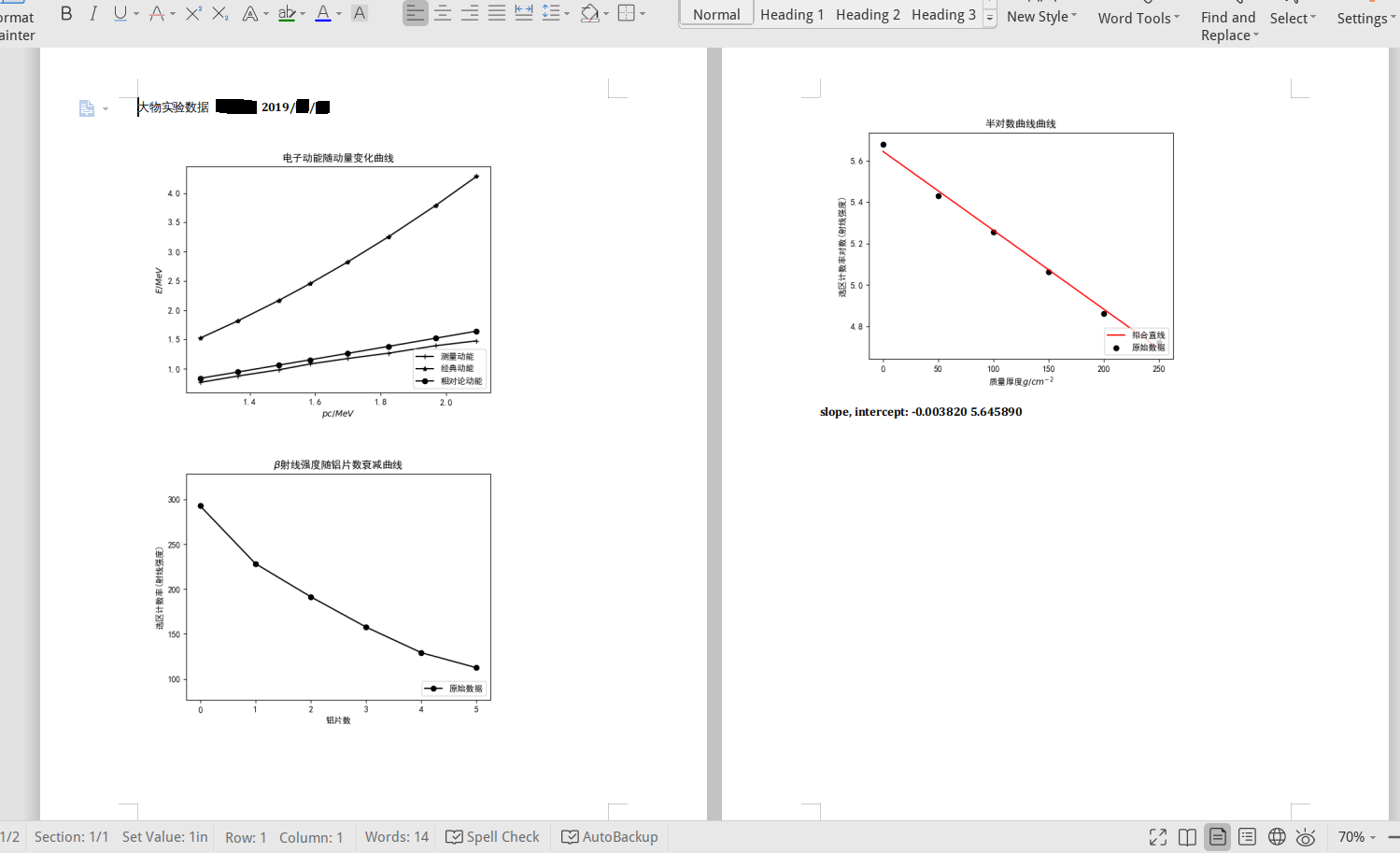
Don't forget to change my name to yours.
Later I found that using jupyter notebook is WAY MUCH better than coding in python editor:
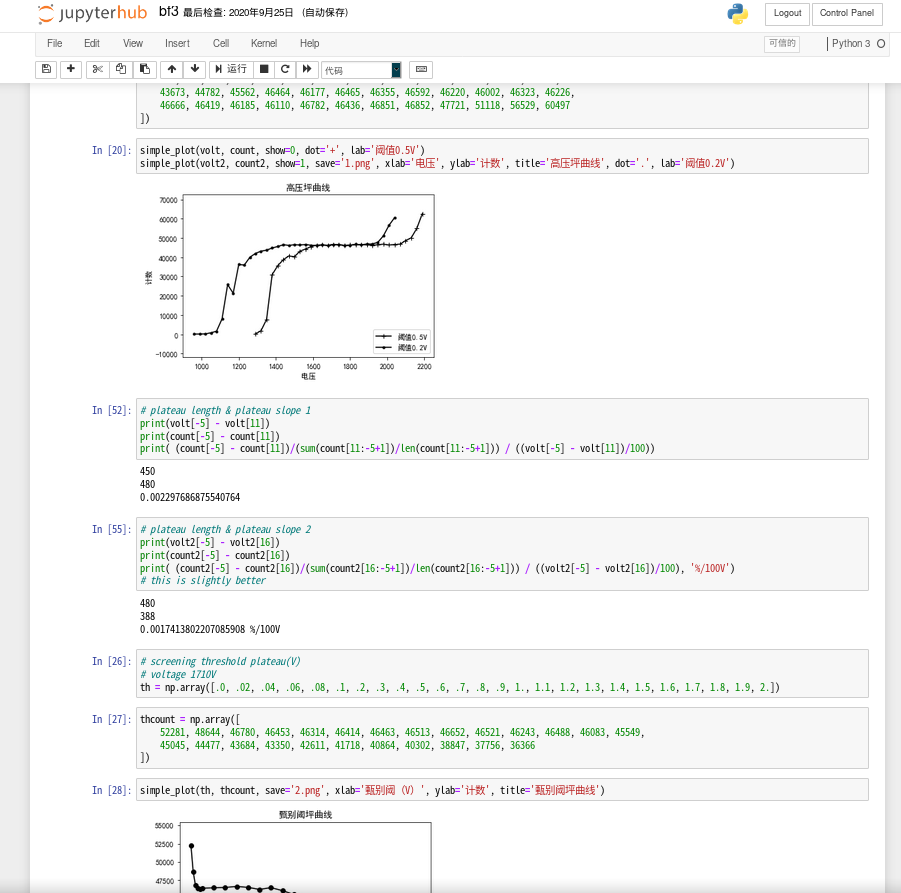
And, Jupyterhub can provide jupyter notebook access for a group of users: the common case when several people want to share their experiment data processing script with each other.
In ./jupyterhub is my config being used to run jupyterhub: docker spawner with a shared strorage, dummy authenication. Literally no security or access control but acceptable for a group of trustable people on a private server.
Wanna know how to use after reading the example?
You can:
However, they are not intended to run directly on your machine and magically give you correct answer without any change, but, if you really want to run them, maybe a
git reseton this repository and dive into the dark history is the last resort.
Read the source code yourself. Especially physicsexp/mainfunc.py and physicsexp/gendocx.py -- with the example covering most use cases, you just need to check out function declaration and extra available options(they make life easier).
Or open an issue. If you are also a USTC student just contact me with QQ/Email. Contacts are on my website.
But don't be frustrated if none of these works. The project comes with absolutely no warrenty.
And can using these tools boost your efficiency? I don't know, but probably can't.
**However, if these can make you feel better despite spending more time, use it. **
Finally, think twice before wasting time on this project, instead, enjoy your life, learn some real physics, and find a (boy|girl)friend.
Here.







