unordered_dense
v4.5.0

基于Robin-Hood向后移位删除C ++ 17及更高版本的快速且密集的哈希图和哈希集。
ankerl::unordered_dense::map and ankerl::unordered_dense::set是(几乎) std::unordered_map和std::unordered_set的(几乎)替换。尽管他们没有强大的迭代 /参考稳定性保证,但通常会更快。
此外,还有ankerl::unordered_dense::segmented_map和ankerl::unordered_dense::segmented_set具有较低的峰值内存使用情况。和稳定的迭代器/插入中的引用。
ankerl::unordered_dense::hashis_transparent异质过载std::hashauto extract() && -> value_container_typeextract()单元素[[nodiscard]] auto values() const noexcept -> value_container_type const&auto replace(value_container_type&& container)ankerl::unordered_dense::bucket_type::standardankerl::unordered_dense::bucket_type::bigsegmented_map和segmented_set所选的设计比std::unordered_map具有一些优势:
std::vector中,所有数据都是连续的!absl::flat_hash_map的同一球场上std::allocators和多态性分配器的全面支持。有ankerl::unordered_dense::pmr Typedefs可用std::vector转换到boost::interprocess::vector或任何其他兼容的随机访问容器。std::vector调试器中都可以轻松看到基础数据。没有免费的午餐,所以有一些缺点:
std::pair<Key, Value> no const Key >默认安装位置是/usr/local 。
克隆存储库并将这些命令运行在克隆文件夹中:
mkdir build && cd build
cmake ..
cmake --build . --target install如果您不想安装unordered_dense系统宽,请考虑设置安装前缀,例如:
mkdir build && cd build
cmake -DCMAKE_INSTALL_PREFIX:PATH= ${HOME} /unordered_dense_install ..
cmake --build . --target install
要使用已安装的库,请将其添加到您的项目中:
 find_package (unordered_dense CONFIG REQUIRED)
target_link_libraries (your_project_name unordered_dense::unordered_dense)ankerl::unordered_dense支持C ++ 20模块。只需编译src/ankerl.unordered_dense.cpp并使用结果模块,例如这样:
clang++ -std=c++20 -I include --precompile -x c++-module src/ankerl.unordered_dense.cpp
clang++ -std=c++20 -c ankerl.unordered_dense.pcm要在module_test.cpp中使用与EG一起使用的模块,请使用
import ankerl.unordered_dense;并用例如
clang++ -std=c++20 -fprebuilt-module-path=. ankerl.unordered_dense.o module_test.cpp -o main可以在test/modules中找到一个简单的演示脚本。
ankerl::unordered_dense::hash是基于Wyhash的快速而高质量的哈希。 ankerl::unordered_dense MAP/设置高质量哈希(良好的雪崩效果)和不良质量之间的区分。质量高的哈希包含一个特殊的标记:
using is_avalanching = void ;这是专业bool , char , unsigned char signed char char8_t ,char16_t, char16_t , char32_t , wchar_t , short , unsigned short ,int, int , unsigned int , long , long long , unsigned long ,长,长时间长, enum unsigned long long , T* ,t*,std std::unique_ptr<T> std::shared_ptr<T> std::basic_string<C> std::basic_string_view<C> 。
认为不包含这种标记的哈希被认为是质量不佳,并在地图/设置实现内接收另一个混合步骤。
考虑一种简单的自定义密钥类型:
 struct id {
    uint64_t value{};

    auto operator ==(id const & other) const -> bool {
        return value == other. value ;
    }
};
哈希的最简单实现是这样的:
 struct custom_hash_simple {
    auto operator ()(id const & x) const noexcept -> uint64_t {
        return x. value ;
    }
};
这可以与
auto ids = ankerl::unordered_dense::set<id, custom_hash_simple>();因为custom_hash_simple没有using is_avalanching = void;标记被认为是不良的质量,并且在集合中自动提供x.value的其他混合。
回到id示例,我们可以轻松地实现更高质量的哈希:
 struct custom_hash_avalanching {
    using is_avalanching = void ;

    auto operator ()(id const & x) const noexcept -> uint64_t {
        return ankerl::unordered_dense::detail::wyhash::hash (x. value );
    }
};我们知道wyhash::hash具有高质量,因此我们可以using is_avalanching = void;使地图/集合直接使用返回的值。
ankerl::unordered_dense::hash与其创建新课程,还可以专业化ankerl::unordered_dense::hash :
 template <>
struct ankerl ::unordered_dense::hash<id> {
    using is_avalanching = void ;

    [[nodiscard]] auto operator ()(id const & x) const noexcept -> uint64_t {
        return detail::wyhash::hash (x. value );
    }
};is_transparent异质过载如P2363中所述,该地图/集合支持异质过载,扩展了具有剩余的异质过载的关联容器,该过载针对C ++ 26。这具有用于find , count , contains超载, equal_range (请参见p0919r3), erase (请参见p2077r2)和try_emplace , insert_or_assign , operator[] , at和insert & emplace的集合(请参阅P2363R3)。
为了使异质过载具有影响, hasher和key_equal都需要将属性is_transparent集。
这是一个示例实现,可与任何可转换为std::string_view字符串类型一起使用(例如char const* and std::string ):
 struct string_hash {
    using is_transparent = void ; // enable heterogeneous overloads
    using is_avalanching = void ; // mark class as high quality avalanching hash

    [[nodiscard]] auto operator ()(std::string_view str) const noexcept -> uint64_t {
        return ankerl::unordered_dense::hash<std::string_view>{}(str);
    }
};
key_equal is_transparent此哈希
auto map = ankerl::unordered_dense::map<std::string, size_t , string_hash, std::equal_to<>>();有关更多信息,请参见test/unit/transparent.cpp中的示例。
std::hash当可以使用自定义类型的std::hash的实现时,这将自动使用并假定为质量不好(因此使用了std::hash ,但执行了附加的混合步骤)。
当该类型具有唯一的对象表示(无填充,可琐碎的复制)时,就可以放置对象的内存。考虑一个简单的课程
 struct point {
    int x{};
    int y{};

    auto operator ==(point const & other) const -> bool {
        return x == other. x && y == other. y ;
    }
};
可以像这样轻松地提供快速,高质量的哈希:
 struct custom_hash_unique_object_representation {
    using is_avalanching = void ;

    [[nodiscard]] auto operator ()(point const & f) const noexcept -> uint64_t {
        static_assert (std::has_unique_object_representations_v<point>);
        return ankerl::unordered_dense::detail::wyhash::hash (&f, sizeof (f));
    }
};除了标准std::unordered_map api(请参阅https://en.cppreference.com/w/cpp/container/unordered_map)我们还有其他API,与节点API有些相似,但是利用了我们内部使用随机访问容器的事实:
auto extract() && -> value_container_type提取内部使用的容器。 *this被清空了。
extract()单元素类似于erase()我有一个API调用extract() 。它的行为与erase完全相同,只是返回值是从容器中删除的移动元素:
auto extract(const_iterator it) -> value_typeauto extract(Key const& key) -> std::optional<value_type>template <class K> auto extract(K&& key) -> std::optional<value_type>请注意, extract(key) API返回一个std::optional<value_type>未找到键时为空的。
[[nodiscard]] auto values() const noexcept -> value_container_type const&公开基础值容器。
auto replace(value_container_type&& container)丢弃内部持有的容器,并用一个通过的容器代替。除去非唯一元素,并在发现非唯一元素时部分重新排序容器。
unordered_dense接受自定义分配器,但您还可以为该模板参数指定自定义容器。这样,可以用EG std::deque或任何其他容器(例如boost::interprocess::vector替换内部使用的std::vector vector。这支持了花式指针(例如OffSet_ptr),因此可以将容器与EG boost::interprocess提供的共享内存一起使用。
地图/集合支持两种不同的存储桶类型。默认值几乎应该对每个人都有好处。
ankerl::unordered_dense::bucket_type::standardankerl::unordered_dense::bucket_type::bigsegmented_map和segmented_set ankerl::unordered_dense提供了一个自定义的容器实现,其内存要求较低,而默认的std::vector 。内存不是连续的,但是它可以分配段,而无需重新分配和移动所有元素。总而言之,这导致
std::vector相比,索引略慢,因为需要额外的间接方向。这是与absl::flat_hash_map和ankerl::unordered_dense::map插入1000万条目时的比较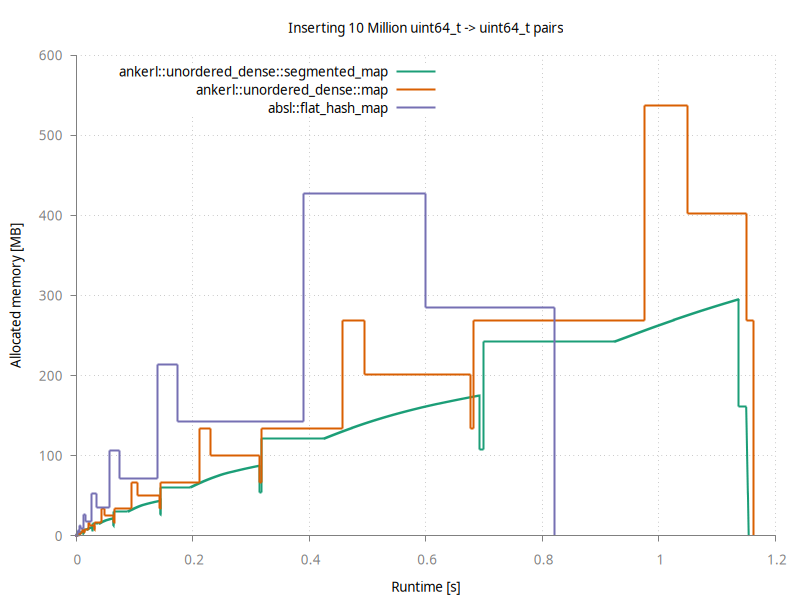
对于这个简单的插入测试,Abseil是最快的,需要超过0.8秒的时间。峰值内存使用率约为430 MB。请注意,在最后一个峰值之后,内存使用情况如何下降;当降低到〜290MB时,它已经完成重新进行,并且可以释放先前使用的内存块。
ankerl::unordered_dense::segmented_map没有这些峰,而是对内存使用的平稳增加。请注意,由于索引数据结构需求仍然需要增加固定因素,因此仍存在突然的下降和增加的内存。但是,由于将数据固定在单独的容器中,我们可以首先释放旧数据结构,然后分配一个新的,更大的索引结构。因此,我们没有峰值。
地图/集有两个数据结构:
std::vector<value_type>保存所有数据。地图/设置迭代器只是std::vector<value_type>::iterator !每当添加元素时,都会将其emplace_back到向量。密钥是哈希,并且在存储库数组中的相应位置添加了一个条目(存储桶)。水桶具有这种结构:
 struct Bucket {
    uint32_t dist_and_fingerprint;
    uint32_t value_idx;
};
每个桶存储3件事:
dist_and_fingerprint中的3个最重要的字节)dist_and_fingerprint中的最低字节)该结构是专门为碰撞解决策略而设计的,罗宾·霍德(Robin-Hood Hoshing)和向后偏移删除。
钥匙是哈希,如果用指纹在该位置有条目,则搜索水桶阵列。当发现时,比较数据向量中的密钥,当返回值时,将其返回。
由于所有数据都存储在向量中,因此删除更为复杂:
value_idx 。这需要另一个查找。 在2023-09-10,我在Github上进行了快速搜索,以查看此地图是否在任何流行的开源项目中都使用。这是我发现的一些项目。如果您愿意在该列表中,请给我发便笺!