hyperparameter_hunter
v3.0.0 (Artemis)

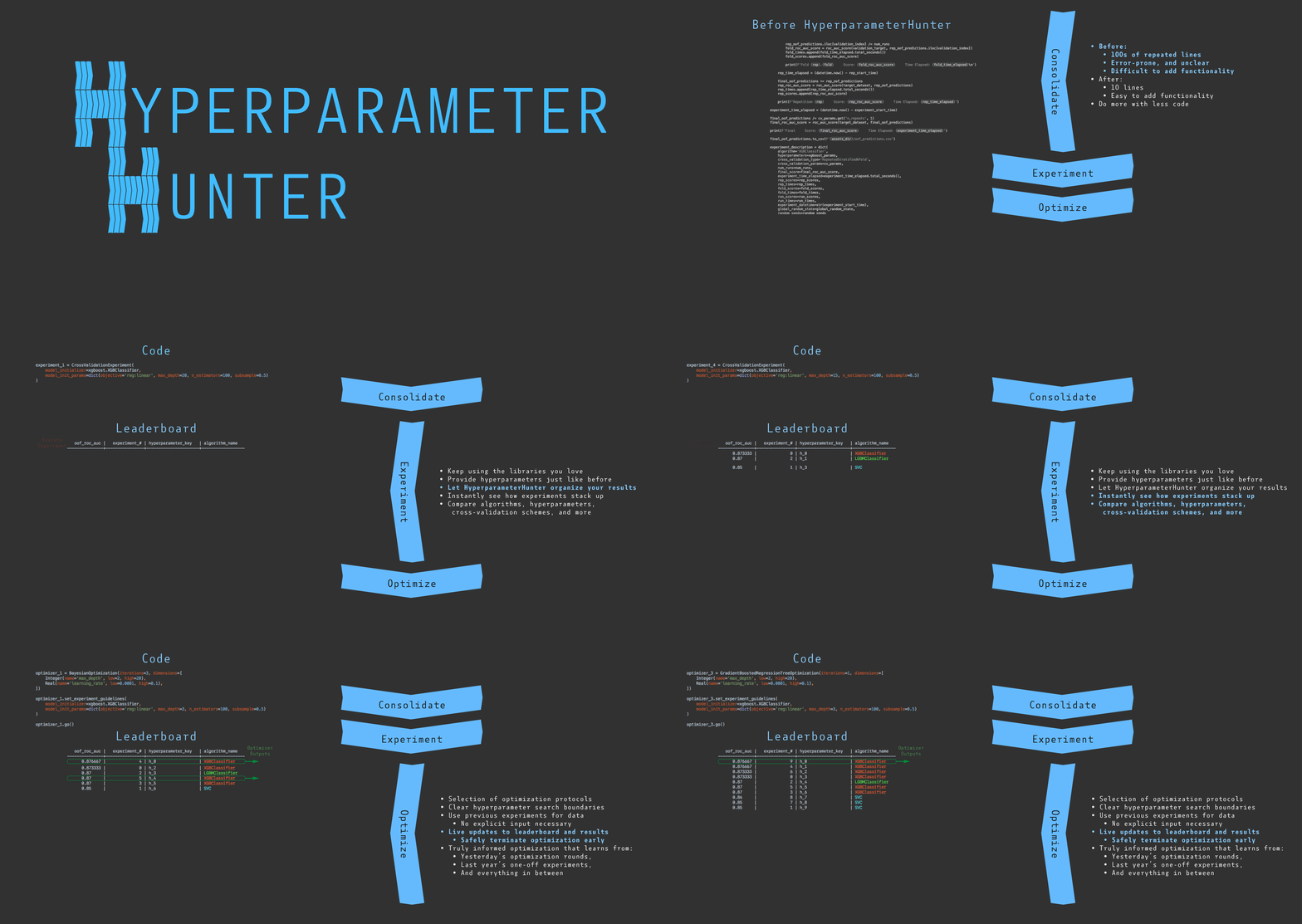
自动保存并从实验结果中学习,从而导致长期的持续优化,以纪念您的所有测试。
HyperParameterHunter为机器学习算法提供了一个包装器,可保存所有重要数据。通过让HyperParameterHunter进行录制,组织和从测试中学习的辛勤工作来简化实验和超参数调整过程,同时使用了您已经做过的相同库。不要让任何实验浪费,然后开始按原定的方式进行超参数优化。
pip install hyperparameter-hunter不要将超级参数猎人视为另一个优化库,只有在进行超参数优化的时间时才出现。当然,它确实进行了优化,但是最好将HyperParameterHunter视为您自己的个人机器学习工具箱/助手。
这个想法是立即开始使用HyperGaremeterHunter。通过它运行所有基准/一次性实验。
您使用HyperParameterHunter的越多,结果就越好。当然,如果您只将其用于优化,它将完成您想要的工作,但这缺少了HyperParameterHunter的点。
如果您一直在整个项目的整个过程中都使用它进行实验和优化,那么当您决定进行超参数优化时,HyperparameterHunter已经意识到您已经完成的所有工作,而这是HyperParameterHunter做一些出色的事情。它不会像其他库那样从头开始优化。它从您已经通过它运行的所有实验和以前的优化回合开始。
建立一个环境来组织实验和优化结果。
我们执行的任何实验或优化回合都将使用我们的主动环境。
 from hyperparameter_hunter import Environment , CVExperiment
import pandas as pd
from sklearn . datasets import load_breast_cancer
from sklearn . model_selection import StratifiedKFold

data = load_breast_cancer ()
df = pd . DataFrame ( data = data . data , columns = data . feature_names )
df [ 'target' ] = data . target

env = Environment (
    train_dataset = df ,  # Add holdout/test dataframes, too
    results_path = 'path/to/results/directory' ,  # Where your result files will go
    metrics = [ 'roc_auc_score' ],  # Callables, or strings referring to `sklearn.metrics`
    cv_type = StratifiedKFold ,  # Class, or string in `sklearn.model_selection`
    cv_params = dict ( n_splits = 5 , shuffle = True , random_state = 32 )
)仅通过提供模型初始化器和超级参数来对您喜欢的库进行实验
 # Same format used by `keras.wrappers.scikit_learn`. Nothing new to learn
def build_fn ( input_shape ):  # `input_shape` calculated for you
    model = Sequential ([
        Dense ( 100 , kernel_initializer = 'uniform' , input_shape = input_shape , activation = 'relu' ),
        Dropout ( 0.5 ),
        Dense ( 1 , kernel_initializer = 'uniform' , activation = 'sigmoid' )
    ])  # All layer arguments saved (whether explicit or Keras default) for future use
    model . compile ( optimizer = 'adam' , loss = 'binary_crossentropy' , metrics = [ 'accuracy' ])
    return model

experiment = CVExperiment (
    model_initializer = KerasClassifier ,
    model_init_params = build_fn ,  # We interpret your build_fn to save hyperparameters in a useful, readable format
    model_extra_params = dict (
        callbacks = [ ReduceLROnPlateau ( patience = 5 )],  # Use Keras callbacks
        batch_size = 32 , epochs = 10 , verbose = 0  # Fit/predict arguments
    )
) experiment = CVExperiment (
model_initializer = LinearSVC , # (Or any of the dozens of other SK-Learn algorithms)
model_init_params = dict ( penalty = 'l1' , C = 0.9 ) # Default values used and recorded for kwargs not given
) experiment = CVExperiment (
model_initializer = XGBClassifier ,
model_init_params = dict ( objective = 'reg:linear' , max_depth = 3 , n_estimators = 100 , subsample = 0.5 )
) experiment = CVExperiment (
model_initializer = LGBMClassifier ,
model_init_params = dict ( boosting_type = 'gbdt' , num_leaves = 31 , max_depth = - 1 , min_child_samples = 5 , subsample = 0.5 )
) experiment = CVExperiment (
model_initializer = CatboostClassifier ,
model_init_params = dict ( iterations = 500 , learning_rate = 0.01 , depth = 7 , allow_writing_files = False ),
model_extra_params = dict ( fit = dict ( verbose = True )) # Send kwargs to `fit` and other extra methods
) experiment = CVExperiment (
model_initializer = RGFClassifier ,
model_init_params = dict ( max_leaf = 1000 , algorithm = 'RGF' , min_samples_leaf = 10 )
)就像实验一样,但是如果您想优化超参数,请使用以下导入的类
 from hyperparameter_hunter import Real , Integer , Categorical
from hyperparameter_hunter import optimization as opt def build_fn ( input_shape ):
model = Sequential ([
Dense ( Integer ( 50 , 150 ), input_shape = input_shape , activation = 'relu' ),
Dropout ( Real ( 0.2 , 0.7 )),
Dense ( 1 , activation = Categorical ([ 'sigmoid' , 'softmax' ]))
])
model . compile (
optimizer = Categorical ([ 'adam' , 'rmsprop' , 'sgd' , 'adadelta' ]),
loss = 'binary_crossentropy' , metrics = [ 'accuracy' ]
)
return model
optimizer = opt . RandomForestOptPro ( iterations = 7 )
optimizer . forge_experiment (
model_initializer = KerasClassifier ,
model_init_params = build_fn ,
model_extra_params = dict (
callbacks = [ ReduceLROnPlateau ( patience = Integer ( 5 , 10 ))],
batch_size = Categorical ([ 32 , 64 ]),
epochs = 10 , verbose = 0
)
)
optimizer . go () optimizer = opt . DummyOptPro ( iterations = 42 )
optimizer . forge_experiment (
model_initializer = AdaBoostClassifier , # (Or any of the dozens of other SKLearn algorithms)
model_init_params = dict (
n_estimators = Integer ( 75 , 150 ),
learning_rate = Real ( 0.8 , 1.3 ),
algorithm = 'SAMME.R'
)
)
optimizer . go () optimizer = opt . BayesianOptPro ( iterations = 10 )
optimizer . forge_experiment (
model_initializer = XGBClassifier ,
model_init_params = dict (
max_depth = Integer ( low = 2 , high = 20 ),
learning_rate = Real ( 0.0001 , 0.5 ),
n_estimators = 200 ,
subsample = 0.5 ,
booster = Categorical ([ 'gbtree' , 'gblinear' , 'dart' ]),
)
)
optimizer . go () optimizer = opt . BayesianOptPro ( iterations = 100 )
optimizer . forge_experiment (
model_initializer = LGBMClassifier ,
model_init_params = dict (
boosting_type = Categorical ([ 'gbdt' , 'dart' ]),
num_leaves = Integer ( 5 , 20 ),
max_depth = - 1 ,
min_child_samples = 5 ,
subsample = 0.5
)
)
optimizer . go () optimizer = opt . GradientBoostedRegressionTreeOptPro ( iterations = 32 )
optimizer . forge_experiment (
model_initializer = CatBoostClassifier ,
model_init_params = dict (
iterations = 100 ,
eval_metric = Categorical ([ 'Logloss' , 'Accuracy' , 'AUC' ]),
learning_rate = Real ( low = 0.0001 , high = 0.5 ),
depth = Integer ( 4 , 7 ),
allow_writing_files = False
)
)
optimizer . go () optimizer = opt . ExtraTreesOptPro ( iterations = 10 )
optimizer . forge_experiment (
model_initializer = RGFClassifier ,
model_init_params = dict (
max_leaf = 1000 ,
algorithm = Categorical ([ 'RGF' , 'RGF_Opt' , 'RGF_Sib' ]),
l2 = Real ( 0.01 , 0.3 ),
normalize = Categorical ([ True , False ]),
learning_rate = Real ( 0.3 , 0.7 ),
loss = Categorical ([ 'LS' , 'Expo' , 'Log' , 'Abs' ])
)
)
optimizer . go ()这是您可以期望Experiment生成的文件结构的简单说明。有关目录结构和各种文件内容的深入说明,请参见文档中的文件结构概述部分。但是,必需品如下:
Experiment将文件添加到每个高参数hunterassets/实验子目录中,由experiment_id命名Experiment还为HyperParameterHunterAssets/排行榜/GlobAlleaderboard.csv添加了一个条目Environment的file_blacklist和do_full_save kwargs创建的(此处记录) HyperparameterHunterAssets
| Heartbeat.log
|
└───Experiments
| |
| └───Descriptions
| | | <Files describing Experiment results, conditions, etc.>.json
| |
| └───Predictions<OOF/Holdout/Test>
| | | <Files containing Experiment predictions for the indicated dataset>.csv
| |
| └───Heartbeats
| | | <Files containing the log produced by the Experiment>.log
| |
| └───ScriptBackups
| | <Files containing a copy of the script that created the Experiment>.py
|
└───Leaderboards
| | GlobalLeaderboard.csv
| | <Other leaderboards>.csv
|
└───TestedKeys
| | <Files named by Environment key, containing hyperparameter keys>.json
|
└───KeyAttributeLookup
| <Files linking complex objects used in Experiments to their hashes>
pip install hyperparameter-hunter
如果您喜欢登顶,并且想要所有最新的发展,请运行:
pip install git+https://github.com/HunterMcGushion/hyperparameter_hunter.git
如果您想为HyperparameterHunter做出贡献,请在此处开始。
没关系。不要感到难过。缠绕您的头有些奇怪。这是一个示例,说明了一切如何相关:
 from hyperparameter_hunter import Environment , CVExperiment , BayesianOptPro , Integer
from hyperparameter_hunter . utils . learning_utils import get_breast_cancer_data
from xgboost import XGBClassifier

# Start by creating an `Environment` - This is where you define how Experiments (and optimization) will be conducted
env = Environment (
    train_dataset = get_breast_cancer_data ( target = 'target' ),
    results_path = 'HyperparameterHunterAssets' ,
    metrics = [ 'roc_auc_score' ],
    cv_type = 'StratifiedKFold' ,
    cv_params = dict ( n_splits = 10 , shuffle = True , random_state = 32 ),
)

# Now, conduct an `Experiment`
# This tells HyperparameterHunter to use the settings in the active `Environment` to train a model with these hyperparameters
experiment = CVExperiment (
    model_initializer = XGBClassifier ,
    model_init_params = dict (
        objective = 'reg:linear' ,
        max_depth = 3
    )
)

# That's it. No annoying boilerplate code to fit models and record results
# Now, the `Environment`'s `results_path` directory will contain new files describing the Experiment just conducted

# Time for the fun part. We'll set up some hyperparameter optimization by first defining the `OptPro` (Optimization Protocol) we want
optimizer = BayesianOptPro ( verbose = 1 )

# Now we're going to say which hyperparameters we want to optimize.
# Notice how this looks just like our `experiment` above
optimizer . forge_experiment (
    model_initializer = XGBClassifier ,
    model_init_params = dict (
        objective = 'reg:linear' ,  # We're setting this as a constant guideline - Not one to optimize
        max_depth = Integer ( 2 , 10 )  # Instead of using an int like the `experiment` above, we provide a space to search
    )
)
# Notice that our range for `max_depth` includes the `max_depth=3` value we used in our `experiment` earlier

optimizer . go ()  # Now, we go

assert experiment . experiment_id in [ _ [ 2 ] for _ in optimizer . similar_experiments ]
# Here we're verifying that the `experiment` we conducted first was found by `optimizer` and used as learning material
# You can also see via the console that we found `experiment`'s saved files, and used it to start optimization

last_experiment_id = optimizer . current_experiment . experiment_id
# Let's save the id of the experiment that was just conducted by `optimizer`

optimizer . go ()  # Now, we'll start up `optimizer` again...

# And we can see that this second optimization round learned from both our first `experiment` and our first optimization round
assert experiment . experiment_id in [ _ [ 2 ] for _ in optimizer . similar_experiments ]
assert last_experiment_id in [ _ [ 2 ] for _ in optimizer . similar_experiments ]
# It even did all this without us having to tell it what experiments to learn from

# Now think about how much better your hyperparameter optimization will be when it learns from:
# - All your past experiments, and
# - All your past optimization rounds
# And the best part: HyperparameterHunter figures out which experiments are compatible all on its own
# You don't have to worry about telling it that KFold=5 is different from KFold=10,
# Or that max_depth=12 is outside of max_depth=Integer(2, 10) 这些可能会“ getcha”
OptPro提供初始搜索点?OptPro优化回合CVExperiment特定的搜索点(尚未记录)开始Experiment适合您的OptPro定义的搜索空间,则优化器将在Experiment结果中找到和读取Experiment ,因为结果已保存。离开它只会一遍又一遍地执行相同的ExperimentActivation层之间的切换而引起的,并提供一个Dense层的activation kwargDense(10, activation='sigmoid')Dense(10); Activation('sigmoid')Activation层,要么在其他层提供activation kwargs,然后坚持使用!model.compile参数: optimizer和optimizer_params同时?optimizers期望不同的论点optimizer=Categorical(['adam', 'rmsprop'])时, optimizer_params有两种不同的命令optimizer ,而optimizer_params则可以分别优化optimizer_params值。这样,每个optimizer将使用其默认参数optimizer是最佳的,并设置optimizer=<best optimizer> ,然后继续调整optimizer_params ,并使用特定于您选择的optimizer参数__init__方法在其他地方定义了kwargs None默认值None




