
Recently, OpenAI CEO Sam Altman released an important statement on social platform X, announcing that due to the company's GPU exhaustion, the latest artificial intelligence model GPT-4.5 will have to be released in stages. Artman explained that the GPT-4.5 is huge and extremely costly, requiring "thousands of" GPUs to support more users to access the model. The news has attracted widespread attention, especially for users and developers interested in the field of artificial intelligence.
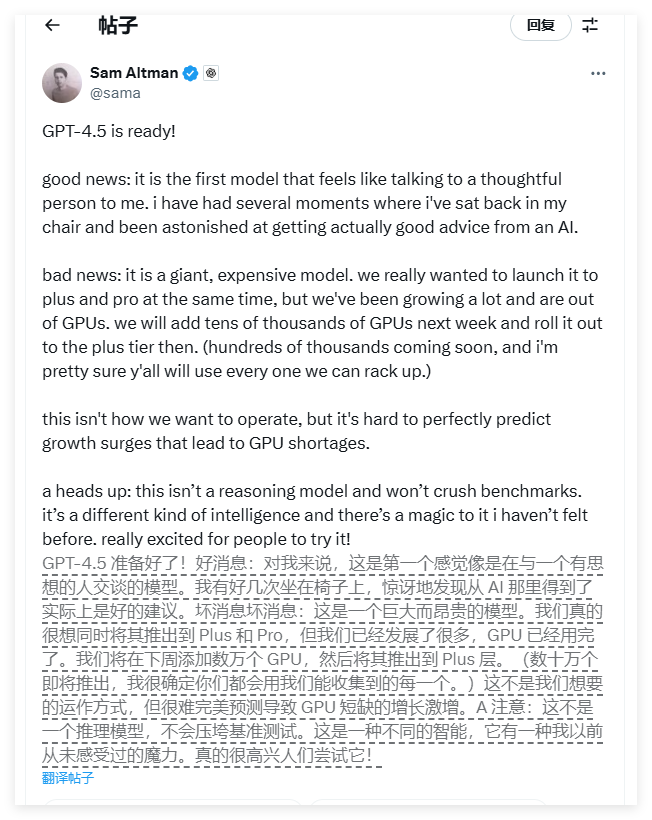
According to Altman's statement, GPT-4.5 will be open to ChatGPT Pro subscription users first and is expected to officially launch this Thursday. ChatGPT Plus users will then gain access next week. This phased release strategy is designed to alleviate the current tight GPU resources and ensure that users can gradually experience this advanced AI model. OpenAI hopes that in this way, it can not only meet user needs, but also effectively manage resources.
Altman also revealed that the cost of using GPT-4.5 is quite expensive. OpenAI will charge $75 per million tokens input (approximately 750,000 words) and $150 per million tokens output. This charging standard is 30 times the input cost and 15 times the output cost of the GPT-4o, the previous main product of OpenAI. This price policy has sparked widespread discussion among users, and many believe that its cost level is too high and may limit the use of ordinary users.
In the statement, Altman further explained: "We are developing very fast and have exhausted GPU resources. We plan to add thousands of GPUs next week and then promote them to Plus-tier users. This is not the operating model we want, but it is difficult to accurately predict the growth wave that leads to GPU shortages." He also mentioned that OpenAI has been facing insufficient computing power and plans to deal with this challenge in the future by developing its own AI chips and building large data centers.
Overall, OpenAI's GPT-4.5 release plan reflects the complexity of the AI field in resource management and technological development. Despite the challenges of GPU resource shortage and high cost, OpenAI remains committed to providing users with the most advanced artificial intelligence experience. In the future, with the research and development of its own AI chips and the construction of data centers, OpenAI is expected to further solve the problem of insufficient computing power and promote the sustainable development of artificial intelligence technology.