
In today's rapidly growing creative industry, artificial intelligence (AI) is becoming an indispensable tool. Many users can use AI models to generate stories, images and even short films by simply entering simple instructions. However, Flora founder and CEO Weber Wong pointed out that most existing AI tools are “designed by non-creatives for other non-creatives” and cannot truly meet the needs of professional creatives. This view reveals the limitations of current AI tools in the creative field.
The official launch of Flora marks the birth of a brand new AI creative tool. The company issued a manifesto highlighting that “AI creative tools are more than just toys that generate AI mud” and expressing its team’s commitment to creating a “powerful tool” to profoundly transform the future of creative work. This declaration distinguishes Flora from existing AI tools, which, while easy to create, lack creative control, and traditional creative software often makes users feel complex and time-consuming.
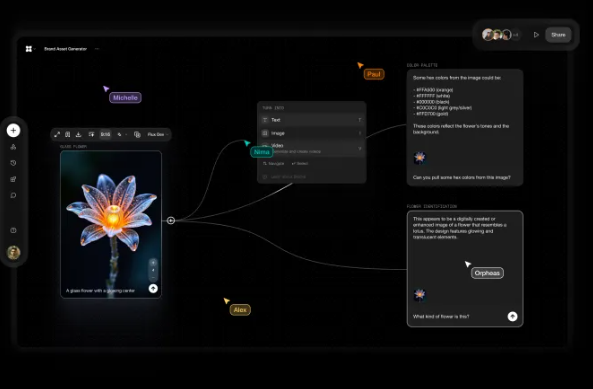
Flora’s core goal is not to develop better generative AI models, but to provide an “infinite canvas” that integrates existing AI models. Weber Wang stressed that "the model is not important, the technology is not important, the key lies in the user interface." Users can generate blocks of text, images and videos on this canvas to form a visual creative process, thereby better controlling the creative process.
For example, a user can first ask Flora to generate an image of a flower, then gradually refine it, and eventually create multiple variations. These processes and variants can be visually displayed on the canvas and collaborated in real time with customers. This design not only improves creative efficiency, but also enhances the flexibility of creative expression.
Flora's initial goal is to serve visual design companies and is currently iterating its products with designers from the famous design company Pentagram. Weber Wang hopes to enable designers to “do 100 times more creative work” by using Flora, such as quickly generating 100 different logo designs. This efficient tool will greatly improve designer work efficiency and creative output.
Weber Wang himself has a dual background in art and technology. He worked for the venture capital firm Menlo Ventures, and later decided to devote himself to the creative field. Flora launched an Alpha version in August this year, where users can use AI to stylize live videos by signing up for waiting lists. This feature demonstrates Flora’s innovative potential in the field of creative tools.
Regarding some artists and professionals’ skepticism about AI, Weber Wang said Flora’s goal is to attract users who are “curious about AI” and make those who oppose AI willing to try it out. He stressed that Flora does not train its own AI models, but uses other companies’ models and will follow social standards to ensure the legitimacy and ethics of its tools.
Flora’s products are available for free and are available on this basis for a professional version, priced at $16 per month. Although no financing details have been disclosed yet, Flora's investors include well-known institutions such as A16Z Games Speedrun and Menlo Ventures. These support provides a solid foundation for Flora's future development.