
Recently, Tencent’s AI assistant "Tencent Yuanbao" has attracted widespread attention and heated discussion for modifying the content of the user agreement. This incident not only gave users new thoughts on the copyright issue of AI tools, but also triggered discussions on how companies can find a balance between technological development and user rights.
According to Taishan Finance, the focus of the dispute is on the provisions of Article 5 of the Tencent Yuanbao User Agreement on intellectual property rights, especially Article 5.4. This clause clearly states that the content uploaded by users to the platform (including prompt words, etc.) and the content generated by using the service will grant Tencent and its affiliates an irrevocable, permanent, free and without geographical restrictions to use. This license covers storage, use, copying, editing, publishing and other behaviors, and can be used for model optimization, academic research and marketing purposes.

Once this clause was exposed, it immediately sparked heated discussions on the Internet. Many netizens expressed concern about this, believing that if the creator uses Tencent Yuanbao to polish or modify the text, his copyright may be at risk of being infringed. Some users even worry that their creative achievements may be "taken for themselves" by Tencent, thereby damaging the rights and interests of creators.
In the face of user doubts, Tencent Yuanbao team responded quickly. On the afternoon of March 5, @Tencent Yuanbao posted on official social media that it had received feedback from users and added data management functions to the latest version. Users can choose whether to allow the platform to use its input and output for model optimization through the "Data Management" option in the settings. In addition, Tencent Yuanbao also emphasized that by default, user content will not be used for model optimization to protect users' rights.
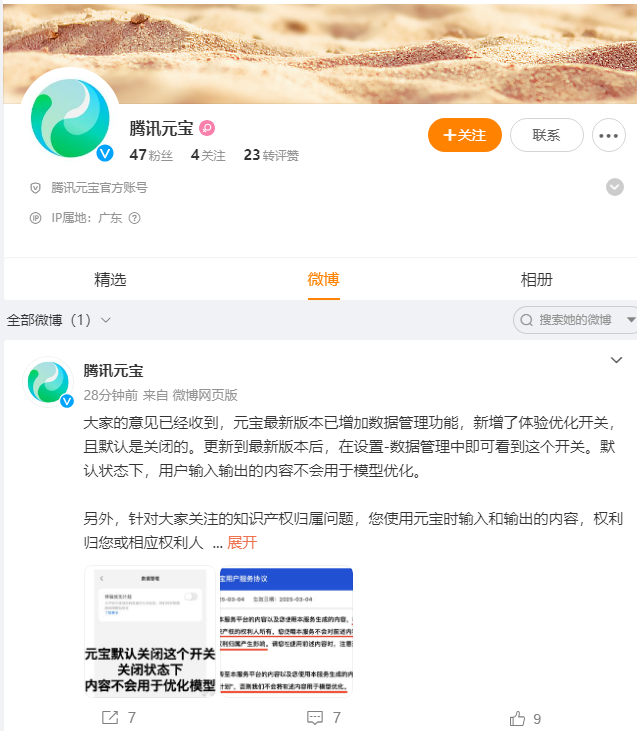
Tencent Yuanbao also made a clear response to the issue of intellectual property ownership that users are most concerned about. The rights of the content input and output by the user when using the ingot are still owned by the user or the corresponding right holder. Using the ingot will not change this ownership. Tencent Yuanbao team expressed its gratitude to users for their criticism and supervision, and will continue to strive to find a better balance between technological development and user rights.
This incident not only reflects the high sensitivity of users to the copyright issues of AI tools, but also highlights the challenges facing enterprises when formulating relevant agreements. How to fully respect and protect the rights and interests of users while promoting technological innovation has become a question that enterprises need to think deeply about. In the future, with the continuous development of AI technology, similar disputes may be more frequent, and companies need to find more reasonable solutions between laws, technology and user needs.