
Harvard University and Google's DeepMind Artificial Intelligence Laboratory have teamed up to create a virtual AI mouse. This technological breakthrough not only demonstrates the huge potential of artificial intelligence in simulating biological behavior, but also may create a "virtual" "A new field of research in neuroscience." The significance of this study is not limited to the technical level, it may also have profound implications for brain science and robotics.
The birth of virtual rats is the result of scientists imitating the evolutionary miracle of nature. Humans and animals are able to move flexibly, which is the result of long-term evolution. By studying mice with intelligence equivalent to 8-year-olds and their physical control abilities, scientists are trying to crack the secrets of how the brain controls complex movements. Unlike previous research, instead of sacrificing the real mouse, scientists created a virtual AI mouse that can mimic all the movements of real rodents and even show some novel behaviors that are not clearly trained. .
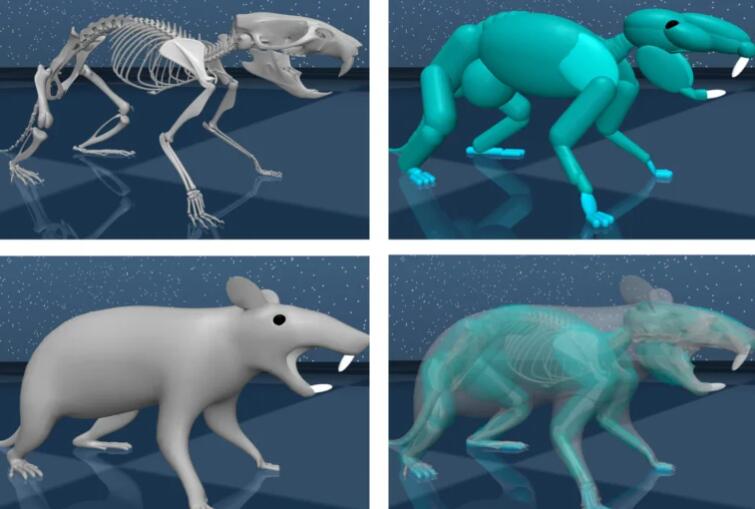
The groundbreaking study, published in the journal Nature, demonstrates that activation states in virtual control networks can accurately predict neural activity in real mice’s brains. Using high-resolution data recorded from real mice, the team trained an artificial neural network to act as the "brain" of the virtual mouse to control its body in the MuJoCo physics simulator. This achievement marks the birth of a new field of "virtual neuroscience".
Matthew Botvinick of Google DeepMind said the team learned a lot from the challenge of building embodied agents that require turning thinking into practical actions in complex environments. Graduate student Diego Aldarondo, working with researchers at DeepMind, trained artificial neural networks to implement inverse dynamics models, similar to how the brain guides movement. This research not only helps understand how the brain works, but may also provide new ideas for designing improved robotic control systems.
Researchers believe that these simulations can create the field of "virtual neuroscience" and provide convenient and transparent models for studying neural circuits. The platform has the potential to be used to design improved robot control systems to make the robot move more smoothly. Furthermore, the platform allows researchers to test the biological authenticity of different neural networks to understand their ability to cope with complex challenges, which could be a very productive approach to exploring the neural basis of behavior.
Harvard University’s collaboration with Google’s DeepMind Artificial Intelligence Lab provides virtual rat research with the necessary resources and opportunities to train the network. The cooperation between the two parties aims to advance understanding of how the real brain produces complex behaviors. This study not only gives us a deeper understanding of the cross-collaboration between AI and neuroscience, but also provides us with a completely new perspective to observe and understand how the brain works. With the development of virtual neuroscience, we may be able to design more flexible and intelligent robots in the future to allow them to move freely in complex environments.
Paper address: https://www.nature.com/articles/s41586-024-07633-4