
Microsoft recently opened up a general AI proxy system called Magentic-One. Its five-level architecture design is designed to achieve highly automated task processing, covering multiple fields such as law, medical care, finance, and education. The system consists of five agents: Orchestrator, WebSurfer, FileSurfer, Coder and ComputerTerminal. They work together to complete complex tasks efficiently, such as writing reports, etc. Magentic-One is adaptive and can be adapted in dynamic environments to ensure efficient collaboration. The open source code has been released on GitHub, providing new possibilities for intelligent applications in various industries.
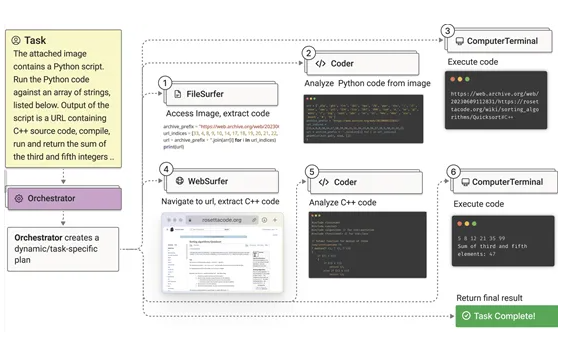
The architecture of Magentic-One is composed of five agent levels. First is the Orchestrator, which is responsible for breaking complex tasks into multiple subtasks and directing other agents to perform these subtasks. Its main function is to plan and monitor tasks to ensure the smooth progress of the overall progress.
Next is WebSurfer, an agent that uses powerful AI models to operate and parse web content, which can help users find relevant information online. While acquiring the data, FileSurfer will read local files and perform tasks such as integration and rewriting to provide the necessary background information for subsequent analysis.
Coder is an important part of Magentic-One. It is mainly used for information analysis and code writing. It can deeply process the data collected by WebSurfer and FileSurfer, generate reports or other new content. ComputerTerminal acts as a console, can execute programs written by Coder, and install new programming libraries as needed to ensure the stable operation of the system.
When a task is received, the various agents of Magentic-One work quickly and collaborate. Taking writing a report as an example, Orchestrator first determines the required agent and the order of work. Subsequently, WebSurfer collects data, FileSurfer extracts relevant information, Coder organizes and analyzes data, and finally generates a report and executes relevant programs through ComputerTerminal. This efficient collaboration significantly improves the speed and accuracy of task processing.
It is worth noting that Magentic-One has adaptive capabilities and is able to adjust in dynamically changing network and file environments to ensure that each agent continues to collaborate efficiently and completes tasks. The release of this open source project undoubtedly opens up new possibilities for intelligent applications in various industries.
The open source code of Magentic-One has been released on GitHub, and developers and researchers are welcome to explore and use it.
Open source address: https://github.com/microsoft/autogen/tree/main/python/packages/autogen-magentic-one
Key points:
- ** New open source system**: Microsoft launches Magentic-One universal AI agent, which supports multi-field automated task processing.
- ** Five-level architecture design**: The system consists of five agents: Orchestrator, WebSurfer, FileSurfer, Coder and ComputerTerminal to complete tasks in concert.
- ** Strong adaptability**:Magentic-One can automatically adjust in dynamic environments to ensure efficient collaboration and task completion.
Magenetic-One's open source provides new directions and tools for the development of AI applications. Its modular design and adaptive capabilities allow it to flexibly deal with various complex tasks and have a wide range of application prospects. We look forward to more developers participating in it and jointly promoting the advancement of AI technology.