
The team of Wu Jiajun at Stanford University has developed a breakthrough technology - "scene language", which can automatically generate realistic 3D models in just one sentence or a picture. This technology cleverly integrates three information: program, text and embedded vectors, uses pre-trained language models to automatically infer scene elements, and generates high-quality 3D scenes through the renderer. It not only generates complex 3D scenes, but also accurately controls and edits the scene structure, providing unprecedented convenience for designers and game developers. Let's take a deeper look at this amazing technology and its wide application prospects.
Do you still remember the cool 3D scenes in science fiction movies? The vast universe, fantasy castles, and the future city... Now, you can easily create such scenes! The latest **"Scene Language" launched by Wu Jiajun's team at Stanford University *Technology allows you to automatically generate lifelike 3D models with just one sentence to describe the scene. It is simply a blessing for designers and game developers!
What is the scene language?
Imagine you are going to describe the mysterious Ahu Akivi stone statue on Easter Island. You will say, "There are a row of seven moai statues, facing the same direction." But if the other party doesn't know what moai statue is, you also have to explain, "Moai statue is a stone statue without legs, but Each one looks slightly different.”
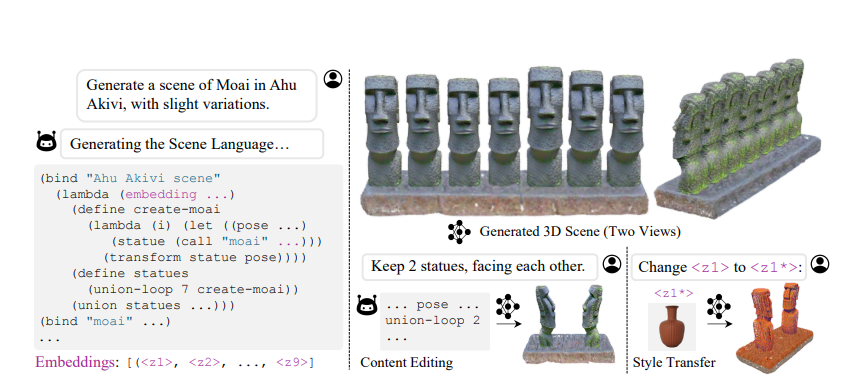
This example tells us that to fully describe a scenario, at least three kinds of information are needed:
Structural information: For example, "a row of seven stone statues" can be described by programs similar to programming languages;
Category semantics: For example, "Moai Stone Statue", can be summarized in words;
Example details: For example, the specific shape, color, and texture of each stone statue are difficult to describe in words, but they can be recognized through images.
Scenario language perfectly integrates these three types of information! It contains three core elements:
Program: Use syntax similar to programming language to define the hierarchical relationship and spatial layout of objects in the scene, such as the arrangement of moai stone statues;
Text: Describe the class semantics of each object in natural language, such as "Moai Stone Statue";
Embed vectors: Use vectors generated by neural networks to capture the visual features of each object, such as the unique appearance of each stone statue.
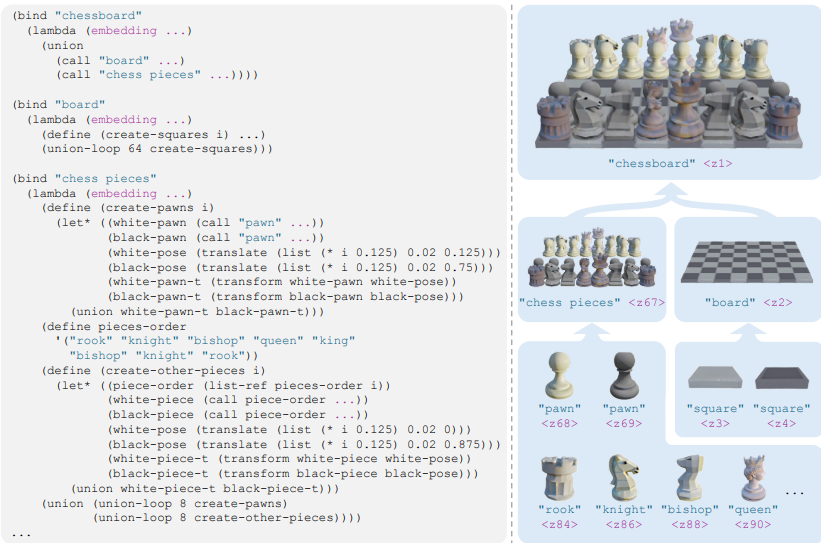
The most amazing thing is that scene language can be automatically generated through pre-trained language models! You only need to enter a text description or an image, and the model can automatically infer programs, text and embed vectors, and then use various renderers to generate high Quality 3D scenes.
What are the advantages of scene language?
Compared with traditional scene graph representations, scene languages can generate more complex and realistic scenes, and can accurately control and edit scene structures. For example, you can use a sentence to modify the properties of an object in the scene, or add new objects, or even change the style of the entire scene.
What are the applications of scenario languages?
Scene language has broad application prospects in the fields of 3D scene generation and editing, such as:
Text generation 3D scene: Enter a text description and the corresponding 3D scene can be automatically generated, such as "a castle on the top of a mountain surrounded by dense forests";
Picture generation 3D scene: Enter a photo to reconstruct the 3D scene in the photo, such as generating a 3D living room model based on a living room photo;
4D scene generation: 4D scenes containing time dimension information can be generated, such as simulating the rotation of a wind turbine;
Scene editing: By modifying the scene language program, text or embed vector, you can accurately edit the scene, such as changing the color, position, or size of an object.
What is the future development direction of scene language?
Scenario language is still in its early stages of development, and there is still a lot of room for development in the future, such as:
More powerful generation ability: can generate more complex and realistic scenes, such as containing more details and richer interactive elements;
More convenient editing methods: You can edit scenes in more natural and intuitive language, such as voice or gesture control;
Wide range of applications: It can be applied to virtual reality, augmented reality, game development, film production and other fields.
Project homepage: https://ai.stanford.edu/~yzzhang/projects/scene-language/
Paper address: https://arxiv.org/abs/2410.16770
In short, the "scenario language" technology has brought revolutionary changes to the field of 3D modeling. Its convenience and powerful generation capabilities will greatly promote the development of related fields, and the future application prospects are limitless. We look forward to this technology bringing us more surprises in the future.