
In recent years, image generation technology has developed rapidly, and various new methods have emerged one after another. In the latest research, Flash Diffusion stands out for its efficiency and versatility, bringing a revolutionary breakthrough in the field of image generation. It achieves multi-step denoising effects through single-step prediction, significantly shortening the generation time and reducing training costs. This article will introduce in detail the core technology, application scenarios and future prospects of Flash Diffusion.
In the latest research, a new method called Flash Diffusion has brought a revolutionary breakthrough to image generation technology. This method accelerates the generation process of pre-trained diffusion models by training the prediction model to generate denoised multi-step predictions in a single step.

Product entrance: https://top.aibase.com/tool/flash-diffusion
The researchers say that the lightning diffusion method not only achieves state-of-the-art FID and CLIP-Score performance in few-step image generation, but also requires less GPU time and the number of trainable parameters during training than existing methods. In addition, this method shows high efficiency and versatility in multiple tasks such as text-to-image, inpainting, face-changing, and super-resolution.
The researchers pointed out that the innovation of the Flash Diffusion method is that it uses an adjustable distribution to select the time step, thereby helping the predictive model to better target specific time steps. In addition, the method adopts an adversarial objective by training a discriminator to distinguish between generated samples and real samples, and applies it to the latent space to reduce computational requirements. At the same time, the research team also used a distribution matching distillation loss to ensure that the generated samples closely resemble the data distribution learned by the prediction model.
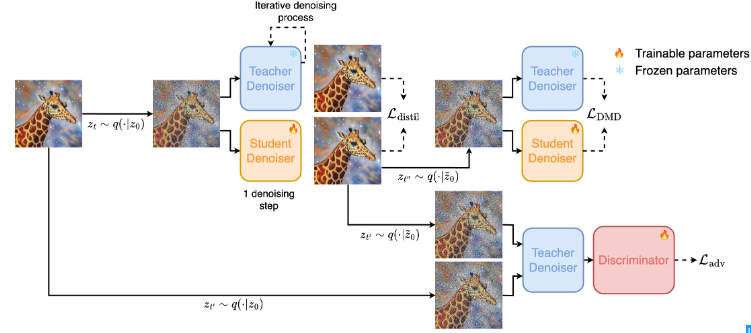
In addition, the researchers also demonstrated the ability of the Flash Diffusion method to adapt to different backbone networks, including UNet-based denoisers (SD1.5, SDXL) and DiT (Pixart-α), and adapters. In several examples, this approach significantly reduces the number of sampling steps while maintaining the high quality of image generation.
The emergence of the Flash Diffusion method has injected new vitality into image generation technology, greatly improving the efficiency and versatility of the generation process. This breakthrough method is expected to have a profound impact in various fields and bring new opportunities and challenges to related research fields.
The efficiency and versatility of Flash Diffusion has opened up a new path for image generation technology, and its application prospects in various fields are worth looking forward to. In the future, I believe there will be more innovative applications based on this method to further promote the progress and development of image generation technology.