
Recently, PearAI, an AI startup incubated by Y Combinator, released an AI coding editor, but caused an uproar due to its licensing issues. The editor of Downcodes will explain the whole incident in detail and analyze the underlying reasons behind it. The founders of PearAI admitted that the product was a clone of the open source project Continue and tried to release it under a closed source license, a move that triggered a strong backlash from the open source community.
Recently, a Y Combinator (YC)-backed startup called PearAI released its first product—an AI coding editor—on social media, which immediately sparked widespread controversy.
Duke Pan, the founder of PearAI, admitted that the product is actually a clone of another AI editor, Continue. Continue itself is a project based on the Apache open source license, and PearAI is trying to publish it under a self-created closed-source license "Pear Enterprise License", and even stated that this license was generated through ChatGPT.
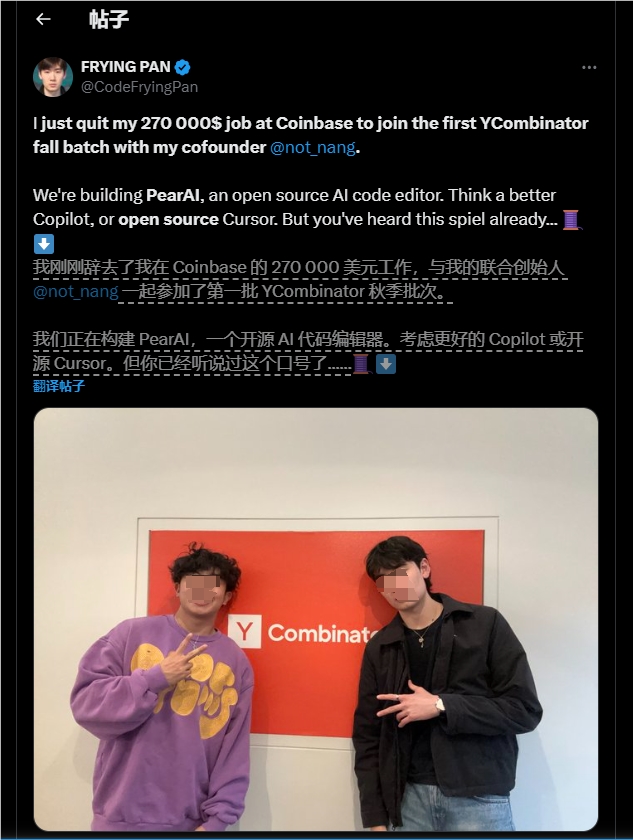
In the open source community, changing the license is a big problem, because it involves legal issues, and more importantly, it goes against the original intention of open source and affects the community's spirit of sharing and contribution. Faced with fierce public opinion, Duke Pan said in a subsequent apology that PearAI has now republished the project under the same Apache open source license as Continue.
PearAI's launch thread on Sunday sparked thousands of comments on social media, with some offering congratulations but others mercilessly criticizing their licensing issues and the fact that PearAI isn't really a "fork" but just a fork. A copy of the new name. To this end, the X platform also released a community note in the comment area, pointing out that PearAI is a fork of Continue. After borrowing the code from Continue, they simply replaced "Continue" with "PearAI", trying to mislead the public into thinking that it was independently developed by them. product.
In response to this controversy, the Continue team also issued a subtle statement, emphasizing that open source is a movement based on trust and respect for contributions, licenses, and intellectual property rights. YC CEO Garry Tan also participated and defended PearAI, believing that the beauty of open source is its openness. However, critics point out that the founder of PearAI has just resigned from his high-paying position at Coinbase, but the proposed project is far from an original idea. In addition, YC has previously supported two other AI coding editors-Void and Melty, this also makes people question why PearAI was chosen to enter the incubator. Some commenters questioned YC's selection, arguing that it reflected problems with YC's review process and due diligence on projects.
Y Combinator plans to increase the number of startup projects from two to four this year, but this expansion has failed to calm outside concerns.
Highlight:
PearAI is a new Y Combinator startup, but its product has been accused of being a simple clone of another open source project.
⚠️ PearAI initially used a self-created closed source license, but later changed back to the Apache open source license under pressure from public opinion.
? Y Combinator has been widely criticized for its support of PearAI, questioning its review and selection criteria for projects.
The PearAI incident once again highlighted the rules and importance of the open source community, and also triggered people's thinking about the ethical bottom line of startups and the review mechanism of incubators. The subsequent development of this incident still requires continued attention. We hope that relevant parties can learn lessons from it and promote the healthy development of the open source ecosystem.