
In the AI era, the film industry is undergoing unprecedented changes. What’s the future of movies?
On October 22, the 2024 Youth Film Week (Zhejiang) "Light and Shadow Future" themed salon and project conference was held. Well-known directors, experts and scholars at home and abroad, as well as from the upstream and downstream industry chains, gathered together to discuss the high-quality development of digital film technology.
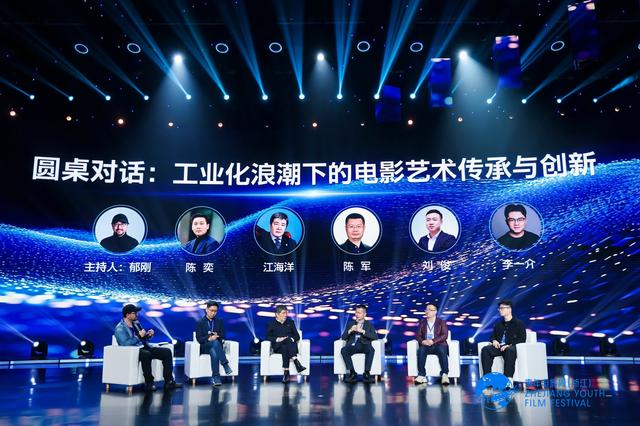
Photo provided by the event organizing committee
The emergence of "Star Wars" and "Jaws" and other films that combine live action and animation have dizzyingly blurred the nature of film to truly record reality. From the photosensitive era to the digital era, what has the film lost and what has it gained? Jiang Haiyang, a national first-level director, an important member of China’s “Fifth Generation Directors” and chairman of the Digital Production Working Committee of the China Film Association, believes that the intervention of AI technology has caused movies to lose their original authenticity, but gain a sense of virtual reality. .
In the film "The Climber", Jiang Haiyang served as the producer. The filming process of this film made this veteran filmmaker feel the impact of AI technology on movies like never before. In the film, 80% of the content is related to Mount Everest. However, due to limitations of objective conditions, it is obviously not feasible for the film crew to go to the Everest Base Camp to shoot. Before filming, the team proposed a plan to use AI technology to present images related to Mount Everest. At that time, he had some doubts, could AI technology do such a complex picture?
"In fact, all live-action shooting was completed in a quarry on the outskirts of Tianjin." Jiang Haiyang said that the scenes of ice and snow, howling winds, and courageous climbing in the film all come from AI technology.
When the image of Mount Everest processed by AI technology appeared in front of his eyes, Jiang Haiyang, who has rich experience in film production, was a little shocked. “The combination of AI and movies can almost create something out of nothing, seamlessly connect, and be omnipotent,” he said.
At the event, Li Yijie, founder of Hollywood's "iFrame Studio" and member of ADG American Film Art Union PDI, shared the AI promotional video of "The Legend of Zheng Chenggong" on the spot. All shots of this promotional video were generated based on AI, and modern technology linked the legendary Zheng Chenggong, which amazed many viewers.
"The Wandering Earth" Group B director Yu Gang mentioned in his sharing that many people asked him that "The Wandering Earth" only came out four years ago, could it be faster? His answer is technically yes. With the support of AI technology, there is no need to build so many real scenes, and many pictures can be completed through AI.
In recent years, AI technology has shone in film production, which also makes people see the unlimited potential of AI. According to estimates by OPEN AI, the parameters of ChatGPT-8 will reach 100 trillion, which will exceed the sum of human IQ. The human brain has an upper limit, and the upper limit of AI seems difficult to predict.
So, what are the difficulties faced by the use of AI technology in the actual film production process?
Li Yijie believes that current AI technology can be naturally integrated into film production. It is also very popular in the market due to its high efficiency and low cost. However, in the specific application process, how to define copyright is a common difficulty faced by everyone.
In the future development of film, can science and art be integrated? How to balance technological innovation and film artistry when using AI?
Jiang Haiyang said that algorithms cannot replace ideas, just like science cannot replace art. "But one thing is clear. In an era where machines and people evolve together, people who can use tools must be at the forefront of the times."
Chen Jun, director of the Film and Television Technology Department of Beijing Film Academy, believes that AI technology is becoming more and more powerful in movies, but it is just a tool anyway. For a work of art to have life, it must still be human-led.
The development of AI technology has opened up the boundaries of applications and brought everyone closer to the virtual environment. But the core problem is that the spiritual core of the movie still needs to be completed through human creation. At this point, AI may not be able to do anything.