libvmcu Virtual MCU Library
1.0.0

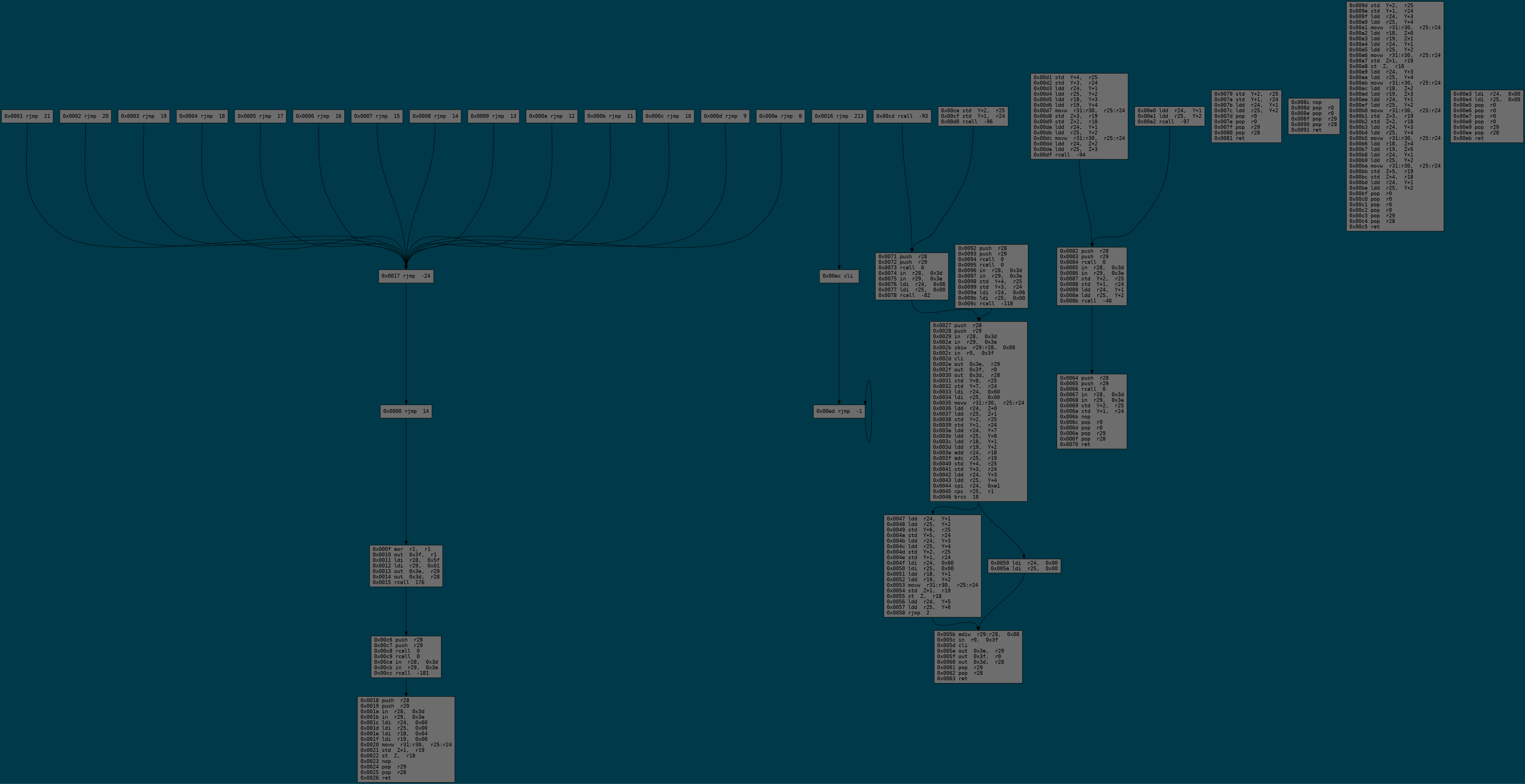
O LIBVMCU é um pequeno motor para análise estática e dinâmica dos binários do microcontrolador AVR.
Ele cuida da preparação de dados brutos, que podem ser processados posteriormente por outros programas. O objetivo aqui é possibilitar interagir programaticamente com o código -fonte AVR.
libvmcu fornece a você
Nota: Esta biblioteca ainda está em desenvolvimento.
Eu exemplos
II mostra
III Configuração VMCU
IV apoiou o MCUS
V análise dinâmica
VI Análise estática
VII Configuração de instrução
Viii ligações
IX contribuindo
X créditos
Documentação XI
 /* A possible implementation of print_instruction can be found below */

int main ( const int argc , const char * * argv ) {

    /* ignoring checks for this example */
    vmcu_model_t  * m328p  = vmcu_model_ctor ( VMCU_DEVICE_M328P );
    vmcu_report_t * report = vmcu_analyze_file ( "file.hex" , m328p );

    for ( uint32_t i = 0 ; i < report -> cfg -> used ; i ++ ) {

        vmcu_cfg_node_t * node = & report -> cfg -> node [ i ];
        print_instruction ( node -> xto . i );

        if ( node -> t != NULL ) {

            printf ( "true  -> " );
            print_instruction ( node -> t -> xto . i );
        }

        if ( node -> f != NULL ) {

            printf ( "false -> " );
            print_instruction ( node -> f -> xto . i );
        }

        printf ( "n" );
    }

    vmcu_report_dtor ( report );
    vmcu_model_dtor ( m328p );

    return EXIT_SUCCESS ;
}
0x0000 .... f1f3 breq - 2 ; (ZF == 1): PC <- PC + -2 + 1
true - > 0x3fff .... 839a sbi 0x10 , 3 ; IO[0x10, 3] <- 1
false - > 0x0001 .... 0fef ldi r16 , 0xff ; r16 <- 0xff
--------------------------------------------------------------------------------
0x0001 .... 0fef ldi r16 , 0xff ; r16 <- 0xff
true - > 0x0002 .... 5817 cp r21 , r24 ; r21 - r24
--------------------------------------------------------------------------------
0x0002 .... 5817 cp r21 , r24 ; r21 - r24
true - > 0x0003 .... 19f4 brne 3 ; (ZF == 0): PC <- PC + 3 + 1
--------------------------------------------------------------------------------
0x0003 .... 19f4 brne 3 ; (ZF == 0): PC <- PC + 3 + 1
true - > 0x0007 .... 0127 eor r16 , r17 ; r16 <- r16 ^ r17
false - > 0x0004 .... a895 wdr ; watchdog reset
--------------------------------------------------------------------------------
0x0004 .... a895 wdr ; watchdog reset
true - > 0x0005 .... 8895 sleep ; circuit sleep
--------------------------------------------------------------------------------
0x0005 .... 8895 sleep ; circuit sleep
true - > 0x0006 .... 0000 nop ; no operation
--------------------------------------------------------------------------------
0x0006 .... 0000 nop ; no operation
true - > 0x0007 .... 0127 eor r16 , r17 ; r16 <- r16 ^ r17
--------------------------------------------------------------------------------
0x0007 .... 0127 eor r16 , r17 ; r16 <- r16 ^ r17
--------------------------------------------------------------------------------
0x3fff .... 839a sbi 0x10 , 3 ; IO[0x10, 3] <- 1
true - > 0x0000 .... f1f3 breq - 2 ; (ZF == 1): PC <- PC + -2 + 1
-------------------------------------------------------------------------------- /* A possible implementation of print_instruction can be found below */
int main ( const int argc , const char * * argv ) {
/* ignoring checks for this example */
vmcu_model_t * m328p = vmcu_model_ctor ( VMCU_DEVICE_M328P );
vmcu_report_t * report = vmcu_analyze_file ( "file.srec" , m328p );
for ( uint32_t i = 0 ; i < report -> progsize ; i ++ ) {
printf ( "0x%04x " , report -> disassembly [ i ]. addr );
print_instruction ( & report -> disassembly [ i ]);
}
vmcu_report_dtor ( report );
vmcu_model_dtor ( m328p );
return EXIT_SUCCESS ;
} 0x004e ldi r27 , 0x06 ; r27 <- 0x06
0x004f rjmp 1 ; PC <- PC + 1 + 1
0x0050 st X +, r1 ; DS[X+] <- r1
0x0051 cpi r26 , 0x20 ; r26 - 0x20
0x0052 cpc r27 , r18 ; r27 - r18 - CF
0x0053 brne - 4 ; (ZF == 0): PC <- PC + -4 + 1
0x0054 call 0x60b ; PC <- 0x60b /* A possible implementation of print_instruction can be found below */
int main ( const int argc , const char * * argv ) {
/* ignoring checks for this example */
vmcu_model_t * m328p = vmcu_model_ctor ( VMCU_DEVICE_M328P );
vmcu_report_t * report = vmcu_analyze_file ( "file.hex" , m328p );
for ( uint32_t i = 0 ; i < report -> progsize ; i ++ ) {
vmcu_instr_t * instr = & report -> disassembly [ i ];
if ( instr -> writes . c_flag == true)
print_instruction ( instr );
if ( instr -> reads . c_flag == true)
print_instruction ( instr );
}
vmcu_report_dtor ( report );
vmcu_model_dtor ( m328p );
return EXIT_SUCCESS ;
} subi r18 , 0x00 ; r18 <- r18 - 0x00
adiw r29:r28 , 0x1a ; r29:r28 <- r29:r28 + 0x1a
sbci r23 , 0xff ; r23 <- r23 - 0xff - CF
cpc r19 , r17 ; r19 - r17 - CF int main ( const int argc , const char * * argv ) {
/* ignoring checks for this example */
vmcu_model_t * m328p = vmcu_model_ctor ( VMCU_DEVICE_M328P );
vmcu_report_t * report = vmcu_analyze_file ( "file.hex" , m328p );
for ( uint32_t i = 0 ; i < report -> n_vector ; i ++ ) {
vmcu_vector_t * vect = & report -> vector [ i ];
vmcu_instr_t * isr = vect -> xto -> i ;
printf ( "Vector ID %d @ 0x%04xn" , vect -> id , vect -> addr );
printf ( " interrupt service routine at 0x%04x" , isr -> addr );
printf ( "nn" );
}
vmcu_report_dtor ( report );
vmcu_model_dtor ( m328p );
return EXIT_SUCCESS ;
} Vector ID 16 @ 0x0020
interrupt service routine at 0x03f5
Vector ID 17 @ 0x0022
interrupt service routine at 0x008a
Vector ID 18 @ 0x0024
interrupt service routine at 0x03c3
Vector ID 19 @ 0x0026
interrupt service routine at 0x039d /* A possible implementation of print_instruction can be found below */
int main ( const int argc , const char * * argv ) {
/* ignoring checks for this example */
vmcu_model_t * m328p = vmcu_model_ctor ( VMCU_DEVICE_M328P );
vmcu_report_t * report = vmcu_analyze_file ( "file.hex" , m328p );
for ( uint32_t i = 0 ; i < report -> n_label ; i ++ ) {
vmcu_label_t * lx = & report -> label [ i ];
printf ( "0x%04xtL%dnn" , lx -> addr , lx -> id );
for ( uint32_t j = 0 ; j < lx -> n_xfrom ; j ++ ) {
vmcu_xref_t * x = & lx -> xfrom [ j ];
printf ( " xref from 0x%04x " , x -> i -> addr );
print_instruction ( x -> i );
}
printf ( "n" );
}
vmcu_report_dtor ( report );
vmcu_model_dtor ( m328p );
return EXIT_SUCCESS ;
} 0x04c6 L75
xref from 0x04a1 call + 1222 ; PC <- 0x4c6
xref from 0x0a84 call + 1222 ; PC <- 0x4c6
xref from 0x0b5c call + 1222 ; PC <- 0x4c6
0x04e2 L76
xref from 0x05d4 rjmp - 243 ; PC <- PC - 0xf3 + 1
0x05d0 L77
xref from 0x04e1 rjmp + 238 ; PC <- PC + 0xee + 1 /* A possible implementation of print_instruction can be found below */
int main ( const int argc , const char * * argv ) {
/* ignoring checks for this example */
vmcu_model_t * m328p = vmcu_model_ctor ( VMCU_DEVICE_M328P );
vmcu_report_t * report = vmcu_analyze_file ( "file.hex" , m328p );
for ( uint32_t i = 0 ; i < report -> n_sfr ; i ++ ) {
vmcu_sfr_t * sfr = & report -> sfr [ i ];
printf ( "SFR ID: %dnn" , sfr -> id );
for ( uint32_t j = 0 ; j < sfr -> n_xfrom ; j ++ ) {
vmcu_xref_t * x = & sfr -> xfrom [ j ];
printf ( " xref from 0x%04x " , x -> i -> addr );
print_instruction ( x -> i );
}
printf ( "n" );
}
vmcu_report_dtor ( report );
vmcu_model_dtor ( m328p );
return EXIT_SUCCESS ;
} SFR ID: 17
xref from 0x00f4 sbi 0x1f , 2 ; IO[1f, 2] <- 0x01
xref from 0x00f5 sbi 0x1f , 1 ; IO[1f, 1] <- 0x01
SFR ID: 50
xref from 0x004c sts 0x006e , r1 ; DATA[0x6e] <- R1
xref from 0x0051 lds r24 , 0x006e ; R24 <- DATA[0x6e]
xref from 0x0054 sts 0x006e , r24 ; DATA[0x6e] <- R24 /* 0x6a97 (little endian) <=> sbiw r29:r28, 0x1a */
int main ( const int argc , const char * * argv ) {
/* initialize a device model */
vmcu_model_t * m328p = vmcu_model_ctor ( VMCU_DEVICE_M328P );
vmcu_instr_t instr ;
vmcu_disassemble_bytes ( 0x6a97 , & instr , m328p );
const VMCU_IKEY key = instr . key ; // VMCU_IKEY_SBIW
const VMCU_GROUP grp = instr . group ; // VMCU_GROUP_MATH_LOGIC
const uint32_t opcode = instr . opcode ; // 0x976a (big endian)
const uint32_t addr = instr . addr ; // 0x0000 (undefined)
const bool dword = instr . dword ; // false
const bool exec = instr . exec ; // true
vmcu_operand_t * src = & instr . src ; // source operand
vmcu_operand_t * dest = & instr . dest ; // destination operand
VMCU_OPTYPE src_type = src -> type ; // VMCU_OPTYPE_K6
VMCU_OPTYPE dest_type = dest -> type ; // VMCU_OPTYPE_RP
const uint8_t src_val = src -> k ; // 0x1a
VMCU_REGISTER dest_rh = dest -> rp . high ; // VMCU_REGISTER_R29
VMCU_REGISTER dest_rl = dest -> rp . low ; // VMCU_REGISTER_R28
const bool writes_hf = instr . writes . h_flag ; // false
const bool writes_cf = instr . writes . c_flag ; // true
const bool reads_io = instr . reads . io ; // false
const bool reads_nf = instr . reads . n_flag ; // false
vmcu_mnemonic_t * mnem = & instr . mnem ; // instruction mnemonic
const char * base_str = mnem -> base ; // "sbiw"
const char * dest_str = mnem -> dest ; // "r29:r28"
const char * src_str = mnem -> src ; // "0x1a"
const char * com_str = mnem -> comment ; // "r29:r28 <- r29:r28 - 0x1a"
vmcu_model_dtor ( m328p );
return EXIT_SUCCESS ;
} /* this snippet can be used to assemble and print an instruction */
void print_instruction ( const vmcu_instr_t * instr ) {
printf ( "%s" , instr -> mnem . base );
if ( instr -> dest . type != VMCU_OPTYPE_NONE )
printf ( " %s," , instr -> mnem . dest );
if ( instr -> src . type != VMCU_OPTYPE_NONE )
printf ( " %s" , instr -> mnem . src );
printf ( " %sn" , instr -> mnem . comment );
}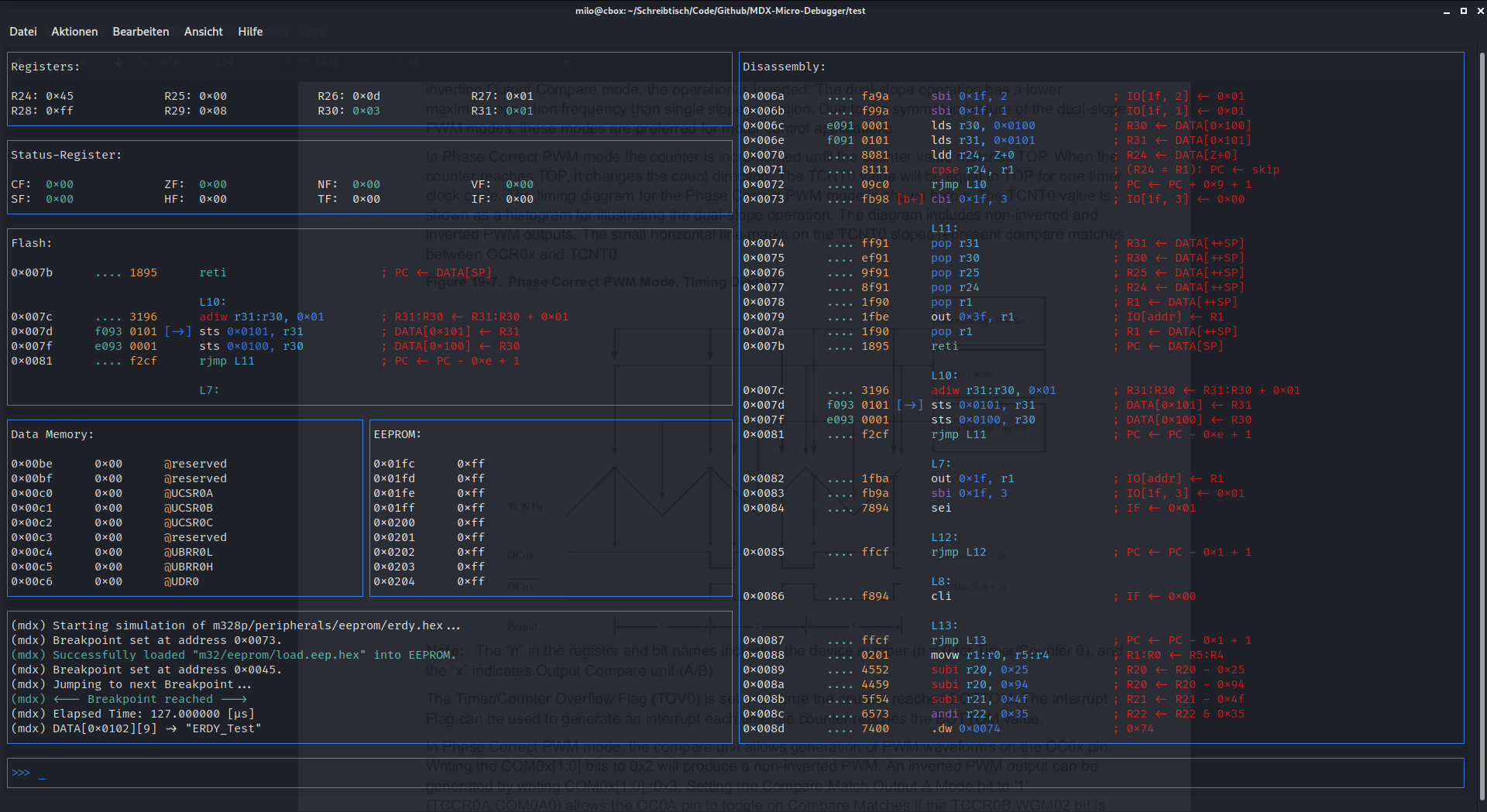 Um pequeno depurador escrito com libvmcu
Atualmente, esta biblioteca vem com dois cabeçalhos, ambos podem ser encontrados no motor/incluir/libvmcu:
Digamos que temos um arquivo chamado prog.c no nível superior deste repositório e queremos vinculá -lo ao libvmcu:
 /* prog.c */

#include "libvmcu_analyzer.h"
#include "libvmcu_system.h"

int main ( void ) {

    /* do something */
    return 0 ;
} You@Terminal:~ $ cd build-release/
You@Terminal:~ $ make -f build.mk You@Terminal:~ $ gcc -Iengine/include/libvmcu/ -c prog.c -o prog.o You@Terminal:~ $ gcc -o prog prog.o -Lbuild-release/ -lvmcu -lmÉ isso. Se você enfrentar problemas, consulte alguns exemplos no driver/ diretório.
O LIBVMCU tenta apoiar o maior número possível de tipos de AVR para análise estática. Atualmente, a análise dinâmica está planejada apenas para a família ATMEGA328, mas pode ser estendida no futuro.
Deve ser muito fácil adicionar novos microcontroladores à análise estática. Para mais informações, consulte o motor/*/arch/
Núcleo do dispositivo AVR
Núcleo do dispositivo AVRE
Núcleo do dispositivo AVRE+
Núcleo do dispositivo AVRXM
Núcleo do dispositivo AVRXT
Núcleo do dispositivo AVRRC
Desmontador
Referências cruzadas (XREF-FRON, XREF-TO)
sinalizadores do analisador
decompor e classificar instruções
analisador para binários AVR
Format Reader
suporte de interrupção
ciclo de simulação precisa em tempo real
Suporte para 133 instruções de montagem AVR
Simulação precisa de periféricos internos
Atualmente, o VMCU suporta: ~ 133 Instruções. Algumas poucas instruções são implementadas como instruções 'nop', portanto, não têm funcionalidade real. Essas instruções serão implementadas o mais rápido possível. A seguir as instruções requerem mais trabalho:
Todas as outras instruções de montagem estão funcionando muito bem.
O LIBVMCU possui ligações Java para funcionalidades básicas. Para mais informações, consulte as ligações/java/
Observe também que as ligações nem sempre funcionam com a versão mais recente devido ao desenvolvimento do mecanismo.
| Motor | Motoristas | Ligações | Teste |
|---|---|---|---|
| fechado para pr | aberto para pr | aberto para pr | aberto para pr |
No momento em que escrever isso, a documentação ainda está em desenvolvimento. A documentação (incompleta) pode ser encontrada em https://github.com/milo-d/libvmcu-virtual-mcu-library/wiki
Se você está faltando informações e não quiser esperar o wiki, os arquivos de cabeçalho LibVMCU também estão muito bem documentados.