libvmcu Virtual MCU Library
1.0.0

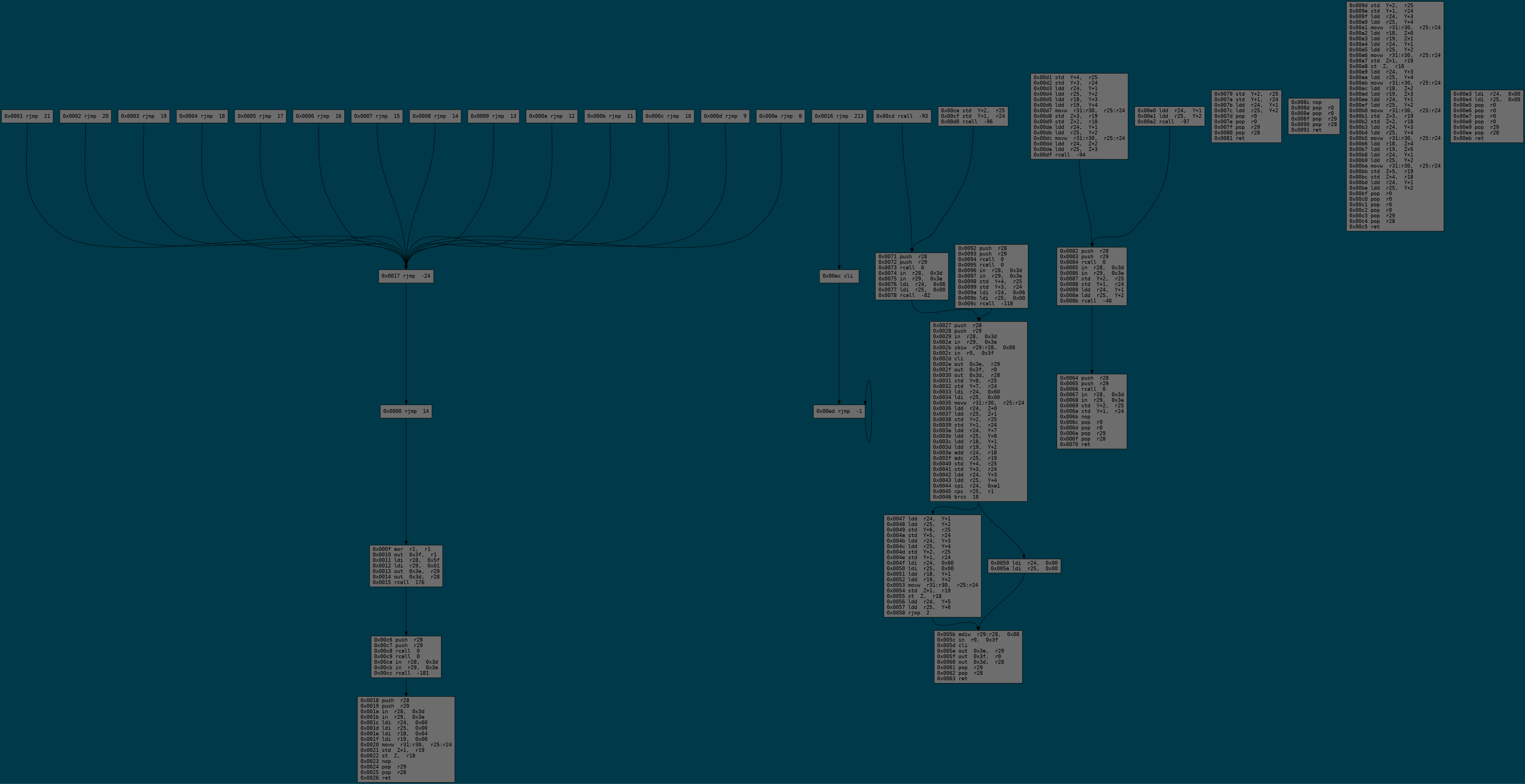
libvmcu هو محرك صغير للتحليل الثابت والديناميكي لثنائيات متحكم AVR.
إنه يهتم بإعداد البيانات الأولية ، والتي يمكن بعد ذلك معالجتها بواسطة برامج أخرى. الهدف هنا هو جعل من الممكن التفاعل برمجيا مع رمز مصدر AVR.
LiBVMCU يوفر لك
ملاحظة: لا تزال هذه المكتبة قيد التطوير.
أنا أمثلة
II عرض
III الإعداد VMCU
IV دعم MCU
V التحليل الديناميكي
السادس تحليل ثابت
السابع التعليمية مجموعة
روابط الثامن
تاسع المساهمة
× ائتمانات
توثيق الحادي عشر
 /* A possible implementation of print_instruction can be found below */

int main ( const int argc , const char * * argv ) {

    /* ignoring checks for this example */
    vmcu_model_t  * m328p  = vmcu_model_ctor ( VMCU_DEVICE_M328P );
    vmcu_report_t * report = vmcu_analyze_file ( "file.hex" , m328p );

    for ( uint32_t i = 0 ; i < report -> cfg -> used ; i ++ ) {

        vmcu_cfg_node_t * node = & report -> cfg -> node [ i ];
        print_instruction ( node -> xto . i );

        if ( node -> t != NULL ) {

            printf ( "true  -> " );
            print_instruction ( node -> t -> xto . i );
        }

        if ( node -> f != NULL ) {

            printf ( "false -> " );
            print_instruction ( node -> f -> xto . i );
        }

        printf ( "n" );
    }

    vmcu_report_dtor ( report );
    vmcu_model_dtor ( m328p );

    return EXIT_SUCCESS ;
}
0x0000 .... f1f3 breq - 2 ; (ZF == 1): PC <- PC + -2 + 1
true - > 0x3fff .... 839a sbi 0x10 , 3 ; IO[0x10, 3] <- 1
false - > 0x0001 .... 0fef ldi r16 , 0xff ; r16 <- 0xff
--------------------------------------------------------------------------------
0x0001 .... 0fef ldi r16 , 0xff ; r16 <- 0xff
true - > 0x0002 .... 5817 cp r21 , r24 ; r21 - r24
--------------------------------------------------------------------------------
0x0002 .... 5817 cp r21 , r24 ; r21 - r24
true - > 0x0003 .... 19f4 brne 3 ; (ZF == 0): PC <- PC + 3 + 1
--------------------------------------------------------------------------------
0x0003 .... 19f4 brne 3 ; (ZF == 0): PC <- PC + 3 + 1
true - > 0x0007 .... 0127 eor r16 , r17 ; r16 <- r16 ^ r17
false - > 0x0004 .... a895 wdr ; watchdog reset
--------------------------------------------------------------------------------
0x0004 .... a895 wdr ; watchdog reset
true - > 0x0005 .... 8895 sleep ; circuit sleep
--------------------------------------------------------------------------------
0x0005 .... 8895 sleep ; circuit sleep
true - > 0x0006 .... 0000 nop ; no operation
--------------------------------------------------------------------------------
0x0006 .... 0000 nop ; no operation
true - > 0x0007 .... 0127 eor r16 , r17 ; r16 <- r16 ^ r17
--------------------------------------------------------------------------------
0x0007 .... 0127 eor r16 , r17 ; r16 <- r16 ^ r17
--------------------------------------------------------------------------------
0x3fff .... 839a sbi 0x10 , 3 ; IO[0x10, 3] <- 1
true - > 0x0000 .... f1f3 breq - 2 ; (ZF == 1): PC <- PC + -2 + 1
-------------------------------------------------------------------------------- /* A possible implementation of print_instruction can be found below */
int main ( const int argc , const char * * argv ) {
/* ignoring checks for this example */
vmcu_model_t * m328p = vmcu_model_ctor ( VMCU_DEVICE_M328P );
vmcu_report_t * report = vmcu_analyze_file ( "file.srec" , m328p );
for ( uint32_t i = 0 ; i < report -> progsize ; i ++ ) {
printf ( "0x%04x " , report -> disassembly [ i ]. addr );
print_instruction ( & report -> disassembly [ i ]);
}
vmcu_report_dtor ( report );
vmcu_model_dtor ( m328p );
return EXIT_SUCCESS ;
} 0x004e ldi r27 , 0x06 ; r27 <- 0x06
0x004f rjmp 1 ; PC <- PC + 1 + 1
0x0050 st X +, r1 ; DS[X+] <- r1
0x0051 cpi r26 , 0x20 ; r26 - 0x20
0x0052 cpc r27 , r18 ; r27 - r18 - CF
0x0053 brne - 4 ; (ZF == 0): PC <- PC + -4 + 1
0x0054 call 0x60b ; PC <- 0x60b /* A possible implementation of print_instruction can be found below */
int main ( const int argc , const char * * argv ) {
/* ignoring checks for this example */
vmcu_model_t * m328p = vmcu_model_ctor ( VMCU_DEVICE_M328P );
vmcu_report_t * report = vmcu_analyze_file ( "file.hex" , m328p );
for ( uint32_t i = 0 ; i < report -> progsize ; i ++ ) {
vmcu_instr_t * instr = & report -> disassembly [ i ];
if ( instr -> writes . c_flag == true)
print_instruction ( instr );
if ( instr -> reads . c_flag == true)
print_instruction ( instr );
}
vmcu_report_dtor ( report );
vmcu_model_dtor ( m328p );
return EXIT_SUCCESS ;
} subi r18 , 0x00 ; r18 <- r18 - 0x00
adiw r29:r28 , 0x1a ; r29:r28 <- r29:r28 + 0x1a
sbci r23 , 0xff ; r23 <- r23 - 0xff - CF
cpc r19 , r17 ; r19 - r17 - CF int main ( const int argc , const char * * argv ) {
/* ignoring checks for this example */
vmcu_model_t * m328p = vmcu_model_ctor ( VMCU_DEVICE_M328P );
vmcu_report_t * report = vmcu_analyze_file ( "file.hex" , m328p );
for ( uint32_t i = 0 ; i < report -> n_vector ; i ++ ) {
vmcu_vector_t * vect = & report -> vector [ i ];
vmcu_instr_t * isr = vect -> xto -> i ;
printf ( "Vector ID %d @ 0x%04xn" , vect -> id , vect -> addr );
printf ( " interrupt service routine at 0x%04x" , isr -> addr );
printf ( "nn" );
}
vmcu_report_dtor ( report );
vmcu_model_dtor ( m328p );
return EXIT_SUCCESS ;
} Vector ID 16 @ 0x0020
interrupt service routine at 0x03f5
Vector ID 17 @ 0x0022
interrupt service routine at 0x008a
Vector ID 18 @ 0x0024
interrupt service routine at 0x03c3
Vector ID 19 @ 0x0026
interrupt service routine at 0x039d /* A possible implementation of print_instruction can be found below */
int main ( const int argc , const char * * argv ) {
/* ignoring checks for this example */
vmcu_model_t * m328p = vmcu_model_ctor ( VMCU_DEVICE_M328P );
vmcu_report_t * report = vmcu_analyze_file ( "file.hex" , m328p );
for ( uint32_t i = 0 ; i < report -> n_label ; i ++ ) {
vmcu_label_t * lx = & report -> label [ i ];
printf ( "0x%04xtL%dnn" , lx -> addr , lx -> id );
for ( uint32_t j = 0 ; j < lx -> n_xfrom ; j ++ ) {
vmcu_xref_t * x = & lx -> xfrom [ j ];
printf ( " xref from 0x%04x " , x -> i -> addr );
print_instruction ( x -> i );
}
printf ( "n" );
}
vmcu_report_dtor ( report );
vmcu_model_dtor ( m328p );
return EXIT_SUCCESS ;
} 0x04c6 L75
xref from 0x04a1 call + 1222 ; PC <- 0x4c6
xref from 0x0a84 call + 1222 ; PC <- 0x4c6
xref from 0x0b5c call + 1222 ; PC <- 0x4c6
0x04e2 L76
xref from 0x05d4 rjmp - 243 ; PC <- PC - 0xf3 + 1
0x05d0 L77
xref from 0x04e1 rjmp + 238 ; PC <- PC + 0xee + 1 /* A possible implementation of print_instruction can be found below */
int main ( const int argc , const char * * argv ) {
/* ignoring checks for this example */
vmcu_model_t * m328p = vmcu_model_ctor ( VMCU_DEVICE_M328P );
vmcu_report_t * report = vmcu_analyze_file ( "file.hex" , m328p );
for ( uint32_t i = 0 ; i < report -> n_sfr ; i ++ ) {
vmcu_sfr_t * sfr = & report -> sfr [ i ];
printf ( "SFR ID: %dnn" , sfr -> id );
for ( uint32_t j = 0 ; j < sfr -> n_xfrom ; j ++ ) {
vmcu_xref_t * x = & sfr -> xfrom [ j ];
printf ( " xref from 0x%04x " , x -> i -> addr );
print_instruction ( x -> i );
}
printf ( "n" );
}
vmcu_report_dtor ( report );
vmcu_model_dtor ( m328p );
return EXIT_SUCCESS ;
} SFR ID: 17
xref from 0x00f4 sbi 0x1f , 2 ; IO[1f, 2] <- 0x01
xref from 0x00f5 sbi 0x1f , 1 ; IO[1f, 1] <- 0x01
SFR ID: 50
xref from 0x004c sts 0x006e , r1 ; DATA[0x6e] <- R1
xref from 0x0051 lds r24 , 0x006e ; R24 <- DATA[0x6e]
xref from 0x0054 sts 0x006e , r24 ; DATA[0x6e] <- R24 /* 0x6a97 (little endian) <=> sbiw r29:r28, 0x1a */
int main ( const int argc , const char * * argv ) {
/* initialize a device model */
vmcu_model_t * m328p = vmcu_model_ctor ( VMCU_DEVICE_M328P );
vmcu_instr_t instr ;
vmcu_disassemble_bytes ( 0x6a97 , & instr , m328p );
const VMCU_IKEY key = instr . key ; // VMCU_IKEY_SBIW
const VMCU_GROUP grp = instr . group ; // VMCU_GROUP_MATH_LOGIC
const uint32_t opcode = instr . opcode ; // 0x976a (big endian)
const uint32_t addr = instr . addr ; // 0x0000 (undefined)
const bool dword = instr . dword ; // false
const bool exec = instr . exec ; // true
vmcu_operand_t * src = & instr . src ; // source operand
vmcu_operand_t * dest = & instr . dest ; // destination operand
VMCU_OPTYPE src_type = src -> type ; // VMCU_OPTYPE_K6
VMCU_OPTYPE dest_type = dest -> type ; // VMCU_OPTYPE_RP
const uint8_t src_val = src -> k ; // 0x1a
VMCU_REGISTER dest_rh = dest -> rp . high ; // VMCU_REGISTER_R29
VMCU_REGISTER dest_rl = dest -> rp . low ; // VMCU_REGISTER_R28
const bool writes_hf = instr . writes . h_flag ; // false
const bool writes_cf = instr . writes . c_flag ; // true
const bool reads_io = instr . reads . io ; // false
const bool reads_nf = instr . reads . n_flag ; // false
vmcu_mnemonic_t * mnem = & instr . mnem ; // instruction mnemonic
const char * base_str = mnem -> base ; // "sbiw"
const char * dest_str = mnem -> dest ; // "r29:r28"
const char * src_str = mnem -> src ; // "0x1a"
const char * com_str = mnem -> comment ; // "r29:r28 <- r29:r28 - 0x1a"
vmcu_model_dtor ( m328p );
return EXIT_SUCCESS ;
} /* this snippet can be used to assemble and print an instruction */
void print_instruction ( const vmcu_instr_t * instr ) {
printf ( "%s" , instr -> mnem . base );
if ( instr -> dest . type != VMCU_OPTYPE_NONE )
printf ( " %s," , instr -> mnem . dest );
if ( instr -> src . type != VMCU_OPTYPE_NONE )
printf ( " %s" , instr -> mnem . src );
printf ( " %sn" , instr -> mnem . comment );
}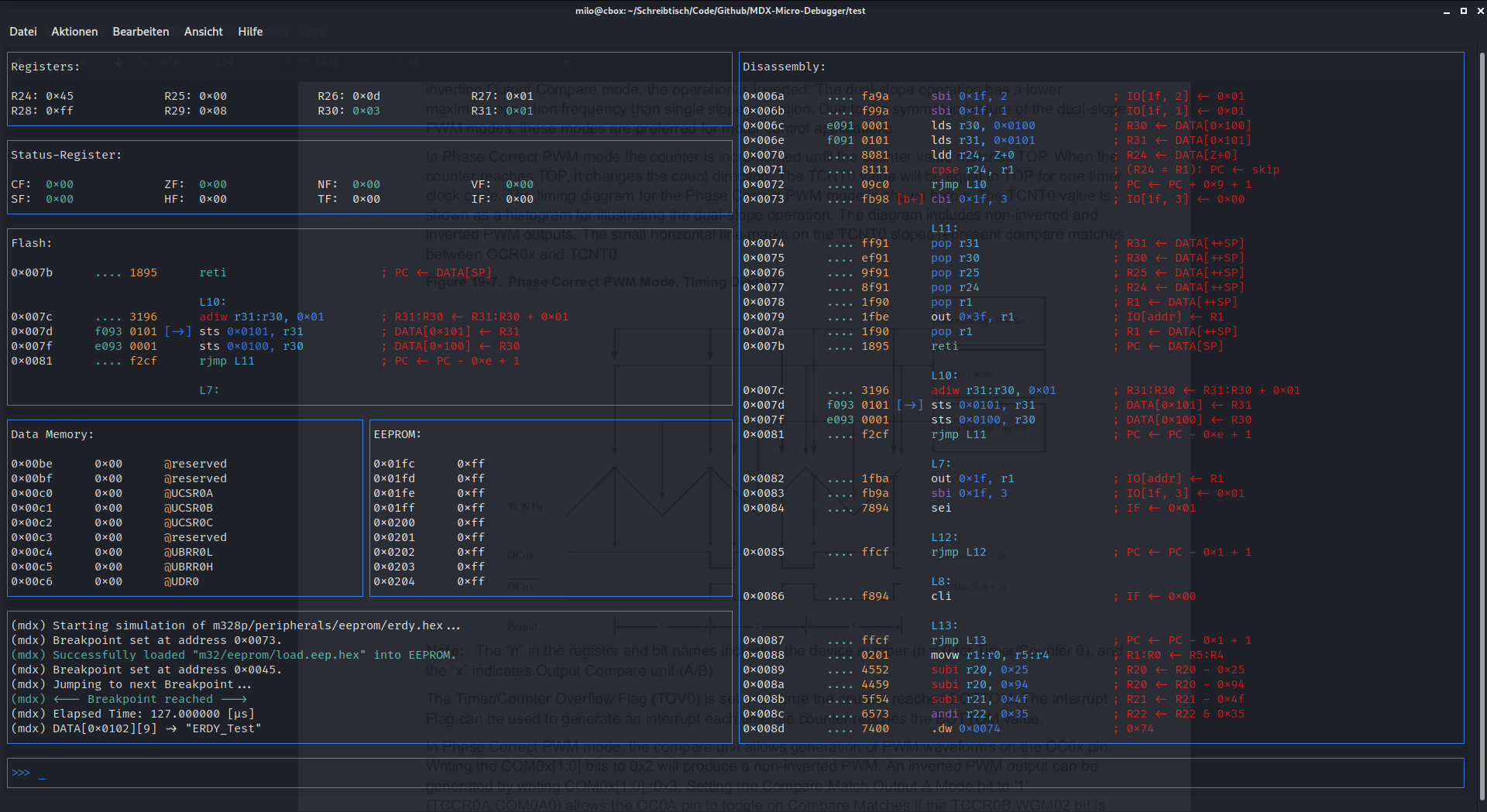 مصحح أخطاء صغيرة مكتوبة مع libvmcu
حاليًا تأتي هذه المكتبة برؤوسين ، يمكن العثور على كلاهما في المحرك/تشمل/libvmcu:
دعنا نقول ، لدينا ملف يسمى prog.c على المستوى العلوي من هذا المستودع ونريد ربطه بـ libvmcu:
 /* prog.c */

#include "libvmcu_analyzer.h"
#include "libvmcu_system.h"

int main ( void ) {

    /* do something */
    return 0 ;
} You@Terminal:~ $ cd build-release/
You@Terminal:~ $ make -f build.mk You@Terminal:~ $ gcc -Iengine/include/libvmcu/ -c prog.c -o prog.o You@Terminal:~ $ gcc -o prog prog.o -Lbuild-release/ -lvmcu -lmهذا كل شيء. إذا كنت تواجه مشكلات ، فقم بإلقاء نظرة على بعض الأمثلة في السائق/ الدليل.
يحاول libvmcu دعم أكبر عدد ممكن من أنواع AVR للتحليل الثابت. يتم التخطيط للتحليل الديناميكي حاليًا فقط لعائلة ATMEGA328 ولكن قد يتم تمديده في المستقبل.
يجب أن يكون من السهل جدًا إضافة صناديق متحكم جديدة إلى التحليل الثابت. لمزيد من المعلومات ، ألق نظرة على المحرك/*/القوس/
AVR Device Core
Avre Device Core
Avre+ Device Core
AVRXM Device Core
AVRXT Device Core
AVRRC الجهاز الأساسية
disassembler
المراجع المتقاطعة (xref-from ، xref-to)
أعلام المحلل
تحلل وتصنيف التعليمات
محلل لثنائيات AVR
تنسيق القارئ
الدعم المقاطعة
دورة محاكاة دقيقة في الوقت الفعلي
دعم 133 تعليمات تجميع AVR
محاكاة دقيقة للأجهزة الطرفية الداخلية
تدعم حاليا VMCU: ~ 133 تعليمات. يتم تنفيذ بعض التعليمات القليلة كتعليمات "NOP" ، وبالتالي ، ليس لها وظيفة حقيقية. سيتم تنفيذ هذه التعليمات في أقرب وقت ممكن. تتطلب التعليمات التالية المزيد من العمل:
جميع تعليمات التجميع الأخرى تعمل بشكل جيد.
LIBVMCU لديه روابط JAVA للوظائف الأساسية. لمزيد من المعلومات ، ألق نظرة على الروابط/Java/
لاحظ أيضًا أن الروابط قد لا تعمل دائمًا مع أحدث إصدار بسبب تطوير المحرك.
| محرك | السائقين | روابط | الاختبار |
|---|---|---|---|
| مغلق للعلاقات العامة | مفتوح للعلاقات العامة | مفتوح للعلاقات العامة | مفتوح للعلاقات العامة |
بحلول وقت كتابة هذا التقرير ، لا تزال الوثائق قيد التطوير. يمكن العثور على الوثائق (غير المكتملة) على https://github.com/milo-d/libvmcu-virtual-mcu-library/wiki
إذا كنت تفتقد المعلومات ولا ترغب في انتظار WIKI ، فإن ملفات رأس LIBVMCU موثقة جيدًا أيضًا.