Keras4Delphi
1.0.0

Keras4Delphi est une API de réseaux de neurones de haut niveau, écrite en Pascal (Delphi Rio 10.3) avec une liaison Python et capable de courir au-dessus de Tensorflow, CNTK ou Theano. Basé sur keras.net et keras
Utilisez des keras si vous avez besoin d'une bibliothèque d'apprentissage en profondeur qui:
Permet un prototypage facile et rapide (par le biais de la convivialité, de la modularité et de l'extensibilité). Prend en charge les réseaux convolutionnels et les réseaux récurrents, ainsi que les combinaisons des deux. Fonctionne parfaitement sur CPU et GPU.
 // Load train data
var x : TNDarray := TNumPy.npArray<Double>( [ [ 0 , 0 ], [ 0 , 1 ], [ 1 , 0 ], [ 1 , 1 ] ] );
var y : TNDarray := TNumPy.npArray<Double>( [ 0 , 1 , 1 , 0 ] );

// Build functional model
var input  : TKInput := TKInput.Create(tnp_shape.Create([ 2 ]));
var hidden1: TBaseLayer  := TDense.Create( 32 , ' relu ' ).& Set ([input]);
var hidden2: TBaseLayer  := TDense.Create( 64 , ' relu ' ).& Set ([hidden1]);
var output : TBaseLayer  := TDense.Create( 1 ,  ' sigmoid ' ).& Set ([hidden2]);

var model : TModel := TModel.Create ( [ input ] , [ output ]);

// Compile and train
model.Compile(TStringOrInstance.Create( TAdam.Create ), ' binary_crossentropy ' ,[ ' accuracy ' ]);

var batch_size : Integer := 2 ;
var history: THistory := model.Fit(x, y, @batch_size, 10 , 1 );

model.Summary;

var logs := history.HistoryLogs;

// Save model and weights
var json : string := model.ToJson;
TFile.WriteAllText( ' model.json ' , json);
model.SaveWeight( ' model.h5 ' );

// Load model and weight
var loaded_model : TBaseModel := TSequential.ModelFromJson(TFile.ReadAllText( ' model.json ' ));
loaded_model.LoadWeight( ' model.h5 ' );
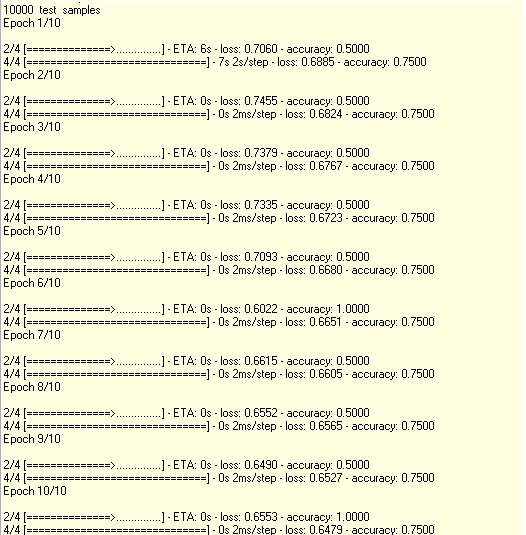
Sortir:
Exemple de python Tiré de: https://keras.io/examples/mnist_cnn/
 var
  res      : TArray<TNDArray>;
begin
    var batch_size : Integer := 128 ; // Training batch size
    var num_classes: Integer := 10 ;  // No. of classes
    var epochs     : Integer := 12 ;  // No. of epoches we will train

    // input image dimensions
    var img_rows: Integer := 28 ;
    var img_cols: Integer := 28 ;

    // Declare the input shape for the network
    var input_shape : Tnp_shape := default(Tnp_shape);

    // Load the MNIST dataset into Numpy array
    res := TMNIST.load_data;
    var x_train, y_train ,x_test, y_test : TNDArray;

    x_train := res[ 0 ];
    y_train := res[ 1 ];
    x_test  := res[ 2 ];
    y_test  := res[ 3 ];

    // Check if its channel fist or last and rearrange the dataset accordingly
    var K: TBackend := TBackend.Create;
    if (K.ImageDataFormat = ' channels_first ' ) then
    begin
        x_train := x_train.reshape([x_train.shape[ 0 ], 1 , img_rows, img_cols]);
        x_test  := x_test.reshape ([x_test.shape[ 0 ] , 1 , img_rows, img_cols]);
        input_shape := Tnp_shape.Create([ 1 , img_rows, img_cols]);
    end else
    begin
        x_train := x_train.reshape([x_train.shape[ 0 ], img_rows, img_cols, 1 ]);
        x_test  := x_test.reshape ([x_test.shape[ 0 ] , img_rows, img_cols, 1 ]);
        input_shape := Tnp_shape.Create([img_rows, img_cols, 1 ]);
    end ;

    // Normalize the input data
    x_train := x_train.astype(vNumpy.float32_);
    x_test  := x_test.astype(vNumpy.float32_);
    x_train := TNDArray.opDiv(x_train, 255 );
    x_test  := TNDArray.opDiv(x_test, 255 );

    redtOutput.Lines.Add( ' x_train shape: ' + x_train.shape.ToString);
    redtOutput.Lines.Add( IntToStr(x_train.shape[ 0 ]) + ' train samples ' );
    redtOutput.Lines.Add( IntToStr(x_test.shape[ 0 ]) + '  test  samples ' );

    // Convert class vectors to binary class matrices
    var Util : TUtil := TUtil.Create;
    y_train := Util.ToCategorical(y_train, @num_classes);
    y_test  := Util.ToCategorical(y_test, @num_classes);

    // Build CNN model
    var model : TSequential := TSequential.Create;

    model.Add( TConv2D.Create( 32 , [ 3 , 3 ], ' relu ' , @input_shape) );
    model.Add( TConv2D.Create( 64 , [ 3 , 3 ], ' relu ' ));
    model.Add( TMaxPooling2D.Create([ 2 , 2 ]));
    model.Add( TDropout.Create( 0.25 ));
    model.Add( TFlatten.Create);
    model.Add( TDense.Create( 128 , ' relu ' ));
    model.Add( TDropout.Create( 0.5 ));
    model.Add( TDense.Create(num_classes, ' softmax ' ));

    // Compile with loss, metrics and optimizer
    model.Compile(TStringOrInstance.Create(TAdadelta.Create), ' categorical_crossentropy ' , [ ' accuracy ' ]);

    // Train the model
    model.Fit(x_train, y_train, @batch_size, epochs, 1 , nil , 0 ,[ x_test, y_test ]);

    // Score the model for performance
    var score : TArray<Double> := model.Evaluate(x_test, y_test, nil , 0 );

    redtOutput.Lines.Add( ' Test loss: '   + FloatToStr(score[ 0 ]));
    redtOutput.Lines.Add( ' Test accuracy: ' + FloatToStr(score[ 1 ]));

    // Save the model to HDF5 format which can be loaded later or ported to other application
    model.Save( ' model.h5 ' );
    // Save it to Tensorflow JS format and we will test it in browser.
    model.SaveTensorflowJSFormat( ' ./ ' );
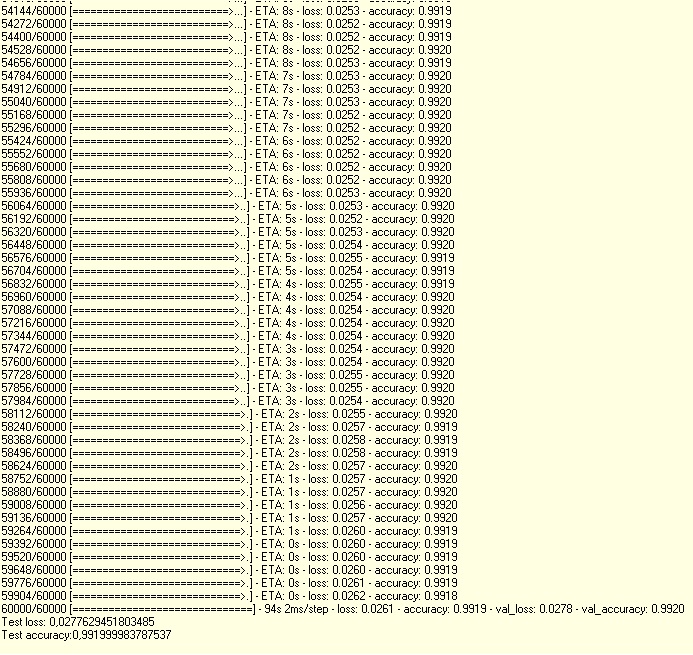
Sortir
Atteint une précision de 98% dans les 3 époques.
Exemple de python pris à partir de: //https://keras.io/examples/imdb_lstm/
 var
  res      : TArray<TNDArray>;
begin
    var max_features: Integer := 20000 ;
    // cut texts after this number of words (among top max_features most common words)
    var maxlen     : Integer := 80 ;
    var batch_size : Integer := 32 ;

    redtOutput.Lines.Add( ' Loading data... ' );
    res := TIMDB.load_data(@max_features);
    var x_train, y_train ,x_test, y_test,X,Y,tmp : TNDArray;

    x_train := res[ 0 ];
    y_train := res[ 1 ];
    x_test  := res[ 2 ];
    y_test  := res[ 3 ];

    redtOutput.Lines.Add( ' train sequences: ' + x_train.shape.ToString);
    redtOutput.Lines.Add( ' test sequences: '  + x_test.shape.ToString);

    redtOutput.Lines.Add( ' Pad sequences (samples x time) ' );
    var tseq : TSequenceUtil := TSequenceUtil.Create;
    x_train := tseq.PadSequences(x_train, @maxlen);
    x_test  := tseq.PadSequences(x_test,  @maxlen);
    redtOutput.Lines.Add( ' x_train shape: ' + x_train.shape.ToString);
    redtOutput.Lines.Add( ' x_test shape: '  + x_test.shape.ToString);

    redtOutput.Lines.Add( ' Build model... ' );
    var model : TSequential := TSequential.Create;
    model.Add( TEmbedding.Create(max_features, 128 ));
    model.Add( TLSTM.Create( 128 , 0.2 , 0.2 ));
    model.Add( TDense.Create( 1 , ' sigmoid ' ));

    // try using different optimizers and different optimizer configs
    model.Compile(TStringOrInstance.Create( ' adam ' ), ' binary_crossentropy ' , [ ' accuracy ' ]);
    model.Summary;

    redtOutput.Lines.Add( ' Train... ' );
    model.Fit(x_train, y_train, @batch_size, 15 , 1 ,[ x_test, y_test ]);

    // Score the model for performance
    var score : TArray<Double> := model.Evaluate(x_test, y_test, @batch_size);

    redtOutput.Lines.Add( ' Test score: '   + FloatToStr(score[ 0 ]));
    redtOutput.Lines.Add( ' Test accuracy: ' + FloatToStr(score[ 1 ]));

    // Save the model to HDF5 format which can be loaded later or ported to other application
model.Save( ' model.h5 ' );Bienvenue aux tests collaboratifs et à l'amélioration du code source. J'ai peu de temps libre