KaSA
1.0.0

[Conjuntos de datos de seguimiento de instrucciones sintéticas de alta calidad generados por GPT4O ON?]
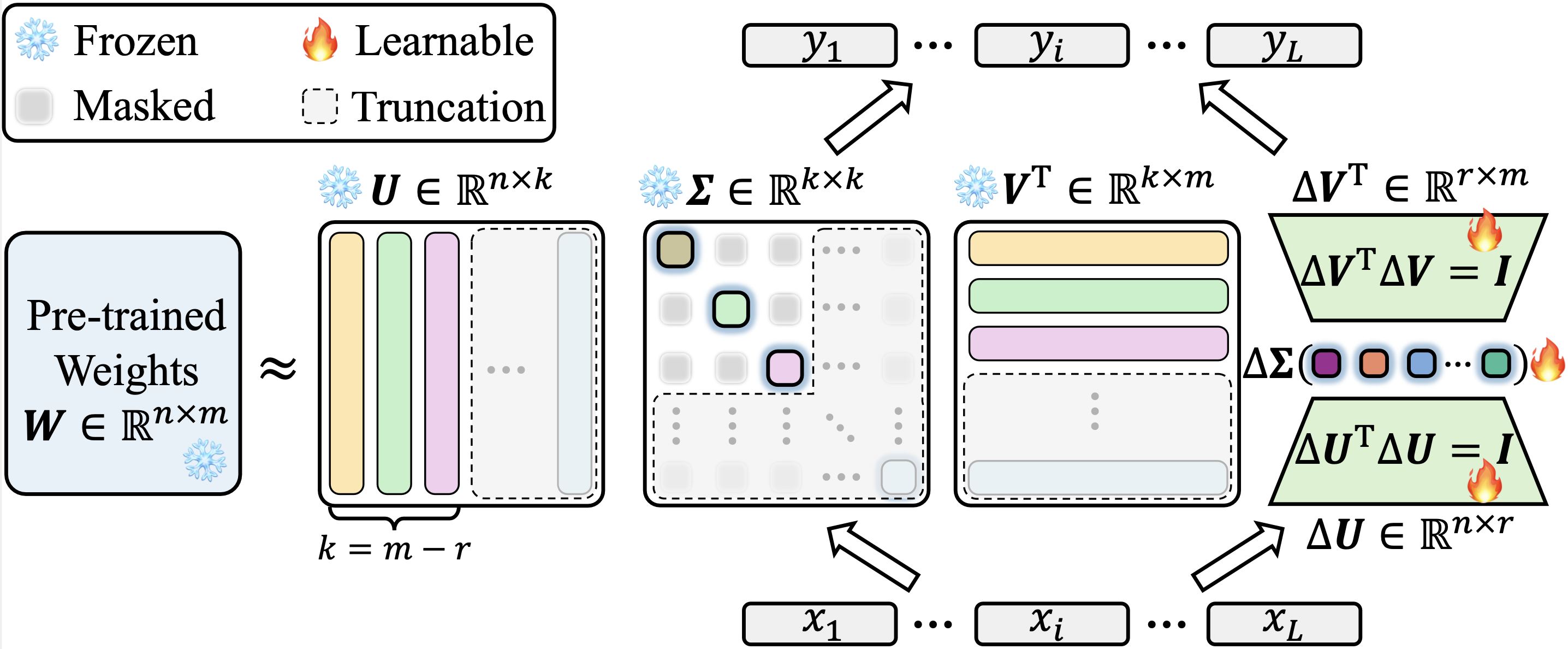
Implementamos nuestro Kasa sobre Lora en el repositorio de Peft oficial de Hugging Face. El código fuente para nuestra implementación KASA se puede encontrar en PEFT/SRC/PEFT/Tuners/Lora/Lapa.py. Vale la pena señalar que nuestra implementación es la versión agnóstica con respecto a PEFT. Logramos resultados consistentes entre las últimas versiones (0.13.1.dev0) y mayores (0.6.3.dev0), evitando así las ganancias debido a las diferencias en la implementación.
Importante
Si usa los datos o el código en este repositorio, considere citar el siguiente documento:
 @article { wang2024kasa ,
  title = { KaSA: Knowledge-Aware Singular-Value Adaptation of Large Language Models } ,
  author = { Wang, Fan and Jiang, Juyong and Park, Chansung and Kim, Sunghun and Tang, Jing } ,
  journal = { arXiv preprint arXiv:2412.06071 } ,
  year = { 2024 }
}conda create -n kasa python=3.10
conda install pytorch==2.1.0 torchvision==0.16.0 torchaudio==2.1.0 pytorch-cuda=11.8 -c pytorch -c nvidia
# install peft with local folder
cd peft
pip install -e .
# note the version of packages
pip install datasets==2.21.0
pip install numpy==1.26.4
pip install scipy
pip install scikit-learn
pip install sentencepieceAjustar los modelos de la comunidad Huggingface para la clasificación de secuencias en el punto de referencia de evaluación de comprensión del lenguaje general (pegamento) implica trabajar con 6 tareas diferentes, incluidas COLA, SST-2, MRPC, STS-B, QNLI y RTE. Los detalles del conjunto de datos se pueden encontrar en https://huggingface.co/datasets/nyu-mll/glue.
Aquí hay un ejemplo de cómo comenzar a ajustar la base de Roberta con la tarea de cola:
 cd runs
bash robert_base_cola.sh
Donde el contenido de robert_base_cola.sh se delinea en lo siguiente:
 #! /bin/bash
cd ../
mkdir -p logs/roberta-base

# variables
CUDA_DEVICE=2

MODEL_NAME_OR_PATH= " roberta-base "

DATASET= " cola "
TASK= " cola "

BATCH_SIZE=32
MAX_LENGTH=512
NUM_EPOCH=100

HEAD_LR=4e-4
MODULE_LR=4e-4

LORA_R=8
LORA_ALPHA=16
LORA_DROPOUT=0.0

BETA=0.0001
GEMMA=0.001

SEED=0
WEIGHT_DECAY=0.0

# run
LOG_FILE= " logs/ ${MODEL_NAME_OR_PATH} / ${MODEL_NAME_OR_PATH} _ ${TASK} _bs_ ${BATCH_SIZE} _maxlen_ ${MAX_LENGTH} _lora_r_ ${LORA_R} _lora_alpha_ ${LORA_ALPHA} _lora_dropout_ ${LORA_DROPOUT} _modulelr_ ${MODULE_LR} _headlr_ ${HEAD_LR} _beta_ ${BETA} _gemma_ ${GEMMA} _weight_decay_ ${WEIGHT_DECAY} _seed_ ${SEED} .log "
CUDA_VISIBLE_DEVICES= $CUDA_DEVICE python main.py
    --model_name_or_path $MODEL_NAME_OR_PATH
    --dataset $DATASET
    --task $TASK
    --max_length $MAX_LENGTH
    --bs $BATCH_SIZE
    --lora_r $LORA_R
    --lora_alpha $LORA_ALPHA
    --lora_dropout $LORA_DROPOUT
    --num_epoch $NUM_EPOCH
    --head_lr $HEAD_LR
    --module_lr $MODULE_LR
    --beta $BETA
    --gemma $GEMMA
    --weight_decay $WEIGHT_DECAY
    --seed $SEED 2>&1 | tee $LOG_FILE
Para cargar un modelo PEFT para inferencia:
 from peft import AutoPeftModelForCausalLM
from transformers import AutoTokenizer
import torch

model = AutoPeftModelForCausalLM . from_pretrained ( "saves/kasa/checkpoint-52580" ). to ( "cuda" )
tokenizer = AutoTokenizer . from_pretrained ( "saves/kasa/checkpoint-52580" )

model . eval ()

template = "### Context : {} n ### Completion : "
prompt = template . format ( "name : Blue Spice | Type : coffee shop | area : city centre" )
inputs = tokenizer ( prompt , return_tensors = "pt" )

outputs = model . generate ( input_ids = inputs [ "input_ids" ]. to ( "cuda" ), max_new_tokens = 50 )
print ( tokenizer . batch_decode ( outputs , skip_special_tokens = True )[ 0 ])

> "Blue Spice is a coffee shop located in the city centre." Consejo
Los registros de ejecución y los resultados de todos nuestros experimentos se guardan en la ruta de registros . El siguiente es un ejemplo.
epoch 0: { ' matthews_correlation ' : 0.0} , current_best_corr: 0.0 train_loss: 0.5064952373504639
epoch 1: { ' matthews_correlation ' : 0.4528085001256977} , current_best_corr: 0.4528085001256977 train_loss: 0.2968645691871643
epoch 2: { ' matthews_correlation ' : 0.5314083843246411} , current_best_corr: 0.5314083843246411 train_loss: 0.3451506495475769
...
epoch 96: { ' matthews_correlation ' : 0.6331219341866674} , current_best_corr: 0.6581805893879898 train_loss: 0.057534683495759964
epoch 97: { ' matthews_correlation ' : 0.6206837048829764} , current_best_corr: 0.6581805893879898 train_loss: 0.057706814259290695
epoch 98: { ' matthews_correlation ' : 0.6281691768918801} , current_best_corr: 0.6581805893879898 train_loss: 0.05744687840342522
epoch 99: { ' matthews_correlation ' : 0.6256673855627156} , current_best_corr: 0.6581805893879898 train_loss: 0.0582236722111702
model_name_or_path: roberta-base
dataset: cola
task: cola
peft: kasa
num_epochs: 100
bs: 32
lora_r: 8
lora_alpha: 16
lora_dropout: 0.0
head_lr: 0.0004
module_lr: 0.0004
max_length: 512
weight_decay: 0.0
warmup_ratio: 0.06
seed: 0
beta: 0.0001
gemma: 0.001
...
0% | | 0/33 [00: 00< ? , ? it/s]
9% | ▉ | 3/33 [00: 00< 00:01, 27.53it/s]
21% | ██ | 7/33 [00: 00< 00:00, 30.12it/s]
30% | ███ | 10/33 [00: 00< 00:00, 28.58it/s]
39% | ███▉ | 13/33 [00: 00< 00:00, 27.65it/s]
48% | ████▊ | 16/33 [00: 00< 00:00, 27.95it/s]
58% | █████▊ | 19/33 [00: 00< 00:00, 25.45it/s]
67% | ██████▋ | 22/33 [00: 00< 00:00, 25.99it/s]
76% | ███████▌ | 25/33 [00: 00< 00:00, 24.67it/s]
88% | ████████▊ | 29/33 [00: 01< 00:00, 25.53it/s]
100% | ██████████ | 33/33 [00: 01< 00:00, 27.68it/s]
100% | ██████████ | 33/33 [00: 01< 00:00, 27.01it/s]
epoch 99: { ' matthews_correlation ' : 0.6256673855627156}, current_best_corr: 0.6581805893879898 train_loss: 0.0582236722111702






