henry hugo
Release 2 2022.08.14


Henry ist ein Hugo-Thema mit einem wunderschönen Leseerlebnis, der voller Funktionen ist. Weitere Informationen zu allen Funktionen finden Sie in diesem Blog -Beitrag.
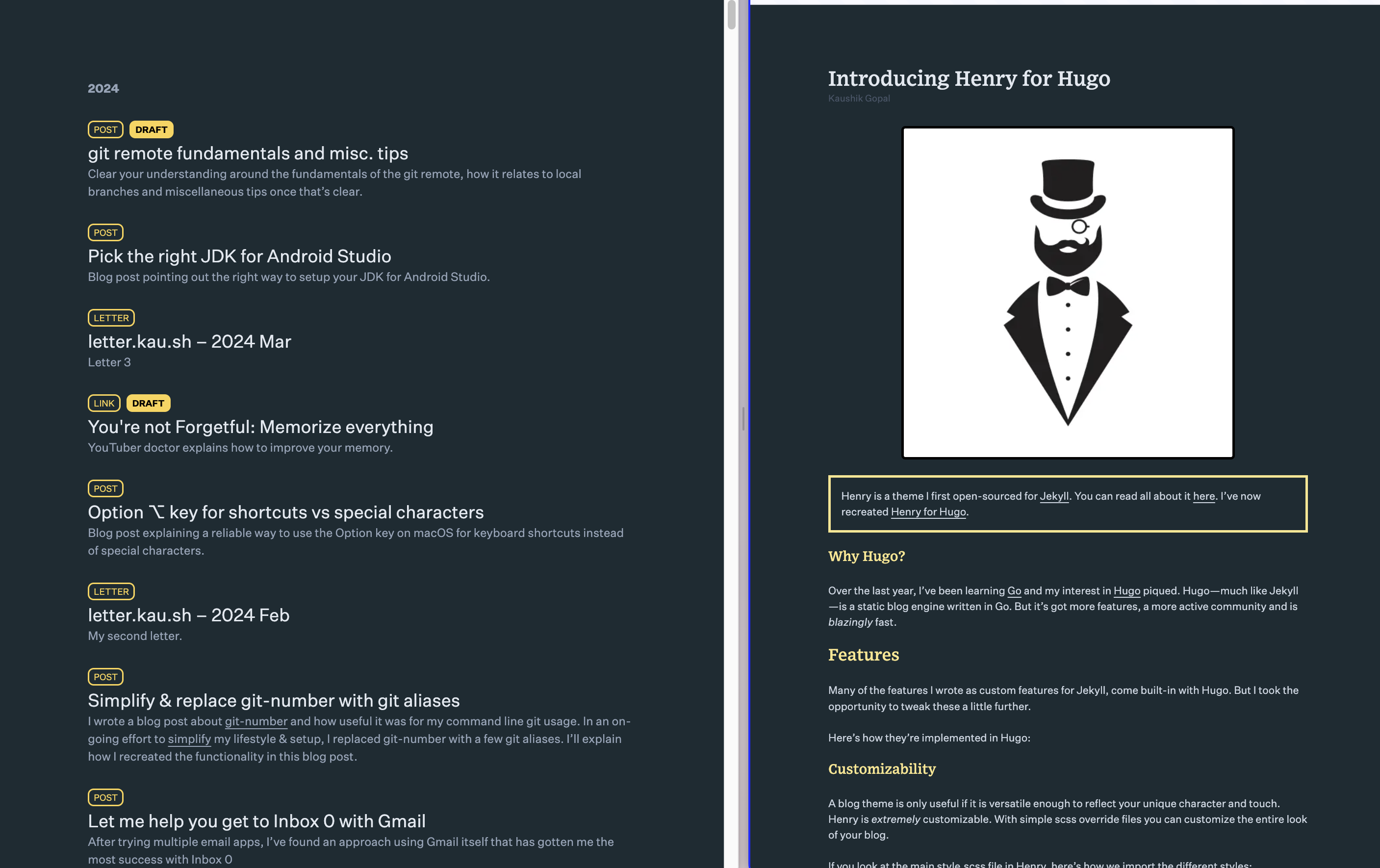
Dies sind die Anweisungen zum Einrichten eines Hugo -Blogs mit dem Henry -Thema.
 # 1. Install Hugo
#    https://gohugo.io/getting-started/installing/
brew install hugo

hugo new site blog-henry
cd blog-henry

# 2. clone Henry
git clone https://github.com/kaushikgopal/henry-hugo.git themes/henry
touch assets/css/{output,override,override-fonts}.css
# brew install node # if you don't have npm installed
cp themes/henry/tailwind.config.henry.js ./tailwind.config.js
npm install -D tailwindcss
npx tailwindcss -i themes/henry/assets/css/input.css -o ./assets/css/output.css

# 3. configure blog
# # add these lines to your hugo.toml config file
theme = " henry "

# 4. run Hugo!

# Option: use a single dev script
# See my blog post on this https://kau.sh/blog/tailwind-hugo#bonus-tip

./bin/dev

# open http://0.0.0.0:1313/

# sample posts are in henry's content folder : themes/henry/content
# if you want to see some samples, just mark them from draft true → false
Du bist gut zu gehen. Happy Blogging!
Jetzt, wann immer Sie Ihren Hugo -Blog wieder zum Laufen bringen müssen, rennen Sie einfach ./bin/dev .
Hier sind einige empfohlene Anpassungen, die in Ihrer hugo.toml -Konfigurationsdatei zusätzlich zu den oben erwähnten Konfigurationsdateien vorgenommen werden müssen.
 # # hugo.toml

# enable .json RSS feeds
[ outputFormats ]
# output formats
# https://gohugo.io/templates/output-formats/#output-format-definitions
[ outputFormats . rss ]
    mediatype = " application/rss "
    # change RSS path for default XML feed to /feed.xml (default index.xml)
    baseName = " feed "
[ outputFormats . json ]
    # change RSS path for JSON feed to /feed.json
    baseName = " feed "

# configure RSS feeds for specific pages
[ outputs ]
# output format for pages
# https://gohugo.io/templates/output-formats/#output-formats-for-pages
    page = [ " html " ]
    home = [ " html " , " rss " , " json " ]
    # sections = directories e.g. blog, letters, ppt
    section = [ " html " , " rss " , " json " ]
    # taxonomies = virtual tags/directories e.g. categories, tags (built-in)
    # no rss for these as they're mostly "list" pages
    taxonomy = [ " html " ]
    # terms = values of taxonomies e.g. categories/programming
term = [ " html " , " rss " , " json " ] # # hugo.toml
[ related ]
includeNewer = true
threshold = 80
toLower = true
# weight index distribution tags > categories > title
[[ related . indices ]]
name = " tags "
weight = 80
[[ related . indices ]]
name = " categories "
weight = 20
[[ related . indices ]]
name = " title "
weight = 10Hier sind ein paar Blogs, die Henry verwenden:
Das Thema ist unter den Bedingungen der MIT -Lizenz als Open Source erhältlich.
Fehlerberichte und Zuganfragen sind auf GitHub willkommen. Dieses Projekt soll ein sicherer, einladender Raum für die Zusammenarbeit sein, und die Mitwirkenden sollen sich an den Verhaltenskodex für den Mitwirkenden halten.