genai chatbot
1.0.0

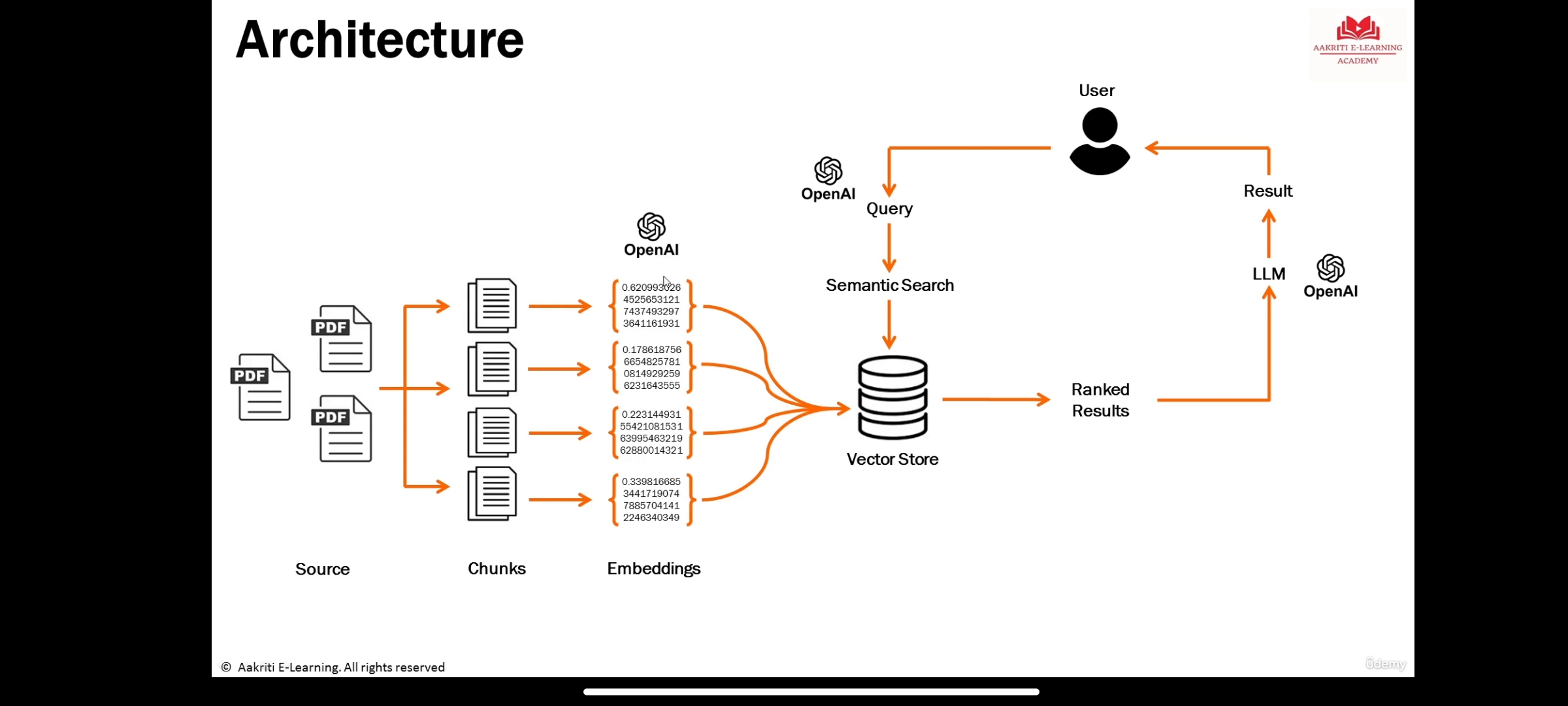
LLMs sind große, tiefgreifende Modelle, die auf großen Datenmengen ausgebildet sind, die Antworten auf Benutzeranfragen generieren können
Informationsdarstellung der semantischen Bedeutung eines Textes oder Objekte wie Audio, Video, Bilder usw., die von maschinellen Lernmodellen oder Seamantic -Suchalgorithmen (LLM) konsumiert werden sollen.
ist eine Datenbank, um die Einbettungen zu speichern, in denen semantische Suche stattfindet.
 import streamlit as st
from PyPDF2 import PdfReader
from langchain . text_splitter import RecursiveCharacterTextSplitter
from langchain_community . embeddings import OpenAIEmbeddings
from langchain_community . vectorstores import FAISS
from langchain . chains . question_answering import load_qa_chain
from langchain_community . chat_models import ChatOpenAI


OPENAI_API_KEY = "sk-Wr5VzIVOwRoIyzTkQTjiaLQ6lSc84" #Pass your key here

#Upload PDF files
st . header ( "My first Chatbot" )

with  st . sidebar :
    st . title ( "Your Documents" )
    file = st . file_uploader ( " Upload a PDf file and start asking questions" , type = "pdf" )

#Extract the text
if file is not None :
    pdf_reader = PdfReader ( file )
    text = ""
    for page in pdf_reader . pages :
        text += page . extract_text ()
        #st.write(text)

#Break it into chunks
    text_splitter = RecursiveCharacterTextSplitter (
        separators = " n " ,
        chunk_size = 1000 ,
        chunk_overlap = 150 ,
        length_function = len
    )
    chunks = text_splitter . split_text ( text )
    #st.write(chunks)

    # generating embedding
    embeddings = OpenAIEmbeddings ( openai_api_key = OPENAI_API_KEY )

    # creating vector store - FAISS
    vector_store = FAISS . from_texts ( chunks , embeddings )

    # get user question
    user_question = st . text_input ( "Type Your question here" )

    # do similarity search
    if user_question :
        match = vector_store . similarity_search ( user_question )
        #st.write(match)
        #define the LLM
        llm = ChatOpenAI (
            openai_api_key = OPENAI_API_KEY ,
            temperature = 0 ,
            max_tokens = 1000 ,
            model_name = "gpt-3.5-turbo"
        )
        #output results
        #chain -> take the question, get relevant document, pass it to the LLM, generate the output
        chain = load_qa_chain ( llm , chain_type = "stuff" )
        response = chain . run ( input_documents = match , question = user_question )
        st . write ( response )