transformer
1.0.0

该代码是在2019年编写的,那时我对变压器模型并不熟悉。因此,不要太信任此代码。目前,我无法很好地管理此代码,因此,如果您在代码中找到错误并要修复,请打开拉动请求。
我自己的实施变压器模型(您需要注意的全部-Google Brain,2017年) 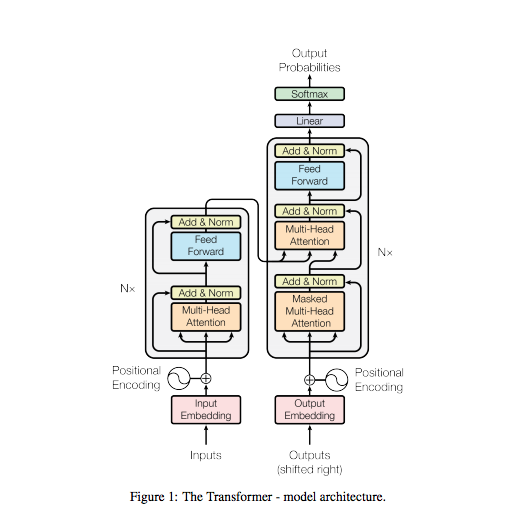
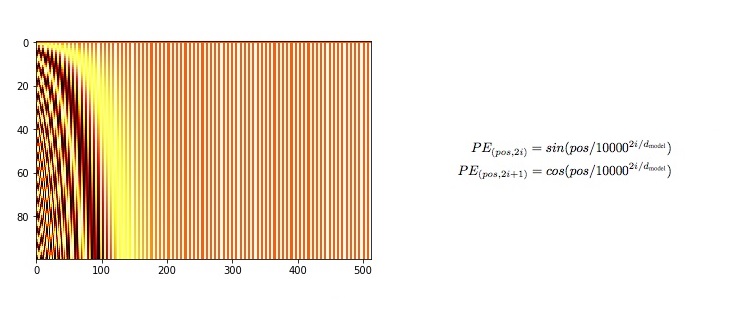
 class PositionalEncoding ( nn . Module ):
    """
    compute sinusoid encoding.
    """
    def __init__ ( self , d_model , max_len , device ):
        """
        constructor of sinusoid encoding class

        :param d_model: dimension of model
        :param max_len: max sequence length
        :param device: hardware device setting
        """
        super ( PositionalEncoding , self ). __init__ ()

        # same size with input matrix (for adding with input matrix)
        self . encoding = torch . zeros ( max_len , d_model , device = device )
        self . encoding . requires_grad = False  # we don't need to compute gradient

        pos = torch . arange ( 0 , max_len , device = device )
        pos = pos . float (). unsqueeze ( dim = 1 )
        # 1D => 2D unsqueeze to represent word's position

        _2i = torch . arange ( 0 , d_model , step = 2 , device = device ). float ()
        # 'i' means index of d_model (e.g. embedding size = 50, 'i' = [0,50])
        # "step=2" means 'i' multiplied with two (same with 2 * i)

        self . encoding [:, 0 :: 2 ] = torch . sin ( pos / ( 10000 ** ( _2i / d_model )))
        self . encoding [:, 1 :: 2 ] = torch . cos ( pos / ( 10000 ** ( _2i / d_model )))
        # compute positional encoding to consider positional information of words

    def forward ( self , x ):
        # self.encoding
        # [max_len = 512, d_model = 512]

        batch_size , seq_len = x . size ()
        # [batch_size = 128, seq_len = 30]

        return self . encoding [: seq_len , :]
        # [seq_len = 30, d_model = 512]
# it will add with tok_emb : [128, 30, 512] 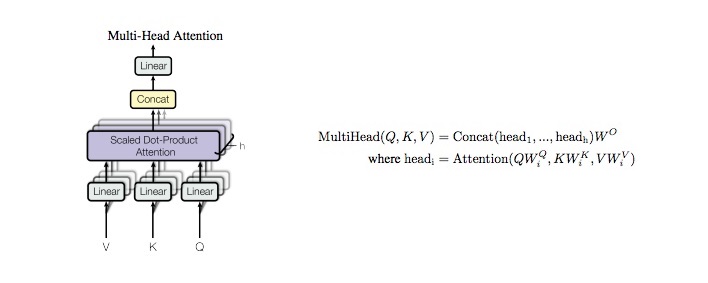
 class MultiHeadAttention ( nn . Module ):

    def __init__ ( self , d_model , n_head ):
        super ( MultiHeadAttention , self ). __init__ ()
        self . n_head = n_head
        self . attention = ScaleDotProductAttention ()
        self . w_q = nn . Linear ( d_model , d_model )
        self . w_k = nn . Linear ( d_model , d_model )
        self . w_v = nn . Linear ( d_model , d_model )
        self . w_concat = nn . Linear ( d_model , d_model )

    def forward ( self , q , k , v , mask = None ):
        # 1. dot product with weight matrices
        q , k , v = self . w_q ( q ), self . w_k ( k ), self . w_v ( v )

        # 2. split tensor by number of heads
        q , k , v = self . split ( q ), self . split ( k ), self . split ( v )

        # 3. do scale dot product to compute similarity
        out , attention = self . attention ( q , k , v , mask = mask )

        # 4. concat and pass to linear layer
        out = self . concat ( out )
        out = self . w_concat ( out )

        # 5. visualize attention map
        # TODO : we should implement visualization

        return out

    def split ( self , tensor ):
        """
        split tensor by number of head

        :param tensor: [batch_size, length, d_model]
        :return: [batch_size, head, length, d_tensor]
        """
        batch_size , length , d_model = tensor . size ()

        d_tensor = d_model // self . n_head
        tensor = tensor . view ( batch_size , length , self . n_head , d_tensor ). transpose ( 1 , 2 )
        # it is similar with group convolution (split by number of heads)

        return tensor

    def concat ( self , tensor ):
        """
        inverse function of self.split(tensor : torch.Tensor)

        :param tensor: [batch_size, head, length, d_tensor]
        :return: [batch_size, length, d_model]
        """
        batch_size , head , length , d_tensor = tensor . size ()
        d_model = head * d_tensor

        tensor = tensor . transpose ( 1 , 2 ). contiguous (). view ( batch_size , length , d_model )
        return tensor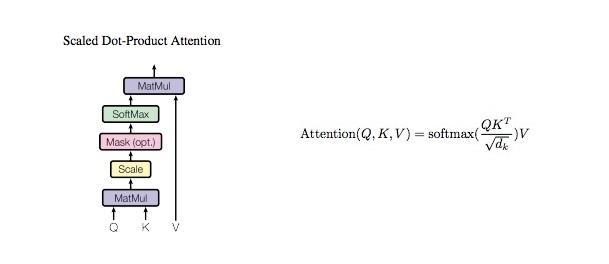
 class ScaleDotProductAttention ( nn . Module ):
    """
    compute scale dot product attention

    Query : given sentence that we focused on (decoder)
    Key : every sentence to check relationship with Qeury(encoder)
    Value : every sentence same with Key (encoder)
    """

    def __init__ ( self ):
        super ( ScaleDotProductAttention , self ). __init__ ()
        self . softmax = nn . Softmax ( dim = - 1 )

    def forward ( self , q , k , v , mask = None , e = 1e-12 ):
        # input is 4 dimension tensor
        # [batch_size, head, length, d_tensor]
        batch_size , head , length , d_tensor = k . size ()

        # 1. dot product Query with Key^T to compute similarity
        k_t = k . transpose ( 2 , 3 )  # transpose
        score = ( q @ k_t ) / math . sqrt ( d_tensor )  # scaled dot product

        # 2. apply masking (opt)
        if mask is not None :
            score = score . masked_fill ( mask == 0 , - 10000 )

        # 3. pass them softmax to make [0, 1] range
        score = self . softmax ( score )

        # 4. multiply with Value
        v = score @ v

        return v , score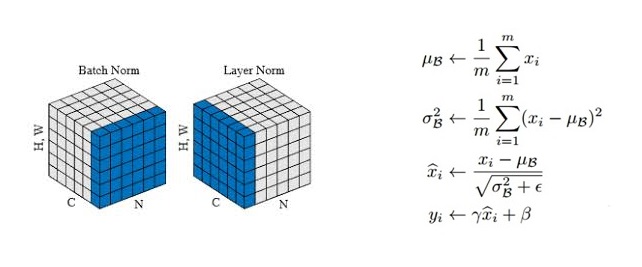
 class LayerNorm ( nn . Module ):
    def __init__ ( self , d_model , eps = 1e-12 ):
        super ( LayerNorm , self ). __init__ ()
        self . gamma = nn . Parameter ( torch . ones ( d_model ))
        self . beta = nn . Parameter ( torch . zeros ( d_model ))
        self . eps = eps

    def forward ( self , x ):
        mean = x . mean ( - 1 , keepdim = True )
        var = x . var ( - 1 , unbiased = False , keepdim = True )
        # '-1' means last dimension.

        out = ( x - mean ) / torch . sqrt ( var + self . eps )
        out = self . gamma * out + self . beta
        return out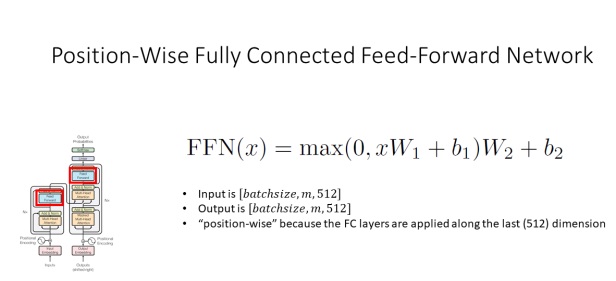
 class PositionwiseFeedForward ( nn . Module ):

    def __init__ ( self , d_model , hidden , drop_prob = 0.1 ):
        super ( PositionwiseFeedForward , self ). __init__ ()
        self . linear1 = nn . Linear ( d_model , hidden )
        self . linear2 = nn . Linear ( hidden , d_model )
        self . relu = nn . ReLU ()
        self . dropout = nn . Dropout ( p = drop_prob )

    def forward ( self , x ):
        x = self . linear1 ( x )
        x = self . relu ( x )
        x = self . dropout ( x )
        x = self . linear2 ( x )
        return x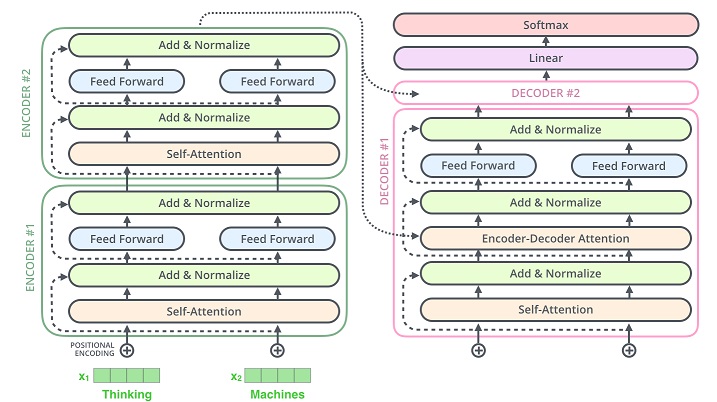
 class EncoderLayer ( nn . Module ):

    def __init__ ( self , d_model , ffn_hidden , n_head , drop_prob ):
        super ( EncoderLayer , self ). __init__ ()
        self . attention = MultiHeadAttention ( d_model = d_model , n_head = n_head )
        self . norm1 = LayerNorm ( d_model = d_model )
        self . dropout1 = nn . Dropout ( p = drop_prob )

        self . ffn = PositionwiseFeedForward ( d_model = d_model , hidden = ffn_hidden , drop_prob = drop_prob )
        self . norm2 = LayerNorm ( d_model = d_model )
        self . dropout2 = nn . Dropout ( p = drop_prob )

    def forward ( self , x , src_mask ):
        # 1. compute self attention
        _x = x
        x = self . attention ( q = x , k = x , v = x , mask = src_mask )

        # 2. add and norm
        x = self . dropout1 ( x )
        x = self . norm1 ( x + _x )

        # 3. positionwise feed forward network
        _x = x
        x = self . ffn ( x )

        # 4. add and norm
        x = self . dropout2 ( x )
        x = self . norm2 ( x + _x )
        return x
class Encoder ( nn . Module ):
def __init__ ( self , enc_voc_size , max_len , d_model , ffn_hidden , n_head , n_layers , drop_prob , device ):
super (). __init__ ()
self . emb = TransformerEmbedding ( d_model = d_model ,
max_len = max_len ,
vocab_size = enc_voc_size ,
drop_prob = drop_prob ,
device = device )
self . layers = nn . ModuleList ([ EncoderLayer ( d_model = d_model ,
ffn_hidden = ffn_hidden ,
n_head = n_head ,
drop_prob = drop_prob )
for _ in range ( n_layers )])
def forward ( self , x , src_mask ):
x = self . emb ( x )
for layer in self . layers :
x = layer ( x , src_mask )
return x class DecoderLayer ( nn . Module ):
def __init__ ( self , d_model , ffn_hidden , n_head , drop_prob ):
super ( DecoderLayer , self ). __init__ ()
self . self_attention = MultiHeadAttention ( d_model = d_model , n_head = n_head )
self . norm1 = LayerNorm ( d_model = d_model )
self . dropout1 = nn . Dropout ( p = drop_prob )
self . enc_dec_attention = MultiHeadAttention ( d_model = d_model , n_head = n_head )
self . norm2 = LayerNorm ( d_model = d_model )
self . dropout2 = nn . Dropout ( p = drop_prob )
self . ffn = PositionwiseFeedForward ( d_model = d_model , hidden = ffn_hidden , drop_prob = drop_prob )
self . norm3 = LayerNorm ( d_model = d_model )
self . dropout3 = nn . Dropout ( p = drop_prob )
def forward ( self , dec , enc , trg_mask , src_mask ):
# 1. compute self attention
_x = dec
x = self . self_attention ( q = dec , k = dec , v = dec , mask = trg_mask )
# 2. add and norm
x = self . dropout1 ( x )
x = self . norm1 ( x + _x )
if enc is not None :
# 3. compute encoder - decoder attention
_x = x
x = self . enc_dec_attention ( q = x , k = enc , v = enc , mask = src_mask )
# 4. add and norm
x = self . dropout2 ( x )
x = self . norm2 ( x + _x )
# 5. positionwise feed forward network
_x = x
x = self . ffn ( x )
# 6. add and norm
x = self . dropout3 ( x )
x = self . norm3 ( x + _x )
return x class Decoder ( nn . Module ):
def __init__ ( self , dec_voc_size , max_len , d_model , ffn_hidden , n_head , n_layers , drop_prob , device ):
super (). __init__ ()
self . emb = TransformerEmbedding ( d_model = d_model ,
drop_prob = drop_prob ,
max_len = max_len ,
vocab_size = dec_voc_size ,
device = device )
self . layers = nn . ModuleList ([ DecoderLayer ( d_model = d_model ,
ffn_hidden = ffn_hidden ,
n_head = n_head ,
drop_prob = drop_prob )
for _ in range ( n_layers )])
self . linear = nn . Linear ( d_model , dec_voc_size )
def forward ( self , trg , src , trg_mask , src_mask ):
trg = self . emb ( trg )
for layer in self . layers :
trg = layer ( trg , src , trg_mask , src_mask )
# pass to LM head
output = self . linear ( trg )
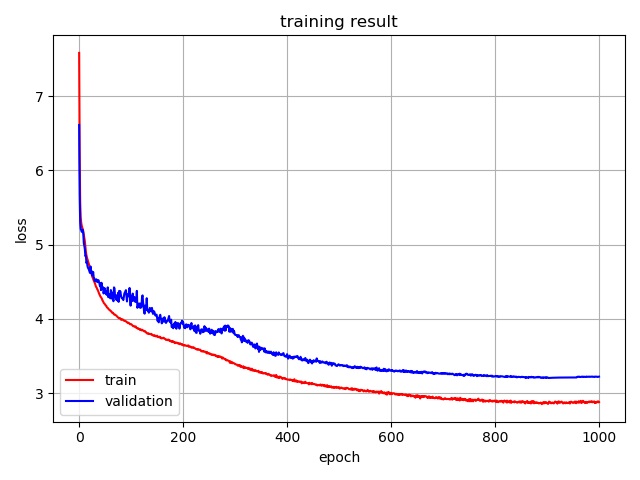
return output 我使用Multi30k数据集训练和评估模型
您可以在此处查看数据集的详细信息
我遵循原始论文的参数设置。 (以下)

| 模型 | 数据集 | BLEU得分 |
|---|---|---|
| 原始论文 | WMT14 en-de | 25.8 |
| 我的实施 | Multi30k en-de | 26.4 |
 Copyright 2019 Hyunwoong Ko.

Licensed under the Apache License, Version 2.0 (the "License");
you may not use this file except in compliance with the License.
You may obtain a copy of the License at

http://www.apache.org/licenses/LICENSE-2.0

Unless required by applicable law or agreed to in writing, software
distributed under the License is distributed on an "AS IS" BASIS,
WITHOUT WARRANTIES OR CONDITIONS OF ANY KIND, either express or implied.
See the License for the specific language governing permissions and
limitations under the License.