
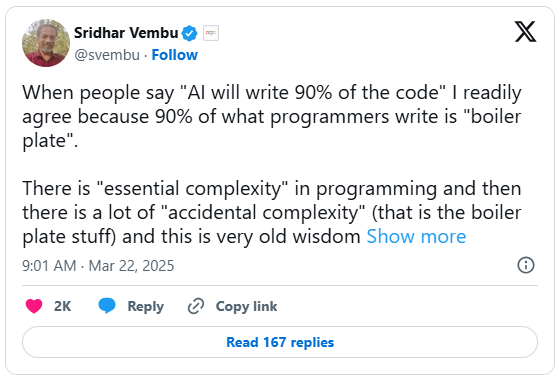
Against the backdrop of rapid development of artificial intelligence (AI) technology, Zoho founder Sridhar Vembu and OpenAI CEO Sam Altman both said that 90% of programmers' work in the future may be replaced by AI, especially those with more repetitive tasks. Vembu shared his opinion on social media, saying that most programmers write codes in "boilerplate code", that is, some content that is highly repetitive and less creative. According to him, there are "necessary complexity" and "accidental complexity" in programming. AI is good at dealing with these accidental complexities, so it can generate large amounts of code efficiently.
Vembu further points out that despite AI’s outstanding performance in eliminating incidental complexity, human programmers are still indispensable in addressing core challenges. He said that AI can easily deal with patterns that have been discovered by humans, but to discover completely new models, it still requires human intelligence and creativity.
In addition, Vembu resigned as CEO of Zoho in January to devote more energy to research and development, especially in the context of rapid development of AI, and he hopes to better address challenges and opportunities in this field. When he resigned, he mentioned that focusing on R&D and personal rural development missions is the focus of his future work.
Meanwhile, Sam Altman expressed a similar view. In an interview, he pointed out that as AI models develop, the demand for software engineers may decrease. He predicts that each software engineer will be able to do more work in the short term, but the number of software engineers may decline in the long run. Altman also mentioned that "at least half" of the code in many companies is generated by AI, and this proportion is rising.
AI is rapidly changing the landscape of the software development industry. Although the role of programmers will not completely disappear in the short term, the content and quantity of their work may change significantly. How the industry will develop in the future is still worthy of our continued attention.