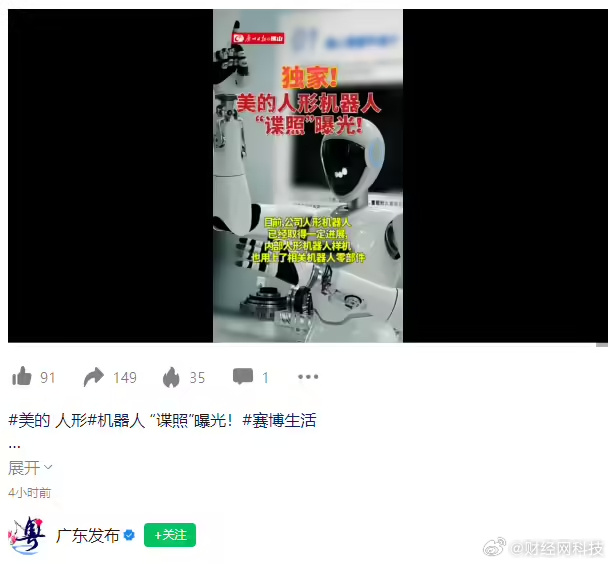
Recently, Midea Group released its humanoid robot prototype for the first time and showed off its 11-second video. In the video, the robot can not only dance flexibly, but also make heart-like movements and understand and execute voice commands. This debut marks an important progress in the research and development of Midea Group in the field of humanoid robots.
Wei Chang, vice president and CTO of Midea Group, announced at a press conference yesterday that the company has established a humanoid robot innovation center and plans to increase R&D investment in this field. Wei Chang said that Midea Group's goal is to develop products that can be implemented in the short term to meet market demand.
Wei Chang further revealed that the research and development focus of Midea's embodied intelligent team mainly focuses on three aspects: core components of humanoid robots, machine development and home appliance robotization. At present, key components such as reducers, motors, sensors and controllers have been tested on internal prototypes. Thanks to the previous technical accumulation of acquisition of German Kuka Group, Midea has already had a mature R&D team in the field of core components of industrial robots, which will greatly accelerate the research and development process of humanoid robots.
The R&D scope of the Humanoid Robot Innovation Center of Midea Central Research Institute is not only limited to core components, but also covers the development of the entire machine and practical application scenarios. Wei Chang pointed out that the biggest challenge of humanoid robots lies in how to solve the actual needs of users, not just to demonstrate technical capabilities. He predicts that humanoid robot products will be first used in industrial and commercial scenarios, and then gradually expand to home scenarios.
Regarding the timetable for humanoid robots to enter the home, Wei Chang believes that they also face two major challenges: cost and technology. He said that the robotization of home appliances may be the direction for faster implementation, because targeting specific and relatively simple tasks can not only solve users' pain points, but also achieve them in the short term. Midea will integrate the technical resources and talent team of industrial robots and home appliance robotization, hoping to develop more products that can be implemented in the short term.