
In the field of humanoid robots, while other products are still pursuing "long legs" and "hard muscles", Mirokaï quickly became popular with his unique "cute" design and rich "personal design". This new robot, created by Pepper and NAO creator Jérôme Monceaux, not only won the "Most Popular" award for two consecutive years at the CES show, but also attracted Nvidia CEO Huang Renxun to stop. Where is Mirokaï’s unique charm?
Mirokaï's uniqueness is first reflected in its unconventional "alien" setting. It boasts itself as the Mirokaï tribe from distant galaxies, with mysterious magic and cutting-edge technology. In order to help the earthlings get rid of daily trivial matters, the Mirokaï sisters projected consciousness on the earth and descended to the earth with the body of a machine. This unique background setting adds a layer of mystery and appeal to Mirokaï.
Mirokaï's most eye-catching logo is its 3D face produced by top animation company Gaumont. Under the real-time drive of Nvidia GPU, this face seems to be given life, with various expressions appearing on the "screen", and then projected through special technology, presenting a holographic suspension effect full of sci-fi. Paired with a pair of agile fox ears, Mirokaï instantly transformed from a cold machine into a lively "electronic pet". No wonder some people jokingly call it "breaking the dimension" of the game character.
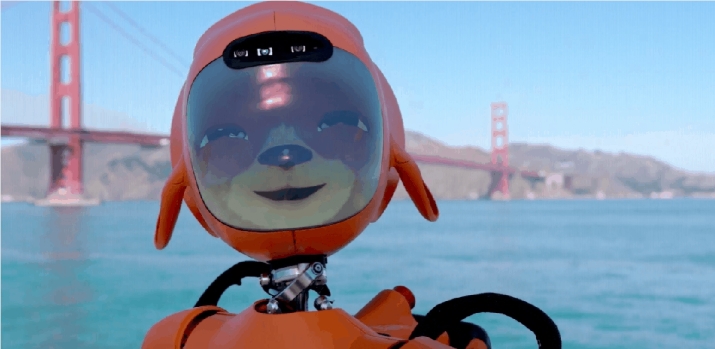
In order to better integrate into the human world, Mirokaï also has a lot of effort in body design. The height of 1.3 meters is deliberately close to the child's perspective, eliminating the pressure of adult size; the weight of 30 kilograms makes it light and flexible, making it easy to move; the flexible neck design allows it to interact with people naturally and convey emotions. Founder Monceaux believes that giving robots "soul" and "story" is a key step in building human-machine trust. Facts have proved that Mirokaï's "cute character" strategy was a great success. Every subtle action such as waving his hand, punching his fist interaction, and listening with his ears made Mirokaï exude a unique "personal charm", which is difficult for traditional humanoid robots to reach.
Of course, Mirokaï is by no means an "embroidered pillow", and its $30,000 price is its powerful practical value. In a hospital in France, Mirokaï transformed into a "little expert in delivering medicine", reducing the nurse's hardships; in children's hospitals and dental clinics in the United States, Mirokaï transformed into a "baby-coaxing tool" to calm the emotions of the sick children with "cute power". Mirokaï is equipped with generative AI, which can "see all directions of eyes and listen to all directions", perceive the environment and face in real time, and can adapt to various tasks independently without cumbersome programming. Its special "dexterous hand" combined with a special handle achieves a crawling success rate of up to 97%, far exceeding the industry average. Whether it is shipping pallets or handling tool boxes, Mirokaï can handle it easily. The unique spherical sport chassis allows it to move flexibly at 360 degrees and can be easily pushed away even when encountering obstacles. In addition to the medical field, hotels, restaurants, airports, shopping malls and other service venues have also become a potential stage for Mirokaï.
As the "direct descendant" of humanoid robots NAO and Pepper, Mirokaï shoulders the mission of "practicality" of the family. Founder Monceaux hopes that Mirokaï will not only be "extremely good-looking", but also "capable" and become a "right assistant" who truly integrates into people's daily lives. Despite its high price, Mirokaï has gained market recognition and has been constantly ordering, and is moving towards the goal of producing 200 units per year. Can this "alien cute pet" robot, which combines "cute" and "use" in one, set off a new revolution in the field of humanoid robots? Let's wait and see.