
DuckDuckGo recently announced that its innovative AI service Duck.ai has finished its testing phase and is officially open to the public. With its unique privacy protection concept and flexible and diverse AI model selection, this highly anticipated AI tool quickly gains a place in the crowded AI market, indicating that a new pattern of AI applications is taking shape.
The core highlight of Duck.ai is that it gives users the right to choose the AI model independently. Users can switch freely between a variety of large language models (LLMs) including proprietary GPT-4o mini, o3-mini and Claude3, as well as open source Llama3.3 and Mistral Small3, depending on their own needs and preferences.
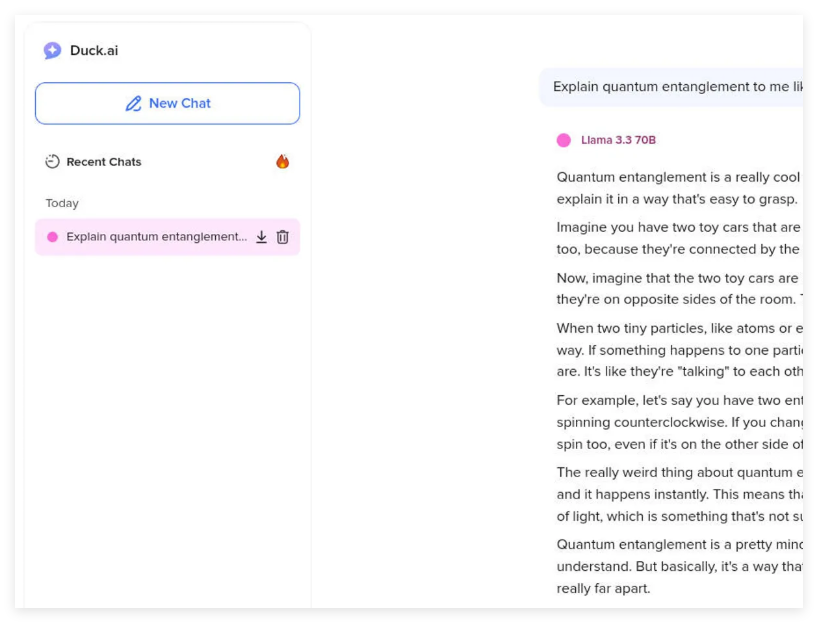
This unprecedented flexibility breaks the dependence of traditional AI products on a single model, allowing users to choose the most suitable AI assistant for different tasks. For example, GPT-4o performs well in real-time interaction and sentiment analysis, while Llama3.3 has more advantages in image recognition and visual understanding. Users can flexibly choose models that best provide high-quality results based on the research topic or specific needs.
Privacy protection is another important cornerstone of Duck.ai. DuckDuckGo's long-term high attention to user privacy is also reflected in the design of Duck.ai. All user queries are anonymous to ensure that no third party can access the user's AI chat history. In addition, Duck.ai has taken additional measures to divest personal metadata from chats and further strengthen user privacy protection.
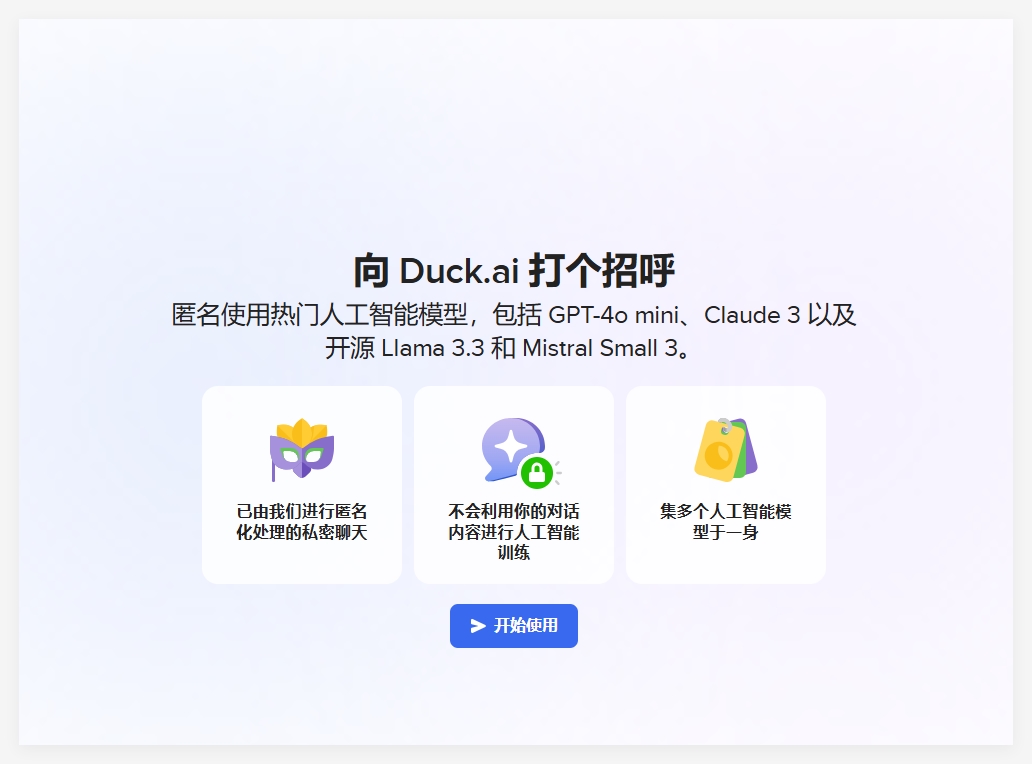
It is worth mentioning that Duck.ai not only provides services on the web side, but also integrates into the latest version of DuckDuckGo browser, supporting multiple platforms such as Android, iOS, MacOS and Windows. What's even more surprising is that Duck.ai and all the models it contains are free to use. This undoubtedly further enhances its market competitiveness and is expected to attract a large number of users who have requirements for privacy and model selection.